Portret William Linton

Obrazy: 45 najsłynniejszych dzieł artysty William Linton – spojrzenie galerii

Aktualizacja: Październik 2026 · ranking według naszego wskaźnika popularności (liczba wyszukiwań, wizyt i zamówień dla każdego dzieła) · 46 dzieł William Linton w naszym katalogu

W skrócie

Według opinii kuratorów galerii, najsłynniejszym obrazem William Linton jest Self-portrait (1813), którego oryginał znajduje się w Narodowa Galeria Kanady w Ottawa. Louise-Amélie Panet (1815) i Indian Dance at Amherstburg (1825) dopełniają trio, które zna każde oko. Z 46 dzieł William Linton w naszym katalogu, galeria prezentuje poniżej 45 najsłynniejszych prac – każda z nich jest oryginałem z podaniem roku powstania, muzeum oraz cech wyróżniających ją na tle innych.

1791 – 1876, Liverpool Romanticism Najwięcej dzieł: Narodowa Galeria Kanady

10 najlepszych obrazów artysty William Linton w galerii

1
Self-portrait (1813) autorstwa William Linton

Self-portrait

1813 · Black and White Photography · Narodowa Galeria Kanady, Ottawa

In the work titled Self-portrait by William Linton, a sepia-toned, black and white photograph captures a formal gathering of people. The composition is strictly symmetrical, anchored by a large group posed before a textured building. A light-colored wall rises behind them, featuring a large arched doorway and a niche that holds a standing statue. The subjects, likely a class or an organization, are arranged in a series of precise, tiered…

Obrazy artysty William Linton, uszeregowane od 11 do 45 miejsca

Tematy, które przyciągnęły wzrok William Linton

Cztery motywy najczęściej powracające w tych oryginałach, z których każdy doczekał się swojego najdoskonalszego przykładu.

Muzea przechowujące oryginały William Linton

5 muzeów, w których znajduje się najwięcej obrazów z tej strony.

Muzea Miasto Dzieła artysty William Linton Obrazy z tej listy
Narodowa Galeria Kanady, OttawaNarodowa Galeria Kanady Ottawa 3 Self-portrait, Louise-Amélie Panet, Indian Dance at Amherstburg
Yale Center for British Art, New HavenYale Center for British Art New Haven 1 Cottages By A River
Anglesey AbbeyAnglesey Abbey 1 Windsor Castle From The Road To Virginia Water
Hartwell House, AylesburyHartwell House Aylesbury 1 View Of The Forum With Two Herdsmen And Three Cows
Fitzwilliam MuseumFitzwilliam Museum 1 Mistra

William Linton, flagowe dzieła każdego roku

Kariera William Linton prezentowana na tej stronie obejmuje 13 lata, od 1813 do 1825: każdy rok został zestawiony z jego najsłynniejszymi oryginalnymi dziełami.

Dzieła według lat

Wybierz rok, aby zobaczyć oryginały.

Obrazy artysty William Linton: odpowiedzi galerii

Który obraz William Linton jest najsłynniejszy ze wszystkich?Odkryj odpowiedź

Self-portrait (1813), Narodowa Galeria Kanady, Ottawa. Następne są Louise-Amélie Panet (1815) oraz Indian Dance at Amherstburg (1825).

Ile lat miał William Linton, gdy ukończył Self-portrait?Odkryj odpowiedź

22 lat: Self-portrait pochodzi z 1813, a William Linton urodził(a) się w 1791.

Które to 10 najlepszych obrazów William Linton?Odkryj odpowiedź

Self-portrait, Louise-Amélie Panet, Indian Dance at Amherstburg, View Of Edinburgh; And View Of Stirling, Bury From Blackford Bridge, An Italianate Landscape, With Peasants And Livestock In The Foreground, A classical landscape, The Bathing Pool, Cottages By A River i Scotch Thistle. Powyższy ranking zawiera rok powstania oraz muzeum dla każdego z nich.

Ile dzieł stworzył/a William Linton?Odkryj odpowiedź

Nasz katalog zawiera 46 dzieł artysty William Linton, datowanych od 1813 do 1825.

Gdzie można znaleźć najsłynniejsze oryginały autorstwa William Linton?Odkryj odpowiedź

W większości znajdują się w Narodowa Galeria Kanady (Ottawa), Yale Center for British Art (New Haven) i Anglesey Abbey. Powyższa tabela muzeów zawiera ich pełną listę.

Które z najsłynniejszych dzieł William Linton należą do jego najwcześniejszych i najpóźniejszych prac?Odkryj odpowiedź

Na tej stronie najwcześniejszy to Self-portrait (1813), a najpóźniejszy Indian Dance at Amherstburg (1825).

Do jakich tematów William Linton powracał najczęściej?Odkryj odpowiedź

Landscape (9), Scenes (7) i Rural landscape (4), w ramach 45 dzieł na tej stronie.

Z jakim nurtem związany jest William Linton?Odkryj odpowiedź

Romanticism, sądząc po oryginałach na tej stronie.

Które oryginały artysty William Linton znajdują się w zbiorach Narodowa Galeria Kanady?Odkryj odpowiedź

Self-portrait, Louise-Amélie Panet i Indian Dance at Amherstburg: Narodowa Galeria Kanady, Ottawa posiada 3 dzieł widocznych na tej stronie.

William Linton: artysta

The Romantic Visionary of Classical Landscape

William Linton, born in the maritime atmosphere of Liverpool in 1791, emerged as a pivotal figure in British landscape painting during the Victorian era—a period defined by a profound fascination with both scientific observation and idealized beauty. His artistic journey began not with the grand gestures of a master, but through the humble and disciplined practice of copying the works of legends like Claude Lorrain and Richard Wilson. These early encounters were transformative, instilling in Linton a deep-seated appreciation for the interplay of natural light and the sweeping grandeur of panoramic compositions. This foundational period shaped his distinctive style, allowing him to weave classical sensibilities into the fabric of 19th-century Romanticism.

Linton’s connection to the natural world was deeply rooted in his formative years spent amidst the picturesque landscapes of Lancaster and Cartmel. His education at Windermere School fostered a lifelong intimacy with the serene, mist-covered vistas of the Yorkshire Dales and the Lake District. While he initially pursued a career in the merchant’s trade—a vocation he found spiritually unfulfilling—his innate talent for visual representation eventually compelled him to dedicate himself fully to the pursuit of art. This transition from commerce to creativity marked the beginning of a prolific career that would see him become a mainstay of the London art scene.

A Journey Through Light and Atmosphere

As his reputation grew, Linton became a regular presence at the Royal Academy and the British Institution, exhibiting his works from 1817 onwards. His subject matter often drew from the rugged beauty of Scotland and Northern England, where he captured scenes imbued with an atmospheric grandeur that reflected the prevailing Romantic sensibility. However, it was his travels through Italy between 1828 and 1829 that perhaps most significantly expanded his artistic vocabulary. During these extensive sketching expeditions, Linton absorbed the sun-drenched textures and classical ruins of the Mediterranean, producing a substantial collection of drawings that would later serve as the blueprint for his monumental oil paintings.

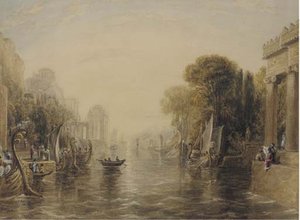
His ability to blend historical reverence with naturalistic detail allowed him to create landscapes that felt both grounded in reality and elevated by fantasy. Whether depicting the dramatic coastal fortresses of Positano or the serene, pastoral charm of an Italianate Landscape populated by peasants and livestock, Linton utilized a masterful command of light to evoke emotion. His works often feature:

  • Classical Grandeur: A focus on architectural elements and ruins that suggest the weight of history.
  • Atmospheric Depth: The use of soft, hazy horizons and dramatic shadows to create a sense of infinite space.
  • Textural Richness: Detailed rendering of geological formations, water, and foliage to ground his idealized scenes in tactile reality.

Legacy and Artistic Leadership

Beyond his individual canvases, Linton was a vital architect of the British art community. His commitment to fostering innovation and collaboration led him to play a crucial role in the establishment of the Society of British Artists in 1823-1824. His leadership qualities were formally recognized when he served as the society's president in 1837, a testament to the respect he commanded among his peers. Through this role, he helped create a platform for emerging artists to navigate the complexities of the Victorian art market.

The historical significance of William Linton lies in his ability to bridge the gap between the classical traditions of the past and the burgeoning Romanticism of his era. He did not merely record landscapes; he reimagined them, infusing the rugged terrain of the English Lakes and the sun-soaked coasts of Italy with a sense of poetic timelessness. Today, his legacy survives in collections such as the Tate, where his works continue to invite viewers into a world of architectural fantasy and sublime natural beauty, reminding us of a time when the canvas was a window into the eternal.