Portret William Garl Brown

5 najsłynniejszych obrazów artysty William Garl Brown, każdy niepowtarzalny

Aktualizacja: Listopad 2026 · ranking według naszego wskaźnika popularności (liczba wyszukiwań, wizyt i zamówień dla każdego dzieła) · 5 dzieł William Garl Brown w naszym katalogu

W skrócie

William Ellery (1835) to obraz autorstwa William Garl Brown, który przyciąga najwięcej spojrzeń; oryginał znajduje się w Metropolitan Museum of Art, Nowy Jork. Następnie wzrok kieruje się na Zachary Taylor at Walnut Springs (1847) i John Buchanan Floyd (1800). Spośród 5 dzieł William Garl Brown w naszym katalogu, tych 5 jest najbardziej znanych – każde z nich to unikatowy oryginał, przedstawiony wraz z rokiem powstania, muzeum oraz powodem, dla którego przetrwało próbę czasu.

1823 – 1894, Leicester Najwięcej dzieł: Library of Virginia

10 najlepszych obrazów autorstwa William Garl Brown według oka galerii

1
William Ellery (1835) autorstwa William Garl Brown

William Ellery

1835 · Watercolor · Metropolitan Museum of Art, Nowy Jork

A quiet presence emerges from the pale, mottled background. This portrait miniature captures William Ellery in a moment of stillness, his gaze fixed directly upon the viewer. The light falls from the upper left, carving the architecture of his face with soft shadows. It is a study of bone and skin rendered in a monochromatic palette. Deep blacks define the heavy fabric of his clothing, while luminous whites catch the…

2
Zachary Taylor at Walnut Springs (1847) autorstwa William Garl Brown

Zachary Taylor at Walnut Springs

1847 · Oil On Canvas · National Portrait Gallery, Waszyngton

Zachary Taylor at Walnut Springs by William Garl Brown presents a wide, landscape-oriented view of an organized military encampment. On the right, a group of military officers gathers around a large canvas tent, their presence anchored by the structural poles of the shelter. To the left, the composition finds balance through a white horse tethered near several smaller tents, where a soldier stands nearby. The arrangement emphasizes a sense of…

3
John Buchanan Floyd (1800) autorstwa William Garl Brown

John Buchanan Floyd

1800 · Oil · Library of Virginia, Richmond

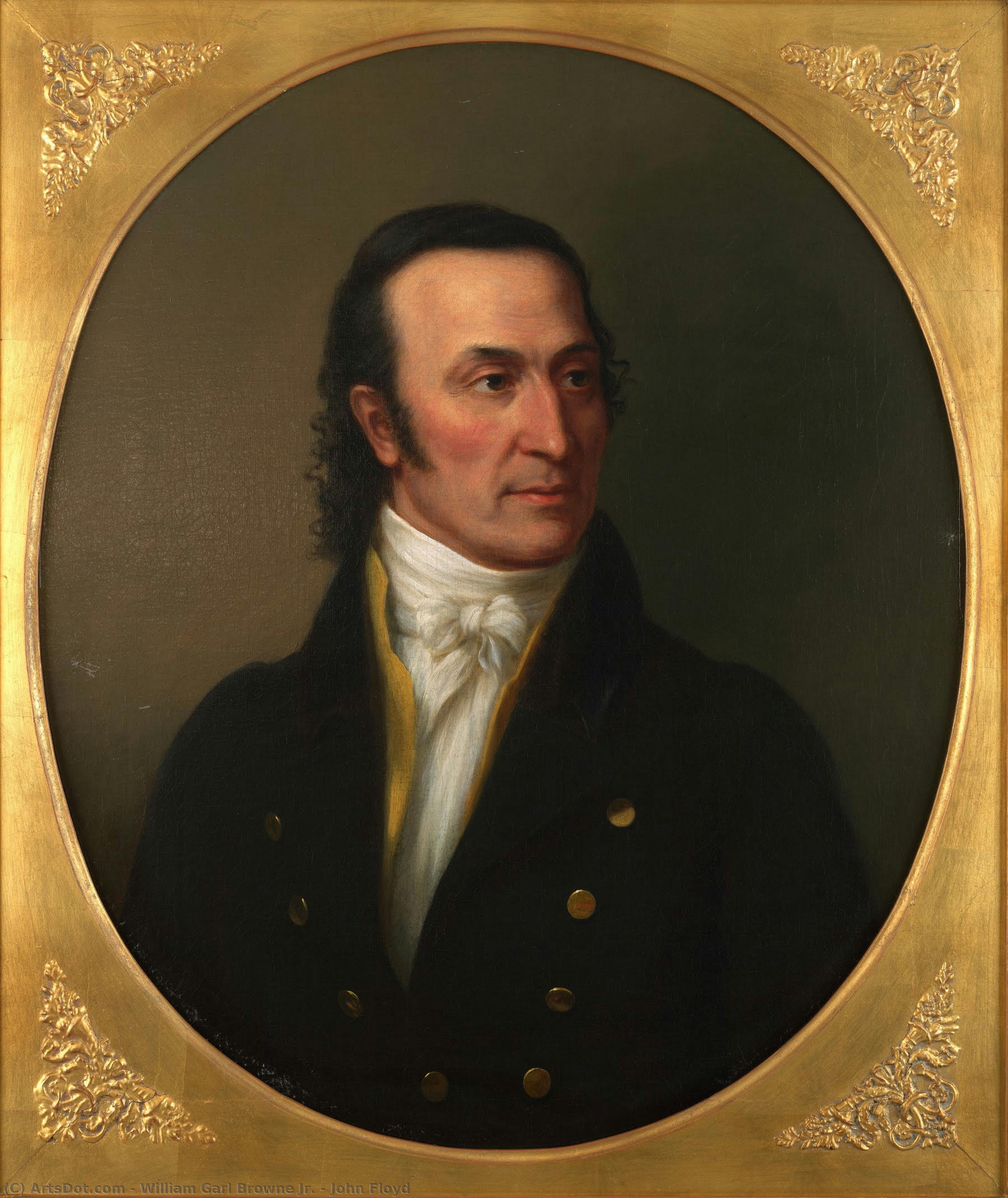
In the quiet dignity of this masterful portrait, we encounter the commanding presence of John Buchanan Floyd, the 34th Governor of Virginia. Painted by the skilled hands of William Garl Browne Jr., the work transcends a mere photographic likeness to become an evocative study of leadership and historical weight. The subject, an elder statesman with a meticulously groomed beard and mustache, gazients directly at the viewer, establishing an immediate and…

5
John Floyd (1872) autorstwa William Garl Brown

John Floyd

1872 · Oil · Library of Virginia, Richmond

William Garl Brown painted this portrait of John Floyd, a man who held the office of governor from March 4, 1830, to March 31, 1834. The work, dating from about 1872, captures a significant figure from Virginia's political history. Brown, who lived from 1823 to 1894, was a prolific chronicler of the American South, often focusing on the leadership and social hierarchies of the nineteenth century.

Tematy, które przyciągnęły wzrok William Garl Brown

Cztery motywy najczęściej powracające w tych oryginałach, z których każdy doczekał się swojego najdoskonalszego przykładu.

Muzea przechowujące oryginały William Garl Brown

4 muzeów, w których znajduje się najwięcej obrazów z tej strony.

Muzea Miasto Dzieła artysty William Garl Brown Obrazy z tej listy
Library of Virginia, RichmondLibrary of Virginia Richmond 2 John Buchanan Floyd, John Floyd
Metropolitan Museum of Art, Nowy JorkMetropolitan Museum of Art Nowy Jork 1 William Ellery
National Portrait Gallery, WaszyngtonNational Portrait Gallery Waszyngton 1 Zachary Taylor at Walnut Springs
The Abraham Lincoln Foundation of The Union League of Philadelphia, FiladelfiaThe Abraham Lincoln Foundation of The Union League of Philadelphia Filadelfia 1 Rutherford B. Hayes

William Garl Brown na przestrzeni dekad: jeden unikatowy oryginał dla każdego

Dzieła według dekad

Wybierz dekadę, aby zobaczyć dzieło, które ją definiuje.

Obrazy artysty William Garl Brown: pytania do galerii

Jakie jest najsłynniejsze dzieło artysty William Garl Brown?Odkryj odpowiedź

William Ellery (1835), Metropolitan Museum of Art, Nowy Jork. Następne są Zachary Taylor at Walnut Springs (1847) oraz John Buchanan Floyd (1800).

W jakim wieku William Garl Brown stworzył/a William Ellery?Odkryj odpowiedź

12 lat: William Ellery pochodzi z 1835, a William Garl Brown urodził(a) się w 1823.

Ile znanych dzieł stworzył William Garl Brown?Odkryj odpowiedź

Nasz katalog zawiera 5 dzieł artysty William Garl Brown, datowanych od 1835 do 1878.

Gdzie można zobaczyć najsłynniejsze oryginały William Garl Brown?Odkryj odpowiedź

W większości znajdują się w Library of Virginia (Richmond), Metropolitan Museum of Art (Nowy Jork) i National Portrait Gallery (Waszyngton). Powyższa tabela muzeów zawiera ich pełną listę.

W jakim okresie William Garl Brown stworzył/a swoje najsłynniejsze obrazy?Odkryj odpowiedź

W 1870s: 2 z 5 dzieł na tej stronie powstało w tym czasie, w tym Rutherford B. Hayes.

Który z najsłynniejszych obrazów artysty William Garl Brown powstał najwcześniej, a który najpóźniej?Odkryj odpowiedź

Na tej stronie najwcześniejszy to William Ellery (1835), a najpóźniejszy Rutherford B. Hayes (1878).

Jakie tematy preferował William Garl Brown?Odkryj odpowiedź

Man (3), Portrait (3) i Suit (2), w ramach 5 dzieł na tej stronie.

Jakich materiałów William Garl Brown używał najczęściej?Odkryj odpowiedź

Oil On Canvas, dla 2 z 5 dzieł na tej stronie.

Jakie oryginały William Garl Brown można zobaczyć w Library of Virginia?Odkryj odpowiedź

John Buchanan Floyd i John Floyd: Library of Virginia, Richmond posiada 2 dzieł widocznych na tej stronie.

William Garl Brown: portret artysty

A Legacy of Likeness: The Life and Art of William Garl Browne Jr.

In the grand tapestry of nineteenth-century portraiture, few threads are as intricately woven into the fabric of American history as those left by William Garl Browne Jr. Born in Leicester, England, in October 1823, Browne was a man whose artistic destiny was inextricably linked to the shifting landscapes of both continents. He did not merely paint faces; he captured the very essence of an era defined by expansion, conflict, and the burgeoning identity of the American South. His journey from the traditional artistic circles of the United Kingdom to the battlefields and parlors of the United States allowed him to develop a style that was as much about psychological depth as it was about technical precision.

The foundations of his mastery were laid under the watchful eye of his father, William G. Browne Sr., an accomplished landscape and genre painter. This early immersion in the meticulous traditions of English art instilled in the younger Browne a profound reverence for detail and a luminous approach to color. As he traveled with his father to the United States, the young artist began to absorb the rugged vitality of the New World. His early exhibitions, including a notable appearance at the National Academy in 1840, hinted at a burgeoning talent that would soon transcend mere imitation, moving toward a realism that could convey the weight of command and the quiet dignity of civilian life.

The Crucible of Fame: From Mexico to the American South

The defining moment of Browne’s career arrived amidst the smoke and fervor of the Mexican-American War. In 1847, at the remarkably young age of twenty-four, Browne undertook a commission that would cement his place in the annals of historical art. Stationed at the U.S. Army headquarters in Mexico, he painted a series of portraits featuring General Zachary Taylor and his staff. These works were far more than mere military records; they were vibrant, breathing documents of leadership. When these portraits were exhibited in Washington, New York, and Baltimore, they ignited a national sensation. Critics were captivated by the lifelikeness of the subjects, noting how Browne managed to capture the moral fortitude and commanding presence of Taylor—a man who embodied the republican virtues of the age.

Following this meteoric rise to fame, Browne made a deliberate choice that would shape his entire oeuvre: he turned his gaze toward the American South. While his contemporaries might have sought the established art markets of the North, Browne found inspiration in the complex social hierarchies and storied landscapes of the Southern states. His itinerant career took him through North Carolina, Virginia, and beyond, where he became a prolific chronicler of the region's most influential figures. It is estimated that during his time in North Carolina alone, he produced over a thousand portraits, creating a vast, though often fragmented, visual record of Southern society.

Artistic Mastery and Historical Significance

The technique of William Garl Browne Jr. was characterized by a sophisticated use of light and a palette that felt both rich and naturalistic. Drawing inspiration from the meticulousness of artists like John Smart, he possessed an uncanny ability to render textures—the heavy wool of a military uniform, the delicate lace of a lady's gown, or the weathered skin of a veteran. His work often bridged the gap between formal portraiture and narrative storytelling, imbuing his subjects with a sense of their own personal histories.

Beyond the aesthetic beauty of his canvases, Browne’s historical significance lies in his role as a visual biographer of a vanishing world. His portraits of political leaders, such as Rutherford B. Hayes and John Buchanan Floyd, serve as windows into the character of the nineteenth-century leadership. Through his brush, we see the faces of those who navigated the turbulent waters of American politics and war. Though much of his work remains scattered due to his wandering life, the surviving pieces stand as a testament to a painter who possessed the rare gift of capturing not just the likeness of a person, but the very spirit of an age.