Portret Yoo Youngkuk

30 najsłynniejszych obrazów artysty Yoo Youngkuk, każdy niepowtarzalny

Aktualizacja: Listopad 2026 · ranking według naszego wskaźnika popularności (liczba wyszukiwań, wizyt i zamówień dla każdego dzieła) · 30 dzieł Yoo Youngkuk w naszym katalogu

W skrócie

Mountain (1968) to obraz autorstwa Yoo Youngkuk, który przyciąga najwięcej spojrzeń. Następnie wzrok kieruje się na Work i Mountain (1960). Spośród 30 dzieł Yoo Youngkuk w naszym katalogu, tych 30 jest najbardziej znanych – każde z nich to unikatowy oryginał, przedstawiony wraz z rokiem powstania, muzeum oraz powodem, dla którego przetrwało próbę czasu.

1916 – 2002, Ulchin Abstract expressionism Najwięcej dzieł: Statens Museum for Kunst

10 najlepszych obrazów autorstwa Yoo Youngkuk według oka galerii

1
Mountain (1968) autorstwa Yoo Youngkuk

Mountain

1968 · Oil On Canvas

Mountain is an artwork created by Yoo Youngkuk. This piece emerged in 1968, a time when the artist was refining a visual language of pure form. Yoo Youngkuk was born in 1916 in Uljin, South Korea, and remained a dedicated presence in the art world until his death in 2002. His practice sought to distill the essence of the landscape into something elemental.

2
Work autorstwa Yoo Youngkuk

Work

Oil On Canvas

In the quietude of this canvas, we find a profound dialogue between the tangible earth and the purity of geometric thought. This particular piece presents a sweeping landscape where the ruggedness of a mountain range is distilled into a rhythmic arrangement of light and shadow. The eye is immediately drawn to the striking, pyramidal silhouette of the peaks, a shape that feels both ancient and avant-garde. Through a masterful command…

5
CIRCLE_A (1968) autorstwa Yoo Youngkuk

CIRCLE_A

1968 · Oil On Canvas

In this 1968 oil on canvas, the canvas is divided by a warm, red field that provides a sense of depth and heat. Two distinct circles occupy the space, positioned in a way that creates a subtle tension between the upper left and the center-right. The first circle is a pale orange, while the second is a deeper, more saturated hue. These forms do not represent physical objects but instead…

6
Work (1968) autorstwa Yoo Youngkuk

Work

1968 · Painting

The painting Work is an abstract composition featuring a prominent red triangle. This central triangular structure has a pointy top and a rounded bottom, with its edges transitioning into warm orange hues. At the heart of the triangle lies a luminous yellow circle, which serves as a focal point. The artwork is executed on canvas and utilizes a palette of red, yellow, and orange.

7
Work (1967) autorstwa Yoo Youngkuk

Work

1967 · Oil On Canvas

The painting titled Work was created by the artist Yoo Youngkuk in 1967. It is a product of a vision shaped by the coastal landscape of Ulchin, South Korea, where the artist was born in 1916. This specific piece emerged from a period of intense formal exploration, long before the artist's death in 2002.

8
Work (1957) autorstwa Yoo Youngkuk

Work

1957 · Oil On Canvas

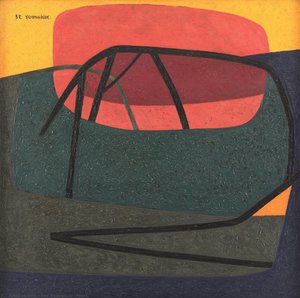
In this masterful 1957 composition, Yoo Youngkuk invites the viewer into a realm where the boundaries between form and emotion dissolve into a striking abstract landscape. The artwork presents a captivating dance of geometric shapes, dominated by a powerful interplay of black, red, and green. At first glance, the eye is met with a sense of profound mystery; the canvas feels like a fragmented window into a structured yet enigmatic…

9
Work (1968) autorstwa Yoo Youngkuk

Work

1968

In the realm of mid-century abstraction, few voices resonate with as much structural purity and rhythmic vitality as that of Yoo Youngkuk. His 1968 masterpiece, Work, serves as a profound testament to his lifelong pursuit of distilling the natural world into its most fundamental geometric essences. At first glance, the viewer is met with a striking, crimson-hued triangle, a central void that commands the eye and anchors the composition. Yet,…

10
Work (1967) autorstwa Yoo Youngkuk

Work

1967 · Oil On Canvas

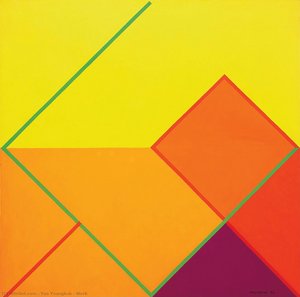
In this mesmerizing 1967 masterpiece, the legendary Korean pioneer Yoo Youngkuk invites us into a realm where the boundaries between landscape and pure abstraction dissolve. At first glance, the eye is immediately captured by a commanding, luminous yellow triangle that anchors the composition with an almost celestial intensity. This central form, bathed in a glow that suggests a light source from below, acts as a beacon of stability amidst a…

Słynne obrazy artysty Yoo Youngkuk, od 11 do 30

Tematy, które przyciągnęły wzrok Yoo Youngkuk

Cztery motywy najczęściej powracające w tych oryginałach, z których każdy doczekał się swojego najdoskonalszego przykładu.

Muzea przechowujące oryginały Yoo Youngkuk

Muzeum, w którym znajduje się najwięcej obrazów prezentowanych na tej stronie.

Muzea Miasto Dzieła artysty Yoo Youngkuk Obrazy z tej listy
Statens Museum for Kunst, KopenhagaStatens Museum for Kunst Kopenhaga 2 Work, Work

Yoo Youngkuk na przestrzeni dekad: jeden unikatowy oryginał dla każdego

Dzieła według dekad

Wybierz dekadę, aby zobaczyć dzieło, które ją definiuje.

Obrazy artysty Yoo Youngkuk: pytania do galerii

Jakie jest najsłynniejsze dzieło artysty Yoo Youngkuk?Odkryj odpowiedź

Mountain (1968). Następne są Work oraz Mountain (1960).

W jakim wieku Yoo Youngkuk stworzył/a Mountain?Odkryj odpowiedź

52 lat: Mountain pochodzi z 1968, a Yoo Youngkuk urodził(a) się w 1916.

Które dziesięć obrazów Yoo Youngkuk jest najbardziej znanych?Odkryj odpowiedź

Mountain, Work, Mountain, Work, CIRCLE_A, Work, Work, Work, Work i Work. Powyższy ranking zawiera rok powstania oraz muzeum dla każdego z nich.

Ile znanych dzieł stworzył Yoo Youngkuk?Odkryj odpowiedź

Nasz katalog zawiera 30 dzieł artysty Yoo Youngkuk, datowanych od 1940 do 1994.

Gdzie można zobaczyć najsłynniejsze oryginały Yoo Youngkuk?Odkryj odpowiedź

W większości znajdują się w Statens Museum for Kunst (Kopenhaga). Powyższa tabela muzeów zawiera ich pełną listę.

W jakim okresie Yoo Youngkuk stworzył/a swoje najsłynniejsze obrazy?Odkryj odpowiedź

W 1960s: 12 z 30 dzieł na tej stronie powstało w tym czasie, w tym Mountain.

Który z najsłynniejszych obrazów artysty Yoo Youngkuk powstał najwcześniej, a który najpóźniej?Odkryj odpowiedź

Na tej stronie najwcześniejszy to Work (1940), a najpóźniejszy Mountain-Blue (1994).

Jakie tematy preferował Yoo Youngkuk?Odkryj odpowiedź

Geometric (7), Korean abstraction (4) i Geometric abstraction (3), w ramach 30 dzieł na tej stronie.

Jakich materiałów Yoo Youngkuk używał najczęściej?Odkryj odpowiedź

Oil On Canvas, dla 8 z 30 dzieł na tej stronie.

Do jakiego nurtu należy twórczość Yoo Youngkuk?Odkryj odpowiedź

Abstract expressionism i Abstract art, sądząc po oryginałach na tej stronie.

Jakie oryginały Yoo Youngkuk można zobaczyć w Statens Museum for Kunst?Odkryj odpowiedź

Work i Work: Statens Museum for Kunst, Kopenhaga posiada 2 dzieł widocznych na tej stronie.

Yoo Youngkuk: portret artysty

Yoo Youngkuk: A Pioneer of Korean Abstract Art

Yoo Youngkuk (劉永國; denoted as YYK) stands as a monumental figure in the history of Korean art, recognized universally as the first abstract painter and one of the foremost masters of modern Korean painting. His artistic journey began amidst profound societal transformations—the annexation of Korea by Japan, World War II, and the Korean War—yet he steadfastly pursued his vision of abstraction despite immense challenges. Born in 1916 in Uljin-gun, Gyeongsangbuk-do Province, Yoo’s formative years were steeped in the majesty of Taebaek Mountains, a landscape that would profoundly influence his artistic sensibility and become a recurring motif throughout his oeuvre. Early training at Bunka Gakuin University in Tokyo exposed him to Western abstract movements—Suprematism and Constructivism—inspiring him to forge his own distinctive path toward non-representational art.
  • Early Influences: Murai Masanari and Hasegawa Saburo
  • Participation in Avant-garde Movements
  • Formation of Sinsasil-pa (新寫實派)

Sinsasil-pa and Early Experimentation

In 1948, Yoo joined forces with Kim Whanki and Lee Kyusang to establish *Sinsasil-pa*, marking a pivotal moment in Korean art history. This collective bravely rejected traditional representational styles, advocating for an art that reflected the realities of postwar Korea through abstraction—a bold declaration that ignited debate within the artistic community.
  • The Manifesto of Sinsasil-pa
  • Early Paintings: Color Field Exploration
  • Influence of Japanese Avant-garde Artists

The Mountain Within: Evolution of Style and Symbolic Resonance

Throughout the 1950s and early 60s, Yoo’s artistic style underwent a dramatic metamorphosis. Initially exploring color field painting, he gradually incorporated geometric shapes—influenced by his enduring connection to nature and personal experiences—resulting in his signature motif: the mountain.
  • The Mountain as Symbol
  • Geometric Abstraction Emerges
  • Participation in Sao Paulo Biennial

Recognition and Enduring Influence

Yoo Youngkuk’s contributions to Korean modern art were widely acknowledged during his lifetime, culminating in a comprehensive survey by *Monthly Art* magazine that hailed him as the most outstanding artist among over a hundred contemporaries.
  • Institutional Exhibitions
  • Critical Engagement
  • Legacy and Influence on Subsequent Artists
Yoo Youngkuk’s art embodies basic formal elements of point, line, plane, form and color. At times, there is a sense of tension and competition among them while they also maintain a certain sense of balance, thereby ultimately amplifying their innate energy.“The mountain is just another aspect of physics that have been endowed by nature. It could be an empty bowl of abstraction. It can also be under-interpreted to be a used pillow at an inn in the mountain side, facilitating friendly conversations all night long. The mountain changes whenever I look at it. Ultimately, the mountain is not in front of me but inside of me.”(Oct. 1996. Excerpted from an interview with 'Monthly Art' ) His unwavering dedication garnered significant critical engagement and several major institutional exhibitions across Korea.His ability to translate the emotional and spiritual qualities of nature into a purely abstract visual language remains a testament to his profound artistry and enduring influence.