Portret William Morris

The 26 Most Famous William Morris Paintings, a Gallery Selection

Aktualizacja: Październik 2026 · ranking według naszego wskaźnika popularności (liczba wyszukiwań, wizyt i zamówień dla każdego dzieła) · 37 dzieł William Morris w naszym katalogu

In short

Of all the originals William Morris left, the most famous is Strawberry Thief (1936), in the collection of the Cleveland Museum of Art, Cleveland. Close behind it come The Little Tree (Hammersmith Rug) (1895) and Snakeshead (1900). Our catalog holds 37 works by William Morris; the gallery has kept the 26 the world admires most, each shown with its date, its museum and its story.

1834 – 1896, Walthamstow Arts and crafts Najwięcej dzieł: William Morris Gallery

William Morris's top 10 paintings: the gallery's choice

1
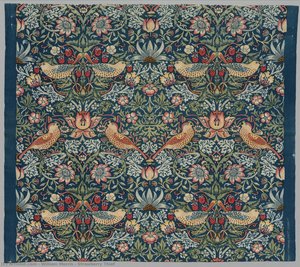
Strawberry Thief (1936) autorstwa William Morris

Strawberry Thief

1936 · Textile · Cleveland Museum of Art, Cleveland

William Morris's "Strawberry Thief," completed in 1936, isn’t merely a decorative textile; it’s a vibrant distillation of the Arts and Crafts movement’s core tenets – a celebration of nature, a rejection of industrialization, and a subtle yet potent expression of social critique. This iconic design, now instantly recognizable, draws its inspiration from Morris's own garden at Kelmscott Manor in Oxfordshire, specifically the mischievous thrushes that frequented his fruit beds. The…

2
The Little Tree (Hammersmith Rug) (1895) autorstwa William Morris

The Little Tree (Hammersmith Rug)

1895 · Textile · Muzeum Sztuki Stosowanej w Budapeszcie, Budapeszt

William Morris’s “The Little Tree” (Hammersmith Rug), completed in 1895, isn't merely a decorative textile; it’s a meticulously crafted portal to a world steeped in medieval romance, folklore, and the enduring beauty of nature. Born from the fertile imagination of one of England’s most influential artists and designers, this rug embodies the core tenets of the Arts and Crafts movement – a rejection of mass-produced industrialism in favour of handcrafted…

3
Snakeshead (1900) autorstwa William Morris

Snakeshead

1900 · Textile · Cleveland Museum of Art, Cleveland

The fabric breathes with a heavy, rhythmic energy, pulling the eye into a dense thicket of color. Deep reds and stark blacks collide in a pattern that feels both grounded and strikingly bold. Small, delicate motifs move across the surface, creating a sense of movement that mimics the swaying of wildflowers in a summer breeze. There is a certain tension here, found in the way the dark tones press against…

4
Design for (1881) autorstwa William Morris

Design for

1881 · Textile · William Morris Gallery, Walthamstow

Before he was a revolutionary socialist, a poet of immense talent, or simply one of the most celebrated textile designers in history, William Morris was a young man captivated by the remnants of a lost world. Born in Walthamstow, Essex, in 1834, his childhood was steeped in the romanticism of medieval chivalry and the beauty of the English countryside—a landscape he would relentlessly strive to capture within his designs. This…

5
Design for (1876) autorstwa William Morris

Design for

1876 · William Morris Gallery, Walthamstow

In the delicate interplay of flora and geometry, Design for stands as a profound testament to the visionary genius of William Morris. Created in 1876, this exquisite piece is far more than a mere decorative pattern; it is a bridge between the artisanal traditions of the past and the burgeoning aesthetic movements of the nineteenth century. The work captures a moment where nature and craftsmanship converge, offering a rhythmic dance…

8
Design for (1862) autorstwa William Morris

Design for

1862 · Acrylic · William Morris Gallery, Walthamstow

A Celebration of Pastoral Harmony: Exploring William Morris’s Watercolor Design The watercolor painting titled “Design for” by William Morris stands as a testament to the Arts and Crafts movement's unwavering belief in the restorative power of nature and its rejection of mass production. Executed in 1862, this artwork isn’t merely a depiction of flora; it’s an embodiment of Morris’s artistic ethos—a deliberate attempt to recapture the idealized beauty of the…

9
Design for woven fabric with birds and palms (1870) autorstwa William Morris

Design for woven fabric with birds and palms

1870 · William Morris Gallery, Walthamstow

This sketch by William Morris was likely intended for a woven textile repeat pattern, but was never realised. It bears a resemblance to a number of bird designs Morris & Co. produced in the late 1870s, including ‘Bird’ and ‘Bird and Dragon’, both designed by Morris in 1878. The fabrics were manufactured at the Morris & Co. premises at Queen Square, London, before subsequently being woven on hand-activated jacquard looms…

10
Qui Bien Aime Tard Oublie (1860) autorstwa William Morris

Qui Bien Aime Tard Oublie

1860 · Embroidery · William Morris Gallery, Walthamstow

In the delicate interplay of thread and color, "Qui Bien Aime Tard Oublie" emerges as a breathtaking testament to the Pre-Raphaelite spirit and the profound connection between art and the natural world. Created in 1860 by the legendary William Morris, this extraordinary embroidery is far more than a mere decorative hanging; it is a window into a romanticized era where craftsmanship served as a vessel for deep emotion. The work…

The William Morris selection continues, 11 to 26

The subjects that held William Morris's eye

The four subjects that come back most often in these originals, each with its finest example.

The museums that keep William Morris's originals

6 muzeów, w których znajduje się najwięcej obrazów z tej strony.

Muzeum Miasto Dzieła artysty William Morris Obrazy z tej listy
William Morris Gallery, WalthamstowWilliam Morris Gallery Walthamstow 13 Design for, Design for, Design for
Cleveland Museum of Art, ClevelandCleveland Museum of Art Cleveland 2 Strawberry Thief, Snakeshead
Muzeum Sztuki Stosowanej w Budapeszcie, BudapesztMuzeum Sztuki Stosowanej w Budapeszcie Budapeszt 1 The Little Tree (Hammersmith Rug)
Boca Raton Museum of Art, Boca RatonBoca Raton Museum of Art Boca Raton 1 Petroglyfowa Łódka
The Baltimore Museum of Art, BaltimoreThe Baltimore Museum of Art Baltimore 1 Rosa
Tate Britain, LondynTate Britain Londyn 1 La Belle Iseult

William Morris decade by decade: the original that defines each

Dzieła według dekad

Pick a decade to see the original that defines it.

Collectors' questions about William Morris's paintings

Which work is William Morris most famous for?Reveal the answer

Strawberry Thief (1936), Cleveland Museum of Art, Cleveland. The Little Tree (Hammersmith Rug) (1895) and Snakeshead (1900) come next.

What are the ten most famous William Morris paintings?Reveal the answer

Strawberry Thief, The Little Tree (Hammersmith Rug), Snakeshead, Design for, Design for, Fruit, Honeycomb, Design for, Design for woven fabric with birds and palms i Qui Bien Aime Tard Oublie. The ranking above gives each one's year and museum.

How many paintings did William Morris leave?Reveal the answer

Our catalog holds 37 works by William Morris, dated from 1857 to 1895.

In which museums do William Morris's masterpieces hang?Reveal the answer

Mostly in William Morris Gallery (Walthamstow), Cleveland Museum of Art (Cleveland) i Muzeum Sztuki Stosowanej w Budapeszcie (Budapeszt). The museum table above lists them all.

In which years did William Morris paint the most famous works?Reveal the answer

In 1870s: 5 of the 26 works on this page were made then, Design for among them.

What are the first and the last famous originals of William Morris?Reveal the answer

On this page, the earliest is Sword (1857) and the latest The Little Tree (Hammersmith Rug) (1895).

Which subjects did William Morris choose most often?Reveal the answer

Floral pattern (5), Pattern (4) i Textile art (4), across the 26 works on this page.

Which technique did William Morris use most?Reveal the answer

Textile, for 4 of the 26 works on this page.

To which art movement does William Morris belong?Reveal the answer

Arts and crafts, judging by the originals on this page.

Which William Morris works hang at the William Morris Gallery?Reveal the answer

Design for, Design for i Design for: the William Morris Gallery, Walthamstow holds 10 of the works on this page.

Can I commission a reproduction of a William Morris painting?Reveal the answer

Yes, as a reproduction: the original stays in its museum, but any painting on this page can be painted by hand for you, made to order one at a time, from the painting's own page.

William Morris: life and work

A Life Rooted in Nature and Romance

William Morris, born on March 24, 1834, in Walthamstow, Essex, emerged from a comfortably affluent middle-class background—a circumstance that afforded him the freedom to pursue passions rather than professions. His father’s success as a financier provided not only security but also an environment where aesthetic sensibilities could flourish. Morris's childhood was deeply shaped by the English countryside surrounding his home and a fascination with tales of medieval chivalry, laying the groundwork for a lifelong devotion to both natural beauty and romantic narratives. These early influences weren’t merely sentimental; they formed the core of his artistic philosophy. He wasn’t simply *inspired* by nature or the past—he believed in their inherent moral and aesthetic superiority to the rapidly industrializing present. His formal education at Oxford University initially steered him toward a clerical path, but it was within the vibrant intellectual circles of the university that his true calling began to take shape. He joined “The Set,” a group of students who shared an intense interest in art, literature, and medieval history, forging friendships—most notably with Edward Burne-Jones—that would profoundly impact his artistic trajectory. It was during this period that he encountered the writings of John Ruskin, whose critique of industrial society and advocacy for craftsmanship resonated deeply with Morris’s burgeoning beliefs.

The Arts & Crafts Revolution

Following Oxford, a brief foray into architecture quickly gave way to painting, as Morris collaborated with Dante Gabriel Rossetti on mural projects. However, it was the founding of Morris, Marshall, Faulkner & Co. in 1861—later known simply as Morris & Co.—that marked a pivotal moment, not just in his career but in the history of design. This wasn’t merely a business venture; it was an attempt to create a new way of life, one where art permeated every aspect of daily existence and craftsmanship was valued above all else. Alongside Burne-Jones, Rossetti, Philip Webb, and others, Morris sought to revive traditional techniques and produce beautiful, well-made objects for the home. The firm’s early work was profoundly influenced by Red House, a home Morris commissioned from Webb—a structure that embodied the Arts & Crafts ideal of creating a unified aesthetic environment through handcrafted furnishings and decoration. Morris became a leading voice in the burgeoning Arts & Crafts movement, championing handmade craftsmanship as an antidote to the perceived dehumanizing effects of mass production. He believed passionately that art should be accessible to all, not just the wealthy elite, and that it should be integrated into everyday life—a radical notion at a time when design was often seen as separate from function. This philosophy extended beyond mere aesthetics; it was rooted in a deep social conscience and a desire to improve the lives of working people.

A Legacy Woven in Textiles, Poetry, and Print

While Morris & Co. encompassed a wide range of decorative arts—furniture, stained glass, carpets—he is perhaps most celebrated for his textile designs. These weren’t simply patterns; they were intricate narratives woven with flowing floral motifs, lush foliage, and rich, evocative colors. His wallpapers, in particular, revolutionized interior design, moving away from the sterile imitations prevalent during the Victorian era toward nature-inspired creations that were both beautiful and functional. He didn't just *design* these patterns; he immersed himself in the process of their creation, understanding the nuances of dyeing techniques and weaving methods. Morris’s artistic vision extended beyond textiles into monumental tapestry projects—epic narratives depicting biblical stories and Arthurian legends—demonstrating his mastery of traditional weaving skills and his ability to convey complex ideas through visual storytelling. His contribution to literature was equally significant; *The Earthly Paradise* (1868-1870) and *News from Nowhere* (1890) are visionary explorations of utopian ideals, reflecting his belief in a harmonious society guided by moral principles and rooted in the beauty of craftsmanship.

Socialism, Conservation, and Enduring Influence

Morris’s commitment to social reform was unwavering. He actively supported various socialist causes and utilized his artistic platform to advocate for workers' rights and greater equality—a stance that aligned perfectly with Ruskin’s critique of industrial capitalism and its detrimental impact on human dignity. Recognizing the importance of preserving historic buildings and landscapes, Morris championed conservation efforts, arguing that these sites held invaluable cultural heritage and deserved protection from destructive forces. His influence resonated far beyond his immediate circle, shaping the aesthetic sensibilities of an entire generation and inspiring artists and designers to embrace handcrafted techniques and celebrate natural beauty as a counterbalance to industrial uniformity. William Morris’s enduring legacy continues to inspire admiration for its profound ethical core and its unwavering devotion to artistic excellence—a testament to his transformative vision of what constitutes a truly fulfilling human existence.

Wszystkie 37 dzieła artysty William Morris →