Portret Paul Sandby

79 najsłynniejszych obrazów artysty Paul Sandby – wybór z galerii

Aktualizacja: Listopad 2026 · ranking według naszego wskaźnika popularności (liczba wyszukiwań, wizyt i zamówień dla każdego dzieła) · 79 dzieł Paul Sandby w naszym katalogu

W skrócie

Z wszystkich oryginałów pozostawionych przez Paul Sandby, najsłynniejszym jest Man standing in a landscape. Tuż za nimi znajdują się Horse Fair on Bruntsfield Links, Edinburgh (1750) oraz London Cries: A Muffin Man (1759). Nasz katalog zawiera 79 dzieł autorstwa Paul Sandby; galeria zachowała 79 najbardziej podziwianych na świecie prac, z których każda została przedstawiona wraz z datą powstania, informacją o muzeum oraz jej historią.

1798 – 1863, Nottingham Romanticism Najwięcej dzieł: Yale Center for British Art

10 najlepszych obrazów artysty Paul Sandby: wybór galerii

1
Man standing in a landscape autorstwa Paul Sandby

Man standing in a landscape

Charcoal

Paul Sandby presents a quiet study in Man standing in a landscape. The work captures a gentleman in period clothing, frozen in a three-quarter pose. He looks toward the left, his figure occupying much of the vertical space against a simplified rural scene. The man remains the central focus, a solitary presence amidst the soft suggestions of buildings and structures on the horizon.

2
Horse Fair on Bruntsfield Links, Edinburgh (1750) autorstwa Paul Sandby

Horse Fair on Bruntsfield Links, Edinburgh

1750 · Watercolor · Scottish National Gallery, Edynburg

Paul Sandby: The Father of Modern Landscape Painting Paul Sandby RA stands as a pivotal figure in the history of British landscape painting, recognized not merely for his artistic skill but for establishing a new aesthetic tradition that profoundly impacted subsequent generations. Born in Nottingham to Thomas Sandby, a textile worker, Paul’s early life was marked by self-education and an innate fascination with observation—qualities that would prove instrumental in shaping…

3
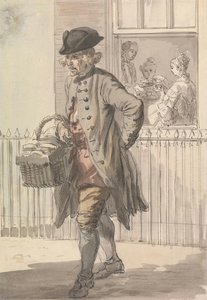
London Cries: A Muffin Man (1759) autorstwa Paul Sandby

London Cries: A Muffin Man

1759 · Drawing · Yale Center for British Art, New Haven

This evocative drawing, titled "London Cries: A Muffin Man," transports the modern viewer directly into the bustling, atmospheric heart of 18th-century London. The scene is rendered with a captivating immediacy that speaks volumes about daily commerce and human interaction. At the center moves the muffin man, his basket laden with tempting goods, embodying a moment of everyday ritual. His figure, complete with a distinctive hat and mustache, anchors the composition,…

6
The Laterna Magica (1760) autorstwa Paul Sandby

The Laterna Magica

1760 · Watercolor · British Museum, Londyn

Paul Sandby’s “The Laterna Magica,” painted in 1760, isn't merely a depiction of a room; it’s a meticulously crafted illusion, a vibrant snapshot of a world fascinated by the burgeoning technology of optical projection. More than just a charming scene of gentlemen observing a theatrical display, this watercolor offers a profound glimpse into the intellectual and social currents of 18th-century England – a period grappling with scientific advancement, artistic convention,…

7
London Cries: A Man with a Bottle (1759) autorstwa Paul Sandby

London Cries: A Man with a Bottle

1759 · Acrylic On Canvas · Yale Center for British Art, New Haven

Paul Sandby's "London Cries: A Man with a Bottle," painted in 1759, isn’t merely a depiction of a street scene; it’s a vibrant, almost theatrical window into the bustling heart of eighteenth-century London. This watercolor, now meticulously reproduced as a hand-painted artwork by WahooArt, captures a moment of everyday commerce and perhaps, a touch of wry observation, offering a glimpse into the lives of ordinary people within the grand tapestry…

8
The Meteor of August 18, 1783, as seen from the East Angle of the North Terrace, Windsor Castle (1783) autorstwa Paul Sandby

The Meteor of August 18, 1783, as seen from the East Angle of the North Terrace, Windsor Castle

1783 · Watercolor · Yale Center for British Art, New Haven

Paul Sandby's watercolor, “The Meteor of August 18, 1783,” isn’t merely a depiction of a fleeting astronomical event; it’s a window into the collective wonder and scientific curiosity of late 18th-century England. Painted from the East Angle of the North Terrace at Windsor Castle, the scene captures a pivotal moment – the transit of a meteor across the night sky – as observed by a small group of onlookers. The…

Kontynuacja zestawienia Paul Sandby, od 11 do 79

11Study of a coachman autorstwa Paul SandbyStudy of a coachmanNational Portrait Gallery of Sweden 12Thomas Sandby and His Family autorstwa Paul SandbyThomas Sandby and His Family 13A Group of Four Children, with Dogs autorstwa Paul SandbyA Group of Four Children, with Dogs 14The Bayswater Road, Paddington autorstwa Paul SandbyThe Bayswater Road, Paddington 15Sketch of an elegant lady autorstwa Paul SandbySketch of an elegant lady 16Two Coaches with Passengers autorstwa Paul SandbyTwo Coaches with Passengers 17View of the Powder Magazine in Hyde Park autorstwa Paul SandbyView of the Powder Magazine in Hyde Park 18A riverside landscape autorstwa Paul SandbyA riverside landscape 19Back of the Public House near Bayswater autorstwa Paul SandbyBack of the Public House near Bayswater 20Windsor Park autorstwa Paul SandbyWindsor Park 21A Sleeping Woman; Study of a Head autorstwa Paul SandbyA Sleeping Woman; Study of a Head 22Travelers Entering a Town autorstwa Paul SandbyTravelers Entering a Town 23Ross Castle, Killarney, with villagers on a ferryboat autorstwa Paul SandbyRoss Castle, Killarney, with villagers on a ferryboat 24Windsor Great Park autorstwa Paul SandbyWindsor Great Park 25St. George's Gate, Canterbury autorstwa Paul SandbySt. George's Gate, Canterbury 26Rochester, Kent autorstwa Paul SandbyRochester, Kent 27Views of Windsor Castle autorstwa Paul SandbyViews of Windsor Castle 28The Iron Forge between Dolgelli and Barmouth 1 autorstwa Paul SandbyThe Iron Forge between Dolgelli and Barmouth 1 29The Light Steps, Hastings autorstwa Paul SandbyThe Light Steps, Hastings 30An Italianate landscape with women washing clothes autorstwa Paul SandbyAn Italianate landscape with women washing clothes 31The Cemetery Gate of St Augustine's Monastery Canterbury autorstwa Paul SandbyThe Cemetery Gate of St Augustine's Monastery Canterbury 32The Encampment in St James's Park autorstwa Paul SandbyThe Encampment in St James's Park 33A Boy Crawling on the Floor autorstwa Paul SandbyA Boy Crawling on the Floor 34A mother and child seated in a garden autorstwa Paul SandbyA mother and child seated in a garden 35A wooded river landscape with figures and cattle, a castle beyond autorstwa Paul SandbyA wooded river landscape with figures and cattle, a castle beyond 36The North Terrace of Windsor Castle looking west autorstwa Paul SandbyThe North Terrace of Windsor Castle looking west 37Naval post with three soldiers autorstwa Paul SandbyNaval post with three soldiers 38Part of the Banqueting Hall of the Royal Palace at Eltham autorstwa Paul SandbyPart of the Banqueting Hall of the Royal Palace at Eltham 39Man driving a donkey, and man leading a cart autorstwa Paul SandbyMan driving a donkey, and man leading a cart 40Woolwich from the Conduit Hill, the Thames estuary beyond autorstwa Paul SandbyWoolwich from the Conduit Hill, the Thames estuary beyond 41Young lady writing at a table autorstwa Paul SandbyYoung lady writing at a table 42A rural landscape autorstwa Paul SandbyA rural landscape 43A cottage by a river with figures in the foreground autorstwa Paul SandbyA cottage by a river with figures in the foreground 44The garden front of Old Somerset House, London autorstwa Paul SandbyThe garden front of Old Somerset House, London 45Henry VIII Gateway, Windsor Castle autorstwa Paul SandbyHenry VIII Gateway, Windsor Castle 46Young boy on a see-saw autorstwa Paul SandbyYoung boy on a see-saw 47Children on a see-saw autorstwa Paul SandbyChildren on a see-saw 48Young man, seated, holding a riding crop autorstwa Paul SandbyYoung man, seated, holding a riding crop 49Two of the artist's children with their nurse, seated in a garden autorstwa Paul SandbyTwo of the artist's children with their nurse, seated in a garden 50The Iron Forge between Dolgelli and Barmouth autorstwa Paul SandbyThe Iron Forge between Dolgelli and Barmouth 51View from a London terrace autorstwa Paul SandbyView from a London terrace 52Windsor Castle: The Round Tower, Royal Court and Devil (1767) autorstwa Paul SandbyWindsor Castle: The Round Tower, Royal Court and Devil1767 · National Gallery of Victoria 53Buildwas autorstwa Paul SandbyBuildwas 54View down a valley towards distant buildings, trees in the foreground autorstwa Paul SandbyView down a valley towards distant buildings, trees in the foreground 55Derwent Waster autorstwa Paul SandbyDerwent Waster 56Edinburgh Castle autorstwa Paul SandbyEdinburgh Castle 57View of Tonbridge autorstwa Paul SandbyView of Tonbridge 58View of Rackett Lodge, Wandsworth, London autorstwa Paul SandbyView of Rackett Lodge, Wandsworth, London 59Study of a donkey autorstwa Paul SandbyStudy of a donkey 60Old Windsor Green autorstwa Paul SandbyOld Windsor Green 61Middleham Castle, Yorkshire autorstwa Paul SandbyMiddleham Castle, Yorkshire 62An extensive river landscape with travellers autorstwa Paul SandbyAn extensive river landscape with travellers 63A horse and cart leaving a harbour autorstwa Paul SandbyA horse and cart leaving a harbour 64Woolwich from the Conduit Hill, the Thames beyond autorstwa Paul SandbyWoolwich from the Conduit Hill, the Thames beyond 65Cows in a Park autorstwa Paul SandbyCows in a Park 66Study of a Tree autorstwa Paul SandbyStudy of a Tree 67Trees and house seen from a meadow - Bishopgate autorstwa Paul SandbyTrees and house seen from a meadow - Bishopgate 68A shepherd driving his flock before a Scottish castle autorstwa Paul SandbyA shepherd driving his flock before a Scottish castle 69South East View of Windsor Castle From the Park autorstwa Paul SandbySouth East View of Windsor Castle From the Park 70A horse autorstwa Paul SandbyA horse 71An old grey horse tethered to a tree, a boy resting nearby autorstwa Paul SandbyAn old grey horse tethered to a tree, a boy resting nearby 72Foresters In Windsor Great Park autorstwa Paul SandbyForesters In Windsor Great Park 73View Of Windsor Castle And Part Of The Town From The Spital Hill autorstwa Paul SandbyView Of Windsor Castle And Part Of The Town From The Spital Hill 74An extensive wooded river landscape with an amorous couple making music under a tree autorstwa Paul SandbyAn extensive wooded river landscape with an amorous couple making music under a tree 75Sanby paul the spread eagle tavern millbank autorstwa Paul SandbySanby paul the spread eagle tavern millbank 76Llangollen, Denbighshire autorstwa Paul SandbyLlangollen, Denbighshire 77Part of the Old Bridge at Shrewsbury with two arches of the new one autorstwa Paul SandbyPart of the Old Bridge at Shrewsbury with two arches of the new one 78Cow­Girl in the Windsor Great Park autorstwa Paul SandbyCow­Girl in the Windsor Great Park 79A Man and a Saddled Horse autorstwa Paul SandbyA Man and a Saddled HorseYale Center for British Art

Tematy, które przyciągnęły wzrok Paul Sandby

Cztery motywy najczęściej powracające w tych oryginałach, z których każdy doczekał się swojego najdoskonalszego przykładu.

Muzea przechowujące oryginały Paul Sandby

5 muzeów, w których znajduje się najwięcej obrazów z tej strony.

Muzea Miasto Dzieła artysty Paul Sandby Obrazy z tej listy
Yale Center for British Art, New HavenYale Center for British Art New Haven 4 London Cries: A Muffin Man, London Cries: A Man with a Bottle, The Meteor of August 18, 1783, as seen from the East Angle of the North Terrace, Windsor Castle
Scottish National Gallery, EdynburgScottish National Gallery Edynburg 1 Horse Fair on Bruntsfield Links, Edinburgh
British Museum, LondynBritish Museum Londyn 1 The Laterna Magica
National Portrait Gallery of Sweden, SträngnäsNational Portrait Gallery of Sweden Strängnäs 1 Study of a coachman
National Gallery of Victoria, MelbourneNational Gallery of Victoria Melbourne 1 Windsor Castle: The Round Tower, Royal Court and Devil

Pytania kolekcjonerów o obrazy Paul Sandby

Z jakiego dzieła najbardziej znany jest Paul Sandby?Odkryj odpowiedź

Man standing in a landscape. Następne są Horse Fair on Bruntsfield Links, Edinburgh (1750) oraz London Cries: A Muffin Man (1759).

Jakie są dziesięć najsłynniejszych obrazów, których autorem jest Paul Sandby?Odkryj odpowiedź

Man standing in a landscape, Horse Fair on Bruntsfield Links, Edinburgh, London Cries: A Muffin Man, Windsor Castle from the Great Park, Miss Marsden - back view, The Laterna Magica, London Cries: A Man with a Bottle, The Meteor of August 18, 1783, as seen from the East Angle of the North Terrace, Windsor Castle, Boy with a whip i Study of a woman pointing. Powyższy ranking zawiera rok powstania oraz muzeum dla każdego z nich.

Ile obrazów pozostawił po sobie Paul Sandby?Odkryj odpowiedź

Nasz katalog zawiera 79 dzieł autorstwa Paul Sandby.

W których muzeach znajdują się arcydzieła Paul Sandby?Odkryj odpowiedź

W większości znajdują się w Yale Center for British Art (New Haven), Scottish National Gallery (Edynburg) i British Museum (Londyn). Powyższa tabela muzeów zawiera ich pełną listę.

Jakie tematy Paul Sandby wybierał najczęściej?Odkryj odpowiedź

Buildings (17), Gardens and parks (11) i Landscape (9), w ramach 79 dzieł na tej stronie.

Której techniki Paul Sandby używał najczęściej?Odkryj odpowiedź

Watercolor, dla 3 z 79 dzieł na tej stronie.

Do jakiego nurtu artystycznego należy Paul Sandby?Odkryj odpowiedź

Romanticism i Neoclassicism, sądząc po oryginałach na tej stronie.

Które dzieła Paul Sandby znajdują się w Yale Center for British Art?Odkryj odpowiedź

London Cries: A Muffin Man, London Cries: A Man with a Bottle i The Meteor of August 18, 1783, as seen from the East Angle of the North Terrace, Windsor Castle: Yale Center for British Art, New Haven posiada 4 dzieł widocznych na tej stronie.

Paul Sandby: życie i twórczość

Paul Sandby RA: The Father of Modern Landscape Painting

Paul Sandby (1731 – 7 listopada 1809) stanowi kluczową postać w historii malarstwa krajobrazowego brytyjskiego, rozpoznawalnego nie tylko ze względu na jego artystyczne umiejętności, ale również za wprowadzenie nowej tradycji estetycznej, która głęboko wpłynęła na kolejne pokolenia. Urodzony w Nottingham u Thomasa Sandby’ego, tkacza, młodość Paula była naznaczona samodzielną edukacją i naturalnym zamiłowaniem do obserwacji – cechy, które okazały się kluczowe dla kształtowania się jego niezwykiej kariery jako mapomawcy i malarza. W odróżnieniu od wielu artystów jego czasu, którzy dążyli do formalnego szkolenia, Sandby doskonalił swoje umiejętności niezależnie, zanurzając się w świat natury i precyzyjnie dokumentując jej piękno za pomocą akwareli.
  • Wczesne lata i edukacja: Formujące lata Paula wykształciły w nim głębokie zrozumienie szczegółów i dokładności – umiejętności, które później bezproblemowo przełożyły się na jego działalność kartograficzną. Jego brat Thomas, również rysownik, wspierał tę artystyczną skłonność, zachęcając do eksperymentowania i budowania współpracy.
  • Usługi wojskowe i badania krajobrazu szkockiego: Zaangażowanie Sandby’ego w dział departamentu rysunków wojskowych w Pałacu Lwowskim wpłynęło na niego, otwierając drogę do poznania potęgi Szkocji podczas rebelii jacobitów. Misja ta powierzyła mu tworzenie map topograficznych i szkiców krajobrazów Wysp Szkockich – projektu, który umocnił jego reputację jako wizualnego rejestratora historii i uczynił jednym z czołowych malarzy krajobrazowych tamtej epoki.
  • Współpraca i styl artystyczny: Współpraca Sandby’ego z Thomasem była kluczowa dla jego rozwoju artystycznego. Razem założyli oni akademię w Nottingham, przyciągając ambitnych artystów pragnących uczyć się od ich doświadczenia. Ich charakterystyczny styl – charakteryzujący się lśniącymi warstwami koloru i mistrzowskim oddaniem atmosferycznej perspektywy – natychmiast stał się rozpoznawalny i głęboko wpływowy.
  • Patronat królewski i wkład architektoniczny: Pozycja Sandby’ego, dzięki wsparciu George'a III, podniosła jego status w środowisku artystycznym, zapewniając mu stanowiska w Akademii Wojskowej w Woolwich oraz w Parku Wielkim Windsor. Jego projekty architektoniczne, takie jak Pałac Cumberlanda, świadczyły o jego wszechstronności i umocniły jego dziedzictwo jako wizjonera budującego harmonię między sztuką a naturą.
  • Dziedzictwo i wpływ: Precyzyjne obserwacje Sandby’ego Szkocji – uchwycone w ikonicznych akwarelach, takich jak „The Light Steps” i „West View of the City of Edinburgh” – uczyniły go pionierem malarstwa romantycznego krajobrazu. Jego dzieła promują moc ekspresji koloru i światła, inspirując artystów we wszystkich krajach Wielkiej Brytanii do przyjęcia nowego poczucia estetyki, które stawiało na emocjonalne oddanie ponad dokładność wizualną.
Sandby’s watercolors are celebrated for their unparalleled realism – a testament to his dedication to capturing the subtleties of natural illumination and texture. He skillfully employed techniques such as glazing and scumbling to achieve breathtaking effects of light and shadow, creating images that convey not only visual splendor but also a palpable sense of mood and atmosphere. His meticulous attention to detail extended beyond mere representation; he sought to evoke the spirit of place – the very essence of Scottish Highlands and English countryside – transforming landscapes into vehicles for conveying emotion and intellectual contemplation. Sandby’s contribution to the Royal Academy was particularly noteworthy, establishing it as a center for artistic innovation and fostering a tradition of scholarly engagement with visual art. Sandby’s lectures on architecture further solidified his reputation as an intellectual leader who championed the fusion of art and science – a conviction that underpinned his lifelong pursuit of beauty and truth.

The Early Years and Military Service

Born in Nottingham, Paul Sandby's early life was marked by a strong connection to the natural world. His father, Thomas Sandby, was a textile worker, and Paul’s education was largely self-directed, fueled by an innate curiosity and a keen eye for detail. This foundation proved crucial to his later success as both a mapmaker and a landscape painter. In 1743, at the age of 12, Sandby joined the military drawing department at the Tower of London, where he was tasked with creating topographical maps and sketches of various locations in England and Scotland. This experience exposed him to the techniques of cartography and provided him with valuable training in observation and representation. During his time at the Tower, Sandby also began to develop his artistic skills, experimenting with watercolor and learning from other artists working in the department. He quickly demonstrated a talent for capturing the nuances of light and shadow, as well as an understanding of perspective and composition. The Jacobite Rebellion and Highland Surveys Sandby’s military service coincided with the Jacobite Rebellion (1745-1746), a period of intense political upheaval in Scotland. The British government commissioned Sandby to document the events of the rebellion, including the Battle of Culloden, one of the most decisive battles in Scottish history. As part of his duties, Sandby traveled extensively throughout the Highlands, sketching and painting landscapes, buildings, and people. He meticulously recorded the devastation caused by the rebellion, as well as the beauty and resilience of the Highland culture. His work during this period is considered to be some of his finest, capturing a sense of drama and emotion that was rare for landscape painters at the time. The Importance of Observation Sandby’s military service instilled in him a deep appreciation for observation and detail – skills that would later prove invaluable in his work as a mapmaker and painter. He learned to see the world with a critical eye, paying attention to every aspect of the landscape, from the smallest details to the grandest vistas. This meticulous approach is evident in all of his paintings, which are characterized by their realism and accuracy.

Collaboration and Artistic Style

Sandby’s artistic style was shaped by his close collaboration with his brother, Thomas Sandby, a renowned architect and draughtsman. Together, they established an academy in Nottingham, attracting aspiring artists eager to learn from their expertise. Their distinctive style—characterized by luminous washes of color and a masterful depiction of atmospheric perspective—became instantly recognizable and profoundly influential. The Influence of the Royal Academy Sandby’s partnership with Thomas was crucial to his artistic development. Together, they established an academy in Nottingham, attracting aspiring artists eager to learn from their expertise. Their distinctive style—characterized by luminous washes of color and a masterful depiction of atmospheric perspective—became instantly recognizable and profoundly influential. In 1768, Sandby and Thomas became founding members of the Royal Academy, a prestigious institution that would become a center for artistic innovation in Britain. A Pioneer of Watercolor Sandby’s work helped to popularize watercolor as a medium for landscape painting. He was one of the first artists to publish his watercolors in print, making them accessible to a wider audience. His innovative use of color and technique inspired other painters to experiment with watercolor, contributing to its growing popularity throughout the 18th century.

Legacy and Influence

Paul Sandby’s legacy as “the father of English watercolor” is secure. His meticulous observations of Scotland—captured in iconic watercolors like “The Light Steps” and “West View of the City of Edinburgh”—established him as a pioneer of Romantic landscape painting. His work championed the expressive power of color and light, inspiring artists throughout Britain and beyond to embrace a new aesthetic sensibility that prioritized emotional resonance alongside visual accuracy. Sandby’s influence can be seen in the works of subsequent generations of landscape painters, who adopted his stylistic principles and embraced his commitment to portraying nature with uncompromising honesty. Sandby remains regarded as “the father of modern landscape painting,” a title justly earned for his pioneering role in shaping British artistic culture and establishing a visual language that continues to resonate with audiences today.