Portret Michael Pacher

The 44 Most Famous Michael Pacher Paintings, a Gallery Selection

Aktualizacja: Październik 2026 · ranking według naszego wskaźnika popularności (liczba wyszukiwań, wizyt i zamówień dla każdego dzieła) · 44 dzieł Michael Pacher w naszym katalogu

In short

Of all the originals Michael Pacher left, the most famous is Altarpiece of the Church Fathers: St Jerome (1483), in the collection of the Alte Pinakothek, Monachium. Close behind it come Altarpiece of the Church Fathers: St Augustine and St Gregory (1483) and St Wolfgang Altarpiece: Resurrection of Lazarus (1479). Our catalog holds 44 works by Michael Pacher; the gallery has kept the 44 the world admires most, each shown with its date, its museum and its story.

1435 – 1498, Pfalzen Northern renaissance Najwięcej dzieł: Parish Church

Michael Pacher's top 10 paintings: the gallery's choice

1
Altarpiece of the Church Fathers: St Jerome (1483) autorstwa Michael Pacher

Altarpiece of the Church Fathers: St Jerome

1483 · Acrylic On Canvas · Alte Pinakothek, Monachium

Michael Pacher’s Altarpiece of the Church Fathers: St. Jerome, completed in 1483, isn't merely a painting; it’s an immersive theatrical experience rendered in oil on wood panel. Created during a pivotal moment in European art – bridging the Gothic and burgeoning Renaissance – this altarpiece transcends its religious function to become a profound meditation on faith, suffering, and the very nature of divine inspiration. Pacher, a Tyrolean artist born amidst…

2
Altarpiece of the Church Fathers: St Augustine and St Gregory (1483) autorstwa Michael Pacher

Altarpiece of the Church Fathers: St Augustine and St Gregory

1483 · Oil On Panel · Alte Pinakothek, Monachium

The Altarpiece of the Church Fathers: A Synthesis of Gothic Tradition and Renaissance Innovation Michael Pacher’s “Altarpiece of the Church Fathers,” completed in 1483 for the Neustift Monastery near Brixen, South Tyrol, stands as a testament to the transformative artistic currents sweeping across Central Europe during the late fifteenth century. More than just a devotional image, it represents a pivotal moment in art history—a harmonious blend of Gothic sensibilities and…

3
St Wolfgang Altarpiece: Resurrection of Lazarus (1479) autorstwa Michael Pacher

St Wolfgang Altarpiece: Resurrection of Lazarus

1479 · Oil On Panel · Parish Church, St. Wolfgang

The air in the scene feels heavy with the scent of damp earth and ancient stone. At the center, a figure of divine authority reaches into the darkness of a tomb to pull a man back from the silence of death. Lazarus emerges, his body a pale contrast against the muted tones of the surrounding architecture. Around him, a crowd of thirteen souls gathers, their faces etched with the sudden,…

4
Mary of Burgundy (1490) autorstwa Michael Pacher

Mary of Burgundy

1490 · Oil On Panel · Heinz Kisters Collection, Kreuzlingen

A woman gazes directly at the viewer, her presence defined by a stark, monochromatic palette. She wears a dark dress that absorbs the light, contrasted by a gold necklace that catches a subtle glint. Her long hair falls around a face marked by a steady, unblinking stare. Behind her, a clock hangs upon the wall, a quiet marker of time within the composition. The work utilizes a black and white…

5
Saint Ambrose from Milan (1480) autorstwa Michael Pacher

Saint Ambrose from Milan

1480 · Tempera On Panel · Bawarskie Państwowe Zbiory Malarstwa, Monachium

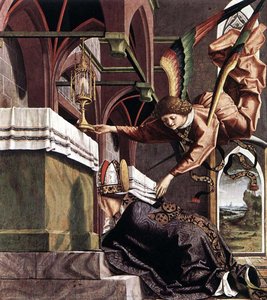
The panel known as Saint Ambrose from Milan emerges from the intricate layers of the Altarpiece of the Church Fathers. Painted by Michael Pacher, this work captures a moment of profound spiritual connection. It exists as one of the four sections of a larger, complex structure designed to honor the great Doctors of the Western Church. The saint appears caught in a state of divine inspiration, a scene that breathes…

7
Laurentius Altar: The Death of Mary (1462) autorstwa Michael Pacher

Laurentius Altar: The Death of Mary

1462 · Tempera On Panel · Bawarskie Państwowe Zbiory Malarstwa, Monachium

The Laurentius Altar: The Death of Mary by Michael Pacher captures a moment of heavy stillness. Created about 1462, the work centers on the Dormition of the Virgin. She lies at the heart of the scene, a figure of quiet transition. Around her, the apostles gather in a dense, crowded assembly. Their presence forms a ring of mourning, each face etched with the weight of the passing. The air in…

The Michael Pacher selection continues, 11 to 44

11Church Fathers Altar, Outer Wing: Disputation of Saint Augustine with the Heretics (1480) autorstwa Michael PacherChurch Fathers Altar, Outer Wing: Disputation of Saint Augustine with the Heretics1480 · Bawarskie Państwowe Zbiory Malarstwa 12Church Fathers Altar: Saint Augustine (1480) autorstwa Michael PacherChurch Fathers Altar: Saint Augustine1480 · Bawarskie Państwowe Zbiory Malarstwa 13Scene on the right: Saint Gregory (1471) autorstwa Michael PacherScene on the right: Saint Gregory1471 · Bawarskie Państwowe Zbiory Malarstwa 14St. Barbara (1485) autorstwa Michael PacherSt. Barbara1485 15Joseph is trown into a well (1474) autorstwa Michael PacherJoseph is trown into a well1474 16Coronation of the Virgin (1471) autorstwa Michael PacherCoronation of the Virgin1471 · Parish Church 17The Engagement of Virgin (1495) autorstwa Michael PacherThe Engagement of Virgin1495 · Österreichische Galerie Belvedere 18Annunciation (1465) autorstwa Michael PacherAnnunciation1465 · Alte Pinakothek 19St Catherine (1465) autorstwa Michael PacherSt Catherine1465 · Tiroler Landesmuseum Ferdinandeum 20Altarpiece of the Church Fathers: St Augustine Liberating a Prisoner (1483) autorstwa Michael PacherAltarpiece of the Church Fathers: St Augustine Liberating a Prisoner1483 · Alte Pinakothek 21St Wolfgang Altarpiece: Circumcision (1479) autorstwa Michael PacherSt Wolfgang Altarpiece: Circumcision1479 · Parish Church 22Altarpiece of the Church Fathers: Vision of St Sigisbert (1483) autorstwa Michael PacherAltarpiece of the Church Fathers: Vision of St Sigisbert1483 · Alte Pinakothek 23Follower of ) (1400) autorstwa Michael PacherFollower of )1400 24Altarpiece of the Church Fathers (1483) autorstwa Michael PacherAltarpiece of the Church Fathers1483 · Alte Pinakothek 25St Wolfgang Altarpiece: The Miracle of the Bread (1479) autorstwa Michael PacherSt Wolfgang Altarpiece: The Miracle of the Bread1479 · Parish Church 26Coronation of the Virgin between St Wolfgang and St Benedict (1479) autorstwa Michael PacherCoronation of the Virgin between St Wolfgang and St Benedict1479 · Parish Church 27St Wolfgang Altarpiece: Temptation of Christ (1479) autorstwa Michael PacherSt Wolfgang Altarpiece: Temptation of Christ1479 · Parish Church 28St Wolfgang Altarpiece: The Attempt to Stone Christ (1479) autorstwa Michael PacherSt Wolfgang Altarpiece: The Attempt to Stone Christ1479 · Parish Church 29St Wolfgang Altarpiece: Nativity (1479) autorstwa Michael PacherSt Wolfgang Altarpiece: Nativity1479 · Parish Church 30St Wolfgang Altarpiece: Purification of the Temple (1479) autorstwa Michael PacherSt Wolfgang Altarpiece: Purification of the Temple1479 · Parish Church 31St Wolfgang Altarpiece: Scenes from the Life of Christ (1479) autorstwa Michael PacherSt Wolfgang Altarpiece: Scenes from the Life of Christ1479 · Parish Church 32Flagellation (1495) autorstwa Michael PacherFlagellation1495 · Österreichische Galerie Belvedere 33St Lawrence Distributing the Alms (1465) autorstwa Michael PacherSt Lawrence Distributing the Alms1465 · Alte Pinakothek 34St. Barbara autorstwa Michael PacherSt. Barbara 35st wolfgang altarpiece autorstwa Michael Pacherst wolfgang altarpiece 36Temptation of Christ autorstwa Michael PacherTemptation of Christ 37Marriage at Cana autorstwa Michael PacherMarriage at Cana 38Baptism of Christ autorstwa Michael PacherBaptism of Christ 39Christ and the Adulteress autorstwa Michael PacherChrist and the Adulteress 40St Augustine and St Gregory autorstwa Michael PacherSt Augustine and St GregoryBawarskie Państwowe Zbiory Malarstwa 41St augustine freeing a prisoner autorstwa Michael PacherSt augustine freeing a prisoner 42Resurrection of Lazar autorstwa Michael PacherResurrection of Lazar 43Scenes from the Life of Christ autorstwa Michael PacherScenes from the Life of Christ 44The Virgin and Child Enthroned with Angels and Saints autorstwa Michael PacherThe Virgin and Child Enthroned with Angels and SaintsNational Gallery

The subjects that held Michael Pacher's eye

The four subjects that come back most often in these originals, each with its finest example.

The museums that keep Michael Pacher's originals

7 muzeów, w których znajduje się najwięcej obrazów z tej strony.

Muzeum Miasto Dzieła artysty Michael Pacher Obrazy z tej listy
Parish Church, St. WolfgangParish Church St. Wolfgang 10 St Wolfgang Altarpiece: Resurrection of Lazarus, Coronation of the Virgin, St Wolfgang Altarpiece: Circumcision
Alte Pinakothek, MonachiumAlte Pinakothek Monachium 7 Altarpiece of the Church Fathers: St Jerome, Altarpiece of the Church Fathers: St Augustine and St Gregory, Annunciation
Bawarskie Państwowe Zbiory Malarstwa, MonachiumBawarskie Państwowe Zbiory Malarstwa Monachium 6 Saint Ambrose from Milan, Laurentius Altar: The Death of Mary, Church Fathers Altar, Outer Wing: Disputation of Saint Augustine with the Heretics
Österreichische Galerie Belvedere, WiedeńÖsterreichische Galerie Belvedere Wiedeń 2 The Engagement of Virgin, Flagellation
Heinz Kisters Collection, KreuzlingenHeinz Kisters Collection Kreuzlingen 1 Mary of Burgundy
Tiroler Landesmuseum Ferdinandeum, InnsbruckTiroler Landesmuseum Ferdinandeum Innsbruck 1 St Catherine
National Gallery, LondynNational Gallery Londyn 1 The Virgin and Child Enthroned with Angels and Saints

Michael Pacher decade by decade: the original that defines each

Dzieła według dekad

Pick a decade to see the original that defines it.

Collectors' questions about Michael Pacher's paintings

Which work is Michael Pacher most famous for?Reveal the answer

Altarpiece of the Church Fathers: St Jerome (1483), Alte Pinakothek, Monachium. Altarpiece of the Church Fathers: St Augustine and St Gregory (1483) and St Wolfgang Altarpiece: Resurrection of Lazarus (1479) come next.

What age was Michael Pacher when Altarpiece of the Church Fathers: St Jerome was made?Reveal the answer

48 years old: Altarpiece of the Church Fathers: St Jerome dates from 1483, and Michael Pacher was born in 1435.

What are the ten most famous Michael Pacher paintings?Reveal the answer

Altarpiece of the Church Fathers: St Jerome, Altarpiece of the Church Fathers: St Augustine and St Gregory, St Wolfgang Altarpiece: Resurrection of Lazarus, Mary of Burgundy, Saint Ambrose from Milan, Saint Lawrence before Emperor Decius, Laurentius Altar: The Death of Mary, St. Peter, Pope Sixtus II. bids farewell to St. Lawrence i St. Paul. The ranking above gives each one's year and museum.

How many paintings did Michael Pacher leave?Reveal the answer

Our catalog holds 44 works by Michael Pacher, dated from 1462 to 1495.

In which museums do Michael Pacher's masterpieces hang?Reveal the answer

Mostly in Parish Church (St. Wolfgang), Alte Pinakothek (Monachium) i Bawarskie Państwowe Zbiory Malarstwa (Monachium). The museum table above lists them all.

In which years did Michael Pacher paint the most famous works?Reveal the answer

In 1470s: 12 of the 44 works on this page were made then, St Wolfgang Altarpiece: Resurrection of Lazarus among them.

What are the first and the last famous originals of Michael Pacher?Reveal the answer

On this page, the earliest is Laurentius Altar: The Death of Mary (1462) and the latest The Engagement of Virgin (1495).

Which subjects did Michael Pacher choose most often?Reveal the answer

Altarpiece (9), Saints (7) i Religious scene (7), across the 44 works on this page.

Which technique did Michael Pacher use most?Reveal the answer

Oil On Panel, for 7 of the 44 works on this page.

To which art movement does Michael Pacher belong?Reveal the answer

Northern renaissance, judging by the originals on this page.

Which Michael Pacher works hang at the Parish Church?Reveal the answer

St Wolfgang Altarpiece: Resurrection of Lazarus, Coronation of the Virgin i St Wolfgang Altarpiece: Circumcision: the Parish Church, St. Wolfgang holds 10 of the works on this page.

Can I commission a reproduction of a Michael Pacher painting?Reveal the answer

Yes, as a reproduction: the original stays in its museum, but any painting on this page can be painted by hand for you, made to order one at a time, from the painting's own page.

Michael Pacher: life and work

Tyroleński most łączący światy

Michael Pacher, urodzony około 1435 roku w alpejskich krajobrazach Bolzano, jawi się jako postać kluczowa dla okresu przejścia od gotyckiego kunsztu do rodzącego się ducha renesansu w krajach niemieckojęzycznych. Nie był on jedynie artystą; był rzemieślnikiem, który w sposób niezwykle płynny łączył malarstwo ze rzeźbą, architekturę z misternym detalem, tworząc ołtarze, które nie były zwykłymi obiektami religijnymi, lecz raczej immersyjnymi światami wiary i opowieści. Choć jego wczesne lata pozostają spowite tajemnicą – szczegóły dotyczące jego początkowego szkolenia są nieliczne – jest jasne, że Pacher posiadał wrodzony talent, pielęgnowany przez prądy artystyczne przepływające przez Tyrol w połowie XV wieku. Jego podróż nabrała decydującego zwrotu podczas wizyty w Padwie we Włoszech, gdzie zetknął się z rewolucyjnymi freskami Andrei Mantegni. To doświadczenie okazało się transformujące, nasycając jego twórczość nowym zrozumieniem perspektywy i kompozycji przestrzennej – elementów, które miały odróżnić go od wielu współczesnych mu twórców.

Ołtarz św. Wolfganga: Odsłonięcie arcydzieła

Reputacja Pachera opiera się najmocniej na wspaniałym Ołtarzu św. Wolfganga, stworzonym między 1471 a 1481 rokiem dla kościoła pielgrzymkowego w Austrii. Nie jest to po prostu obraz; to misterny poliptyk, wielopanelowe arcydzieło zaprojektowane tak, by rozwijać się niczym święta narracja. Genialna konstrukcja ołtarza pozwala na trzy odrębne sposoby prezentacji: jeden do codziennego kultu, drugi, bardziej zdobny, na niedziele oraz wersję w pełni rozłożoną, zarezerwowaną na specjalne święta. Każda konfiguracja ukazuje inne sceny z życia Jezusa i Najświętszej Marii Panny, kulminując w zapierającym dech w piersiach centralnym panelu przedstawiającym Koronację Maryi jako Królowej Niebios – rzeźbioną scenę promieniującą boską majestatycznością. Skrzydła zewnętrzne ukazują epizody z życia samego świętego Wolfganga, patrona pielgrzymów i rzemieślników. Badacze sugerują, że jego brat, Friedrich Pacher, mógł przyczynić się do namalowania niektórych zewnętrznych paneli, co podkreśla wspólnotowy duch panujący w warsztacie. To, co naprawdę wyróżnia to dzieło, to jego ogromna skala, złożoność oraz zdumiewający poziom detalu zarówno w elementach malarskich, jak i w misternie wyrzeźbionych postaciach. Jest to świadectwo zdolności Pachera do jednoczesnego panowania nad wieloma dyscyplinami artystycznymi.

Łączenie dyscyplin: Malarstwo, rzeźba i wizja architektoniczna

Poza Ołtarzem św. Wolfganga, Pacher zaprezentował swoją unikalną syntezę form artystycznych w dziełach takich jak Ołtarz Ojców Kościoła, ukończony około 1483 roku dla klasztoru Neustift. Tutaj mistrzowsko zatarł granice między malarstwem a rzeźbą, tworząc jednolite doświadczenie artystyczne. Monumentalne postacie Ojców Kościoła zdają się wyłaniać ze swoich nisz, przesycone namacalnym poczuciem obecności. Umiejętność Pachera w operowaniu światłem i cieniem dodatkowo potęguje ten efekt, nadając kompozycji głębię i realizm. On nie tylko przedstawiał przestrzeń; on ją *stwarzał* w ramach struktury ołtarza. To nowatorskie podejście znacząco wpłynęło na kolejne pokolenia artystów w Europie Północnej, którzy starali się naśladować jego zdolność do integrowania różnorodnych technik artystycznych w spójną całość.

Dziedzictwo i trwały wpływ

Do 1467 roku Pacher prowadził prężnie działający warsztat w Bruneck, stając się prominentną postacią na tyrolskiej scenie artystycznej. Przyjmował zlecenia od różnych zakonów religijnych, w tym od franciszkanów w Salzburgu około 1484 roku. Niestety, wiele z jego dzieł zostało utraconych lub uszkodzonych w czasie konfliktów i katastrof naturalnych – co stanowi przejmujące przypomnienie o kruchości dziedzictwa artystycznego. Mimo tych strat, przetrwałe arcydzieła stoją jako trwałe świadectwa wyjątkowego talentu i innowacyjnego ducha Pachera. Był prawdziwym pionierem, który z sukcesem wypełnił lukę między ekspresyjnymi formami północnogotyckiej sztuki a rodzącymiymi się zasadami malarstwa włoskiego renesansu. Jego dziedzictwo tkwi nie tylko w pięknie i technicznej doskonałości jego kreacji, ale także w zdolności do wypracowania unikalnego, osobistego stylu, który mimo upływu wieków nadal zachwyca i inspiruje widzów. Twórczość Pachera reprezentuje kluczowy moment w historii sztuki – czas, w którym tradycja i innowacja zbiegły się, dając początek nowym możliwościom artystycznym.

Wszystkie 44 dzieła artysty Michael Pacher →