Portret Max Weber

Obrazy: 75 najsłynniejszych dzieł artysty Max Weber – spojrzenie galerii

Aktualizacja: Październik 2026 · ranking według naszego wskaźnika popularności (liczba wyszukiwań, wizyt i zamówień dla każdego dzieła) · 76 dzieł Max Weber w naszym katalogu

W skrócie

Według galerii najsłynniejszym obrazem Max Weber jest Gauguin Girl (1907). Figures in a Landscape (1911) i Woman Reading (1916) dopełniają trio, które zna każde oko. Z 76 dzieł Max Weber w naszym katalogu, galeria prezentuje poniżej 75 najsłynniejszych prac – każda z nich jest oryginałem z podaniem roku powstania, muzeum oraz cech wyróżniających ją na tle innych.

1881 – 1961, Białystok Cubism Najwięcej dzieł: The Phillips Collection

10 najlepszych obrazów artysty Max Weber w galerii

Obrazy artysty Max Weber, uszeregowane od 11 do 75 miejsca

Słynne obrazy Max Weber epoka po epoce

Tematy, które przyciągnęły wzrok Max Weber

Cztery motywy najczęściej powracające w tych oryginałach, z których każdy doczekał się swojego najdoskonalszego przykładu.

Muzea przechowujące oryginały Max Weber

8 muzeów, w których znajduje się najwięcej obrazów z tej strony.

Muzeum Miasto Dzieła artysty Max Weber Obrazy z tej listy
The Phillips Collection, WaszyngtonThe Phillips Collection Waszyngton 5 High Noon, Colonial Bowl, Rabbi
Brooklyn Museum, BrooklynBrooklyn Museum Brooklyn 2 The Visit, The Cellist
Muzeum Sztuki Johna i Mable Ringlingów, SarasotaMuzeum Sztuki Johna i Mable Ringlingów Sarasota 1 Untitled (Still Life)
Museum of Fine Arts, BostonMuseum of Fine Arts Boston 1 Path in the Woods
Whitney Museum of American Art, Nowy JorkWhitney Museum of American Art Nowy Jork 1 Adoration of the Moon
Art Institute of Chicago, ChicagoArt Institute of Chicago Chicago 1 Still Life
Metropolitan Museum of Art, Nowy JorkMetropolitan Museum of Art Nowy Jork 1 Pacific Coast
Smithsonian American Art Museum, WaszyngtonSmithsonian American Art Museum Waszyngton 1 Summer

Max Weber, jedno kultowe dzieło na dekadę

Dzieła według dekad

Wybierz dekadę, aby zobaczyć dzieło, które ją definiuje.

Obrazy artysty Max Weber: odpowiedzi galerii

Który obraz Max Weber jest najsłynniejszy ze wszystkich?Odkryj odpowiedź

Gauguin Girl (1907). Następne są Figures in a Landscape (1911) oraz Woman Reading (1916).

Ile lat miał Max Weber, gdy ukończył Gauguin Girl?Odkryj odpowiedź

26 lat: Gauguin Girl pochodzi z 1907, a Max Weber urodził(a) się w 1881.

Które to 10 najlepszych obrazów Max Weber?Odkryj odpowiedź

Gauguin Girl, Figures in a Landscape, Woman Reading, Untitled (Still Life), Path in the Woods, untitled (1109), untitled (2416), untitled (5652), untitled (8675) i untitled (7238). Powyższy ranking zawiera rok powstania oraz muzeum dla każdego z nich.

Ile dzieł stworzył/a Max Weber?Odkryj odpowiedź

Nasz katalog zawiera 76 dzieł artysty Max Weber, datowanych od 1907 do 1952.

Gdzie można znaleźć najsłynniejsze oryginały autorstwa Max Weber?Odkryj odpowiedź

W większości znajdują się w The Phillips Collection (Waszyngton), Brooklyn Museum (Brooklyn) i Muzeum Sztuki Johna i Mable Ringlingów (Sarasota). Powyższa tabela muzeów zawiera ich pełną listę.

Kiedy Max Weber stworzył swoje najsłynniejsze obrazy?Odkryj odpowiedź

W 1940s: 5 z 75 dzieł na tej stronie powstało w tym czasie, w tym Untitled (Still Life).

Które z najsłynniejszych dzieł Max Weber należą do jego najwcześniejszych i najpóźniejszych prac?Odkryj odpowiedź

Na tej stronie najwcześniejszy to Gauguin Girl (1907), a najpóźniejszy Pacific Coast (1952).

Do jakich tematów Max Weber powracał najczęściej?Odkryj odpowiedź

Nude figures (3), Melancholy mood (2) i American art (2), w ramach 75 dzieł na tej stronie.

Z jakim nurtem związany jest Max Weber?Odkryj odpowiedź

Cubism, sądząc po oryginałach na tej stronie.

Które oryginały artysty Max Weber znajdują się w zbiorach The Phillips Collection?Odkryj odpowiedź

High Noon, Colonial Bowl i Rabbi: The Phillips Collection, Waszyngton posiada 5 dzieł widocznych na tej stronie.

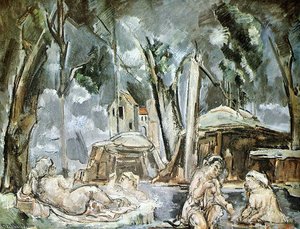
Max Weber: artysta

Early Life and the Seeds of Modernism

Max Weber, born in Białystok, Poland in 1881, embarked on a journey that would indelibly mark the landscape of American art. His early life was steeped in the traditions of Orthodox Judaism, a heritage that would later profoundly influence his artistic expression. The family’s emigration to Brooklyn, New York, when Weber was just ten years old, proved pivotal. This relocation thrust him into a vibrant, rapidly changing society—a crucible where Old World roots and New World aspirations collided. It was at the Pratt Institute in Brooklyn that Weber first formally engaged with art, studying under the influential Arthur Wesley Dow. Dow’s emphasis on innovative approaches to artistic creation, coupled with his exposure to Japanese aesthetics and connections to Paul Gauguin, ignited within Weber a nascent modernist sensibility. He absorbed the lessons of Cézanne's geometric simplification and the expressive power of Matisse’s bold color palettes—influences that would shape his distinctive visual language. Weber’s formative years instilled in him a deep appreciation for both tradition and experimentation. His father, a tailor, represented the solidity of Jewish heritage, while his mother, Helene Fallenstein, descended from Huguenot families known for their intellectual fervor. This dual influence fostered within Weber a desire to reconcile seemingly disparate artistic impulses—a quest that would define his entire career.

The Parisian Awakening and Introduction of Cubism

In 1905, Weber ventured to Europe, specifically Paris, the epicenter of avant-garde thought. His time at the Académie Julian was merely a starting point; it was his immersion in the city’s artistic milieu that truly transformed him. He forged friendships with Henri Rousseau, whose naive yet profound style captivated him, and found himself drawn into the orbits of luminaries like Henri Matisse and Pablo Picasso—artists who were dismantling traditional notions of representation. Weber frequented Gertrude Stein's salon, a legendary gathering place for artists, writers, and intellectuals, and became acquainted with Guillaume Apollinaire, absorbing the latest currents in poetry and art theory. This exposure to the School of Paris fundamentally altered his artistic trajectory. He was particularly struck by Picasso’s revolutionary Cubist techniques—the fragmentation of forms, the simultaneous depiction of multiple viewpoints, and the rejection of illusionistic perspective. Weber meticulously studied these innovations, incorporating them into his own groundbreaking compositions. Weber's Parisian explorations extended beyond formal study; he actively participated in intellectual debates and engaged with fellow artists who challenged conventional artistic dogma. His encounters with Picasso and Matisse solidified his conviction that art should strive for radical innovation—a belief that would underpin his entire artistic practice. He experimented tirelessly with color, texture, and composition, pushing the boundaries of visual expression.

Early Works and Critical Reception

Weber’s debut paintings during this period showcased a remarkable blend of influences. Chinese Restaurant (1915), for example, exemplifies his masterful manipulation of Cubist principles—the fractured planes of color and geometric shapes conveying a sense of dynamism and spatial ambiguity. However, Weber's artistic vision was met with considerable skepticism by the American art establishment. Critics dismissed his work as “pretentious,” “sterile,” and lacking in emotional resonance. James Huneker famously described Weber’s paintings as “a brutal assault on the senses,” highlighting the profound disconnect between Weber’s radical aesthetic choices and prevailing tastes of the time. This uncompromising stance—coupled with a lack of widespread recognition—created an uphill battle for Weber's career. Despite this initial setback, he persevered in his artistic endeavors, driven by an unwavering belief in the transformative power of art.

A Return to Figuration and Jewish Heritage

Around 1920, Weber began to recalibrate his artistic course, moving away from the rigid formalism of Cubism toward more expressive figurative representations. This shift wasn’t a repudiation of modernism but rather an exploration of new avenues for conveying emotion and capturing the essence of human experience. His later paintings often depicted scenes from Jewish life—families gathered in intimate settings, rabbis engaged in Talmudic study, and evocative portraits that conveyed profound spiritual depth. These works reflected Weber's deep connection to his heritage—a legacy rooted in Orthodox Judaism and imbued with a nostalgic yearning for tradition. He skillfully blended Cubist techniques with Impressionistic color palettes, creating images that were both intellectually stimulating and emotionally resonant. Weber’s artistic legacy extends far beyond his individual oeuvre. He served as an influential mentor to younger artists, fostering a spirit of experimentation and challenging conventional artistic norms. His unwavering commitment to innovation—combined with his profound sensitivity to human emotion—established him as one of the most distinctive voices in American Modern Art.

Wszystkie 76 dzieła artysty Max Weber →
