Portret Kawanabe Kyōsai

72 najsłynniejszych obrazów artysty Kawanabe Kyōsai, każdy niepowtarzalny

Aktualizacja: Listopad 2026 · ranking według naszego wskaźnika popularności (liczba wyszukiwań, wizyt i zamówień dla każdego dzieła) · 72 dzieł Kawanabe Kyōsai w naszym katalogu

W skrócie

Three Kyōgen Dancers (801) to obraz autorstwa Kawanabe Kyōsai, który przyciąga najwięcej spojrzeń; oryginał znajduje się w Metropolitan Museum of Art, Nowy Jork. Następnie wzrok kieruje się na Sketches of East Asian Legendary Figures (801) i Yang Guifei Adjusting her Hair (1850). Spośród 72 dzieł Kawanabe Kyōsai w naszym katalogu, tych 72 jest najbardziej znanych – każde z nich to unikatowy oryginał, przedstawiony wraz z rokiem powstania, muzeum oraz powodem, dla którego przetrwało próbę czasu.

1831 – 1889, Koga Ukiyo-e Najwięcej dzieł: Metropolitan Museum of Art

10 najlepszych obrazów autorstwa Kawanabe Kyōsai według oka galerii

1
Three Kyōgen Dancers (801) autorstwa Kawanabe Kyōsai

Three Kyōgen Dancers

801 · Ink · Metropolitan Museum of Art, Nowy Jork

A preliminary ink drawing captures three performers in the midst of a kyōgen dance. These figures, rendered with a fluid and spontaneous energy, embody the comedic essence of traditional Japanese theater. Each dancer is frozen in a distinct, expressive pose that suggests movement and rhythmic timing. One figure holds a drum, another a fan, and the third a bag, marking the specific roles and props essential to the performance. The…

2
Sketches of East Asian Legendary Figures (801) autorstwa Kawanabe Kyōsai

Sketches of East Asian Legendary Figures

801 · Ink · Metropolitan Museum of Art, Nowy Jork

The ink flows across the paper, capturing a moment of quietude and myth. In this black and white drawing, figures from the realm of legend emerge from the shadows of the everyday. We see Japanese figures like Daikoku and Urashima Tarō sharing space with Chinese immortals and the Twenty-Four Paragons of Filial Piety. There is a strange, casual intimacy to the scene, as if these divine and legendary beings have…

3
Yang Guifei Adjusting her Hair (1850) autorstwa Kawanabe Kyōsai

Yang Guifei Adjusting her Hair

1850 · Ink On Paper · Los Angeles County Museum of Art, Los Angeles

In "Yang Guifei Adjusting her Hair" by Kawanabe Kyōsai, the brush captures a moment of quiet preparation. The subject is Yang Guifei, a woman known to history as Lady Yang. She was the beloved consort of Emperor Xuanzong of Tang and remains celebrated as one of the Four Beauties of ancient China. Here, she is a figure of grace, focused on the delicate task of arranging her hair.

4
Yamauba and Kintarō (1850) autorstwa Kawanabe Kyōsai

Yamauba and Kintarō

1850 · Ink On Paper · Los Angeles County Museum of Art, Los Angeles

In this vertical composition, Kawanabe Kyōsai presents a dynamic encounter between two figures from Japanese folklore. The work, created about 1850, centers on the mountain hag Yamauba and the superhuman child Kintarō. A large, standing female figure dominates the space, her presence defined by the voluminous folds of her robes. Beside her, a smaller, crouching male figure provides a sense of scale and tension. The arrangement of these two bodies…

5
Hell Courtesan (1870) autorstwa Kawanabe Kyōsai

Hell Courtesan

1870 · Cleveland Museum of Art, Cleveland

The scene unfolds within the delicate confines of a hanging scroll, where the figure of the Hell Courtesan, known in Japanese as Jigoku Tayū, emerges from the silk. This work, titled Hell Courtesan, captures a moment of profound stillness and spiritual weight. The artist, Kawanabe Kyōsai, brings this legendary character to life through a composition that balances the elegance of a high-ranking courtesan with the unsettling imagery of the afterlife.…

6
Frolicking Figures and Animals (1870) autorstwa Kawanabe Kyōsai

Frolicking Figures and Animals

1870 · Ink On Paper · Metropolitan Museum of Art, Nowy Jork

In this horizontal handscroll from 1870, we find a quiet, almost whispered dialogue between human presence and the natural world. The composition relies heavily on the use of negative space, a deliberate emptiness that allows the viewer to focus entirely on the gestural energy of the brushstrokes. It is a work of profound restraint, where the absence of color speaks more loudly than a full palette could. The monochromatic shades…

7
Calligraphy and Painting Party (1877) autorstwa Kawanabe Kyōsai

Calligraphy and Painting Party

1877 · Ink On Paper

Calligraphy and Painting Party is a hanging scroll created by the Japanese painter and caricaturist Kawanabe Kyōsai. Born in 1831 in Koga, Japan, the artist navigated the shifting tides of the Edo and Meiji periods. This work dates to 1880, a moment when his brush captured the restless energy of a changing nation. His hand moved with the precision of a trained scholar and the wit of a satirist.

8
Wisteria Maiden and Demon Priest (1872) autorstwa Kawanabe Kyōsai

Wisteria Maiden and Demon Priest

1872 · Ink · Minneapolis Institute of Art, Minneapolis

In this work, Wisteria Maiden and Demon Priest, Kawanabe Kyōsai presents a dramatic encounter between a maiden and a demon priest. The composition is centered on a woman dressed in an ornate, multi-colored kimono featuring red, blue, and white patterns. She appears to dance or float gracefully above a crouching, monstrous figure. This figure, the demon priest, is depicted with a weathered, muscular, and grotesque face, wearing dark, heavy robes…

9
Painting Party (1880) autorstwa Kawanabe Kyōsai

Painting Party

1880 · Woodblock Print · Cleveland Museum of Art, Cleveland

Painting Party is a traditional Japanese ukiyo-e woodblock print by Kawanabe Kyōsai. The artist, born in 1831 in Koga, Japan, lived until 1889. This work emerged from a life defined by the shifting currents of the Meiji era. It captures a specific moment of social gathering through the precision of the woodblock medium.

10
Night Procession of One Hundred Demons (1880) autorstwa Kawanabe Kyōsai

Night Procession of One Hundred Demons

1880 · Ink

Kawanabe Kyōsai painted Night Procession of One Hundred Demons about 1880. The work captures a Hyakki Yagyō, a traditional Japanese Night Parade of One Hundred Demons. This supernatural event brings a chaotic procession of various yokai into the light of the viewer's gaze. It is a rhythmic movement of spirits passing through the dark.

Słynne obrazy artysty Kawanabe Kyōsai, od 11 do 72

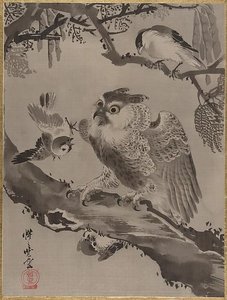
11Hell Courtesan (1880) autorstwa Kawanabe KyōsaiHell Courtesan1880 12Jurōjin [center of a triptych] (1884) autorstwa Kawanabe KyōsaiJurōjin [center of a triptych]1884 · Minneapolis Institute of Art 13Theatre Curtain of Shintomi-za, with an Impromputu Sketch Monster (1880) autorstwa Kawanabe KyōsaiTheatre Curtain of Shintomi-za, with an Impromputu Sketch Monster1880 14Squirrels Eating Chestnuts (1886) autorstwa Kawanabe KyōsaiSquirrels Eating Chestnuts1886 · Los Angeles County Museum of Art 15A Beauty in Front of King Enma's Mirror (1887) autorstwa Kawanabe KyōsaiA Beauty in Front of King Enma's Mirror1887 16Urashima Tarō Riding on a Tortoise (1888) autorstwa Kawanabe KyōsaiUrashima Tarō Riding on a Tortoise1888 · Metropolitan Museum of Art 17Two Children Playing with Goldfish (1887) autorstwa Kawanabe KyōsaiTwo Children Playing with Goldfish1887 · Metropolitan Museum of Art 18Two Birds on a Branch (1887) autorstwa Kawanabe KyōsaiTwo Birds on a Branch1887 · Metropolitan Museum of Art 19Singing Bird on a Branch (1887) autorstwa Kawanabe KyōsaiSinging Bird on a Branch1887 · Metropolitan Museum of Art 20滝に燕図 Swallows by a Waterfall (1887) autorstwa Kawanabe Kyōsai滝に燕図 Swallows by a Waterfall1887 · Metropolitan Museum of Art 21Tale of the Tongue-cut Sparrow (1800) autorstwa Kawanabe KyōsaiTale of the Tongue-cut Sparrow1800 · Los Angeles County Museum of Art 22Sketches of Birds and Animals (1870) autorstwa Kawanabe KyōsaiSketches of Birds and Animals1870 · Metropolitan Museum of Art 23Three Crossbills on a Leafless Tree (1878) autorstwa Kawanabe KyōsaiThree Crossbills on a Leafless Tree1878 · Minneapolis Institute of Art 24Chinese-style Landscape with Man Fishing from a Boat by Moonlight [right of a triptych] (1884) autorstwa Kawanabe KyōsaiChinese-style Landscape with Man Fishing from a Boat by Moonlight [right of a triptych]1884 · Minneapolis Institute of Art 25Landscape with River in Mountainous Country [left of a triptych] (1884) autorstwa Kawanabe KyōsaiLandscape with River in Mountainous Country [left of a triptych]1884 · Minneapolis Institute of Art 26猿を襲う鷲図 Eagle Attacking a Monkey (1885) autorstwa Kawanabe Kyōsai猿を襲う鷲図 Eagle Attacking a Monkey1885 · Metropolitan Museum of Art 27兎を追う鷲図 Eagle Pursuing Rabbit (1885) autorstwa Kawanabe Kyōsai兎を追う鷲図 Eagle Pursuing Rabbit1885 · Metropolitan Museum of Art 28Eagle Attacking a Mountain Lion (1885) autorstwa Kawanabe KyōsaiEagle Attacking a Mountain Lion1885 · Metropolitan Museum of Art 29White Eagle Eyeing a Mountain Lion (1885) autorstwa Kawanabe KyōsaiWhite Eagle Eyeing a Mountain Lion1885 · Metropolitan Museum of Art 30Rocky Landscape (1887) autorstwa Kawanabe KyōsaiRocky Landscape1887 · Metropolitan Museum of Art 31Crow on a Branch (1887) autorstwa Kawanabe KyōsaiCrow on a Branch1887 · Metropolitan Museum of Art 32Untitled (D2X7KF) (1887) autorstwa Kawanabe KyōsaiUntitled (D2X7KF)1887 · Metropolitan Museum of Art 33Fox Catching Bird (1887) autorstwa Kawanabe KyōsaiFox Catching Bird1887 · Metropolitan Museum of Art 34Bird and Frog (1887) autorstwa Kawanabe KyōsaiBird and Frog1887 · Metropolitan Museum of Art 35松に鴉図 Two Crows on a Pine Branch (1887) autorstwa Kawanabe Kyōsai松に鴉図 Two Crows on a Pine Branch1887 · Metropolitan Museum of Art 36Cranes in Marsh (1887) autorstwa Kawanabe KyōsaiCranes in Marsh1887 · Metropolitan Museum of Art 37Buffalo and Herdsman (1887) autorstwa Kawanabe KyōsaiBuffalo and Herdsman1887 · Metropolitan Museum of Art 38柳に鴉図 Crow and Willow Tree (1887) autorstwa Kawanabe Kyōsai柳に鴉図 Crow and Willow Tree1887 · Metropolitan Museum of Art 39岩に鴉図 Crow on a Rock (1887) autorstwa Kawanabe Kyōsai岩に鴉図 Crow on a Rock1887 · Metropolitan Museum of Art 40Owl Mocked by Small Birds (1887) autorstwa Kawanabe KyōsaiOwl Mocked by Small Birds1887 · Metropolitan Museum of Art 41木に鴉図 Crow on a Branch (1887) autorstwa Kawanabe Kyōsai木に鴉図 Crow on a Branch1887 · Metropolitan Museum of Art 42竹に鴉図 Crow on a Bamboo Branch (1887) autorstwa Kawanabe Kyōsai竹に鴉図 Crow on a Bamboo Branch1887 · Metropolitan Museum of Art 43旭に群鴉図 Flock of Crows at Dawn (1887) autorstwa Kawanabe Kyōsai旭に群鴉図 Flock of Crows at Dawn1887 · Metropolitan Museum of Art 44ムクドリ図 Starlings on a Branch (1887) autorstwa Kawanabe Kyōsaiムクドリ図 Starlings on a Branch1887 · Metropolitan Museum of Art 45Fish in a Whirlpool (1887) autorstwa Kawanabe KyōsaiFish in a Whirlpool1887 · Metropolitan Museum of Art 46富士図 Mount Fuji (1887) autorstwa Kawanabe Kyōsai富士図 Mount Fuji1887 · Metropolitan Museum of Art 47Rocky Landscape (1887) autorstwa Kawanabe KyōsaiRocky Landscape1887 · Metropolitan Museum of Art 48瓜に鼠図 Mice in a Melon (1887) autorstwa Kawanabe Kyōsai瓜に鼠図 Mice in a Melon1887 49Eagle Attacking Fish (1887) autorstwa Kawanabe KyōsaiEagle Attacking Fish1887 · Metropolitan Museum of Art 50Squirrels Gathering Chestnuts (1887) autorstwa Kawanabe KyōsaiSquirrels Gathering Chestnuts1887 · Metropolitan Museum of Art 51Monkey Hanging from Grapevines (1887) autorstwa Kawanabe KyōsaiMonkey Hanging from Grapevines1887 · Metropolitan Museum of Art 52雪中鴉図 Crow Flying in the Snow (1887) autorstwa Kawanabe Kyōsai雪中鴉図 Crow Flying in the Snow1887 · Metropolitan Museum of Art 53Waterfall, Eagle and Monkey (1887) autorstwa Kawanabe KyōsaiWaterfall, Eagle and Monkey1887 · Metropolitan Museum of Art 54月に鴉図 Crow and the Moon (1887) autorstwa Kawanabe Kyōsai月に鴉図 Crow and the Moon1887 · Metropolitan Museum of Art 55Pheasant Caught by a Snake (1887) autorstwa Kawanabe KyōsaiPheasant Caught by a Snake1887 · Metropolitan Museum of Art 56Shakyamuni Conquering the Demons (Shaka Gōma zu) (1888) autorstwa Kawanabe KyōsaiShakyamuni Conquering the Demons (Shaka Gōma zu)1888 · Metropolitan Museum of Art 57Eagle Holding Small Bird (1887) autorstwa Kawanabe KyōsaiEagle Holding Small Bird1887 · Metropolitan Museum of Art 58Monkeys (1888) autorstwa Kawanabe KyōsaiMonkeys1888 · Metropolitan Museum of Art 59Deer and Monkeys (1887) autorstwa Kawanabe KyōsaiDeer and Monkeys1887 · Metropolitan Museum of Art 60Rabbits (1887) autorstwa Kawanabe KyōsaiRabbits1887 · Metropolitan Museum of Art 61Cat Catching a Frog (1887) autorstwa Kawanabe KyōsaiCat Catching a Frog1887 · Metropolitan Museum of Art 62水辺に鴉図 Crow and Reeds by a Stream (1887) autorstwa Kawanabe Kyōsai水辺に鴉図 Crow and Reeds by a Stream1887 · Metropolitan Museum of Art 63白衣観音図 White Robed Kannon (1887) autorstwa Kawanabe Kyōsai白衣観音図 White Robed Kannon1887 · Metropolitan Museum of Art 64Playful Demon autorstwa Kawanabe KyōsaiPlayful DemonYale University Art Gallery 65Frolicking Animals, Nekomata and Tanuki Badger autorstwa Kawanabe KyōsaiFrolicking Animals, Nekomata and Tanuki Badger 66Long Arms [right of a pair of Long Legs and Long Arms] autorstwa Kawanabe KyōsaiLong Arms [right of a pair of Long Legs and Long Arms]Minneapolis Institute of Art 67Long Legs [left of a pair of Long Legs and Long Arms] autorstwa Kawanabe KyōsaiLong Legs [left of a pair of Long Legs and Long Arms]Minneapolis Institute of Art 68Seven Otafukus autorstwa Kawanabe KyōsaiSeven OtafukusMinneapolis Institute of Art 69Tanuki (Racoon Dog) Viewing Its Reflection in Water (801) autorstwa Kawanabe KyōsaiTanuki (Racoon Dog) Viewing Its Reflection in Water801 · Metropolitan Museum of Art 70Boy’s Day Carp Streamer and Shōki Banner (1870) autorstwa Kawanabe KyōsaiBoy’s Day Carp Streamer and Shōki Banner1870 · Metropolitan Museum of Art 71Figure Sketches autorstwa Kawanabe KyōsaiFigure Sketches 72Frolicking Figures and Animals autorstwa Kawanabe KyōsaiFrolicking Figures and Animals

Słynne obrazy Kawanabe Kyōsai epoka po epoce

Tematy, które przyciągnęły wzrok Kawanabe Kyōsai

Cztery motywy najczęściej powracające w tych oryginałach, z których każdy doczekał się swojego najdoskonalszego przykładu.

Muzea przechowujące oryginały Kawanabe Kyōsai

5 muzeów, w których znajduje się najwięcej obrazów z tej strony.

Muzea Miasto Dzieła artysty Kawanabe Kyōsai Obrazy z tej listy
Metropolitan Museum of Art, Nowy JorkMetropolitan Museum of Art Nowy Jork 48 Three Kyōgen Dancers, Sketches of East Asian Legendary Figures, Frolicking Figures and Animals
Minneapolis Institute of Art, MinneapolisMinneapolis Institute of Art Minneapolis 8 Wisteria Maiden and Demon Priest, Jurōjin [center of a triptych], Three Crossbills on a Leafless Tree
Los Angeles County Museum of Art, Los AngelesLos Angeles County Museum of Art Los Angeles 4 Yang Guifei Adjusting her Hair, Yamauba and Kintarō, Squirrels Eating Chestnuts
Cleveland Museum of Art, ClevelandCleveland Museum of Art Cleveland 2 Hell Courtesan, Painting Party
Yale University Art Gallery, Nowe HavaneYale University Art Gallery Nowe Havane 1 Playful Demon

Kawanabe Kyōsai na przestrzeni dekad: jeden unikatowy oryginał dla każdego

Dzieła według dekad

Wybierz dekadę, aby zobaczyć dzieło, które ją definiuje.

Obrazy artysty Kawanabe Kyōsai: pytania do galerii

Jakie jest najsłynniejsze dzieło artysty Kawanabe Kyōsai?Odkryj odpowiedź

Three Kyōgen Dancers (801), Metropolitan Museum of Art, Nowy Jork. Następne są Sketches of East Asian Legendary Figures (801) oraz Yang Guifei Adjusting her Hair (1850).

Które dziesięć obrazów Kawanabe Kyōsai jest najbardziej znanych?Odkryj odpowiedź

Three Kyōgen Dancers, Sketches of East Asian Legendary Figures, Yang Guifei Adjusting her Hair, Yamauba and Kintarō, Hell Courtesan, Frolicking Figures and Animals, Calligraphy and Painting Party, Wisteria Maiden and Demon Priest, Painting Party i Night Procession of One Hundred Demons. Powyższy ranking zawiera rok powstania oraz muzeum dla każdego z nich.

Ile znanych dzieł stworzył Kawanabe Kyōsai?Odkryj odpowiedź

Nasz katalog zawiera 72 dzieł artysty Kawanabe Kyōsai, datowanych od 1850 do 1888.

Gdzie można zobaczyć najsłynniejsze oryginały Kawanabe Kyōsai?Odkryj odpowiedź

W większości znajdują się w Metropolitan Museum of Art (Nowy Jork), Minneapolis Institute of Art (Minneapolis) i Los Angeles County Museum of Art (Los Angeles). Powyższa tabela muzeów zawiera ich pełną listę.

W jakim okresie Kawanabe Kyōsai stworzył/a swoje najsłynniejsze obrazy?Odkryj odpowiedź

W 1880s: 52 z 72 dzieł na tej stronie powstało w tym czasie, w tym Painting Party.

Który z najsłynniejszych obrazów artysty Kawanabe Kyōsai powstał najwcześniej, a który najpóźniej?Odkryj odpowiedź

Na tej stronie najwcześniejszy to Yang Guifei Adjusting her Hair (1850), a najpóźniejszy Urashima Tarō Riding on a Tortoise (1888).

Jakie tematy preferował Kawanabe Kyōsai?Odkryj odpowiedź

Animals (8), Woman (6) i Black ink (6), w ramach 72 dzieł na tej stronie.

Jakich materiałów Kawanabe Kyōsai używał najczęściej?Odkryj odpowiedź

Ink, dla 8 z 72 dzieł na tej stronie.

Do jakiego nurtu należy twórczość Kawanabe Kyōsai?Odkryj odpowiedź

Ukiyo-e, sądząc po oryginałach na tej stronie.

Jakie oryginały Kawanabe Kyōsai można zobaczyć w Metropolitan Museum of Art?Odkryj odpowiedź

Three Kyōgen Dancers, Sketches of East Asian Legendary Figures i Frolicking Figures and Animals: Metropolitan Museum of Art, Nowy Jork posiada 48 dzieł widocznych na tej stronie.

Kawanabe Kyōsai: portret artysty

Życie w atramencie i buncie

Kawanabe Kyōsai przyszedł na świat w 1831 roku w Koga, urodzony w rodzinie samurajskiej. Jego wczesne lata zostały naznaczone nagłym, brutalnym spotkaniem ze śmiercią, gdy w wieku dziewięciu lat odkrył ludzką głowę oddzieloną od ciała w rzece Kanda. Ten wczesny wstrząs poprzedził formalną edukację pod okiem mistrzów szkoły Kanō oraz Utagawy Kuniyoshiego. Choć opanował precyzyjne pociągnięcia pędzla wymagane przez tradycję, jego duch skłaniał się ku bardziej wyzwolonym stylom szkół popularnych. Przeprowadził się do Edo, gdzie jego ojciec dołączył do oficjalnych strażaków Szogunatu, i to właśnie tam Kyōsai zaczął kształtować osobowość, która zdefiniuje jego karierę.

Jego droga nigdy nie była ścieżką cichego konformizmu. Podczas politycznych przemian między okresem Edo a erą Meiji, stał się postacią budzącą zarówno fascynację, jak i kontrowersje. Był trzykrotnie aresztowany przez władze Szogunatu, często za satyryczny charakter swoich prac, które wyśmiewały urzędników rządowych i krytykowały obowiązującą politykę. Te starcia z prawem nie osłabiły jego twórczości; wręcz przeciwnie, wzmocniły jego reputację jako niezależnego myśliciela. Jego sztuka odzwierciedlała chaos narodu transformującego się z państwa feudalnego w nowoczesną potęgę.

Demon Pędzla

Techniczna biegłość Kyōsai była równoznaczna z dziką, nieokiełznaną energią. Zyskał przydomek Shuchu gaki, czyli „Malarski Demon” – tytuł, który przyjął, używając w swojej pracy różnorodnych pieczęci. Tematyka jego dzieł była obszerna i często osobliwa, rozciągając się od sfery religijnej po groteskę. Pełnił swoje płótna demonami, szkieletami, żabami i zwierzętami, często nadając im ludzki humor lub polityczne znaczenie. Jedno z jego znaczących dzieł na zwoju, Bitwa pierdów, uchwyciło polityczne wrzenie jego epoki poprzez czystą karykaturę.

Jego proces twórczy był równie legendarny jak jego tematy. Mówiono, że potrafił malować po całej nocy picia, wchodząc w stan, w którym pędzel poruszał się z instynktowną prędkością. Ten spontaniczny styl, czasem określany jako kyōga lub „szalone obrazy”, pozwalał na płynną kreskę, która wydawała się żywa. Choć posiadał techniczne fundamenty szkoły Kanō, jego prace skłaniały się ku chaosowi i komizmowi, a nie ku cichej czci. Był utalentowanym artystą drzeworytnikiem, tworzącym dzieła takie jak Kyōsai hyakuzu oraz liczne odbitki namazu-e, które budziły ogromne poruszenie wśród publiczności.

Dziedzictwo zapisane w liniach

Poza indywidualnymi obrazami, Kyōsai przyczynił się do ewolucji narracji wizualnej. W 1874 roku, wraz z Kanagaki Robunem, pomógł stworzyć to, co uważa się za pierwszy magazyn mangi, Eshinbun Nipponchi. Choć publikacja liczyła tylko trzy numery, stanowiła wczesną próbę nowej formy mediów graficznych. Jego wpływ wykraczał daleko poza Japonię, a jego prace trafiły do takich kolekcji jak British Museum czy Muzeum Guimet w Paryżu. Nawet zachodni goście, w tym architekci tacy jak Josiah Conder, dokumentowali jego nadzwyczajne zdolności.

Artysta zmarł w 1889 roku na raka żołądka. Pozostawił po sobie ogromny dorobek, szacowany na ponad 10 000 dzieł, obejmujący drzeworyty, szkice i albumy. Jego życie było lustrem epoki, w której żył – burzliwej, przejściowej i głęboko złożonej. Dzięki jego atramentowi przejście od średniowiecza do nowoczesnego, uprzemysłowionego społeczeństwa zyskało swój najbardziej ekspresyjny głos.