Portret Joseph Beuys

Obrazy: 32 najsłynniejszych dzieł artysty Joseph Beuys – spojrzenie galerii

Aktualizacja: Październik 2026 · ranking według naszego wskaźnika popularności (liczba wyszukiwań, wizyt i zamówień dla każdego dzieła) · 33 dzieł Joseph Beuys w naszym katalogu

W skrócie

Według opinii kuratorów galerii, najsłynniejszym obrazem Joseph Beuys jest Lightning with Stag in Its Glare (1985), którego oryginał znajduje się w Guggenheim Museum Bilbao w Bilbao. Bathtub (1977) i Halved Felt Cross with Dust Image "Magda" (1965) dopełniają trio, które zna każde oko. Z 33 dzieł Joseph Beuys w naszym katalogu, galeria prezentuje poniżej 32 najsłynniejszych prac – każda z nich jest oryginałem z podaniem roku powstania, muzeum oraz cech wyróżniających ją na tle innych.

1921 – 1986, Krefeld Conceptual art Najwięcej dzieł: Bawarskie Państwowe Zbiory Malarstwa

10 najlepszych obrazów artysty Joseph Beuys w galerii

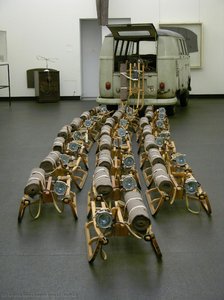
1
Lightning with Stag in Its Glare (1985) autorstwa Joseph Beuys

Lightning with Stag in Its Glare

1985 · Assemblage · Guggenheim Museum Bilbao, Bilbao

The Genesis of a Mythic Landscape Joseph Beuys's *Lightning with Stag in Its Glare* isn’t merely a sculpture; it’s an invocation, a primal scream rendered in bronze and imbued with the weight of history. Completed between 1958 and 1985, this monumental work emerged from a confluence of influences – Beuys's own turbulent past, his deep engagement with shamanic traditions, and a profound yearning to bridge the gap between individual experience…

2
Bathtub (1977) autorstwa Joseph Beuys

Bathtub

1977 · Other-None · Lenbachhaus, Monachium

Joseph Beuys's "Bathtub," created in 1977, isn't merely a photograph of an antique claw-foot tub; it’s a carefully orchestrated meditation on the cyclical nature of existence, the potential for renewal, and the inherent dignity within the commonplace. This seemingly simple image—a white bathtub resting on its metal frame against a muted grey backdrop—holds a profound depth that speaks to Beuys's core artistic philosophy: the belief that art could be a…

3
Halved Felt Cross with Dust Image "Magda" (1965) autorstwa Joseph Beuys

Halved Felt Cross with Dust Image "Magda"

1965 · Assemblage · Museum Ludwig, Kolonia

In the evocative landscape of mid-century avant-garde art, few works command such a quiet, somber presence as Joseph Beuys’s Halved Felt Cross with Dust Image “Magda”. Created in 1965, this striking assemblage serves as a profound testament to the artist’s deep engagement with themes of loss, remembrance, and the ephemeral nature of existence. At its heart, the piece is a masterclass in the Neo-Dada movement, where the boundaries between traditional…

5
I Like America and America Likes Me autorstwa Joseph Beuys

I Like America and America Likes Me

A master of compelling performance pieces, Beuys flew to New York, picked up by an ambulance, and swathed in felt, was transported to a room in the Rene Block Gallery. The room was also occupied by a wild coyote, and for a period of 8 hours a day for the next three days, Beuys spent his time with the coyote in the small room, with little more than a felt…

8
How to Explain Pictures to a Dead Hare autorstwa Joseph Beuys

How to Explain Pictures to a Dead Hare

"One of the artist’s most famous performances, Beuys covered his head first with honey, and then with fifty dollars worth of gold leaf. He cradles a dead hare in his arms, and strapped an iron plate to the bottom of his right shoe. Viewed from behind glass in the gallery, the audience could see Beuys walking from drawing to drawing, quietly whispering in the dead rabbit’s ear. As he walked…

Obrazy artysty Joseph Beuys, uszeregowane od 11 do 32 miejsca

Tematy, które przyciągnęły wzrok Joseph Beuys

Cztery motywy najczęściej powracające w tych oryginałach, z których każdy doczekał się swojego najdoskonalszego przykładu.

Muzea przechowujące oryginały Joseph Beuys

8 muzeów, w których znajduje się najwięcej obrazów z tej strony.

Muzea Miasto Dzieła artysty Joseph Beuys Obrazy z tej listy
Bawarskie Państwowe Zbiory Malarstwa, MonachiumBawarskie Państwowe Zbiory Malarstwa Monachium 3 Attempt II, The Medium, Golden sculpture
Tate Modern, LondynTate Modern Londyn 3 Hearts of the Revolutionaries: Passage of the Planets of the Future, Actresses, Brightly-Lit Stag Chair
Guggenheim Museum Bilbao, BilbaoGuggenheim Museum Bilbao Bilbao 1 Lightning with Stag in Its Glare
Lenbachhaus, MonachiumLenbachhaus Monachium 1 Bathtub
Museum Ludwig, KoloniaMuseum Ludwig Kolonia 1 Halved Felt Cross with Dust Image "Magda"
Narodowa Galeria Armenii, ErewanNarodowa Galeria Armenii Erewan 1 The silence of Marcel Duchamp is overrated
Modern Art Oxford, OxfordModern Art Oxford Oxford 1 Seminar with Joseph Beuys
Scottish National Gallery, EdynburgScottish National Gallery Edynburg 1 Capri Battery

Joseph Beuys, jedno kultowe dzieło na dekadę

Dzieła według dekad

Wybierz dekadę, aby zobaczyć dzieło, które ją definiuje.

Obrazy artysty Joseph Beuys: odpowiedzi galerii

Który obraz Joseph Beuys jest najsłynniejszy ze wszystkich?Odkryj odpowiedź

Lightning with Stag in Its Glare (1985), Guggenheim Museum Bilbao, Bilbao. Następne są Bathtub (1977) oraz Halved Felt Cross with Dust Image "Magda" (1965).

Ile lat miał Joseph Beuys, gdy ukończył Lightning with Stag in Its Glare?Odkryj odpowiedź

64 lat: Lightning with Stag in Its Glare pochodzi z 1985, a Joseph Beuys urodził(a) się w 1921.

Które to 10 najlepszych obrazów Joseph Beuys?Odkryj odpowiedź

Lightning with Stag in Its Glare, Bathtub, Halved Felt Cross with Dust Image "Magda", The silence of Marcel Duchamp is overrated, I Like America and America Likes Me, Fat chair, Fat chair, How to Explain Pictures to a Dead Hare, Attempt II i Fettecke. Powyższy ranking zawiera rok powstania oraz muzeum dla każdego z nich.

Ile dzieł stworzył/a Joseph Beuys?Odkryj odpowiedź

Nasz katalog zawiera 33 dzieł artysty Joseph Beuys, datowanych od 1952 do 1985.

Gdzie można znaleźć najsłynniejsze oryginały autorstwa Joseph Beuys?Odkryj odpowiedź

W większości znajdują się w Bawarskie Państwowe Zbiory Malarstwa (Monachium), Tate Modern (Londyn) i Guggenheim Museum Bilbao (Bilbao). Powyższa tabela muzeów zawiera ich pełną listę.

Kiedy Joseph Beuys stworzył swoje najsłynniejsze obrazy?Odkryj odpowiedź

W 1960s: 9 z 32 dzieł na tej stronie powstało w tym czasie, w tym Halved Felt Cross with Dust Image "Magda".

Które z najsłynniejszych dzieł Joseph Beuys należą do jego najwcześniejszych i najpóźniejszych prac?Odkryj odpowiedź

Na tej stronie najwcześniejszy to Bug der Argo (1952), a najpóźniejszy Lightning with Stag in Its Glare (1985).

Do jakich tematów Joseph Beuys powracał najczęściej?Odkryj odpowiedź

Social commentary (3) i Photography (2), w ramach 32 dzieł na tej stronie.

W jakiej technice najczęściej tworzył Joseph Beuys?Odkryj odpowiedź

Assemblage, dla 2 z 32 dzieł na tej stronie.

Z jakim nurtem związany jest Joseph Beuys?Odkryj odpowiedź

Conceptual art i Neo-dada, sądząc po oryginałach na tej stronie.

Które oryginały artysty Joseph Beuys znajdują się w zbiorach Bawarskie Państwowe Zbiory Malarstwa?Odkryj odpowiedź

Attempt II, The Medium i Golden sculpture: Bawarskie Państwowe Zbiory Malarstwa, Monachium posiada 3 dzieł widocznych na tej stronie.

Joseph Beuys: artysta

A Life Sculpted in Society

Joseph Beuys, a name synonymous with the expansion of artistic boundaries, was more than just an artist; he was a visionary who believed creativity held the key to societal transformation. Born in Krefeld, Germany, in 1921, his life unfolded against a backdrop of immense political and social upheaval, profoundly shaping his artistic philosophy. From a childhood marked by relocation and early exposure to both natural sciences and the burgeoning darkness of Nazism—an event crystallized by rescuing Carl Linnaeus’s *Systema Naturae* from a book burning—Beuys developed a sensitivity to the fragility of existence and the power of symbolic action. His formative years were steeped in an intellectual curiosity that spanned music, mythology, and history, laying the groundwork for his later multidisciplinary approach. Though briefly involved with the Hitler Youth as a teenager – a common experience for German youth at the time – Beuys’s trajectory would ultimately lead him to challenge established norms and advocate for radical social change through art.

The Crucible of War and the Birth of an Iconography

World War II proved a pivotal, almost mythic, turning point in Beuys's life. Volunteering for the Luftwaffe in 1941, he experienced a near-fatal plane crash in Crimea in 1944. The story that emerged from this event—his rescue by Tatar tribesmen who wrapped his broken body in felt and fat to preserve warmth and aid healing—became central to his artistic identity. While historical accounts dispute the details of this narrative, Beuys embraced it as a foundational myth, imbuing these materials with profound symbolic weight. Felt, representing protection, insulation, and connection to nature; and fat, symbolizing energy, healing, and transformation—these became recurring motifs in his work, acting as potent metaphors for the human condition and the potential for renewal. Following the war, Beuys formally studied sculpture at the Düsseldorf Academy of Fine Arts, but it was his engagement with anthroposophy, the spiritual philosophy developed by Rudolf Steiner, that truly ignited his artistic vision. This encounter profoundly influenced his belief in the interconnectedness of all things and the transformative power of art to heal both individuals and society.

Social Sculpture: Art as a Revolutionary Force

Beuys’s most significant contribution to art history is arguably his concept of “Social Sculpture” (*Soziale Plastik*). This wasn't merely about creating physical objects; it was a holistic vision where creativity played a vital role in shaping society and politics. He believed that every individual possessed creative potential, and that this potential could be unlocked through participation—blurring the lines between artist, artwork, and audience. Social Sculpture wasn’t confined to galleries or museums; it extended into everyday life, encompassing political activism, educational initiatives, and public performances. He envisioned a “Gesamtkunstwerk”—a total work of art—where all aspects of human existence could be creatively engaged to foster positive social change. This philosophy underpinned his numerous actions, installations, and pedagogical endeavors, challenging the traditional role of the artist as a solitary creator and positioning them instead as a catalyst for collective transformation.

Performance, Materials, and Political Engagement

Beuys’s artistic practice was remarkably diverse, encompassing performance art, installations, drawings, sculptures, and political activism. His performances were often ritualistic, involving direct engagement with the public and unconventional materials. Iconic works like his felt suits, which he wore during numerous actions, symbolized warmth, protection, and a primal connection to nature. Fat Installations explored themes of energy, healing, and transformation, while performances such as “I Like to Learn” (1965), where he sat in a gallery window with stones and honey inviting dialogue, emphasized the importance of knowledge sharing and open communication. Sculptures like “Lightning with Stag in Its Glare” represented primal forces and human consciousness. Beyond his artistic creations, Beuys actively participated in political debates, founding the Free International Zone (FIZ) at documenta 7—a space for artistic experimentation and social dialogue—and becoming a vocal supporter of the German Green Party. He consistently advocated for environmental protection, social justice, and democratic ideals throughout his life.

A Lasting Legacy

Joseph Beuys died in 1986, leaving behind a legacy that continues to inspire artists, activists, and thinkers today. He radically challenged conventional notions of creativity and authorship, emphasizing participation and social engagement. His work expanded the definition of art beyond aesthetic concerns to encompass political, environmental, and spiritual dimensions. His concept of Social Sculpture remains profoundly relevant, urging us to recognize the creative potential within ourselves and to actively participate in shaping a more just and sustainable future. Beuys wasn’t simply an artist; he was a prophet of possibility, reminding us that art has the power not only to reflect society but also to transform it. His work continues to be studied and interpreted, solidifying his position as one of the most influential artists of the 20th century.