Portret James Rosenquist

52 najsłynniejszych obrazów artysty James Rosenquist, każdy niepowtarzalny

Aktualizacja: Październik 2026 · ranking według naszego wskaźnika popularności (liczba wyszukiwań, wizyt i zamówień dla każdego dzieła) · 52 dzieł James Rosenquist w naszym katalogu

W skrócie

Prezydent Elekt (1960) to obraz autorstwa James Rosenquist, który przyciąga najwięcej spojrzeń. Następnie wzrok kieruje się na Flamingo Capsule (1970) i Paper clip. Spośród 52 dzieł James Rosenquist w naszym katalogu, tych 52 jest najbardziej znanych – każde z nich to unikatowy oryginał, przedstawiony wraz z rokiem powstania, muzeum oraz powodem, dla którego przetrwało próbę czasu.

1933 – 2017, Grand Forks Pop art Najwięcej dzieł: Tate Modern

10 najlepszych obrazów autorstwa James Rosenquist według oka galerii

1
Prezydent Elekt (1960) autorstwa James Rosenquist

Prezydent Elekt

1960 · Akryl na płótnie

Eksploracja warstw amerykańskiej popkultury Ten prowokacyjny kolaż po mistrzowsku zamyka w sobie istotę amerykańskiego społeczeństwa połowy XX wieku poprzez wielowarstwową, wieloaspektową kompozycję. Łącząc elementy realizmu, projektowania graficznego i surrealizmu, dzieło to zaprasza widzów do wizualnego dialogu, który zgłębia tematy niewinności, konsumpcjonizmu oraz pamięci historycznej. Jego eklektyczne zestawienie obrazów — od portretu uśmiechniętego dziecka, przez zabytkowe samochody, aż po surowe, wręcz fizjologiczne przedstawienia — tworzy przejmującą narrację, która rezonuje zarówno na…
2
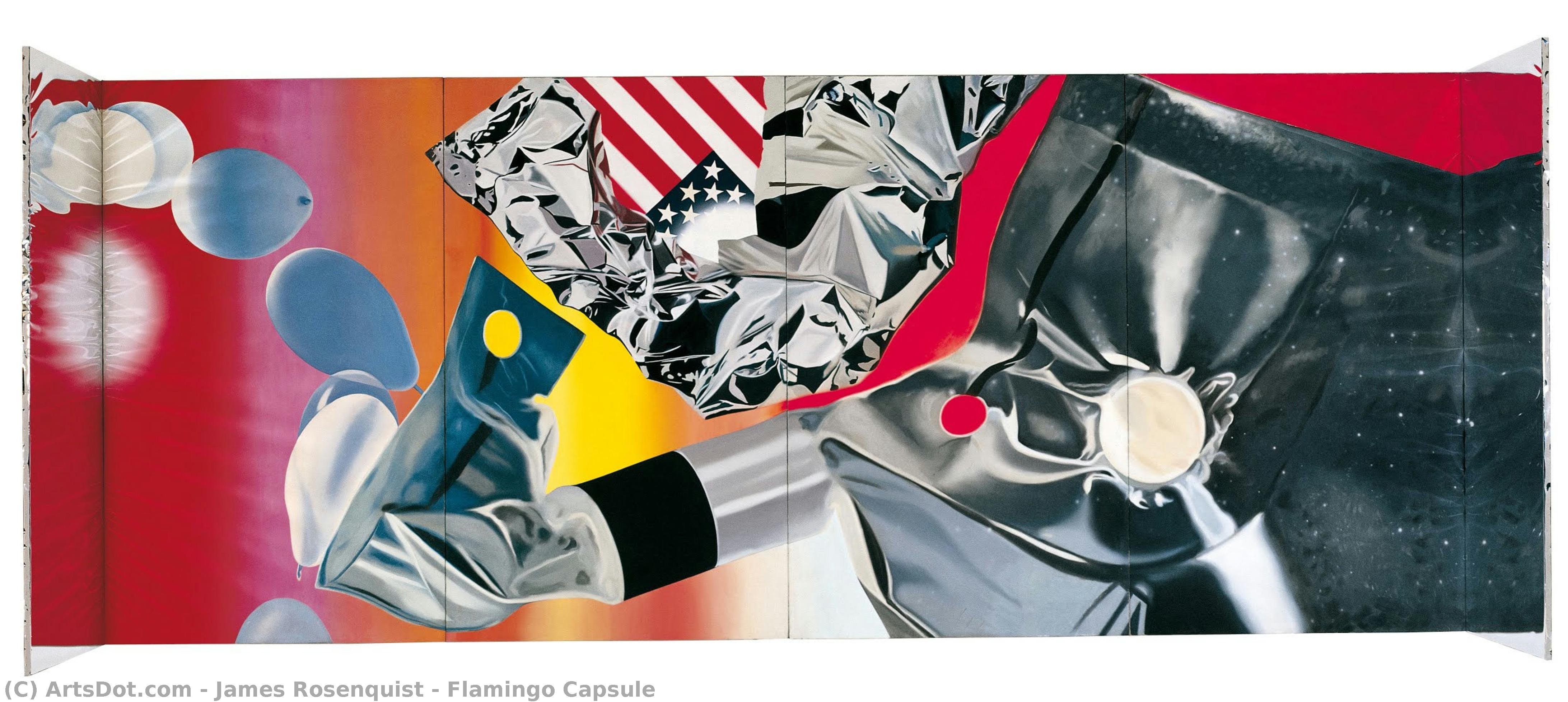
Flamingo Capsule (1970) autorstwa James Rosenquist

Flamingo Capsule

1970 · Oil On Canvas · Guggenheim Museum Bilbao, Bilbao

The air within the frame feels heavy with the heat of a contained explosion. A fiery red and yellow backdrop surges behind fragmented shapes, suggesting a sudden, searing light. Amidst this glow, a flamingo drifts, its form caught in a moment of suspended animation. It is not alone in this metallic enclosure; crumpled foil bearing the emblem of the United States Air Force clings to the composition alongside a distorted…

3
Paper clip autorstwa James Rosenquist

Paper clip

Painting

In the vibrant landscape of twentieth-century American art, few works capture the surreal intersection of consumerism and reality as poignantly as James Rosenquist’s "Paper Clip." This captivating painting serves as a profound testament to the power of the Pop Art movement, where the boundaries between high art and everyday life are intentionally blurred. At first glance, the viewer is met with a striking juxtaposition: a woman, rendered with meticulous care,…

4
Silo (1964) autorstwa James Rosenquist

Silo

1964 · Oil On Canvas · Tate Modern, Londyn

In the vibrant, often overwhelming landscape of the mid-twentieth century, James Rosenquist’s Silo emerges as a profound visual manifesto. Created between 1963 and 1964, this monumental work serves as a cornerstone of the Pop Art movement, capturing the restless energy of an era defined by rapid industrialization and the rise of mass media. The painting does not merely present a scene; it orchestrates a collision of disparate images, much like…

5
Volunteer (1964) autorstwa James Rosenquist

Volunteer

1964 · Oil On Canvas · Art Institute of Chicago, Chicago

We are looking at Volunteer, a significant oil on canvas painting by James Rosenquist. This work emerged from the artist's practice between 1963 and 1964, a period during which his approach to the canvas was deeply informed by his background in commercial sign painting. The scale of the piece is substantial, measuring 183.0 x 198.0cm.

7
Off the Continental Divide (1974) autorstwa James Rosenquist

Off the Continental Divide

1974 · Lithography · Tate Modern, Londyn

In the vibrant, often disorienting landscape of mid-century American art, few voices resonate with as much kinetic energy as James Rosenquist. His masterpiece, Off the Continental Divide, created between 1973 and 1974, serves as a breathtaking window into a psyche caught between the mundane and the monumental. To gaze upon this work is to enter a dreamscape where the boundaries of reality are blurred by the sheer force of color…

Słynne obrazy artysty James Rosenquist, od 11 do 52

Tematy, które przyciągnęły wzrok James Rosenquist

Cztery motywy najczęściej powracające w tych oryginałach, z których każdy doczekał się swojego najdoskonalszego przykładu.

Muzea przechowujące oryginały James Rosenquist

6 muzeów, w których znajduje się najwięcej obrazów z tej strony.

Muzeum Miasto Dzieła artysty James Rosenquist Obrazy z tej listy
Tate Modern, LondynTate Modern Londyn 2 Silo, Off the Continental Divide
Guggenheim Museum Bilbao, BilbaoGuggenheim Museum Bilbao Bilbao 1 Flamingo Capsule
Art Institute of Chicago, ChicagoArt Institute of Chicago Chicago 1 Volunteer
Muzeum Izraela, JerozolimaMuzeum Izraela Jerozolima 1 Melted Butter
Muzeum Sztuki w Toledo, ToledoMuzeum Sztuki w Toledo Toledo 1 Secret Incarnation
Detroit Institute of Arts, DetroitDetroit Institute of Arts Detroit 1 Masquerade of the Military Industrial Complex Looking Down on the Insect World

James Rosenquist na przestrzeni dekad: jeden unikatowy oryginał dla każdego

Dzieła według dekad

Wybierz dekadę, aby zobaczyć dzieło, które ją definiuje.

Obrazy artysty James Rosenquist: pytania do galerii

Jakie jest najsłynniejsze dzieło artysty James Rosenquist?Odkryj odpowiedź

Prezydent Elekt (1960). Następne są Flamingo Capsule (1970) oraz Paper clip.

W jakim wieku James Rosenquist stworzył/a Prezydent Elekt?Odkryj odpowiedź

27 lat: Prezydent Elekt pochodzi z 1960, a James Rosenquist urodził(a) się w 1933.

Które dziesięć obrazów James Rosenquist jest najbardziej znanych?Odkryj odpowiedź

Prezydent Elekt, Flamingo Capsule, Paper clip, Silo, Volunteer, Flowers, Fish and Females for the Four Seasons, Off the Continental Divide, Dishes, Melted Butter i Thaddaeus Ropac. Powyższy ranking zawiera rok powstania oraz muzeum dla każdego z nich.

Ile znanych dzieł stworzył James Rosenquist?Odkryj odpowiedź

Nasz katalog zawiera 52 dzieł artysty James Rosenquist, datowanych od 1960 do 1998.

Gdzie można zobaczyć najsłynniejsze oryginały James Rosenquist?Odkryj odpowiedź

W większości znajdują się w Tate Modern (Londyn), Guggenheim Museum Bilbao (Bilbao) i Art Institute of Chicago (Chicago). Powyższa tabela muzeów zawiera ich pełną listę.

W jakim okresie James Rosenquist stworzył/a swoje najsłynniejsze obrazy?Odkryj odpowiedź

W 1980s: 5 z 52 dzieł na tej stronie powstało w tym czasie, w tym Flowers, Fish and Females for the Four Seasons.

Który z najsłynniejszych obrazów artysty James Rosenquist powstał najwcześniej, a który najpóźniej?Odkryj odpowiedź

Na tej stronie najwcześniejszy to Prezydent Elekt (1960), a najpóźniejszy Feng Shui (1998).

Jakie tematy preferował James Rosenquist?Odkryj odpowiedź

Consumer culture (5), American culture (4) i Advertising (3), w ramach 52 dzieł na tej stronie.

Jakich materiałów James Rosenquist używał najczęściej?Odkryj odpowiedź

Oil On Canvas, dla 3 z 52 dzieł na tej stronie.

Do jakiego nurtu należy twórczość James Rosenquist?Odkryj odpowiedź

Pop art, sądząc po oryginałach na tej stronie.

Jakie oryginały James Rosenquist można zobaczyć w Tate Modern?Odkryj odpowiedź

Silo i Off the Continental Divide: Tate Modern, Londyn posiada 2 dzieł widocznych na tej stronie.

James Rosenquist: portret artysty

James Rosenquist (1933–2017): A Pioneer of Pop Art

James Rosenquist emerged as a pivotal figure in American art, though he often resisted easy categorization—a distinction that cemented his place among the most influential artists of the second half of the 20th century. Born November 29, 1933, in Grand Forks, North Dakota, to Swedish parents Louis and Ruth Rosenquist, James’s upbringing was marked by constant movement as his family pursued employment opportunities wherever they arose. This nomadic experience instilled in him a unique perspective—a sensitivity to the transient nature of imagery and experience that would profoundly shape his artistic vision. His mother, herself a painter, nurtured his early artistic inclinations, recognizing and fostering a talent destined for greatness. A scholarship to the Minneapolis School of Art during junior high school provided initial formal training, followed by studies at the University of Minnesota from 1952 to 1954—a foundation upon which he would build an extraordinary career.
  • Early Life and Artistic Beginnings: Rosenquist’s fascination with art began early in life, fueled by his mother's encouragement and a scholarship that propelled him toward serious artistic pursuits. His childhood memories of flying planes alongside his parents—a legacy passed down through generations—would later resonate within his artwork as he explored themes of movement and displacement.
  • Education at Minneapolis School of Art & University of Minnesota: Rosenquist honed his skills at the Minneapolis School of Art, studying under Edwin Dickinson and George Grosz, absorbing influences from abstract expressionism and gaining invaluable experience in commercial art through summer jobs. These formative years instilled a disciplined approach to craft that would serve him well throughout his artistic journey.
  • The Billboard Years: Rosenquist’s career took an unexpected turn when he joined Artkraft-Strauss, becoming their lead painter and mastering the techniques of large-scale billboard production. This period wasn't merely about earning a living; it was an immersion in the visual language of advertising—a world of bold colors, fragmented imagery, and persuasive power that would become a crucial element of his artistic style.

A Synthesis of Surrealism and Advertising Imagery

Rosenquist’s distinctive artistic style defied easy categorization, blending elements of surrealism with the iconography of advertising—a bold juxtaposition that challenged conventional notions of art and captivated audiences worldwide. He rejected the simplistic imitation of popular culture championed by some contemporaries, opting instead for a more complex exploration of its underlying structures and manipulative tendencies. His canvases became arenas for confronting these contradictions head-on, forcing viewers to question their assumptions about reality and perception.
  • F-111: Rosenquist’s magnum opus, F-111 (1964–65), exemplifies his approach—a monumental painting that combines images of a military aircraft with consumer products, creating a jarring commentary on war, technology, and the American dream.
  • Target II: Similarly, Target II (1965) dissects the imagery of advertising, revealing its underlying structures and manipulative power—a testament to Rosenquist’s intellectual rigor and artistic ambition.

Recognition and Legacy

Rosenquist achieved international acclaim in 1965 with the exhibition featuring F-111 at Leo Castelli Gallery, establishing a long-standing collaboration with the gallery that propelled him to prominence. His work was recognized by critics and fellow artists alike—a validation of his artistic vision and unwavering commitment to experimentation. He continued to produce monumental commissions for public spaces, cementing his place in art history as one of the most innovative and influential figures of the Pop Art movement. Rosenquist’s legacy extends beyond his striking visual style; he challenged conventional boundaries between high and low culture, demonstrating that advertising imagery could be a legitimate subject for artistic exploration—a perspective that continues to resonate with artists today. His influence can be seen in subsequent generations who embraced collage techniques and explored themes of consumerism and cultural commentary.

Wszystkie 52 dzieła artysty James Rosenquist →