Portret Giuseppe Cesari

48 najsłynniejszych obrazów artysty Giuseppe Cesari, każdy niepowtarzalny

Aktualizacja: Listopad 2026 · ranking według naszego wskaźnika popularności (liczba wyszukiwań, wizyt i zamówień dla każdego dzieła) · 50 dzieł Giuseppe Cesari w naszym katalogu

W skrócie

Perseus Rescuing Andromeda (1593) to obraz autorstwa Giuseppe Cesari, który przyciąga najwięcej spojrzeń; oryginał znajduje się w Saint Louis Art Museum, Saint Louis. Następnie wzrok kieruje się na The Flight into Egypt (1595) i Christ Taken Prisoner (1597). Spośród 50 dzieł Giuseppe Cesari w naszym katalogu, tych 48 jest najbardziej znanych – każde z nich to unikatowy oryginał, przedstawiony wraz z rokiem powstania, muzeum oraz powodem, dla którego przetrwało próbę czasu.

1568 – 1640, Arpino Mannerism Najwięcej dzieł: Szépművészeti Múzeum

10 najlepszych obrazów autorstwa Giuseppe Cesari według oka galerii

1
Perseus Rescuing Andromeda (1593) autorstwa Giuseppe Cesari

Perseus Rescuing Andromeda

1593 · Oil · Saint Louis Art Museum, Saint Louis

In this tiny rendering of a classical tale, Giuseppe Cesari presents the mythological scene of Perseus Rescuing Andromeda. Created about 1593–1594, the work captures the moment of intervention as the hero descends to save the princess from her fate. It is a quiet, intimate object of art that invites a closer look to fully grasp its scale and narrative tension.

2
The Flight into Egypt (1595) autorstwa Giuseppe Cesari

The Flight into Egypt

1595 · Oil On Panel · Galleria Borghese, Rzym

Giuseppe Cesari’s “The Flight into Egypt,” completed in 1595, is more than just a biblical scene; it's a meticulously crafted tableau brimming with symbolic depth and the palpable drama characteristic of the late Mannerist and early Baroque periods. Housed within the Galleria Borghese in Rome, this oil-on-panel work offers a rare glimpse into the artistic sensibilities of a master often overshadowed by his more celebrated contemporaries, yet undeniably possessing a…

3
Christ Taken Prisoner (1597) autorstwa Giuseppe Cesari

Christ Taken Prisoner

1597 · Acrylic · Staatliche Museen, Kassel

Giuseppe Cesari’s Dramatic Capture – A Mannerist Masterpiece Subject Matter: The painting portrays a pivotal moment in Christian history: the arrest of Jesus Christ by Roman soldiers. It captures the tension and drama surrounding this event, depicting a confrontation between faith and imperial authority. Style: Cesari’s work firmly establishes itself within the Mannerist style—a reaction against the idealized beauty of the High Renaissance. Characterized by elongated figures, exaggerated poses, and…

4
Storm of the Giants against Olympus (1620) autorstwa Giuseppe Cesari

Storm of the Giants against Olympus

1620 · Oil On Canvas · Kunsthistorisches Museum, Wiedeń

Step closer to observe the tension held within this composition. The scene presents a profound division between two realms: the serene heavens and the violent earth. In the upper register, we find Zeus and Hera seated amidst soft, luminous clouds. Their presence is marked by a quiet authority, bathed in a light that feels almost weightless. Pale blues, golds, and whites define this celestial plane, offering a sense of stillness…

5
The Fall of the Rebel Angels (1610) autorstwa Giuseppe Cesari

The Fall of the Rebel Angels

1610 · Oil · Kunsthistorisches Museum, Wiedeń

A single, powerful figure descends from a source of divine light, cutting through the heavy air. This archangel wears a teal cuirass and a crimson drapery that flows like spilled wine against the dark. He moves with a sharp, defined grace, his shield marked with a red cross, his sword catching a glint of celestial fire. Below him, the sky is not empty; it is a churning vortex of limbs…

6
The Expulsion from Paradise (1610) autorstwa Giuseppe Cesari

The Expulsion from Paradise

1610 · Oil On Copper

The Expulsion from Paradise is a work by the Italian painter Giuseppe Cesari. Born in 1568 and passing away in 1640, the artist captured this biblical scene about 1610. The composition centers on the heavy moment of separation, featuring the figures of Adam and Eve alongside an angel. Their presence is set against a landscape that marks the boundary of their loss.

8
Perseus and Andromeda (1592) autorstwa Giuseppe Cesari

Perseus and Andromeda

1592 · Oil On Canvas · Rhode Island School of Design Museum of Art, Providence

Perseus and Andromeda, executed by Giuseppe Cesari about 1592, captures a moment of high-stakes mythological intervention. The narrative centers on the hero Perseus, who arrives to rescue the princess Andromeda from a perilous fate. She remains bound to a rocky outcrop, vulnerable to the threat emerging from the sea.

9
Portrait of an architect (1591) autorstwa Giuseppe Cesari

Portrait of an architect

1591 · Oil On Canvas · Musée de Grenoble, Grenoble

Portrait of an architect by Giuseppe Cesari, executed in 1591, presents a formal study of a man whose profession is signaled by his attributes. The subject is depicted from the waist up, positioned slightly off-center against a dark, neutral background. He holds a compass in one hand and rests another hand near an ornate, classical architectural element or vessel, symbols of his technical vocation.

10
Madonna with Child, Angels and Saints (1604) autorstwa Giuseppe Cesari

Madonna with Child, Angels and Saints

1604 · Oil · Bawarskie Państwowe Zbiory Malarstwa, Monachium

Madonna with Child, Angels and Saints, painted by Giuseppe Cesari around 1604, presents a deeply devotional scene centered on the Virgin Mary. She is depicted holding the infant Jesus, forming the spiritual nucleus of the composition. The work captures a sacred gathering, bringing together the divine and the earthly through a crowded, intimate arrangement of figures.

Słynne obrazy artysty Giuseppe Cesari, od 11 do 48

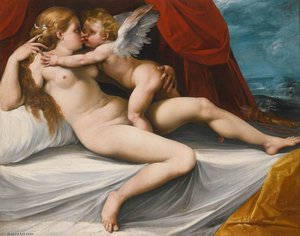
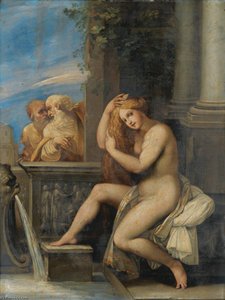
11The Freeing of Andromeda (1604) autorstwa Giuseppe CesariThe Freeing of Andromeda1604 · Bawarskie Państwowe Zbiory Malarstwa 12Adam and Eve Expelled from Paradise (1597) autorstwa Giuseppe CesariAdam and Eve Expelled from Paradise1597 13Presentation of the Virgin at the Temple (1597) autorstwa Giuseppe CesariPresentation of the Virgin at the Temple1597 14Portrait of Pope Clement VIII Aldobrandini (1598) autorstwa Giuseppe CesariPortrait of Pope Clement VIII Aldobrandini1598 15Perseus Freeing Andromeda (1596) autorstwa Giuseppe CesariPerseus Freeing Andromeda1596 · Gemäldegalerie 16Judith with the Head of Holofernes (1605) autorstwa Giuseppe CesariJudith with the Head of Holofernes1605 · Berkeley Art Museum 17Combat of the Horatii and the Curiatii (1612) autorstwa Giuseppe CesariCombat of the Horatii and the Curiatii1612 · Muzea Kapitolińskie 18Perseus and Andromeda (1602) autorstwa Giuseppe CesariPerseus and Andromeda1602 · Kunsthistorisches Museum 19Diana and Actaeon (1603) autorstwa Giuseppe CesariDiana and Actaeon1603 · Szépművészeti Múzeum 20Madonna and Child with Sts John the Baptist, Mary Magdalen and Anne (1592) autorstwa Giuseppe CesariMadonna and Child with Sts John the Baptist, Mary Magdalen and Anne1592 21St Francis Consoled by an Angel (1593) autorstwa Giuseppe CesariSt Francis Consoled by an Angel1593 · Musée de la Chartreuse 22Raising of Lazarus (1592) autorstwa Giuseppe CesariRaising of Lazarus1592 23Susanna and the Elders (detail) (1606) autorstwa Giuseppe CesariSusanna and the Elders (detail)1606 24Diana and Actaeon (detail) (1603) autorstwa Giuseppe CesariDiana and Actaeon (detail)1603 · Szépművészeti Múzeum 25Susanna and the Elders (1606) autorstwa Giuseppe CesariSusanna and the Elders1606 26Passion scenes (1596) autorstwa Giuseppe CesariPassion scenes1596 · Sacristy 27Battle of Tullius Hostilius against the Veii (1601) autorstwa Giuseppe CesariBattle of Tullius Hostilius against the Veii1601 · Muzea Kapitolińskie 28Venus and Cupid (1602) autorstwa Giuseppe CesariVenus and Cupid1602 29The Mocking of Christ (1598) autorstwa Giuseppe CesariThe Mocking of Christ1598 · Chiesa dei Santi Biagio e Carlo ai Catinari 30The Dome of the Pauline Chapel (1600) autorstwa Giuseppe CesariThe Dome of the Pauline Chapel1600 · Bazylika Santa Maria Maggiore 31The Rest on the Flight into Egypt (detail) (1597) autorstwa Giuseppe CesariThe Rest on the Flight into Egypt (detail)1597 · Museum of Fine Arts 32The Martyrdom of Saint Elizabeth (1611) autorstwa Giuseppe CesariThe Martyrdom of Saint Elizabeth1611 · National Gallery of Art 33The Rest on the Flight into Egypt (1597) autorstwa Giuseppe CesariThe Rest on the Flight into Egypt1597 · Museum of Fine Arts 34The Archangel Michael autorstwa Giuseppe CesariThe Archangel MichaelMinneapolis Institute of Art 35The Betrayal of Christ (1596) autorstwa Giuseppe CesariThe Betrayal of Christ1596 · Galleria Borghese 36St Clare with the Scene of the Siege of Assisi autorstwa Giuseppe CesariSt Clare with the Scene of the Siege of AssisiErmitaż 37Madonna and Child with Sts. Peter and Paul (1608) autorstwa Giuseppe CesariMadonna and Child with Sts. Peter and Paul1608 · Nelson-Atkins Museum of Art 38Perseus and Andromeda autorstwa Giuseppe CesariPerseus and AndromedaMusée Bonnat-Helleu 39Saint Ursula autorstwa Giuseppe CesariSaint UrsulaAuckland Art Gallery Toi o Tāmaki 40Noli Me Tangere autorstwa Giuseppe CesariNoli Me Tangere 41Perseus Rescuing Andromeda autorstwa Giuseppe CesariPerseus Rescuing Andromeda 42Diana i Aktaeon (1603) autorstwa Giuseppe CesariDiana i Aktaeon1603 · Szépművészeti Múzeum 43Portrait of a Pope (1630) autorstwa Giuseppe CesariPortrait of a Pope1630 44Suzanne et les vieillards autorstwa Giuseppe CesariSuzanne et les vieillards 45Rest on the Flight into Egypt (detail) autorstwa Giuseppe CesariRest on the Flight into Egypt (detail) 46The annuciation autorstwa Giuseppe CesariThe annuciation 47Lamentation autorstwa Giuseppe CesariLamentation 48Diana i Aktéon (1603) autorstwa Giuseppe CesariDiana i Aktéon1603 · Szépművészeti Múzeum

Słynne obrazy Giuseppe Cesari epoka po epoce

Tematy, które przyciągnęły wzrok Giuseppe Cesari

Cztery motywy najczęściej powracające w tych oryginałach, z których każdy doczekał się swojego najdoskonalszego przykładu.

Muzea przechowujące oryginały Giuseppe Cesari

8 muzeów, w których znajduje się najwięcej obrazów z tej strony.

Muzea Miasto Dzieła artysty Giuseppe Cesari Obrazy z tej listy
Szépművészeti Múzeum, BudapesztSzépművészeti Múzeum Budapeszt 4 Diana and Actaeon, Diana and Actaeon (detail), Diana i Aktaeon
Kunsthistorisches Museum, WiedeńKunsthistorisches Museum Wiedeń 3 Storm of the Giants against Olympus, The Fall of the Rebel Angels, Perseus and Andromeda
Galleria Borghese, RzymGalleria Borghese Rzym 2 The Flight into Egypt, The Betrayal of Christ
Bawarskie Państwowe Zbiory Malarstwa, MonachiumBawarskie Państwowe Zbiory Malarstwa Monachium 2 Madonna with Child, Angels and Saints, The Freeing of Andromeda
Muzea Kapitolińskie, RzymMuzea Kapitolińskie Rzym 2 Combat of the Horatii and the Curiatii, Battle of Tullius Hostilius against the Veii
Museum of Fine Arts, BostonMuseum of Fine Arts Boston 2 The Rest on the Flight into Egypt (detail), The Rest on the Flight into Egypt
Saint Louis Art Museum, Saint LouisSaint Louis Art Museum Saint Louis 1 Perseus Rescuing Andromeda
Staatliche Museen, KasselStaatliche Museen Kassel 1 Christ Taken Prisoner

Giuseppe Cesari na przestrzeni dekad: jeden unikatowy oryginał dla każdego

Dzieła według dekad

Wybierz dekadę, aby zobaczyć dzieło, które ją definiuje.

Obrazy artysty Giuseppe Cesari: pytania do galerii

Jakie jest najsłynniejsze dzieło artysty Giuseppe Cesari?Odkryj odpowiedź

Perseus Rescuing Andromeda (1593), Saint Louis Art Museum, Saint Louis. Następne są The Flight into Egypt (1595) oraz Christ Taken Prisoner (1597).

W jakim wieku Giuseppe Cesari stworzył/a Perseus Rescuing Andromeda?Odkryj odpowiedź

25 lat: Perseus Rescuing Andromeda pochodzi z 1593, a Giuseppe Cesari urodził(a) się w 1568.

Które dziesięć obrazów Giuseppe Cesari jest najbardziej znanych?Odkryj odpowiedź

Perseus Rescuing Andromeda, The Flight into Egypt, Christ Taken Prisoner, Storm of the Giants against Olympus, The Fall of the Rebel Angels, The Expulsion from Paradise, Portrait of Prospero Farinaccio, Perseus and Andromeda, Portrait of an architect i Madonna with Child, Angels and Saints. Powyższy ranking zawiera rok powstania oraz muzeum dla każdego z nich.

Ile znanych dzieł stworzył Giuseppe Cesari?Odkryj odpowiedź

Nasz katalog zawiera 50 dzieł artysty Giuseppe Cesari, datowanych od 1591 do 1630.

Gdzie można zobaczyć najsłynniejsze oryginały Giuseppe Cesari?Odkryj odpowiedź

W większości znajdują się w Szépművészeti Múzeum (Budapeszt), Kunsthistorisches Museum (Wiedeń) i Galleria Borghese (Rzym). Powyższa tabela muzeów zawiera ich pełną listę.

W jakim okresie Giuseppe Cesari stworzył/a swoje najsłynniejsze obrazy?Odkryj odpowiedź

W 1590s: 17 z 48 dzieł na tej stronie powstało w tym czasie, w tym Perseus Rescuing Andromeda.

Który z najsłynniejszych obrazów artysty Giuseppe Cesari powstał najwcześniej, a który najpóźniej?Odkryj odpowiedź

Na tej stronie najwcześniejszy to Portrait of an architect (1591), a najpóźniejszy Portrait of a Pope (1630).

Jakie tematy preferował Giuseppe Cesari?Odkryj odpowiedź

Woman (11), Man (11) i Angel (6), w ramach 48 dzieł na tej stronie.

Jakich materiałów Giuseppe Cesari używał najczęściej?Odkryj odpowiedź

Oil On Canvas, dla 11 z 48 dzieł na tej stronie.

Do jakiego nurtu należy twórczość Giuseppe Cesari?Odkryj odpowiedź

Mannerism, sądząc po oryginałach na tej stronie.

Jakie oryginały Giuseppe Cesari można zobaczyć w Szépművészeti Múzeum?Odkryj odpowiedź

Diana and Actaeon, Diana and Actaeon (detail) i Diana i Aktaeon: Szépművészeti Múzeum, Budapeszt posiada 4 dzieł widocznych na tej stronie.

Giuseppe Cesari: portret artysty

Giuseppe Cesari: Mistrz Manierycznej Wielkości

Giuseppe Cesari, urodzony w Arpino około 1568 roku i tragicznie zmarły w Rzymie w 1640 roku, pozostaje fascynującą, choć nieco enigmatyczną postacią w bogatym gobelinie historii sztuki włoskiej. Choć nie zawsze cieszył się tak żarliwym uznaniem, jakie przypadało jego współczesnym – zwłaszcza tym związanym z dojrzałym Renesansem czy Barokiem – kariera Cesari obejmowała niezwykły okres, będąc świadkiem i aktywnym uczestnikiem kluczowych przemian w stylu artystycznym oraz mecenacie. Jego historia to opowieść spleciona z ambicją, technicznym kunsztem i nieustanną walką o ustanowienie trwałego dziedzictwa pośród blasku rzymskiej sceny artystycznej. Był kluczową postacią okresu manieryzmu, stanowiąc stylistyczny pomost między klasycznymi ideałami Renesansu a dramatycznymi innowacjami, które zdefiniowały erę Baroku. Wczesne lata Cesari pozostają w pewnym stopniu spowite tajemnicą, choć powszechnie przyjmuje się, że urodził się w Arpino, małym miasteczku położonym między Rzymem a Neapolem. Jego ojciec, również o imieniu Giuseppe, był malarzem, co zapewniło młodemu artyście pierwsze podstawy w zakresie technik malarskich. Jednak to przeprowadzka do Rzymu prawdziwie ukształtowała trajektorię jego kariery. Miasto, będące sercem papieskiego mecenatu i magnesem dla artystów z całej Italii i spoza jej granic, oferowało niespotykane możliwości, ale i zaciekłą konkurencję. Początkowo odbywał praktyki u Benedetto Cesanie, malarza znanego z fresków w Watykanie, zanim ostatecznie związał się ze słynnym architektem Carlo Maderno. Ta relacja okazała się kluczowa, otwierając drzwi do znaczących zleceń i wprowadzając go w krąg wpływowych postaci rzymskiego świata sztuki.

Wzlot malarza dworskiego

Kariera Cesari prawdziwie wzbiła się w górę za panowania papieża Klemensa VIII (1592–1605). Szybko ugruntował swoją pozycję jako niezwykle pożądany malarz, zdobywając prestiżowe zlecenia, które przypieczętowały jego reputację i przyniosły mu znaczne bogactwo. Jego najbardziej celebrowanym osiągnięciem jest bez wątpienia udział w dekoracji Bazyliki św. Piotra. Między 1603 a 1612 rokiem powierzono mu zaprojektowanie wspaniałych mozaik zdobiących kopułę – monumentalne przedsięwzięcie, które zaprezentowało jego biegłość techniczną i artystyczną ambicję. Te mozaiki, przedstawiające sceny z życia Chrystusa i Najświętszej Maryi Panny, są uważane za jedne z najdoskonalszych przykładów manierycznej sztuki mozaikowej. Poza Bazyliką św. Piotra, Cesari otrzymywał liczne inne zlecenia, w tym freski do pałaców, kościołów i prywatnych rezydencji w całym Rzymie. Był artystą niezwykle płodnym, tworzącym ogromny dorobek odzwierciedlający jego różnorodne umiejętności i preferencje stylistyczne.

Styl i technika

Styl artystyczny Cesari jest często opisywany jako manieryczny, charakteryzujący się elegancją, wyrafinowaniem i misternym detalem. Jego kompozycje są zazwyczaj zrównoważone i symetryczne, co odzwierciedla wpływ takich artystów jak Giulio Romano czy Pontormo. Stosował bogatą paletę barw, często wykorzystując płatki złota, aby stworzyć wrażenie przepychu i wielkości. Choć wykazywał się ogromnymi umiejętnościami w malarstwie freskowym – co jest szczególnie widoczne w jego pracy w Bazylice św. Piotra – równie sprawnie tworzył obrazy gabinetowe (małe formy malarskie przeznaczone do prywatnych kolekcji). Dzieła te często przedstawiały tematy religijne lub mitologiczne, wykonane z niezwykłą dbałością o szczegół i wyraźnymi wpływami flamandzkimi. Jego styl bywa określany jako wygładzony i nieco sztuczny, pozbawiony surowej intensywności emocjonalnej późniejszych artystów barokowych, takich jak Caravaggio.

Wpływy i dziedzictwo

ł Rozwój artystyczny Cesari był niewątpliwie kształtowany przez kontakt z różnorodnymi stylami dominującymi w Rzymie w jego czasach. Chłonął wpływy mistrzów dojrzałego Renesansu – Rafaela i Michała Anioła – jednocześnie angażując się w bardziej ekscentryczne tendencje manieryzmu. Jego współpraca z Carlo Maderno, czołowym architektem epoki, dodatkowo poszerzyła jego horyzonty artystyczne, eksponując go na innowacyjne koncepcje architektoniczne i zasady projektowania. Mimo znacznego sukcesu, dziedzictwo Cesari pozostaje nieco niejednoznaczne. Choć za życia cieszył się szeroką popularnością, jego twórczość jest często postrzegana jako technicznie biegła, lecz pozbawiona oryginalności czy głębi emocjonalnej. Niemniej jednak, jego wkład w dekorację Bazyliki św. Piotra sprawia, że jego nazwisko na zawsze pozostanie związane z jednym z najbardziej ikonicznych zabytków chrześcijaństwa.

Zapomniany mistrz?

Historia Giuseppe Cesariego służy jako przejmujące przypomnienie o wyzwaniach, przed którymi stali artyści poruszający się w złożonym i konkurencyjnym świecie renesansowego mecenatu. Jego kariera, naznaczona zarówno triumfami, jak i zapomnieniem, oferuje cenne spostrzeżenia na temat dynamiki produkcji i odbioru sztuki w kluczowym okresie historii europejskiej sztuki. Mimo że pozostaje w cieniu bardziej sławnych współczesnych, dzieło Cesariego jest nadal badane i cenione za techniczną biegłość, elegancki styl oraz znaczący wkład w wizualny krajobraz Rzymu. Dalsze badania i krytyczna reewaluacja mogą jeszcze ujawnić głębsze zrozumienie tego często pomijanego mistrza manierycznej wielkości.