Portret Georges D'Espagnat

Obrazy: 50 najsłynniejszych dzieł artysty Georges D'Espagnat – spojrzenie galerii

Aktualizacja: Listopad 2026 · ranking według naszego wskaźnika popularności (liczba wyszukiwań, wizyt i zamówień dla każdego dzieła) · 50 dzieł Georges D'Espagnat w naszym katalogu

W skrócie

Według galerii najsłynniejszym obrazem Georges D'Espagnat jest Untitled (A Set of Seven Decorative Panels) (1900). Tuna Vessels Saint-gilles Croix De Vié i Girl Painting at an Easel (1910) dopełniają trio, które zna każde oko. Z 50 dzieł Georges D'Espagnat w naszym katalogu, galeria prezentuje poniżej 50 najsłynniejszych prac – każda z nich jest oryginałem z podaniem roku powstania, muzeum oraz cech wyróżniających ją na tle innych.

1870 – 1950, Melun Impressionism Najwięcej dzieł: Petit Palais

10 najlepszych obrazów artysty Georges D'Espagnat w galerii

1
Untitled (A Set of Seven Decorative Panels) (1900) autorstwa Georges D'Espagnat

Untitled (A Set of Seven Decorative Panels)

1900 · Painting

A set of seven decorative panels captures a quiet moment of feminine connection. Within the composition, two women occupy the foreground; one sits upon a bench while the other stands beside her, their long dresses suggesting a bygone era of formal grace. A third figure lingers in the background, partially obscured, adding a layer of depth to the social tableau. The arrangement of figures creates a sense of private conversation,…

2
Tuna Vessels Saint-gilles Croix De Vié autorstwa Georges D'Espagnat

Tuna Vessels Saint-gilles Croix De Vié

Oil On Canvas

The artwork Tuna Vessels Saint-gilles Croix De Vié is an impressionistic oil painting on canvas that captures a lively harbor scene. The composition is horizontally oriented, featuring a horizon line positioned near the center of the frame. In the foreground, several figures are situated near smaller boats, while the midground is occupied by larger vessels and various activities. The background shows additional boats receding into the distance, which creates a…

3
Girl Painting at an Easel (1910) autorstwa Georges D'Espagnat

Girl Painting at an Easel

1910 · Oil

In this 1910 work, we find ourselves in a private, domestic space where time seems to have slowed. A woman sits before an easel, her attention entirely consumed by the canvas before her. There is a profound sense of focus in her posture, a stillness that suggests the world outside the room has ceased to exist. On the dining table nearby, a simple arrangement of two apples and a vase…

4
Woman Reading autorstwa Georges D'Espagnat

Woman Reading

Oil On Canvas

We are looking at Woman Reading, a work by the French artist Georges D'Espagnat. This piece offers a quiet glimpse into the artist's ability to capture a private, domestic moment. D'Espagnat was born in Melun in 1870 and spent much of his life immersed in the French art scene, eventually passing away in Paris in 1950.

5
Femmes et enfants dans la terrasse du moulin de Beaulieu à Villennes sur Seine (1898) autorstwa Georges D'Espagnat

Femmes et enfants dans la terrasse du moulin de Beaulieu à Villennes sur Seine

1898 · Oil On Canvas

The oil painting depicts a group of figures gathered on a terrace within a lush garden setting. In the center, four children and an adult woman are positioned together, focused on the act of collecting flowers. Nearby, another woman sits in a relaxed posture. A small dog is situated within the composition, adding to the domestic atmosphere. The scene is framed by trees that create a sense of enclosure around…

6
Woman and Child (1925) autorstwa Georges D'Espagnat

Woman and Child

1925 · Oil On Canvas

In the quietude of a grassy landscape, the figures of Woman and Child emerge through the soft, hazy light of a distant afternoon. This work, painted by Georges D'Espagnat, captures a tender moment of connection set against a backdrop of rolling hills and a far-off castle. The scene feels suspended in time, as if the air itself holds its breath around the mother and her young one. It is a…

7
Woman and Children in an Orchard: Sketch for the Cloister of the Girls' School of Avenue Simon-Bolivar, 19th Arrondissement of Paris (1933) autorstwa Georges D'Espagnat

Woman and Children in an Orchard: Sketch for the Cloister of the Girls' School of Avenue Simon-Bolivar, 19th Arrondissement of Paris

1933 · Oil · Petit Palais, Paryż

This landscape sketch, created in 1933, depicts a serene outdoor scene within an orchard. The composition is characterized by a roughly symmetrical arrangement, framed by two slender, arching trees that establish a natural border on the left and right sides of the image. Within this verdant setting, human figures are integrated into the lush vegetation: a woman is positioned on the left holding a child, while a young girl stands…

8
The Sewing: Sketch for the cloister of the girls' school on avenue Simon-Bolivar, 19th arrondissement of Paris (1933) autorstwa Georges D'Espagnat

The Sewing: Sketch for the cloister of the girls' school on avenue Simon-Bolivar, 19th arrondissement of Paris

1933 · Oil · Petit Palais, Paryż

In this 1933 oil painting, a woman and a child are seated together on a bench within an outdoor setting. They are positioned beneath a canopy formed by the arching branches of trees, which frame the central figures. The woman and child appear engaged in a quiet activity, specifically sewing. The scene is rendered with loose, gestural lines and visible, textured brushstrokes that prioritize the play of light and atmosphere…

9
Maisonette by the Sea (1900) autorstwa Georges D'Espagnat

Maisonette by the Sea

1900 · Oil On Canvas

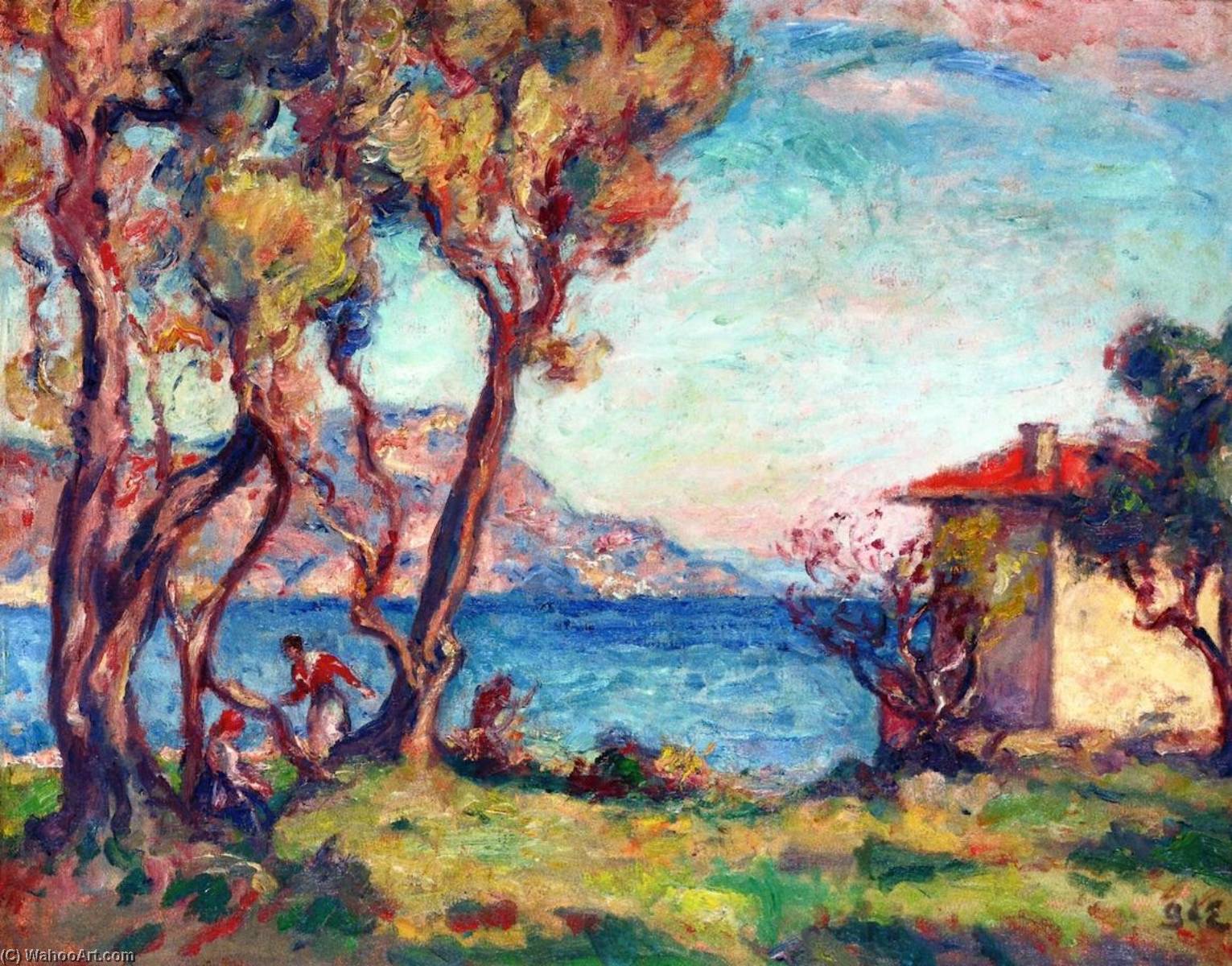
A solitary figure stands near a tree, pausing to observe the sea. This 1900 oil on canvas captures a quiet afternoon where life moves at the pace of the tide. Scattered figures populate the shoreline, some near the water's edge and others further back, creating a sense of lived-in space. A single boat rests upon the water, anchoring the composition within a peaceful maritime setting. The scene is framed by…

10
Naked Styling autorstwa Georges D'Espagnat

Naked Styling

Oil

The soft glow of early light spills into a private room, catching the curve of a woman's shoulder as she prepares for the day. She sits amidst the quiet intimacy of a domestic setting, her dark hair swept up in a loose, elegant style. A red headscarf provides a sudden, sharp pulse of color against the muted, earthy tones that surround her. There is a stillness here, a suspended moment…

Obrazy artysty Georges D'Espagnat, uszeregowane od 11 do 50 miejsca

Tematy, które przyciągnęły wzrok Georges D'Espagnat

Cztery motywy najczęściej powracające w tych oryginałach, z których każdy doczekał się swojego najdoskonalszego przykładu.

Muzea przechowujące oryginały Georges D'Espagnat

4 muzeów, w których znajduje się najwięcej obrazów z tej strony.

Muzea Miasto Dzieła artysty Georges D'Espagnat Obrazy z tej listy
Petit Palais, ParyżPetit Palais Paryż 2 Woman and Children in an Orchard: Sketch for the Cloister of the Girls' School of Avenue Simon-Bolivar, 19th Arrondissement of Paris, The Sewing: Sketch for the cloister of the girls' school on avenue Simon-Bolivar, 19th arrondissement of Paris
Wallraf-Richartz-Museum, KoloniaWallraf-Richartz-Museum Kolonia 1 Garden in Verneuil
Królewskie Muzea Sztuk Pięknych w Belgii, BrukselaKrólewskie Muzea Sztuk Pięknych w Belgii Bruksela 1 Portrait Of Andrée
Dallas Museum of Art, DallasDallas Museum of Art Dallas 1 Jeune Fille Assise

Georges D'Espagnat, jedno kultowe dzieło na dekadę

Dzieła według dekad

Wybierz dekadę, aby zobaczyć dzieło, które ją definiuje.

Obrazy artysty Georges D'Espagnat: odpowiedzi galerii

Który obraz Georges D'Espagnat jest najsłynniejszy ze wszystkich?Odkryj odpowiedź

Untitled (A Set of Seven Decorative Panels) (1900). Następne są Tuna Vessels Saint-gilles Croix De Vié oraz Girl Painting at an Easel (1910).

Ile lat miał Georges D'Espagnat, gdy ukończył Untitled (A Set of Seven Decorative Panels)?Odkryj odpowiedź

30 lat: Untitled (A Set of Seven Decorative Panels) pochodzi z 1900, a Georges D'Espagnat urodził(a) się w 1870.

Które to 10 najlepszych obrazów Georges D'Espagnat?Odkryj odpowiedź

Untitled (A Set of Seven Decorative Panels), Tuna Vessels Saint-gilles Croix De Vié, Girl Painting at an Easel, Woman Reading, Femmes et enfants dans la terrasse du moulin de Beaulieu à Villennes sur Seine, Woman and Child, Woman and Children in an Orchard: Sketch for the Cloister of the Girls' School of Avenue Simon-Bolivar, 19th Arrondissement of Paris, The Sewing: Sketch for the cloister of the girls' school on avenue Simon-Bolivar, 19th arrondissement of Paris, Maisonette by the Sea i Naked Styling. Powyższy ranking zawiera rok powstania oraz muzeum dla każdego z nich.

Ile dzieł stworzył/a Georges D'Espagnat?Odkryj odpowiedź

Nasz katalog zawiera 50 dzieł artysty Georges D'Espagnat, datowanych od 1893 do 1933.

Gdzie można znaleźć najsłynniejsze oryginały autorstwa Georges D'Espagnat?Odkryj odpowiedź

W większości znajdują się w Petit Palais (Paryż), Wallraf-Richartz-Museum (Kolonia) i Królewskie Muzea Sztuk Pięknych w Belgii (Bruksela). Powyższa tabela muzeów zawiera ich pełną listę.

Kiedy Georges D'Espagnat stworzył swoje najsłynniejsze obrazy?Odkryj odpowiedź

W 1900s: 10 z 50 dzieł na tej stronie powstało w tym czasie, w tym Untitled (A Set of Seven Decorative Panels).

Które z najsłynniejszych dzieł Georges D'Espagnat należą do jego najwcześniejszych i najpóźniejszych prac?Odkryj odpowiedź

Na tej stronie najwcześniejszy to Garden in Verneuil (1893), a najpóźniejszy Woman and Children in an Orchard: Sketch for the Cloister of the Girls' School of Avenue Simon-Bolivar, 19th Arrondissement of Paris (1933).

Do jakich tematów Georges D'Espagnat powracał najczęściej?Odkryj odpowiedź

Flowers (8), Woman (6) i Vase (6), w ramach 50 dzieł na tej stronie.

W jakiej technice najczęściej tworzył Georges D'Espagnat?Odkryj odpowiedź

Oil On Canvas, dla 5 z 50 dzieł na tej stronie.

Z jakim nurtem związany jest Georges D'Espagnat?Odkryj odpowiedź

Impressionism i Post-impressionism, sądząc po oryginałach na tej stronie.

Które oryginały artysty Georges D'Espagnat znajdują się w zbiorach Petit Palais?Odkryj odpowiedź

Woman and Children in an Orchard: Sketch for the Cloister of the Girls' School of Avenue Simon-Bolivar, 19th Arrondissement of Paris i The Sewing: Sketch for the cloister of the girls' school on avenue Simon-Bolivar, 19th arrondissement of Paris: Petit Palais, Paryż posiada 2 dzieł widocznych na tej stronie.

Georges D'Espagnat: artysta

Dziedzictwo Światła: Życie i Sztuka Georges'a D’Espagnata

W barwnej tkaninie francuskiej sztuki przełomu XIX i XX wieku, niewiele postaci uosabia przejście od tradycji do nowoczesności z taką gracją jak Georges D’Espagnat. Urodzony w Melun w 1870 roku, D’Espagnat był przeznaczony do życia zanurzonego w estetyce piękna. Założenie przez jego ojca legendarnej galerii Durand-Ruel zapewniło mu bezprecedensowy wgląd w ewolucję modernizmu, stawiając go w samym sercu paryskiego świata sztuki. Ta wczesna ekspozycja pozwoliła mu na własne oczy obserwować zmieniające się przypływy historii sztuki, kształtując unikalną perspektywę, która później umożliwiła mu zbudowanie mostu między surowym realizmem szkoły Barbizon a świetlistymi, ulotnymi wrażeniami impresjonizmu.

Artystyczna podróż D’Espagnata była procesem głębokiej syntezy. Choć jego lata formacyjne kształtowane były przez ciężkie, szczere przedstawienia życia wiejskiego, promowane przez mistrzów takich jak Gustave Courbet i Jean-François Millet, jego serce skłaniało się ku bardziej lirycznej i nastrojowej ekspresji. W 1888 roku przeprowadził się do Paryża, gdzie rozpoczął samodzielny proces kształcenia, sporadycznie kierowany przez malarzy takich jak Gustave-Claude-Etienne Courtois. Jego styl ostatecznie rozkwitł w wyrafinowany język postimpresjonistyczny, silnie zadłużony wobec miękkiego, nakrapianego światła Pierre-Auguste Renoir oraz delikatnych tekstur Alfreda Sisleya. Ta stylistyczna dwoistość — strukturalna integralność realizmu połączona z emocjonalną mocą koloru — stała się znakiem rozpoznawczym jego twórczości.

Mistrzostwo Tematu i Ducha

Szerokość tematyki D’Espagnata odzwierciedla głęboki, trwały szacunek zarówno dla ludzkiej formy, jak i świata natury. Jego pejzaże nie są jedynie topograficznymi zapisami, lecz emocjonalnymi ewokacjami francuskiej prowincji. W dziełach takich jak jego arcydzieło z 1900 roku, "Pejzaż", można dostrzec, jak swobodne, tańczące pociągnięcia pędzla tworzą iluzję ruchu, chwytając samą esencję przechodzącego wiatru czy zmieniającego się światła słonecznego. Jego zdolność do przekazywania spokoju poprzez żywe barwy i bogatą teksturę pozwala widzowi wejść bezpośrednio w serce pełnej harmonii, naturalnej chwili.

Poza horyzontem natury, D’Espagnat zgłębiał intymność ludzkiego doświadczenia poprzez akty i sceny rodzajowe. Jego przedstawienia ludzkiej formy są cenione za anatomiczną precyzję, a jednak nigdy nie mają charakteru klinicznego; zamiast tego posiadają pełną wdzięku, poetycką jakość osiągniętą dzięki subtelnemu cieniowaniu i miękkiemu światłu. Ta czułość rozciąga się na jego malarstwo rodzajowe, jak w dziele "Kobiety i dzieci na tarasie młyna Beaulieu w Villennes sur Seine", gdzie chwyta on cichą magię życia rodzinnego wśród bujnych, zielonych ogrodów. Bez względu na to, czy malował martwą naturę, jak pełne energii "Czerwone kwiaty i owoce", czy czuły moment macierzyństwa w "Kobiecie i dziecku", jego praca pozostaje zakotwiczona w namacalnym poczuciu atmosfery i emocji.

Znaczenie Historyczne i Trwały Wpływ

D’Espagnat był kimś znacznie więcej niż malarzem; był żywym uczestnikiem tkanki kulturowej swojej epoki. Jego kariera obejmowała wystawy w prestiżowym Salon des Refusés, a później wkład w same fundamenty Salon d’Automne, gdzie ostatecznie pełnił funkcję wiceprezesa. Jego intelektualny zasięg sięgał literatury i scenografii, gdyż ilustrował dzieła znanych autorów, takich jak Alphonse Daudet i Rémy de Gourmont, udowadniając, że jego wizja artystyczna była głęboko spleciona z szerszymi ruchami literackimi Francji.

Dziś historyczne znaczenie Georges'a D’Espagnata jest potwierdzone obecnością jego dzieł w najbardziej cenionych instytucjach świata. Jego dziedzictwo trwa w kolekcjach takich jak:

  • Musée d’Orsay w Paryżu, które przechowuje jego wkład w francuską tradycję impresjonistyczną.
  • Metropolitan Museum of Art w Nowym Jorku, ukazujące jego międzynarodowy zasięg.
  • Art Institute of Chicago, gdzie jego mistrzostwo światła i formy nieustannie inspiruje.
  • Museo Thyssen-Bornemisza, podkreślające jego miejsce wśród znaczących przedstawicieli postimpresjonizmu.

Patrząc wstecz na życie, które rozciągało się od szczytu wpływów szkoły Barbizon po świt nowoczesnej abstrakcji, D’Espagnat pozostaje postacią świetlistą. Nauczył nas, że sztuka może czcić ciężar tradycji, jednocześnie obejmując ulotne piękno obecnej chwili, pozostawiając po sobie dorobek, który wciąż oddycha światłem i życiem.