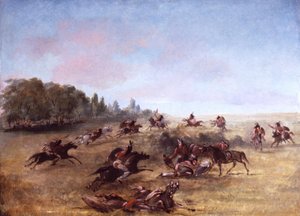
Portret George Catlin

100 najsłynniejszych obrazów artysty George Catlin, każdy niepowtarzalny

Aktualizacja: Październik 2026 · ranking według naszego wskaźnika popularności (liczba wyszukiwań, wizyt i zamówień dla każdego dzieła) · 908 dzieł George Catlin w naszym katalogu

W skrócie

Say-say-gon, Hail Storm, War Chief (1845) to obraz autorstwa George Catlin, który przyciąga najwięcej spojrzeń; oryginał znajduje się w Smithsonian American Art Museum, Waszyngton. Następnie wzrok kieruje się na La dóo ke a, Buffalo Bull, a Grand Pawnee Warrior (1832) i Sky se ró ka, Second Chief of the Tribe (1834). Spośród 908 dzieł George Catlin w naszym katalogu, tych 100 jest najbardziej znanych – każde z nich to unikatowy oryginał, przedstawiony wraz z rokiem powstania, muzeum oraz powodem, dla którego przetrwało próbę czasu.

1796 – 1872, Wilkes-Barre Romanticism Najwięcej dzieł: Smithsonian American Art Museum

10 najlepszych obrazów autorstwa George Catlin według oka galerii

1
Say-say-gon, Hail Storm, War Chief (1845) autorstwa George Catlin

Say-say-gon, Hail Storm, War Chief

1845 · Oil On Canvas · Smithsonian American Art Museum, Waszyngton

George Catlin’s arresting oil on canvas, "Say-say-gon, Hail Storm, War Chief," is far more than a mere portrait; it is a profound historical document rendered with the immediacy of a living memory. Created in 1845, this work plunges the viewer directly into the dramatic confluence of cultures at the American frontier. The subject—a Native American man adorned with feathers and bearing an air of solemn authority—commands attention through his unwavering,…

2
La dóo ke a, Buffalo Bull, a Grand Pawnee Warrior (1832) autorstwa George Catlin

La dóo ke a, Buffalo Bull, a Grand Pawnee Warrior

1832 · Oil On Canvas

To stand before George Catlin’s depiction of La dóo ke a, Buffalo Bull, a Grand Pawnee Warrior is to step across the threshold of time itself. This painting from 1832 is far more than a mere portrait; it is a profound historical document rendered with breathtaking artistic skill. Catlin, the artist who dedicated his life to chronicling cultures on the cusp of dramatic change, captured not just the likeness of…

3
Sky se ró ka, Second Chief of the Tribe (1834) autorstwa George Catlin

Sky se ró ka, Second Chief of the Tribe

1834 · Oil On Canvas · Smithsonian American Art Museum, Waszyngton

To stand before this portrait of Sky se ró ka, Second Chief of the Tribe, is to encounter not merely paint on canvas, but a profound echo from a bygone era. George Catlin’s masterful rendering captures more than just a likeness; it arrests a moment in time—a moment steeped in dignity, contemplation, and the quiet weight of history. The subject dominates the composition with an undeniable presence. His gaze, seemingly…

4
Né hee ó ee wóo tis, Wolf on the Hill, Chief of the Tribe (1832) autorstwa George Catlin

Né hee ó ee wóo tis, Wolf on the Hill, Chief of the Tribe

1832 · Oil On Canvas · Smithsonian American Art Museum, Waszyngton

This evocative portrait, dating from 1832, presents us with an arresting vision of an Indigenous man, likely hailing from the Plains tribes. The work immediately draws the viewer into a moment of profound stillness and quiet authority. George Catlin, the masterful chronicler of American frontier life, has captured more than just a likeness; he has preserved a presence. The subject is rendered in a style deeply rooted in early American…

5
Ee mat lá , King Phillip, Second Chief (1838) autorstwa George Catlin

Ee mat lá , King Phillip, Second Chief

1838 · Oil On Canvas · Smithsonian American Art Museum, Waszyngton

Before us rests a profoundly moving portrait, George Catlin’s evocative depiction of Ee mat lá , King Phillip, Second Chief. This 1838 work transcends mere representation; it is a solemn meditation on culture, resilience, and the passing of time. The subject commands attention with an undeniable dignity that seems to emanate from within the very texture of the paint. Catlin has gifted us not just a likeness, but a window…

6
Eeh nís kim, Crystal Stone, Wife of the Chief (1832) autorstwa George Catlin

Eeh nís kim, Crystal Stone, Wife of the Chief

1832 · Oil On Canvas · Smithsonian American Art Museum, Waszyngton

To stand before George Catlin’s portrait, Eeh nís kim, Crystal Stone, Wife of the Chief, is to step across the threshold of time itself. This 1832 oil painting is far more than a mere likeness; it is a profound historical document rendered with the delicate touch of an artist obsessed with preservation. Catlin, whose life spanned the collision of two worlds—the burgeoning American frontier and the ancient cultures of Native…

7
Steeh tcha kó me co, Great King (called Ben Perryman), a Chief (1834) autorstwa George Catlin

Steeh tcha kó me co, Great King (called Ben Perryman), a Chief

1834 · Oil On Canvas · Smithsonian American Art Museum, Waszyngton

To stand before George Catlin’s Steeh tcha kó me co, Great King (called Ben Perryman), a Chief is to step across the threshold of time itself. This arresting portrait, executed in 1834, is far more than a mere likeness; it is a profound historical document rendered with the passionate brushstrokes of Romanticism. Catlin, forever drawn to the edges of civilization, captured here the dignity and complex spirit of an Indigenous…

8
Cáh be múb bee, He Who Sits Everywhere, a Brave (1835) autorstwa George Catlin

Cáh be múb bee, He Who Sits Everywhere, a Brave

1835 · Oil On Canvas · Smithsonian American Art Museum, Waszyngton

To stand before George Catlin’s depiction of Cáh be múb bee, He Who Sits Everywhere, a Brave is to step across the threshold of time and into a world both vividly real and deeply mythic. Painted in 1835, this work transcends mere portraiture; it is an eloquent testament to a vanishing culture, rendered with the passionate intensity characteristic of Romanticism blended seamlessly with meticulous Realism. The central figure commands attention,…

9
Os ce o lá, The Black Drink, a Warrior of Great Distinction (1838) autorstwa George Catlin

Os ce o lá, The Black Drink, a Warrior of Great Distinction

1838 · Oil On Canvas · Smithsonian American Art Museum, Waszyngton

To stand before George Catlin’s Os ce o lá, The Black Drink, a Warrior of Great Distinction is not merely to observe a painting; it is to step across the threshold of time. This arresting portrait, executed in 1838, captures more than just the likeness of an Indigenous man, believed to be from the Shawnee tribe—it arrests the viewer with the profound weight of cultural memory. Catlin, forever positioned as…

10
Stán au pat, Bloody Hand, Chief of the Tribe (1832) autorstwa George Catlin

Stán au pat, Bloody Hand, Chief of the Tribe

1832 · Oil On Canvas · Smithsonian American Art Museum, Waszyngton

To stand before George Catlin’s portrait, Stán au pat, Bloody Hand, Chief of the Tribe, is to step across the threshold of time itself. Painted in 1832, this work transcends mere depiction; it is a profound act of witnessing. Catlin, whose life spanned the tumultuous collision between burgeoning American civilization and the ancient ways of the Native American peoples, captured more than just a likeness on canvas. He immortalized a…

Słynne obrazy artysty George Catlin, od 11 do 100

11Wa kon chásh kaw, He Who Comes on the Thunder (1828) autorstwa George CatlinWa kon chásh kaw, He Who Comes on the Thunder1828 · Smithsonian American Art Museum 12Wah chee háhs ka, Man Who Puts All Out of Doors (1835) autorstwa George CatlinWah chee háhs ka, Man Who Puts All Out of Doors1835 · Smithsonian American Art Museum 13Né-hee-ó-ee-wóo-tis, Wolf on the Hill, Chief of the Tribe (1832) autorstwa George CatlinNé-hee-ó-ee-wóo-tis, Wolf on the Hill, Chief of the Tribe1832 · Smithsonian American Art Museum 14Mún ne o ye, a Woman (1832) autorstwa George CatlinMún ne o ye, a Woman1832 · Smithsonian American Art Museum 15Mah táhp ta a, Rushes through the Middle, a Brave (1832) autorstwa George CatlinMah táhp ta a, Rushes through the Middle, a Brave1832 · Smithsonian American Art Museum 16A'h tee wát o mee, a Woman (1830) autorstwa George CatlinA'h tee wát o mee, a Woman1830 · Smithsonian American Art Museum 17Sha có pay, The Six, Chief of the Plains Ojibwa (1832) autorstwa George CatlinSha có pay, The Six, Chief of the Plains Ojibwa1832 18Chin cha pee, Fire Bug That Creeps, Wife of Pigeon's Egg Head (1832) autorstwa George CatlinChin cha pee, Fire Bug That Creeps, Wife of Pigeon's Egg Head1832 · Smithsonian American Art Museum 19A'h sha la cóots ah, Mole in the Forehead, Chief of the Republican Pawnee (1832) autorstwa George CatlinA'h sha la cóots ah, Mole in the Forehead, Chief of the Republican Pawnee1832 · Smithsonian American Art Museum 20Stu mick o súcks, Buffalo Bull's Back Fat, Head Chief, Blood Tribe (1832) autorstwa George CatlinStu mick o súcks, Buffalo Bull's Back Fat, Head Chief, Blood Tribe1832 21Du cór re a, Chief of the Tribe, and His Family (1830) autorstwa George CatlinDu cór re a, Chief of the Tribe, and His Family1830 · Smithsonian American Art Museum 22Ish a ró yeh, He Who Carries a Wolf, a Distinguished Brave (1834) autorstwa George CatlinIsh a ró yeh, He Who Carries a Wolf, a Distinguished Brave1834 · Smithsonian American Art Museum 23Mun ne pús kee, He Who Is Not Afraid Ko ha túnk a, Big Crow and Nah cóm ee shee, Man of the Bed, Three Young Warriors (1834) autorstwa George CatlinMun ne pús kee, He Who Is Not Afraid Ko ha túnk a, Big Crow and Nah cóm ee shee, Man of the Bed, Three Young Warriors1834 · Smithsonian American Art Museum 24Hidatsa Village, Earth covered Lodges, on the Knife River, 1810 Miles above St. Louis (1832) autorstwa George CatlinHidatsa Village, Earth covered Lodges, on the Knife River, 1810 Miles above St. Louis1832 · Smithsonian American Art Museum 25Two Comanche Girls (1834) autorstwa George CatlinTwo Comanche Girls1834 · Smithsonian American Art Museum 26Náh se ús kuk, Whirling Thunder, Eldest Son of Black Hawk (1832) autorstwa George CatlinNáh se ús kuk, Whirling Thunder, Eldest Son of Black Hawk1832 · Smithsonian American Art Museum 27Le sháw loo láh le hoo, Big Elk, Chief of the Skidi (Wolf) Pawnee (1832) autorstwa George CatlinLe sháw loo láh le hoo, Big Elk, Chief of the Skidi (Wolf) Pawnee1832 · Smithsonian American Art Museum 28Wash ka mon ya, Fast Dancer, a Warrior (1844) autorstwa George CatlinWash ka mon ya, Fast Dancer, a Warrior1844 · Smithsonian American Art Museum 29No ho mun ya, One Who Gives No Attention (1844) autorstwa George CatlinNo ho mun ya, One Who Gives No Attention1844 · Smithsonian American Art Museum 30Shón ka ki he ga, Horse Chief, Grand Pawnee Head Chief (1832) autorstwa George CatlinShón ka ki he ga, Horse Chief, Grand Pawnee Head Chief1832 · Smithsonian American Art Museum 31Kid á day, a Distinguished Brave (1834) autorstwa George CatlinKid á day, a Distinguished Brave1834 · Smithsonian American Art Museum 32Tchán dee, Tobacco, an Oglala Chief (1832) autorstwa George CatlinTchán dee, Tobacco, an Oglala Chief1832 · Smithsonian American Art Museum 33Tóh to wah kón da pee, Blue Medicine, a Medicine Man of the Ting ta to ah Band (1835) autorstwa George CatlinTóh to wah kón da pee, Blue Medicine, a Medicine Man of the Ting ta to ah Band1835 · Smithsonian American Art Museum 34Hee láh dee, Pure Fountain, Wife of The Smoke (1832) autorstwa George CatlinHee láh dee, Pure Fountain, Wife of The Smoke1832 · Smithsonian American Art Museum 35Lay láw she kaw, Goes Up the River, an Aged Chief (1830) autorstwa George CatlinLay láw she kaw, Goes Up the River, an Aged Chief1830 · Smithsonian American Art Museum 36Wá nah de túnk ah, Big Eagle (or Black Dog), Chief of the O hah kas ka toh y an te Band (1835) autorstwa George CatlinWá nah de túnk ah, Big Eagle (or Black Dog), Chief of the O hah kas ka toh y an te Band1835 · Smithsonian American Art Museum 37Shon ta yi ga, Little Wolf, a Famous Warrior (1844) autorstwa George CatlinShon ta yi ga, Little Wolf, a Famous Warrior1844 · Smithsonian American Art Museum 38Big Bend on the Upper Missouri, 1900 Miles above St. Louis (1832) autorstwa George CatlinBig Bend on the Upper Missouri, 1900 Miles above St. Louis1832 · Smithsonian American Art Museum 39Battle Between Sioux and Sac and Fox (1848) autorstwa George CatlinBattle Between Sioux and Sac and Fox1848 · Smithsonian American Art Museum 40H'co a h'co a h'cotes min, No Horns on His Head, a Brave (1832) autorstwa George CatlinH'co a h'co a h'cotes min, No Horns on His Head, a Brave1832 · Smithsonian American Art Museum 41Eé shah kó nee, Bow and Quiver, First Chief of the Tribe (1834) autorstwa George CatlinEé shah kó nee, Bow and Quiver, First Chief of the Tribe1834 · Smithsonian American Art Museum 42Fort Pierre, Mouth of the Teton River, 1200 Miles above Saint Louis (1832) autorstwa George CatlinFort Pierre, Mouth of the Teton River, 1200 Miles above Saint Louis1832 · Smithsonian American Art Museum 43Lay lóo ah pee ái shee kaw, Grass, Bush, and Blossom, Semicivilized (1830) autorstwa George CatlinLay lóo ah pee ái shee kaw, Grass, Bush, and Blossom, Semicivilized1830 · Smithsonian American Art Museum 44Mah kée mee teuv, Grizzly Bear, Chief of the Tribe (1831) autorstwa George CatlinMah kée mee teuv, Grizzly Bear, Chief of the Tribe1831 · Smithsonian American Art Museum 45Ha na tá nu maúk, Wolf Chief, Head Chief of the Tribe (1832) autorstwa George CatlinHa na tá nu maúk, Wolf Chief, Head Chief of the Tribe1832 · Smithsonian American Art Museum 46Prairie Bluffs Burning (1832) autorstwa George CatlinPrairie Bluffs Burning1832 · Smithsonian American Art Museum 47Hard Hickory, an Amiable Man (1831) autorstwa George CatlinHard Hickory, an Amiable Man1831 · Smithsonian American Art Museum 48Bread, Chief of the Tribe (1831) autorstwa George CatlinBread, Chief of the Tribe1831 · Smithsonian American Art Museum 49On sáw kie, The Sauk, in the Act of Praying (1830) autorstwa George CatlinOn sáw kie, The Sauk, in the Act of Praying1830 · Smithsonian American Art Museum 50Ye hów lo gee, The Cloud, a Chief (1838) autorstwa George CatlinYe hów lo gee, The Cloud, a Chief1838 · Smithsonian American Art Museum 51Wá hón ga shee, No Fool, a Great Fop (1832) autorstwa George CatlinWá hón ga shee, No Fool, a Great Fop1832 · Smithsonian American Art Museum 52Máh to tóh pa, Four Bears, Second Chief in Mourning (1832) autorstwa George CatlinMáh to tóh pa, Four Bears, Second Chief in Mourning1832 · Smithsonian American Art Museum 53Oó je en á he a, Woman Who Lives in a Bear's Den (1832) autorstwa George CatlinOó je en á he a, Woman Who Lives in a Bear's Den1832 54W'y ee yogh, Man of Sense, a Brave (1832) autorstwa George CatlinW'y ee yogh, Man of Sense, a Brave1832 · Smithsonian American Art Museum 55Is sa wáh tám ah, Wolf Tied with Hair, a Chief (1834) autorstwa George CatlinIs sa wáh tám ah, Wolf Tied with Hair, a Chief1834 · Smithsonian American Art Museum 56Ru ton ye wee ma, Strutting Pigeon, Wife of White Cloud (1844) autorstwa George CatlinRu ton ye wee ma, Strutting Pigeon, Wife of White Cloud1844 · Smithsonian American Art Museum 57Meach o shín gaw, Little White Bear, a Distinguished Brave (1832) autorstwa George CatlinMeach o shín gaw, Little White Bear, a Distinguished Brave1832 · Smithsonian American Art Museum 58Mandan Dance (also known as The Last Race, Mandan O-kee-pa Ceremony) (1832) autorstwa George CatlinMandan Dance (also known as The Last Race, Mandan O-kee-pa Ceremony)1832 59Tul lock chísh ko, Drinks the Juice of the Stone, in Ball player's Dress (1834) autorstwa George CatlinTul lock chísh ko, Drinks the Juice of the Stone, in Ball player's Dress1834 · Smithsonian American Art Museum 60Há-tchoo-túc-knee, Snapping Turtle, a Half-breed (1834) autorstwa George CatlinHá-tchoo-túc-knee, Snapping Turtle, a Half-breed1834 · Smithsonian American Art Museum 61White Sand Bluffs, on Santa Rosa Island, Near Pensacola (1835) autorstwa George CatlinWhite Sand Bluffs, on Santa Rosa Island, Near Pensacola1835 62Little Wolf (Shon-ta-ye-ga) (1846) autorstwa George CatlinLittle Wolf (Shon-ta-ye-ga)1846 63La-dóo-ke-a, Buffalo Bull, a Grand Pawnee Warrior (1832) autorstwa George CatlinLa-dóo-ke-a, Buffalo Bull, a Grand Pawnee Warrior1832 · Smithsonian American Art Museum 64Hón-je-a-pút-o, Wife of Bear-catcher (1832) autorstwa George CatlinHón-je-a-pút-o, Wife of Bear-catcher1832 · Smithsonian American Art Museum 65Tuch-ee, A Celebrated War Chief of the Cherokees (1834) autorstwa George CatlinTuch-ee, A Celebrated War Chief of the Cherokees1834 · Virginia Museum of Fine Arts 66Múk-a-tah-mish-o-káh-kaik, Black Hawk, Prominent Sac Chief (1832) autorstwa George CatlinMúk-a-tah-mish-o-káh-kaik, Black Hawk, Prominent Sac Chief1832 · Smithsonian American Art Museum 67The White Cloud, Head Chief of the Iowas (1844) autorstwa George CatlinThe White Cloud, Head Chief of the Iowas1844 · National Gallery of Art 68Bird (1839) autorstwa George CatlinBird1839 · Smithsonian American Art Museum 69Háw che ke súg ga, He Who Kills the Osages, Chief of the Tribe (1832) autorstwa George CatlinHáw che ke súg ga, He Who Kills the Osages, Chief of the Tribe1832 · Smithsonian American Art Museum 70Mó-sho-la-túb-bee, He Who Puts Out and Kills, Chief of the Tribe (1834) autorstwa George CatlinMó-sho-la-túb-bee, He Who Puts Out and Kills, Chief of the Tribe1834 · Smithsonian American Art Museum 71Portrait of a Gentleman (1827) autorstwa George CatlinPortrait of a Gentleman1827 · Metropolitan Museum of Art 72Boy Chief - Ojibbeway (1843) autorstwa George CatlinBoy Chief - Ojibbeway1843 · National Gallery of Art 73Mounted War Party Scouring a Thicket (1848) autorstwa George CatlinMounted War Party Scouring a Thicket1848 · Smithsonian American Art Museum 74See-non-ty-a, an Iowa Medicine Man (1844) autorstwa George CatlinSee-non-ty-a, an Iowa Medicine Man1844 · National Gallery of Art 75The Cheyenne Brothers Starting on Their Fall Hunt (1861) autorstwa George CatlinThe Cheyenne Brothers Starting on Their Fall Hunt1861 · National Gallery of Art 76Tul lock chísh ko, Drinks the Juice of the Stone (1834) autorstwa George CatlinTul lock chísh ko, Drinks the Juice of the Stone1834 · Smithsonian American Art Museum 77Wah pón jee a, The Swan, a Warrior (1830) autorstwa George CatlinWah pón jee a, The Swan, a Warrior1830 · Smithsonian American Art Museum 78Nóm ba mon nee, Double Walker, a Brave (1832) autorstwa George CatlinNóm ba mon nee, Double Walker, a Brave1832 · Smithsonian American Art Museum 79Naugh háigh hee kaw, He Who Moistens the Wood (1828) autorstwa George CatlinNaugh háigh hee kaw, He Who Moistens the Wood1828 · Smithsonian American Art Museum 80Turtle Hunt (1869) autorstwa George CatlinTurtle Hunt1869 81Ru-ton-wee-me, Pigeon on the Wing (1844) autorstwa George CatlinRu-ton-wee-me, Pigeon on the Wing1844 · Smithsonian American Art Museum 82William Clark (1832) autorstwa George CatlinWilliam Clark1832 · National Portrait Gallery 83Peh-tó-pe-kiss, Eagle's Ribs, a Piegan Chief (1832) autorstwa George CatlinPeh-tó-pe-kiss, Eagle's Ribs, a Piegan Chief1832 · Smithsonian American Art Museum 84Canoe Race Near Sault Ste. Marie (1837) autorstwa George CatlinCanoe Race Near Sault Ste. Marie1837 · Smithsonian American Art Museum 85Elk and Buffalo Grazing among Prairie Flowers, Texas (1848) autorstwa George CatlinElk and Buffalo Grazing among Prairie Flowers, Texas1848 · Smithsonian American Art Museum 86Túnk aht óh ye, Thunderer, a Boy, and Wun pán to mee, White Weasel, a Girl (1834) autorstwa George CatlinTúnk aht óh ye, Thunderer, a Boy, and Wun pán to mee, White Weasel, a Girl1834 · Smithsonian American Art Museum 87An Old Nayas Indian, His Granddaughter, and a Boy (1875) autorstwa George CatlinAn Old Nayas Indian, His Granddaughter, and a Boy1875 · National Gallery of Art 88Mrs. George Catlin (Clara Bartlet Gregory) (1830) autorstwa George CatlinMrs. George Catlin (Clara Bartlet Gregory)1830 · Metropolitan Museum of Art 89Theodore Burr Catlin, in Indian Costume (1840) autorstwa George CatlinTheodore Burr Catlin, in Indian Costume1840 · Smithsonian American Art Museum 90Háh nee, The Beaver, a Warrior (1834) autorstwa George CatlinHáh nee, The Beaver, a Warrior1834 · Smithsonian American Art Museum 91Pash ee pa hó, Little Stabbing Chief, the Younger, One of Black Hawk's Braves (1832) autorstwa George CatlinPash ee pa hó, Little Stabbing Chief, the Younger, One of Black Hawk's Braves1832 · Smithsonian American Art Museum 92Kotz a tó ah, Smoked Shield, a Distinguished Warrior (1834) autorstwa George CatlinKotz a tó ah, Smoked Shield, a Distinguished Warrior1834 · Smithsonian American Art Museum 93Eé hee a duck cée a, He Who Ties His Hair Before (1832) autorstwa George CatlinEé hee a duck cée a, He Who Ties His Hair Before1832 · Smithsonian American Art Museum 94Three Blackfoot Men (1862) autorstwa George CatlinThree Blackfoot Men1862 · National Gallery of Art 95Pash ee pa hó, Little Stabbing Chief, a Venerable Sauk Chief (1835) autorstwa George CatlinPash ee pa hó, Little Stabbing Chief, a Venerable Sauk Chief1835 · Smithsonian American Art Museum 96View on the Missouri, Alluvial Banks Falling in, 600 Miles above St. Louis (1832) autorstwa George CatlinView on the Missouri, Alluvial Banks Falling in, 600 Miles above St. Louis1832 · Smithsonian American Art Museum 97Two Apachee Warriors and a Woman (1862) autorstwa George CatlinTwo Apachee Warriors and a Woman1862 · National Gallery of Art 98Camanchees Lancing a Buffalo Bull (1865) autorstwa George CatlinCamanchees Lancing a Buffalo Bull1865 · National Gallery of Art 99Lengua Indians Ascending the Rapids of the Rio Uruguay (1861) autorstwa George CatlinLengua Indians Ascending the Rapids of the Rio Uruguay1861 · National Gallery of Art 100Mauhees Encampment (1869) autorstwa George CatlinMauhees Encampment1869 · National Gallery of Art

Słynne obrazy George Catlin epoka po epoce

Tematy, które przyciągnęły wzrok George Catlin

Cztery motywy najczęściej powracające w tych oryginałach, z których każdy doczekał się swojego najdoskonalszego przykładu.

Muzea przechowujące oryginały George Catlin

5 muzeów, w których znajduje się najwięcej obrazów z tej strony.

Muzeum Miasto Dzieła artysty George Catlin Obrazy z tej listy
Smithsonian American Art Museum, WaszyngtonSmithsonian American Art Museum Waszyngton 479 Say-say-gon, Hail Storm, War Chief, Sky se ró ka, Second Chief of the Tribe, Né hee ó ee wóo tis, Wolf on the Hill, Chief of the Tribe
National Gallery of Art, WaszyngtonNational Gallery of Art Waszyngton 345 The White Cloud, Head Chief of the Iowas, Boy Chief - Ojibbeway, See-non-ty-a, an Iowa Medicine Man
Metropolitan Museum of Art, Nowy JorkMetropolitan Museum of Art Nowy Jork 4 Portrait of a Gentleman, Mrs. George Catlin (Clara Bartlet Gregory)
Virginia Museum of Fine Arts, RichmondVirginia Museum of Fine Arts Richmond 1 Tuch-ee, A Celebrated War Chief of the Cherokees
National Portrait Gallery, WaszyngtonNational Portrait Gallery Waszyngton 1 William Clark

George Catlin na przestrzeni dekad: jeden unikatowy oryginał dla każdego

Dzieła według dekad

Wybierz dekadę, aby zobaczyć dzieło, które ją definiuje.

Obrazy artysty George Catlin: pytania do galerii

Jakie jest najsłynniejsze dzieło artysty George Catlin?Odkryj odpowiedź

Say-say-gon, Hail Storm, War Chief (1845), Smithsonian American Art Museum, Waszyngton. Następne są La dóo ke a, Buffalo Bull, a Grand Pawnee Warrior (1832) oraz Sky se ró ka, Second Chief of the Tribe (1834).

W jakim wieku George Catlin stworzył/a Say-say-gon, Hail Storm, War Chief?Odkryj odpowiedź

49 lat: Say-say-gon, Hail Storm, War Chief pochodzi z 1845, a George Catlin urodził(a) się w 1796.

Które dziesięć obrazów George Catlin jest najbardziej znanych?Odkryj odpowiedź

Say-say-gon, Hail Storm, War Chief, La dóo ke a, Buffalo Bull, a Grand Pawnee Warrior, Sky se ró ka, Second Chief of the Tribe, Né hee ó ee wóo tis, Wolf on the Hill, Chief of the Tribe, Ee mat lá , King Phillip, Second Chief, Eeh nís kim, Crystal Stone, Wife of the Chief, Steeh tcha kó me co, Great King (called Ben Perryman), a Chief, Cáh be múb bee, He Who Sits Everywhere, a Brave, Os ce o lá, The Black Drink, a Warrior of Great Distinction i Stán au pat, Bloody Hand, Chief of the Tribe. Powyższy ranking zawiera rok powstania oraz muzeum dla każdego z nich.

Ile znanych dzieł stworzył George Catlin?Odkryj odpowiedź

Nasz katalog zawiera 908 dzieł artysty George Catlin, datowanych od 1827 do 1869.

Gdzie można zobaczyć najsłynniejsze oryginały George Catlin?Odkryj odpowiedź

W większości znajdują się w Smithsonian American Art Museum (Waszyngton), National Gallery of Art (Waszyngton) i Metropolitan Museum of Art (Nowy Jork). Powyższa tabela muzeów zawiera ich pełną listę.

W jakim okresie George Catlin stworzył/a swoje najsłynniejsze obrazy?Odkryj odpowiedź

W 1830s: 75 z 100 dzieł na tej stronie powstało w tym czasie, w tym La dóo ke a, Buffalo Bull, a Grand Pawnee Warrior.

Który z najsłynniejszych obrazów artysty George Catlin powstał najwcześniej, a który najpóźniej?Odkryj odpowiedź

Na tej stronie najwcześniejszy to Portrait of a Gentleman (1827), a najpóźniejszy Turtle Hunt (1869).

Jakie tematy preferował George Catlin?Odkryj odpowiedź

Native american (60), Indigenous culture (29) i Portrait (28), w ramach 100 dzieł na tej stronie.

Jakich materiałów George Catlin używał najczęściej?Odkryj odpowiedź

Oil On Canvas, dla 69 z 100 dzieł na tej stronie.

Do jakiego nurtu należy twórczość George Catlin?Odkryj odpowiedź

Romanticism, sądząc po oryginałach na tej stronie.

Jakie oryginały George Catlin można zobaczyć w Smithsonian American Art Museum?Odkryj odpowiedź

Say-say-gon, Hail Storm, War Chief, Sky se ró ka, Second Chief of the Tribe i Né hee ó ee wóo tis, Wolf on the Hill, Chief of the Tribe: Smithsonian American Art Museum, Waszyngton posiada 78 dzieł widocznych na tej stronie.

Gdzie mogę zamówić ręcznie malowaną reprodukcję George Catlin?Odkryj odpowiedź

Tak, jako reprodukcja: oryginał pozostaje w muzeum, ale każdy obraz na tej stronie może zostać namalowany ręcznie specjalnie dla Ciebie, na zamówienie, z poziomu strony danego dzieła.

George Catlin: portret artysty

Wczesne lata i wykształcenie prawnicze

George Catlin przyszedł na świat w 1796 roku w Wilkes-Barre w Pensylwanii jako piąte z czternauciga dzieci. Jego wczesne otoczenie zostało ukształtowane przez surową rzeczywistość amerykańskiego pogranicza, a w szczególności przez opowieści jego matki, Polly Sutton. Przeżyła ona niewolę po ataku Indian, co stało się dla syna źródłem nieustannego, niemal fizycznego połączenia z rdzennymi kulturami, które w przyszłości miał dokumentować. Ta osobista historia zakotwiczyła jego zainteresowanie Dzikim Zachodem na długo przed tym, zanim po raz pierwszy chwycił za pędzel w celach zawodowych.

Jego ścieżka życiowa wcale nie była początkowo skierowana ku płótnu. W wieku 17 lat rozpoczął naukę w Litchfield Law School, przygotowując się do kariery prawniczej – był to kierunek narzucony mu przez rodziców. Ostatecznie zdobył status zawodowy, zostając przyjętym na listę adwokacką w 1819 roku. Jednakże profesja prawnika nie potrafiła przykuć jego uwagi. Prawo praktykował zaledwie przez dwa lata, uznając salę sądową za marny substytut swoich prawdziwych pasji. W momencie, gdy porzucił prawnicze księgi, impuls do studiowania sztuki i podróżowania stał się już jego głównym życiowym motorem.

Wyprawy i Galeria Indian

Twórczość Catlina czerpie swoją niezwykłą siłę z ogromnej skali jego wędrówek przez Dziki Zachód. W latach 30. XIX wieku wyruszył on w pięć wielkich wypraw, żeglując wzdłuż rzeki Missouri, by dotrzeć do terytoriów plemion Mandan, Sioux, Blackfeet oraz Choctaw. Nie były to jednak zwykłe wycieczki krajoznawcze. Artysta przemierzał te nieznane ziemie z misją dokumentowania konkretnych, żyjących kultur, gromadząc zarówno płótna, jak i fizyczne artefakty. Ta potężna akumulacja wizualnych i materialnych świadectw stała się fundamentem jego słynnej Galerii Indian – kolekcji liczącej ponad 500 obrazów.

To właśnie skala tego zbioru nadaje jego dorobkowi tak wielkie znaczenie historyczne. Catlin nie malował jedynie z pamięci; on systematycznie gromadził owoce swoich podróży w jedną, monumentalną całość. Ten ambitny wysiłek, mający na celu stworzenie kompleksowej kroniki pogranicza, został później rozszerzony o wyprawy przez Amerykę Południową i Środkową, które odbył w latach 1852–1857. Jego uwaga niezmiennie skupiała się na etnograficznej rzeczywistości napotkanych ludów, przedkładając dokumentację ich obyczajów i wyglądu nad czysto pejzażowe ujęcia natury.

Styl artystyczny i dokumentacja

Podejście George'a Catlina było podyktowane szczególną, palącą potrzebą: dokumentacją stylu życia, który – w jego przekonaniu – nieuchronnie odchodził w zapomnienie. Artysta nie zadowalał się tanią karykaturą ani powierzchownymi stereotypami, tak powszechnymi w XIX wieku. Zamiast tego skupiał się na jednostce, starając się uchwycić godność wodzów plemiennych oraz kinetyczną energię tętniącą podczas tradycyjnych ceremonii. Jego warsztat opierał się na dbałości o najdrobniejszy szczegół, co pozwalało na utrwalenie tekstur ceremonialnych regaliów i niuansów codzienności z niemal etnograficzną precyzją. Była to świadoma próba ocalenia esencji tych kultur, zanim ekspansja na zachód nieodwracalnie je zmieniła.

Wizualna siła jego dzieł opiera się na bogatej palecie barw oraz niezwykle szczegółowym kontekście środowiskowym. Rzadko malował postacie w izolacji; zamiast tego osadzał je w misternie dopracowanych tła, które dostarczały niezbędnych informacji o sytuacji i miejscu akcji. Te scenerie często obejmowały konkretne krajobrazy, tipi czy przedmioty rytualne, które mocno osadzały jego bohaterów w ich rzeczywistym otoczeniu. Włączając te elementy, Catlin wyszedł poza ramy zwykłego portretu, tworząc kompleksową wizualną kronikę amerykańskiego pogranicza. Jego zdolność do oddawania atmosfery sceny – od pyłu unoszącego się nad prerią po strukturę obozowiska – przekształciła jego obrazy w bezcenne świadectwo historyczne, a nie tylko estetyczne ćwiczenia malarskie.

  • Mó-sho-la-túb-bee, He Who Puts Out and Kills, Chief of the Tribe (1834)
  • Ball-play of the Choctaw--Ball Up (1850)

Kluczowe dzieła i wybitne obrazy

Twórczość George'a Catlina funkcjonuje jako wizualny zapis konkretnych, autentycznych chwil, wykraczając daleko poza ramy zwykłego portretu. Jego dzieło z 1834 roku, Mó-sho-la-túb-bee, He Who Puts Out and Kills, Chief of the Tribe, ukazuje wodza o niezłomnym spojrzeniu, który emanuje autorytetem poprzez swoją bezpośrednią, pozbawioną zbędnych ozdobników obecność. Podobnie Ball-play of the Choctaw odchodzi od statycznej pozy, aby udokumentować kinetyczną energię tradycyjnej gry. Te prace dostarczają drobiazgowych szczegółów, które są niezbędne do zrozumienia struktur społecznych i wspólnotowych aktywności plemiennych.

Artysta skupiał się również na nierozerwalnym związku człowieka z jego środowiskiem. Obraz Prairie Meadows Burning rejestruje kontrolowane wypalanie traw przy udziale towarzyszących jeźdźców, uchwycając specyficzną praktykę ekologiczną i społeczną. Jego przedstawienie Pipestone Quarry, Coteau Des Prairies wskazuje na miejsce o głębokim znaczeniu duchowym dla wielu plemion. Nawet jego bardziej intymne lub nietypowe tematy niosą ze sobą ogromny ładunek znaczeniowy; Oó-je-en-á-he-a, Woman Who Lives in a Bear, namalowany około 1832 roku, oferuje wgląd w konkretną narrację kulturową, podczas gdy Little Wolf (Shon-ta-ye-ga), wykonany w 1846 roku, pozostaje istotnym elementem jego późniejszej dokumentacji.

  • Mó-sho-la-túb-bee, He Who Puts Out and Kills, Chief of the Tribe (1834)
  • Little Wolf (Shon-ta-ye-ga) (1846)

Publikacje i podróże wystawiennicze

Dążenia George'a Catlina do zapewnienia swojej Galerii Indian stałego miejsca w historii wymagały czegoś więcej niż tylko wizualnych dowodów; wymagały one obecności w świadomości publicznej. W latach 40. i 50. XIX wieku artysta wyruszył w trasę, prezentując swoją kolekcję w najważniejszych europejskich metropoliach, takich jak Londyn, Paryż czy Berlin. Wystawy te nie były jednak jedynie pasywnymi ekspozycjami dzieł sztuki. Catlin towarzyszył swoim obrazom publicznymi wykładami, wykorzystując osobiste wspomnienia z życia wśród Indian Ameryki, aby nadać obrazom żywy, słowny kontekst. To połączenie wzroku i słowa było przemyślaną próbą przybliżenia surowej rzeczywistości pogranicza widzom, których dzieliły od dorzecza Missouri niezmierzone odległości.

Jego twórczość literacka stanowiła intelektualny fundament dla dokumentacji wizualnej. W 1841 roku wydał Manners, Customs, and Condition of the North American Indians, tekst, który stanowił próbę skodyfikowania obserwacji zebranych podczas licznych wypraw. Później, w 1868 roku, ukazało się dzieło Last Rambles amongst the Indians of the Rocky Mountains and the Andes. Publikacje te nie były zwykłymi relacjami z podróży; stanowiły one desperacką próbę utrwalenia konkretnego, zanikającego porządku społecznego w formie trwałego zapisu historycznego. Catlin posługiwał się słowem pisanym, aby wzmocnić autentyczność swoich płócien, dbając o to, by jego spostrzeżenia przetrwały nawet wtedy, gdy jego własna sytuacja finansowa okazywała się niepewna.

Późne lata i śmierć

Ostatnie dekady życia George Catlin zdominowała niepewność finansowa. Mimo ogromnych starań, by zapewnić swojej kolekcji trwałe, narodowe dziedzictwo, artysta spędził znaczną część późnej twórczości, próbując odzyskać zainwestowane środki. W pragmatycznym dążeniu do odzyskania funduszy, stworzył on ponad 400 mniejszych wersji swoich dzieł, tworząc tzw. „kolekcję szkicową”. Był to przemyślany ruch mający na celu monetyzację dorobku całego życia, jednak nie przyniósł on oczekiwanej stabilizacji, której tak bardzo potrzebował.

Walka o płynność finansową trwała aż do jego ostatnich chwil. George Catlin zmarł 23 grudnia 1872 roku w Jersey City w stanie New Jersey. Został pochowany na cmentarzu Green-Wood w Brooklynie. Jego odejście stanowiło symboliczny koniec życia poświęconego dokumentowaniu pogranicza, które – zgodnie z jego własnymi przewidywaniami – było nieubłaganie zastępowane przez postępującą ekspansję.

Dziedzictwo i znaczenie historyczne

Znaczenie George Catlin sprowadza się do jego roli jako kluczowego źródła wizualnego. Był pierwszym białym człowiekiem, który przedstawił Indianie Wielkich Równin na ich rodzimych terenach, dostarczając bezpośredniego zapisu życia sprzed pełnego uderzenia ekspansji na zachód. Jego obrazy oferują wgląd w kultury, które w głównych nurtach narracji XIX wieku były często błędnie przedstawiane lub całkowicie ignorowane. Zamiast polegać na relacjach osób trzecich, jego twórczość oddaje specyfikę plemiennych obyczajów i struktur społecznych poprzez bezpośrednią obserwację.

Historyczna wartość jego dorobku jest namacalna. Dokumentacja ta dostarcza wglądu w wierzenia religijne i tradycje ceremonialne, które w przeciwnym razie mogłyby zostać zapomniane przez historię. Ta archiwalna jakość przyniosła mu uznanie w późniejszych latach. Został wprowadzony do National Rivers Hall of Fame w 2001 roku oraz do Luzerne County Arts & Entertainment Hall of Fame w 2023 roku. Wyróżnienia te potwierdzają wagę jego wkładu w amerykańskie zasoby historyczne i kulturowe.

Gdzie dziś można podziwiać te dzieła

Wizualny zapis stworzony przez George Catlin nie znajduje się w jednym miejscu; jego dorobek jest rozproszony po kilku najważniejszych instytucjach, co sprawia, że kompleksowe studiowanie jego twórczości wymaga wizyty w konkretnych kolekcjach. Największe skupisko jego prac znajduje się w Waszyngtonie. Smithsonian American Art Museum przechowuje aż 25 jego obrazów, oferując najbardziej obszerne spojrzenie na jego etnograficzną dokumentację. W pobliżu, National Gallery of Art w Waszyngtonie również posiada w swoich zbiorach jedno z jego dzieł.

Poza stolicą, ślad jego obecności odnajdziemy w innych muzeach regionalnych, które przechowują pojedyncze egzemplarze. Denver Art Museum posiada jedno dzieło, podczas gdy Virginia Museum of Fine Arts w Richmond skrywa kolejne. To rozproszenie zbiorów odzwierciedla fragmentaryczny charakter jego oryginalnej Indian Gallery oraz trudności, z jakimi mierzył się za życia, próbując zapewnić swojej kolekcji jedno, stałe miejsce przeznaczenia.

Wszystkie 908 dzieła artysty George Catlin →