Portret Franz Kline

53 najsłynniejszych obrazów artysty Franz Kline, każdy niepowtarzalny

Aktualizacja: Październik 2026 · ranking według naszego wskaźnika popularności (liczba wyszukiwań, wizyt i zamówień dla każdego dzieła) · 53 dzieł Franz Kline w naszym katalogu

W skrócie

Mahoning (1956) to obraz autorstwa Franz Kline, który przyciąga najwięcej spojrzeń; oryginał znajduje się w Whitney Museum of American Art, Nowy Jork. Następnie wzrok kieruje się na Czarny, Biały i Szary (1959) i Untitled (1959). Spośród 53 dzieł Franz Kline w naszym katalogu, tych 53 jest najbardziej znanych – każde z nich to unikatowy oryginał, przedstawiony wraz z rokiem powstania, muzeum oraz powodem, dla którego przetrwało próbę czasu.

1910 – 1962, Wilkes-Barre Abstract expressionism Najwięcej dzieł: Smithsonian American Art Museum

10 najlepszych obrazów autorstwa Franz Kline według oka galerii

1
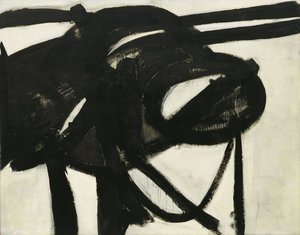
Mahoning (1956) autorstwa Franz Kline

Mahoning

1956 · Oil On Canvas · Whitney Museum of American Art, Nowy Jork

In the pantheon of Abstract Expressionism, few works command the room with such visceral authority as Franz Kline’s “Mahoning,” completed in 1956. To stand before this monumental canvas is to witness a profound dialogue between presence and absence, a struggle captured in the rhythmic collision of black enamel and stark white space. This is not merely a painting; it is an event. As a cornerstone of the New York School,…

3
Untitled (1959) autorstwa Franz Kline

Untitled

1959 · Oil · Smithsonian American Art Museum, Waszyngton

The canvas titled Untitled emerges from the hands of Franz Kline, a presence that commands the space it occupies. Created in 1959, this work exists as a significant expression of the Abstract Expressionism movement. It carries the weight of a specific moment in time, capturing a sense of raw, unmediated energy that defines the era. The piece arrives not as a window into a landscape, but as a direct encounter…

5
Zinc Yellow (1959) autorstwa Franz Kline

Zinc Yellow

1959 · Oil On Canvas · Chrysler Museum of Art, Norfolk

In the pantheon of Abstract Expressionism, few works command the immediate, visceral attention of a room quite like Franz Kline’s Zinc Yellow. Completed in 1959, this monumental canvas serves as a breathtaking masterclass in reductive abstraction, where the boundaries between color and form dissolve into a singular, energetic event. At first glance, the viewer is met with an expansive, luminous field of yellow that seems to vibrate against the stark,…

6
Nie nazwany (1956) autorstwa Franz Kline

Nie nazwany

1956 · Akryl na płótnie

Reprodukcja obrazu „Niepodpisana” przez WahooArt.com oferuje doskonałą okazję do poznania dzieła jednego z największych twórców XX wieku oraz umieszczenia wyjątkowego elementu historii sztuki w swoim wnętrzu.

7
Untitled (1959) autorstwa Franz Kline

Untitled

1959 · Black and White Photography · Metropolitan Museum of Art, Nowy Jork

This monochromatic photograph, dated 1959, captures a candid scene within a dense, wooded environment. The upper two-thirds of the frame are occupied by a heavy canopy of trees and foliage, creating a sense of enclosure through layered, organic lines. Natural daylight filters through the leaves, producing sharp highlights on certain surfaces while casting deep, dark shadows across the background. In the midground, several figures are positioned within a clearing. To…

Słynne obrazy artysty Franz Kline, od 11 do 53

Tematy, które przyciągnęły wzrok Franz Kline

Cztery motywy najczęściej powracające w tych oryginałach, z których każdy doczekał się swojego najdoskonalszego przykładu.

Muzea przechowujące oryginały Franz Kline

8 muzeów, w których znajduje się najwięcej obrazów z tej strony.

Muzeum Miasto Dzieła artysty Franz Kline Obrazy z tej listy
Smithsonian American Art Museum, WaszyngtonSmithsonian American Art Museum Waszyngton 5 Untitled, Palmerton, Pa., Untitled
Museum of Fine Arts, BostonMuseum of Fine Arts Boston 3 Black on Green, Red, and Yellow, Gray Abstraction, Probst I
Metropolitan Museum of Art, Nowy JorkMetropolitan Museum of Art Nowy Jork 2 Czarny, Biały i Szary, Untitled
Worcester Art Museum, WorcesterWorcester Art Museum Worcester 2 Untitled, Untitled
Whitney Museum of American Art, Nowy JorkWhitney Museum of American Art Nowy Jork 1 Mahoning
Albright-Knox Art Gallery, Nowy JorkAlbright-Knox Art Gallery Nowy Jork 1 New York, N.Y.
Chrysler Museum of Art, NorfolkChrysler Museum of Art Norfolk 1 Zinc Yellow
Cleveland Museum of Art, ClevelandCleveland Museum of Art Cleveland 1 Accent Grave

Franz Kline na przestrzeni dekad: jeden unikatowy oryginał dla każdego

Dzieła według dekad

Wybierz dekadę, aby zobaczyć dzieło, które ją definiuje.

Obrazy artysty Franz Kline: pytania do galerii

Jakie jest najsłynniejsze dzieło artysty Franz Kline?Odkryj odpowiedź

Mahoning (1956), Whitney Museum of American Art, Nowy Jork. Następne są Czarny, Biały i Szary (1959) oraz Untitled (1959).

W jakim wieku Franz Kline stworzył/a Mahoning?Odkryj odpowiedź

46 lat: Mahoning pochodzi z 1956, a Franz Kline urodził(a) się w 1910.

Które dziesięć obrazów Franz Kline jest najbardziej znanych?Odkryj odpowiedź

Mahoning, Czarny, Biały i Szary, Untitled, New York, N.Y., Zinc Yellow, Nie nazwany, Untitled, Study for "Flanders", Untitled i Frederick Blumenstein. Powyższy ranking zawiera rok powstania oraz muzeum dla każdego z nich.

Ile znanych dzieł stworzył Franz Kline?Odkryj odpowiedź

Nasz katalog zawiera 53 dzieł artysty Franz Kline, datowanych od 1938 do 1961.

Gdzie można zobaczyć najsłynniejsze oryginały Franz Kline?Odkryj odpowiedź

W większości znajdują się w Smithsonian American Art Museum (Waszyngton), Museum of Fine Arts (Boston) i Metropolitan Museum of Art (Nowy Jork). Powyższa tabela muzeów zawiera ich pełną listę.

W jakim okresie Franz Kline stworzył/a swoje najsłynniejsze obrazy?Odkryj odpowiedź

W 1940s: 18 z 53 dzieł na tej stronie powstało w tym czasie, w tym Frederick Blumenstein.

Który z najsłynniejszych obrazów artysty Franz Kline powstał najwcześniej, a który najpóźniej?Odkryj odpowiedź

Na tej stronie najwcześniejszy to Circus Scene (1938), a najpóźniejszy Study for "Flanders" (1961).

Jakie tematy preferował Franz Kline?Odkryj odpowiedź

Black and white (4), Geometric forms (4) i Black and white art (4), w ramach 53 dzieł na tej stronie.

Jakich materiałów Franz Kline używał najczęściej?Odkryj odpowiedź

Oil On Canvas, dla 3 z 53 dzieł na tej stronie.

Do jakiego nurtu należy twórczość Franz Kline?Odkryj odpowiedź

Abstract expressionism, sądząc po oryginałach na tej stronie.

Jakie oryginały Franz Kline można zobaczyć w Smithsonian American Art Museum?Odkryj odpowiedź

Untitled, Palmerton, Pa. i Untitled: Smithsonian American Art Museum, Waszyngton posiada 5 dzieł widocznych na tej stronie.

Franz Kline: portret artysty

Franz Kline: Pioneer of Abstract Expressionism

Franz Kline, a pivotal figure in the Abstract Expressionist movement, remains an artist whose work resonates with raw power and emotional depth. Born in Wilkes-Barre, Pennsylvania, in 1910, his life was marked by early hardship – the suicide of his father when he was just seven years old cast a long shadow, influencing a sensibility that would later find expression in the stark contrasts defining his art. This formative experience led to a nomadic youth and eventual enrollment at Girard College, a Philadelphia boarding school for boys who had lost their fathers. It was here, amidst structured discipline, that Kline’s artistic inclinations began to surface, nurtured by traditional training in illustration and drafting. He continued his studies at Boston University and later honed his skills at the Heatherley School of Fine Art in London, immersing himself in the works of the Old Masters – Rembrandt, Velázquez, El Greco, Goya, Dürer – and absorbing the nuances of Japanese prints. These early influences, though seemingly distant from his eventual abstract style, laid a foundation for his understanding of composition, light, and the expressive potential of line.

Early Life and Artistic Training

Kline’s childhood was profoundly shaped by tragedy; his father’s suicide instilled in him a deep preoccupation with loss and vulnerability—themes that would permeate his artistic vision throughout his life. Seeking refuge from this sorrowful beginning, he moved to Lehighton, Pennsylvania, where he attended high school, developing an appreciation for the natural world alongside formal academic instruction. Recognizing his burgeoning talent, Kline pursued studies at Boston University and Heatherley’s School of Fine Art in London, immersing himself in the stylistic innovations of European masters. Notably, he was captivated by Rembrandt’s masterful use of chiaroscuro—the dramatic interplay of light and dark—and Velázquez’s meticulous observation of detail, informing his approach to rendering form and texture. Simultaneously, Kline absorbed the aesthetic principles of Japanese prints—particularly *ukiyo-e*—where bold lines and simplified shapes conveyed emotion and narrative with remarkable efficiency. These formative experiences instilled in him a disciplined eye for technique and a sensitivity to visual harmony that would prove invaluable as he transitioned toward abstraction.

From Representation to Simplification: The Emergence of Abstract Style

Kline’s artistic journey began with figurative painting, producing landscapes, cityscapes, portraits, and murals—works characterized by meticulous realism and detailed observation. However, his artistic trajectory took a decisive turn in 1940 when he undertook the ambitious commission for “Hot Jazz,” a mural series celebrating jazz music for Greenwich Village tavern. This project signaled a deliberate simplification of form, foreshadowing the monumental black-and-white canvases that would define his mature style. Influenced by Willem de Kooning’s suggestion to project sketches onto a wall using a Bell-Opticon projector—an act that dramatically enlarged and transformed the image—Kline experienced a revelation. This transformative process underscored the importance of reducing visual complexity to its essential strokes, prioritizing gesture and line over precise depiction. The resulting paintings weren't merely imitations of reality but expressions of inner feeling—a radical departure from traditional artistic conventions.

The Influence of De Kooning and Japanese Prints

Kline’s encounter with Willem de Kooning proved pivotal in unlocking his abstract potential. Recognizing the transformative power of projection, Kline embraced a technique that mirrored the dynamism of Japanese calligraphy—where bold lines convey emotion and meaning with remarkable conciseness. This stylistic affinity reflected Kline’s belief that art should transcend literal representation, prioritizing visceral experience over intellectual analysis. He sought to capture the essence of his subjects through expressive marks—thick, sweeping strokes of black paint on a white ground—creating canvases that pulsated with energy and immediacy. The influence of Rembrandt and Velázquez remained palpable in his early works, informing his understanding of tonal gradation and compositional balance. Similarly, Kline absorbed the aesthetic principles of Japanese prints—particularly *ukiyo-e*—where bold lines and simplified shapes conveyed emotion and narrative with remarkable efficiency. These formative experiences instilled in him a disciplined eye for technique and a sensitivity to visual harmony that would prove invaluable as he transitioned toward abstraction.

Legacy and Recognition: A Lasting Impact on Modern Art

Franz Kline’s contribution to Abstract Expressionism cemented his place among the most influential artists of the postwar era. His monumental black-and-white canvases—characterized by their stark contrasts and forceful gestures—became synonymous with the movement's ethos—a rejection of academic conventions in favor of spontaneous expression. Critics initially dismissed Kline’s work as “scribbles,” labeling it devoid of intellectual merit, yet collectors recognized its profound emotional depth and visual power. His paintings gained acclaim at prestigious venues like the Guggenheim Museum and Sidney Janis Gallery, securing his reputation as a visionary artist whose legacy continues to inspire generations of painters. Notably, Kline's influence extended beyond Abstract Expressionism, subtly shaping the development of Minimalism—a movement championed by Donald Judd and Richard Serra—who sought to reduce art to its fundamental forms. His unwavering commitment to gesture and line—coupled with his rejection of representational illusion—established him as a pioneer of a new aesthetic language that remains relevant today. Kline died in New York City in 1962, leaving behind an oeuvre that embodies the spirit of artistic innovation and emotional intensity—a testament to a life dedicated to exploring the expressive possibilities of abstraction.

Wszystkie 53 dzieła artysty Franz Kline →