Portret Andrea Di Bartolo

Obrazy: 28 najsłynniejszych dzieł artysty Andrea Di Bartolo – spojrzenie galerii

Aktualizacja: Listopad 2026 · ranking według naszego wskaźnika popularności (liczba wyszukiwań, wizyt i zamówień dla każdego dzieła) · 30 dzieł Andrea Di Bartolo w naszym katalogu

W skrócie

Według opinii kuratorów galerii, najsłynniejszym obrazem Andrea Di Bartolo jest Coronation of the Virgin (1410), którego oryginał znajduje się w Pinacoteca di Brera w Mediolan. St. Jerome in the Wildrness (1515) i The Presentation of the Virgin in the Temple (1400) dopełniają trio, które zna każde oko. Z 30 dzieł Andrea Di Bartolo w naszym katalogu, galeria prezentuje poniżej 28 najsłynniejszych prac – każda z nich jest oryginałem z podaniem roku powstania, muzeum oraz cech wyróżniających ją na tle innych.

1360 – 1428, Siena Sienese school Najwięcej dzieł: National Gallery of Art

10 najlepszych obrazów artysty Andrea Di Bartolo w galerii

1
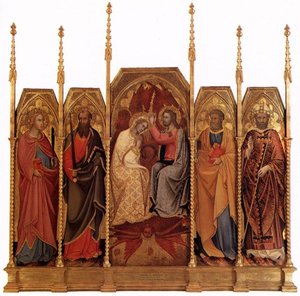
Coronation of the Virgin (1410) autorstwa Andrea Di Bartolo

Coronation of the Virgin

1410 · Oil On Canvas · Pinacoteca di Brera, Mediolan

To stand before this depiction of the Coronation of the Virgin is to be transported across the veil of time, into a realm where earthly grandeur meets divine glory. The scene unfolds with breathtaking solemnity and vibrant energy, capturing that singular moment when Mary, the Mother of God, is elevated to her heavenly throne. Andrea di Bartolo’s masterful hand guides our gaze through this sacred gathering, presenting not merely an…

2
St. Jerome in the Wildrness (1515) autorstwa Andrea Di Bartolo

St. Jerome in the Wildrness

1515 · Oil On Panel · The Bowes Museum, Barnard Castle

In the quiet, rugged expanse of a landscape that feels more European than Syrian, we encounter a moment of profound spiritual intensity. St. Jerome in the Wilderness is not merely a depiction of a saint; it is an immersive experience of penance and prayer. As the viewer’s eye meets the kneeling figure of St. Jerome, there is an immediate sense of the weight of devotion. The artist captures the saint…

3
The Presentation of the Virgin in the Temple (1400) autorstwa Andrea Di Bartolo

The Presentation of the Virgin in the Temple

1400 · Tempera On Panel · National Gallery of Art, Waszyngton

The Presentation of the Virgin in the Temple by Andrea Di Bartolo captures a pivotal moment from the life of the Madonna. Created about 1400/1405, the work illustrates the young Virgin Mary taking leave of her parents, Anna and Joachim. This narrative is drawn from an apocryphal account attributed to the evangelist Matthew, rather than the canonical Gospels.

4
Madonna of Humility, The Blessing Christ, Two Angels, and a Donor [obverse] (1380) autorstwa Andrea Di Bartolo

Madonna of Humility, The Blessing Christ, Two Angels, and a Donor [obverse]

1380 · Tempera On Panel · National Gallery of Art, Waszyngton

The late 14th-century Sienese School finds a profound expression in this tempera and gold leaf panel. Seated upon a patterned cushion, the Virgin Mary nurtures the infant Christ, a composition that emphasizes maternal intimacy within a rigid, hierarchical structure. The gold ground provides a non-naturalistic, divine backdrop, reflecting an omnipresent light that transcends earthly space. This portable altarpiece, dated to approximately 1380, utilizes a vertical arrangement to guide the viewer…

5
Christ on the Cross [reverse] (1380) autorstwa Andrea Di Bartolo

Christ on the Cross [reverse]

1380 · Tempera On Panel · National Gallery of Art, Waszyngton

The viewer encounters Christ on the Cross [reverse], a work by Andrea Di Bartolo that dates to about 1380/1390. This panel functions as a simplified version of a portable diptych, a small and intimate object designed for private contemplation. While the obverse of such an icon typically presents a Madonna and Child, this specific side focuses entirely on the central figure of the Crucifixion. It is a quiet, solitary scene…

6
The Crucifixion (1400) autorstwa Andrea Di Bartolo

The Crucifixion

1400 · Tempera On Panel · Metropolitan Museum of Art, Nowy Jork

In this panoramic composition, we find ourselves witnessing a profound moment of religious tragedy. The scene is crowded, filled with a dense assembly of mourners and soldiers that presses against the foreground, creating a sense of immediate, heavy presence. At the center, the figure of Christ is suspended on the cross, flanked by two thieves, while angels hover within the sky above. The composition is characteristic of the Sienese Gothic…

7
The Assumption of the Virgin with St. Thomas and Two Donors (Ser Palamedes and his Son Matthew) (1390) autorstwa Andrea Di Bartolo

The Assumption of the Virgin with St. Thomas and Two Donors (Ser Palamedes and his Son Matthew)

1390 · Tempera On Panel · Virginia Museum of Fine Arts, Richmond

The composition ascends vertically, guiding the eye from the earthly realm toward a divine summit. At the center of this spiritual movement, the Virgin Mary rises through layers of angelic figures, her presence framed by a background of gold leaf that eliminates earthly shadows. This Sienese Gothic approach creates a flattened, sacred space where light is even and pervasive. The figures are defined by rhythmic, organic shapes and the precise,…

8
Den hellige Blasius (1395) autorstwa Andrea Di Bartolo

Den hellige Blasius

1395 · Tempera On Panel · National Museum of Art, Architecture and Design, Oslo

The gaze meets Den hellige Blasius, a painting that holds a steady, sacred presence. This work by Andrea Di Bartolo brings a singular figure into view, presenting a religious scene or person through the lens of late medieval devotion. The subject, Saint Blasius, emerges from a background of gold, appearing as a quiet pillar of faith. Every line of the figure seems to carry the weight of a prayer, frozen…

9
The Crucifixion (1390) autorstwa Andrea Di Bartolo

The Crucifixion

1390 · Tempera On Panel · Muzeum Narodowe w Warszawie, Warszawa

The Crucifixion by Andrea Di Bartolo emerges from the shadows of the late fourteenth century, a solemn vision captured around 1400. This work places the viewer directly before the central event of Christian history, presenting the Crucifixion of Jesus Christ with a profound sense of spiritual weight. Every line and color choice works to anchor this sacred moment in a space that feels both otherworldly and deeply felt.

10
Saint Stephen (panel from the right pilaster of an altarpiece) (1397) autorstwa Andrea Di Bartolo

Saint Stephen (panel from the right pilaster of an altarpiece)

1397 · Tempera On Panel · Victoria and Albert Museum, Londyn

Saint Stephen (panel from the right pilaster of an altarpiece) is a work by Andrea Di Bartolo. This fragmentary panel originated as part of a series of superimposed figures from the right pilaster of an unidentified Italian altarpiece. The wood panel captures the first Christian martyr, Saint Stephen, in a moment of quiet, heavy presence. He is depicted with the symbols of his devotion and his end: a book held…

Obrazy artysty Andrea Di Bartolo, uszeregowane od 11 do 28 miejsca

Tematy, które przyciągnęły wzrok Andrea Di Bartolo

Cztery motywy najczęściej powracające w tych oryginałach, z których każdy doczekał się swojego najdoskonalszego przykładu.

Muzea przechowujące oryginały Andrea Di Bartolo

8 muzeów, w których znajduje się najwięcej obrazów z tej strony.

Muzea Miasto Dzieła artysty Andrea Di Bartolo Obrazy z tej listy
National Gallery of Art, WaszyngtonNational Gallery of Art Waszyngton 5 The Presentation of the Virgin in the Temple, Madonna of Humility, The Blessing Christ, Two Angels, and a Donor [obverse], Christ on the Cross [reverse]
Musée du Petit Palais, AvignonMusée du Petit Palais Avignon 3 Saint Bishop, Saint Anthony Abbot, Saint Costanzo
Detroit Institute of Arts, DetroitDetroit Institute of Arts Detroit 2 Christ in Benediction, Madonna and Child
Pinacoteca di Brera, MediolanPinacoteca di Brera Mediolan 1 Coronation of the Virgin
The Bowes Museum, Barnard CastleThe Bowes Museum Barnard Castle 1 St. Jerome in the Wildrness
Metropolitan Museum of Art, Nowy JorkMetropolitan Museum of Art Nowy Jork 1 The Crucifixion
Virginia Museum of Fine Arts, RichmondVirginia Museum of Fine Arts Richmond 1 The Assumption of the Virgin with St. Thomas and Two Donors (Ser Palamedes and his Son Matthew)
National Museum of Art, Architecture and Design, OsloNational Museum of Art, Architecture and Design Oslo 1 Den hellige Blasius

Andrea Di Bartolo, jedno kultowe dzieło na dekadę

Dzieła według dekad

Wybierz dekadę, aby zobaczyć dzieło, które ją definiuje.

Obrazy artysty Andrea Di Bartolo: odpowiedzi galerii

Który obraz Andrea Di Bartolo jest najsłynniejszy ze wszystkich?Odkryj odpowiedź

Coronation of the Virgin (1410), Pinacoteca di Brera, Mediolan. Następne są St. Jerome in the Wildrness (1515) oraz The Presentation of the Virgin in the Temple (1400).

Ile lat miał Andrea Di Bartolo, gdy ukończył Coronation of the Virgin?Odkryj odpowiedź

50 lat: Coronation of the Virgin pochodzi z 1410, a Andrea Di Bartolo urodził(a) się w 1360.

Które to 10 najlepszych obrazów Andrea Di Bartolo?Odkryj odpowiedź

Coronation of the Virgin, St. Jerome in the Wildrness, The Presentation of the Virgin in the Temple, Madonna of Humility, The Blessing Christ, Two Angels, and a Donor [obverse], Christ on the Cross [reverse], The Crucifixion, The Assumption of the Virgin with St. Thomas and Two Donors (Ser Palamedes and his Son Matthew), Den hellige Blasius, The Crucifixion i Saint Stephen (panel from the right pilaster of an altarpiece). Powyższy ranking zawiera rok powstania oraz muzeum dla każdego z nich.

Ile dzieł stworzył/a Andrea Di Bartolo?Odkryj odpowiedź

Nasz katalog zawiera 30 dzieł artysty Andrea Di Bartolo, datowanych od 1380 do 1424.

Gdzie można znaleźć najsłynniejsze oryginały autorstwa Andrea Di Bartolo?Odkryj odpowiedź

W większości znajdują się w National Gallery of Art (Waszyngton), Musée du Petit Palais (Avignon) i Detroit Institute of Arts (Detroit). Powyższa tabela muzeów zawiera ich pełną listę.

Kiedy Andrea Di Bartolo stworzył swoje najsłynniejsze obrazy?Odkryj odpowiedź

W 1400s: 8 z 28 dzieł na tej stronie powstało w tym czasie, w tym The Presentation of the Virgin in the Temple.

Które z najsłynniejszych dzieł Andrea Di Bartolo należą do jego najwcześniejszych i najpóźniejszych prac?Odkryj odpowiedź

Na tej stronie najwcześniejszy to Madonna of Humility, The Blessing Christ, Two Angels, and a Donor [obverse] (1380), a najpóźniejszy Madonna and Child (1424).

Do jakich tematów Andrea Di Bartolo powracał najczęściej?Odkryj odpowiedź

Gold background (14), Woman (7) i Child (6), w ramach 28 dzieł na tej stronie.

W jakiej technice najczęściej tworzył Andrea Di Bartolo?Odkryj odpowiedź

Tempera On Panel, dla 19 z 28 dzieł na tej stronie.

Z jakim nurtem związany jest Andrea Di Bartolo?Odkryj odpowiedź

Sienese school, sądząc po oryginałach na tej stronie.

Które oryginały artysty Andrea Di Bartolo znajdują się w zbiorach National Gallery of Art?Odkryj odpowiedź

The Presentation of the Virgin in the Temple, Madonna of Humility, The Blessing Christ, Two Angels, and a Donor [obverse] i Christ on the Cross [reverse]: National Gallery of Art, Waszyngton posiada 5 dzieł widocznych na tej stronie.

Andrea Di Bartolo: artysta

Dziedzictwo Sieny i duchowa głębia

W tętniącym życiem sercu szkoły syeneńskiej, Andrea Di Bartolo wyłonił się jako mistrz, którego pędzel potrafił uchwycić głęboką intensywność duchową swojej epoki. Jako syn i uczeń wybitnego malarza, którym był Bartolo di Fredi, artystyczna droga Andrea Di Bartolo była głęboko zakorzeniona w tradycjach warsztatu jego ojca. Jego wczesne lata upłynęły w otoczeniu prestiżowych zamówień przepływających przez rodzinne studio, co stanowiło okres terminowania, który położył fundamenty pod karierę definiowaną przez pobożność religijną i techniczne mistrzostwo. Współpracując z takimi luminarzami jak Luca di Tommè, przyczynił się do powstania znaczących dzieł wspólnotowych, w tym ołtarza dla cechu szewców w katedrze w Sienie, co stanowiło jego pierwszy udokumentowany ślad w annałach historii sztuki.

Artystyczny kunszt Andrea Di Bartolo nie ograniczał się jedynie do płótna; był on twórcą wszechstronnym, służącym jako malarz, projektant witraży oraz iluminator manuskryptów. Jego twórczość często budowała most między eteryczną gracją tradycji gotyku a rodzącym się humanizmem, który ostatecznie zdefiniował Renesans. W jego tematach religijnych odnajdujemy skrupulatną dbałość o szczegół oraz niezwykłą zdolność do narracyjnej głębi. Bez względu na to, czy przedstawiał cichą samotność św. Hieronima na pustyni, czy dramatyczne napięcie Ukrzyżowania, Andrea posiadał dar osadzania swoich kompozycji w potężnych strukturach, które wciągają widza w stan kontemplacji.

Mistrzostwo światła i narracji

Techniczna biegłość Andrea Di Bartolo jest najbardziej widoczna w jego zdolności do manipulowania światłem i teksturą w celu wywoływania emocji. Jego dzieła często charakteryzują się świetlistą jakością, w której gra cienia i blasku odzwierciedla wewnętrzne duchowe zmagania przedstawianych postaci. W jego przedstawieniach świętych osób wyczuwalny jest namacalny ciężar i obecność; ciężkie, rytmiczne fałdy kardynalskich szat czy delikatna przezroczystość woalu są oddane z precyzją, która sprawia, że boskość staje się tangiblanie ludzka. To mistrzostwo pozwoliło mu tworzyć dzieła służące jako nieme kazania, bogate w symboliczny język, mający inspirować pobożność wśród wiernych.

Poza indywidualnym talentem, znaczenie historyczne Andrea Di Bartolo tkwi w jego roli w ewoluującym krajobrazie środkowych i północnych Włoch. Aktywny przez całe końcówki XIV i początek XV wieku, pomógł utrzymać prestiż szkoły syeneńskiej w okresie wielkich przemian. Jego wkład w tworzenie ołtarzy, witraży oraz iluminowanych manuskryptów sprawił, że jego artystyczna wizja przeniknęła różne aspekty życia religijnego w Sienie i okolicznych miastach. Dzięki oddaniu zarówno dekoracyjnej złożoności swojego rzemiosła, jak i uroczystemu pięknu podjętej tematyki, Andrea Di Bartolo pozostawił niezatarty ślad w wizualnym dziedzictwie Włoch.