Portret Alexander Archipenko

43 najsłynniejszych obrazów artysty Alexander Archipenko – wybór z galerii

Aktualizacja: Październik 2026 · ranking według naszego wskaźnika popularności (liczba wyszukiwań, wizyt i zamówień dla każdego dzieła) · 43 dzieł Alexander Archipenko w naszym katalogu

W skrócie

Z wszystkich oryginałów pozostawionych przez Alexander Archipenko, najsłynniejszym jest The Boxers (La Lutte) (1914). Tuż za nimi znajdują się Mask (1911) oraz Woman combing her hair (1914). Nasz katalog zawiera 43 dzieł autorstwa Alexander Archipenko; galeria zachowała 43 najbardziej podziwianych na świecie prac, z których każda została przedstawiona wraz z datą powstania, informacją o muzeum oraz jej historią.

1887 – 1964, Kijów Cubism Najwięcej dzieł: The Phillips Collection

10 najlepszych obrazów artysty Alexander Archipenko: wybór galerii

The Alexander Archipenko selection continues, 11 to 43

Tematy, które przyciągnęły wzrok Alexander Archipenko

Cztery motywy najczęściej powracające w tych oryginałach, z których każdy doczekał się swojego najdoskonalszego przykładu.

Muzea przechowujące oryginały Alexander Archipenko

3 muzeów, w których znajduje się najwięcej obrazów z tej strony.

Muzeum Miasto Dzieła artysty Alexander Archipenko Obrazy z tej listy
The Phillips Collection, WaszyngtonThe Phillips Collection Waszyngton 1 Standing Woman
Art Gallery of Hamilton, HamiltonArt Gallery of Hamilton Hamilton 1 Woman with Fan
Oldenburg State Museum for Art and Cultural History, OldenburgOldenburg State Museum for Art and Cultural History Oldenburg 1 Geometry

Alexander Archipenko dekada po dekadzie: oryginały definiujące każdy okres

Dzieła według dekad

Wybierz dekadę, aby zobaczyć dzieło, które ją definiuje.

Pytania kolekcjonerów o obrazy Alexander Archipenko

Z jakiego dzieła najbardziej znany jest Alexander Archipenko?Odkryj odpowiedź

The Boxers (La Lutte) (1914). Następne są Mask (1911) oraz Woman combing her hair (1914).

W jakim wieku był Alexander Archipenko, gdy powstało The Boxers (La Lutte)?Odkryj odpowiedź

27 lat: The Boxers (La Lutte) pochodzi z 1914, a Alexander Archipenko urodził(a) się w 1887.

Jakie są dziesięć najsłynniejszych obrazów, których autorem jest Alexander Archipenko?Odkryj odpowiedź

The Boxers (La Lutte), Mask, Woman combing her hair, Standing Woman, Carafe, The Past, Nude, Seated Female Nude (Black Torso), Sorrow i The Gondolier. Powyższy ranking zawiera rok powstania oraz muzeum dla każdego z nich.

Ile obrazów pozostawił po sobie Alexander Archipenko?Odkryj odpowiedź

Nasz katalog zawiera 43 dzieł artysty Alexander Archipenko, datowanych od 1909 do 1963.

W których muzeach znajdują się arcydzieła Alexander Archipenko?Odkryj odpowiedź

W większości znajdują się w The Phillips Collection (Waszyngton), Art Gallery of Hamilton (Hamilton) i Oldenburg State Museum for Art and Cultural History (Oldenburg). Powyższa tabela muzeów zawiera ich pełną listę.

W których latach Alexander Archipenko namalował swoje najsłynniejsze dzieła?Odkryj odpowiedź

W 1910s: 12 z 43 dzieł na tej stronie powstało w tym czasie, w tym The Boxers (La Lutte).

Jakie są pierwsze i ostatnie słynne oryginały Alexander Archipenko?Odkryj odpowiedź

Na tej stronie najwcześniejszy to Sorrow (1909), a najpóźniejszy King Solomon (1963).

Jakie tematy Alexander Archipenko wybierał najczęściej?Odkryj odpowiedź

Women (11), Nudes (7) i Royalty (3), w ramach 43 dzieł na tej stronie.

Do jakiego nurtu artystycznego należy Alexander Archipenko?Odkryj odpowiedź

Cubism, sądząc po oryginałach na tej stronie.
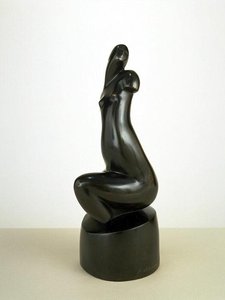
Alexander Archipenko: życie i twórczość

A Pioneer of Cubist Sculpture: The Life and Art of Alexander Archipenko

Alexander Porfirowycz Archipenko, born in Kyiv, Ukraine, on May 30, 1887 (or possibly May 18, 1887), was a sculptor whose radical approach fundamentally reshaped the possibilities of three-dimensional art. His journey began within the vibrant artistic landscape of his native city, where he received early training at the Kyiv Art School from 1902 to 1905, followed by further studies with Serhiy Svetoslavsky. Even in these formative years, Archipenko demonstrated a profound desire to break free from established conventions, evidenced by his participation in exhibitions alongside Alexander Bogomazov in 1906 – a clear signal of his emerging artistic independence. However, it was his relocation to Paris in 1908 that truly ignited the transformative process within him, propelling him into the heart of Europe’s avant-garde movement. Initially enrolling at the École des Beaux-Arts, he quickly recognized that the traditional academic approach wasn't suited to his vision and gravitated instead towards the dynamic circles of La Ruche, a hub for experimental artists like Fernand Léger and Vladimir Baranoff-Rossinè. This immersion in progressive thought proved crucial, laying the groundwork for his groundbreaking contributions to modern sculpture.

Deconstructing Form: The Birth of a New Sculptural Language

Archipenko’s artistic vision was inextricably linked to the burgeoning Cubist movement, yet he refused to simply replicate painting's fractured perspectives in three dimensions. Instead, he sought to redefine sculpture itself – to fundamentally alter its very nature. Unlike traditional sculptors who primarily focused on solid mass and volume, Archipenko began exploring the potent power of *negative space* – voids that became integral components of his compositions. This daring innovation challenged the established definition of form, suggesting that a sculpture could be just as powerfully defined by what was *not* there as by what existed. He masterfully manipulated convex and concave surfaces, creating an intricate interplay of light and shadow, imbuing his works with an unprecedented sense of movement and dynamism. This revolutionary spirit led to the creation of “sculpto-paintings,” a remarkable fusion where he boldly integrated painted color onto intersecting planes, blurring the boundaries between sculpture and painting. Drawing inspiration from Cubist collage techniques, Archipenko further expanded his artistic palette, incorporating materials such as glass, wood, and metal – most notably in his captivating "Medrano" series, which depicted the vibrant world of circus performers. These works weren’t merely representations; they were investigations into the very essence of sculptural possibility, pushing the boundaries of what was considered achievable.

Major Works and Artistic Innovations

Throughout the 1910s, Archipenko produced a remarkable series of seminal works that solidified his position as a leading figure in modern sculpture. Family Life (1912) stands as an early example of his Cubist approach to the human form, showcasing fragmented planes and abstracted figures – capturing a sense of domestic intimacy through geometric deconstruction. Walking Woman (1912) exemplifies his innovative use of voids, creating a dynamic impression of movement as if the figure is perpetually in motion. Boxing Match (1913), with its abstract cubic and ovoid forms, powerfully conveys the energy and brutality of the sport. The “Medrano” series, inspired by the captivating world of the circus, stands out for its unconventional use of materials – glass, metal, and painted wood – creating a collage-like effect that further blurred the lines between sculpture and other art forms. Later in his career, Archipenko undertook monumental projects such as the King Solomon Statue (University of Pennsylvania), demonstrating his continued exploration of abstract forms and geometric principles on a grand scale. These works weren’t simply aesthetic statements; they were intellectual explorations into the nature of perception and representation, reflecting a deep engagement with the complexities of modern experience.

A Shift to America and Lasting Influence

In 1923, Archipenko emigrated to the United States, becoming a citizen in 1928. This move marked a significant shift in his artistic focus, as he continued to create and teach, introducing Cubist ideas and experimental techniques to a wider American audience. He held teaching positions at various institutions, including the New Bauhaus, further disseminating his artistic philosophy. His election to the American Academy of Arts and Letters in 1962 served as a formal recognition of his profound contribution to art history. Archipenko’s legacy extends far beyond specific artworks; it lies in his unwavering commitment to innovation and his willingness to challenge fundamental assumptions about what sculpture could be. He left behind not just a body of work, but a new language for artistic expression – one that continues to resonate with artists and audiences today. His exploration of negative space, combined with the integration of color and diverse materials, profoundly influenced generations of sculptors who followed in his footsteps.

Key Characteristics & Techniques

Archipenko’s distinctive style was characterized by several key elements: a deliberate fragmentation of forms inspired by Cubism; an emphasis on *negative space* – creating visual interest through voids and absences; the incorporation of painted color onto sculptural surfaces, blurring the boundaries between sculpture and painting (his “sculpto-paintings”); and the use of unconventional materials such as glass, wood, and metal. He frequently employed a technique he called "sculpto-painting," where he would paint intersecting planes on his sculptures, creating an illusion of depth and adding another layer of visual complexity. His work often evokes a sense of dynamism and movement, reflecting his interest in capturing the fleeting moments of everyday life.

Wszystkie 43 dzieła artysty Alexander Archipenko →