


1


Aktualizacja: Październik 2026 · ranking według naszego wskaźnika popularności (liczba wyszukiwań, wizyt i zamówień dla każdego dzieła) · 36 dzieł Alan Davie w naszym katalogu
W skrócie
Według galerii najsłynniejszym obrazem Alan Davie jest Woman Arranging Flowers (1945). Untitled Abstract i Self Portrait with Brushes (1937) dopełniają trio, które zna każde oko. Z 36 dzieł Alan Davie w naszym katalogu, galeria prezentuje poniżej 36 najsłynniejszych prac – każda z nich jest oryginałem z podaniem roku powstania, muzeum oraz cech wyróżniających ją na tle innych.


 Joe's Magic Lantern1961
12
 Joe's Lucky Dip1961
13
 Keep Your Fingers Crossed1961
14
 Hopi Studies No.32, Opus 0.11731991 · University of Hertfordshire
15
 Hopi Studies No.30 (Big Blue) (Opus O.1171)1991
16
 Homage to an Earth Goddess No.61992
17
 Symbols in a Landscape1994 · The Pier Arts Centre
18
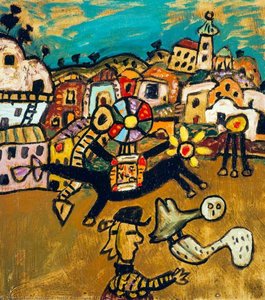 Village Witch (Opus O.1263)1994
19
 Magic Casket1997 · Scottish National Gallery of Modern Art
20
 Celtic Landscape (Dreamscape)1996 · The Pier Arts Centre
21
 Magic Landscape (Opus O.1337)1996
22
 The Alchemist's Mirror No.1 (Opus 1357)1997
23
 Cosmic Signals I2000
24
 Cosmic Signals No.72000
25
 The Golden Palace1999
26
 Magician's Mirror No.22000 · The Mercer Art Gallery
27
 Serpent's Idea of a Horse2000
28
 The Magician's Mirror No.3 (Opus 1450)2000
29
 Without Devices2004 · Pembroke College Oxford Jcr Art Collection
30
 Around and Around in the PinkNarodowa Galeria Kanady
31
 Kaleidoscope for a Parrot
32
 Prize for a Serpent
33
 Flowers on a TableThe Fleming Collection
34Prophet in a Tree, 1963Fitzwilliam College
35
 Double MonumentRobinson College
36
 Hallucination with Monster and Cock
8 muzeów, w których znajduje się najwięcej obrazów z tej strony.
| Muzeum | Miasto | Dzieła artysty Alan Davie | Obrazy z tej listy |
|---|---|---|---|
 The Pier Arts Centre |
Stromness | 2 | Symbols in a Landscape, Celtic Landscape (Dreamscape) |
 University of Hertfordshire |
North Hatley | 1 | Hopi Studies No.32, Opus 0.1173 |
 Scottish National Gallery of Modern Art |
Edynburg | 1 | Magic Casket |
 The Mercer Art Gallery |
Harrogate | 1 | Magician's Mirror No.2 |
 Pembroke College Oxford Jcr Art Collection |
Oxford | 1 | Without Devices |
 Narodowa Galeria Kanady |
Ottawa | 1 | Around and Around in the Pink |
 The Fleming Collection |
London | 1 | Flowers on a Table |
 Fitzwilliam College |
Cambridge | 1 | Prophet in a Tree, 1963 |
Wybierz dekadę, aby zobaczyć dzieło, które ją definiuje.
Woman Arranging Flowers (1945). Następne są Untitled Abstract oraz Self Portrait with Brushes (1937).
25 lat: Woman Arranging Flowers pochodzi z 1945, a Alan Davie urodził(a) się w 1920.
Woman Arranging Flowers, Untitled Abstract, Self Portrait with Brushes, The Saint, Entrance to a Paradise, Jingling Space, Ram Grip, Piggy Chain, Joy Bag No. 1 i Entrance For A Red Temple No. 4. Powyższy ranking zawiera rok powstania oraz muzeum dla każdego z nich.
Nasz katalog zawiera 36 dzieł artysty Alan Davie, datowanych od 1937 do 2004.
W większości znajdują się w The Pier Arts Centre (Stromness), University of Hertfordshire (North Hatley) i Scottish National Gallery of Modern Art (Edynburg). Powyższa tabela muzeów zawiera ich pełną listę.
W 1990s: 10 z 36 dzieł na tej stronie powstało w tym czasie, w tym Hopi Studies No.32, Opus 0.1173.
Na tej stronie najwcześniejszy to Self Portrait with Brushes (1937), a najpóźniejszy Without Devices (2004).
Abstract expressionism, sądząc po oryginałach na tej stronie.
Symbols in a Landscape i Celtic Landscape (Dreamscape): The Pier Arts Centre, Stromness posiada 2 dzieł widocznych na tej stronie.

