Portret Tom Thomson

100 najsłynniejszych obrazów artysty Tom Thomson – wybór z galerii

Aktualizacja: Październik 2026 · ranking według naszego wskaźnika popularności (liczba wyszukiwań, wizyt i zamówień dla każdego dzieła) · 130 dzieł Tom Thomson w naszym katalogu

W skrócie

Spośród wszystkich dzieł oryginalnych, które pozostawił Tom Thomson, najsłynniejszym jest Thunderhead (1913), znajdujący się w kolekcji Narodowa Galeria Kanady w Ottawa. Tuż za nimi znajdują się Pine Cones (1916) oraz The Fisherman (1917). Nasz katalog zawiera 130 dzieł autorstwa Tom Thomson; galeria zachowała 100 najbardziej podziwianych na świecie prac, z których każda została przedstawiona wraz z datą powstania, informacją o muzeum oraz jej historią.

1877 – 1917, Claremont Impressionism Najwięcej dzieł: Narodowa Galeria Kanady

10 najlepszych obrazów artysty Tom Thomson: wybór galerii

1
Thunderhead (1913) autorstwa Tom Thomson

Thunderhead

1913 · Black and White Photography · Narodowa Galeria Kanady, Ottawa

Tom Thomson was born in 1877 in Claremont, Canada. A pioneer of the Canadian wilderness, his brief career ended with his death in 1917. Through works like Thunderhead, Thomson established a visual language for the northern landscape. He acted as a crucial precursor to the Group of Seven, providing a foundational influence on their collective direction. Although he died before their formal establishment, he is widely considered an unofficial member…

2
Pine Cones (1916) autorstwa Tom Thomson

Pine Cones

1916 · Textile · Narodowa Galeria Kanady, Ottawa

There is a stillness in this piece that comes from its lack of perspective. By avoiding the illusion of space, the work focuses entirely on the surface. The viewer is drawn to the small, dark geometric patterns and the way the light catches the delicate holes in the crochet. It feels less like a window into another world and more like a fragment of a domestic history, preserved in thread.…

3
The Fisherman (1917) autorstwa Tom Thomson

The Fisherman

1917 · Oil · Art Gallery of Alberta, Edmonton

Tom Thomson's "The Fisherman" isn't merely a depiction of a solitary figure casting his line; it’s a profound immersion into the heart of Canadian wilderness, a distilled essence of the early 20th century’s burgeoning interest in capturing the soul of the land. Painted in 1917, during a pivotal period for both Thomson and the nascent Group of Seven, this oil on wood panel vibrates with an almost palpable sense of…

4
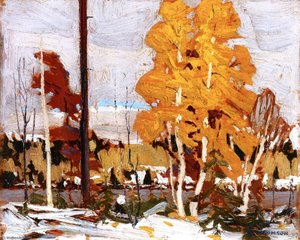
The Birch Grove, Autumn (1916) autorstwa Tom Thomson

The Birch Grove, Autumn

1916 · Oil · Art Gallery of Hamilton, Hamilton

In the quiet, transformative moments of the Canadian wilderness, few works capture the ephemeral beauty of the changing seasons as poignantly as Tom Thomson’s “The Birch Grove, Autumn.” Created in 1916, this masterpiece serves as a breathtaking window into the soul of Ontario's boreal forests. The painting presents a quintessential autumnal landscape, where a grove of birch trees stands bathed in a soft, diffused light against the backdrop of a…

5
Morning (1915) autorstwa Tom Thomson

Morning

1915 · Tom Thomson Art Gallery, Toronto

Tom Thomson’s “Morning,” painted in 1915, isn't merely a landscape; it’s a distilled moment of profound serenity captured on wood-pulp board. This evocative piece, now readily available as a meticulously crafted reproduction at AllPaintingsStore.com, transports the viewer to the heart of Ontario's wilderness – a place where the air is crisp with anticipation and the promise of a new day hangs heavy in the mist.

6
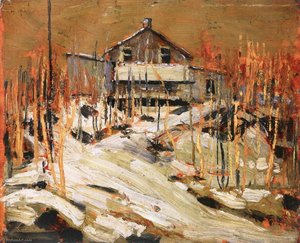
Fraser's Lodge (1915) autorstwa Tom Thomson

Fraser's Lodge

1915 · Oil On Canvas · Art Gallery of Alberta, Edmonton

Fraser’s Lodge – A Vision of Winter Solitude Tom Thomson's *Fraser’s Lodge*, painted in April 1915, stands as one of his most celebrated landscapes—a testament to the artist’s ability to distill the essence of Ontario’s boreal forest into a single, breathtaking image. Located at the Tom Thomson Art Gallery in Owen Sound, this piece embodies Thomson's signature Impressionistic style: loose brushstrokes dance across the canvas, capturing not precise details but…

7
Near Grand Lake, Algonquin Park (1916) autorstwa Tom Thomson

Near Grand Lake, Algonquin Park

1916 · Oil

The scene unfolds in the heart of the Canadian wilderness within the work titled Near Grand Lake, Algonquin Park. Painted by Tom Thomson in 1916, this landscape captures a specific moment of seasonal transition. The air feels heavy with the presence of autumn, as the trees prepare for the coming change. Every brushstroke seeks to hold the essence of this northern terrain, where the wildness of the woods meets the…

8
The Hill in Autumn (1914) autorstwa Tom Thomson

The Hill in Autumn

1914 · Oil On Canvas

is an oil on canvas work by the Canadian artist Tom Thomson. Executed in 1914, the painting captures a hillside blanketed in autumn foliage, primarily utilizing shades of red and orange. The composition features a body of water in the foreground that reflects the sky, creating depth against the warm tones of the landscape.

The Tom Thomson selection continues, 11 to 100

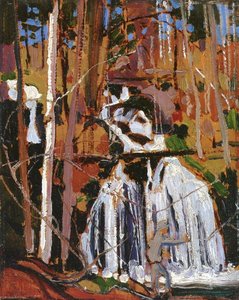
11Tamarack Swamp, Dawn (1916) autorstwa Tom ThomsonTamarack Swamp, Dawn1916 · Narodowa Galeria Kanady 12Snow and Rocks (1916) autorstwa Tom ThomsonSnow and Rocks1916 · Narodowa Galeria Kanady 13Thunder Cloud (1912) autorstwa Tom ThomsonThunder Cloud1912 · Narodowa Galeria Kanady 14Spruce and Maple (1916) autorstwa Tom ThomsonSpruce and Maple1916 · Narodowa Galeria Kanady 15White Frost (1914) autorstwa Tom ThomsonWhite Frost1914 · Narodowa Galeria Kanady 16Rocky Shore and Sky (1915) autorstwa Tom ThomsonRocky Shore and Sky1915 · Narodowa Galeria Kanady 17Tamarack Swamp (1916) autorstwa Tom ThomsonTamarack Swamp1916 · Narodowa Galeria Kanady 18Sunset Sky (1915) autorstwa Tom ThomsonSunset Sky1915 · Narodowa Galeria Kanady 19Grey Sky (1914) autorstwa Tom ThomsonGrey Sky1914 · Narodowa Galeria Kanady 20Tamarack (1915) autorstwa Tom ThomsonTamarack1915 · Narodowa Galeria Kanady 21Trees and Stump above a Shore (1916) autorstwa Tom ThomsonTrees and Stump above a Shore1916 · Narodowa Galeria Kanady 22Logging, Spring, Algonquin Park (1916) autorstwa Tom ThomsonLogging, Spring, Algonquin Park1916 23Little Cauchon Lake (1916) autorstwa Tom ThomsonLittle Cauchon Lake1916 24Twisted Maple (1914) autorstwa Tom ThomsonTwisted Maple1914 · McMichael Canadian Art Collection 25Near Owen Sound (1911) autorstwa Tom ThomsonNear Owen Sound1911 · Narodowa Galeria Kanady 26Nocturne autorstwa Tom ThomsonNocturneNarodowa Galeria Kanady 27In the Woods autorstwa Tom ThomsonIn the WoodsNarodowa Galeria Kanady 28Snow in the Woods autorstwa Tom ThomsonSnow in the WoodsNarodowa Galeria Kanady 29Near Owen Sound (1911) autorstwa Tom ThomsonNear Owen Sound1911 30White Birches, Round Lake (1915) autorstwa Tom ThomsonWhite Birches, Round Lake1915 · Narodowa Galeria Kanady 31The Enchanted Stream, Midnight (1916) autorstwa Tom ThomsonThe Enchanted Stream, Midnight1916 · Narodowa Galeria Kanady 32The Brook (1914) autorstwa Tom ThomsonThe Brook1914 · Narodowa Galeria Kanady 33Decorative Panel (II) (1915) autorstwa Tom ThomsonDecorative Panel (II)1915 · Narodowa Galeria Kanady 34Canoe Lake (1913) autorstwa Tom ThomsonCanoe Lake1913 · Narodowa Galeria Kanady 35Decorative Panel (I) (1915) autorstwa Tom ThomsonDecorative Panel (I)1915 · Narodowa Galeria Kanady 36Thunderhead: Pink Cloud over a Lake (1915) autorstwa Tom ThomsonThunderhead: Pink Cloud over a Lake1915 · Narodowa Galeria Kanady 37Blue Clouds, Wooded Hills, and Marshes (1915) autorstwa Tom ThomsonBlue Clouds, Wooded Hills, and Marshes1915 · Narodowa Galeria Kanady 38Autumn Foliage (1916) autorstwa Tom ThomsonAutumn Foliage1916 · Narodowa Galeria Kanady 39Forest Undergrowth III (1915) autorstwa Tom ThomsonForest Undergrowth III1915 · Narodowa Galeria Kanady 40Forest Undergrowth I (1915) autorstwa Tom ThomsonForest Undergrowth I1915 · Narodowa Galeria Kanady 41Thaw in the Woods (1916) autorstwa Tom ThomsonThaw in the Woods1916 · Narodowa Galeria Kanady 42Cranberry Marsh (1916) autorstwa Tom ThomsonCranberry Marsh1916 · Narodowa Galeria Kanady 43Snow Pillars in the Sky (1915) autorstwa Tom ThomsonSnow Pillars in the Sky1915 · Narodowa Galeria Kanady 44Lumber Camp, Night (1916) autorstwa Tom ThomsonLumber Camp, Night1916 · Narodowa Galeria Kanady 45Autumn Birches and Poplars, Canoe Lake (1914) autorstwa Tom ThomsonAutumn Birches and Poplars, Canoe Lake1914 · Narodowa Galeria Kanady 46The Lily Pond (1914) autorstwa Tom ThomsonThe Lily Pond1914 · Narodowa Galeria Kanady 47Frost-laden Cedars, Big Cauchon Lake (1915) autorstwa Tom ThomsonFrost-laden Cedars, Big Cauchon Lake1915 · Narodowa Galeria Kanady 48Lake in Algonquin Park (1913) autorstwa Tom ThomsonLake in Algonquin Park1913 · Narodowa Galeria Kanady 49Pine Island, Georgian Bay (1915) autorstwa Tom ThomsonPine Island, Georgian Bay1915 · Narodowa Galeria Kanady 50The Silent Lake (1913) autorstwa Tom ThomsonThe Silent Lake1913 · Narodowa Galeria Kanady 51The Breaking of the Ice (1916) autorstwa Tom ThomsonThe Breaking of the Ice1916 · Narodowa Galeria Kanady 52The Hill in Autumn (1914) autorstwa Tom ThomsonThe Hill in Autumn1914 · Narodowa Galeria Kanady 53Nocturne: The Birches (1916) autorstwa Tom ThomsonNocturne: The Birches1916 · Narodowa Galeria Kanady 54Evening Wind: Wooded Point and Rough Water (1914) autorstwa Tom ThomsonEvening Wind: Wooded Point and Rough Water1914 · Narodowa Galeria Kanady 55Approaching Snowstorm (1915) autorstwa Tom ThomsonApproaching Snowstorm1915 · Narodowa Galeria Kanady 56Petawawa Gorges (1914) autorstwa Tom ThomsonPetawawa Gorges1914 · Narodowa Galeria Kanady 57Spring (1916) autorstwa Tom ThomsonSpring1916 · Narodowa Galeria Kanady 58Smoke Lake (1912) autorstwa Tom ThomsonSmoke Lake1912 · Narodowa Galeria Kanady 59Timber Chute (1916) autorstwa Tom ThomsonTimber Chute1916 · Narodowa Galeria Kanady 60First Snow in Autumn (1916) autorstwa Tom ThomsonFirst Snow in Autumn1916 · Narodowa Galeria Kanady 61On Georgian Bay (1914) autorstwa Tom ThomsonOn Georgian Bay1914 · Narodowa Galeria Kanady 62Winter in the Woods (1916) autorstwa Tom ThomsonWinter in the Woods1916 · Narodowa Galeria Kanady 63Red Leaves (1914) autorstwa Tom ThomsonRed Leaves1914 · Narodowa Galeria Kanady 64Swift Water (1916) autorstwa Tom ThomsonSwift Water1916 · Narodowa Galeria Kanady 65Lake, Shore and Sky (1913) autorstwa Tom ThomsonLake, Shore and Sky1913 · Narodowa Galeria Kanady 66Ice in Spring (1916) autorstwa Tom ThomsonIce in Spring1916 · Narodowa Galeria Kanady 67Birch by a Lake with Big Cloud (1916) autorstwa Tom ThomsonBirch by a Lake with Big Cloud1916 · Narodowa Galeria Kanady 68Lake in Autumn (1916) autorstwa Tom ThomsonLake in Autumn1916 · Narodowa Galeria Kanady 69Trees, Red Hill, and Sunset Sky (1916) autorstwa Tom ThomsonTrees, Red Hill, and Sunset Sky1916 · Narodowa Galeria Kanady 70Petawawa (1916) autorstwa Tom ThomsonPetawawa1916 · Narodowa Galeria Kanady 71Snow in the Woods (I) (1915) autorstwa Tom ThomsonSnow in the Woods (I)1915 · Narodowa Galeria Kanady 72Moose at Night (1916) autorstwa Tom ThomsonMoose at Night1916 · Narodowa Galeria Kanady 73Stormy Sky (1915) autorstwa Tom ThomsonStormy Sky1915 · Narodowa Galeria Kanady 74Birches (1916) autorstwa Tom ThomsonBirches1916 · Narodowa Galeria Kanady 75Portage, Ragged Lake (1917) autorstwa Tom ThomsonPortage, Ragged Lake1917 · Narodowa Galeria Kanady 76March (1916) autorstwa Tom ThomsonMarch1916 · Narodowa Galeria Kanady 77Clouds ("The Zeppelins") (1915) autorstwa Tom ThomsonClouds ("The Zeppelins")1915 · Narodowa Galeria Kanady 78Birch Woods in Autumn (1916) autorstwa Tom ThomsonBirch Woods in Autumn1916 · Narodowa Galeria Kanady 79Maple Woods, Bare Trunks (1915) autorstwa Tom ThomsonMaple Woods, Bare Trunks1915 · Narodowa Galeria Kanady 80The Marsh, Early Spring (1916) autorstwa Tom ThomsonThe Marsh, Early Spring1916 · Narodowa Galeria Kanady 81Burnt Country, Evening (1914) autorstwa Tom ThomsonBurnt Country, Evening1914 · Narodowa Galeria Kanady 82Campfire (1916) autorstwa Tom ThomsonCampfire1916 · Narodowa Galeria Kanady 83Giant's Tomb, Georgian Bay (1914) autorstwa Tom ThomsonGiant's Tomb, Georgian Bay1914 · Narodowa Galeria Kanady 84View over a Lake, Autumn (1916) autorstwa Tom ThomsonView over a Lake, Autumn1916 · Narodowa Galeria Kanady 85Snow in the Woods (II) (1915) autorstwa Tom ThomsonSnow in the Woods (II)1915 · Narodowa Galeria Kanady 86Boats (1916) autorstwa Tom ThomsonBoats1916 · Art Gallery of Ontario 87Lake, Shore, and Sky (1913) autorstwa Tom ThomsonLake, Shore, and Sky1913 88Burned Over Land (1916) autorstwa Tom ThomsonBurned Over Land1916 89Grey Day in the North (1913) autorstwa Tom ThomsonGrey Day in the North1913 90Moonlight (1915) autorstwa Tom ThomsonMoonlight1915 91Drowned Land (1912) autorstwa Tom ThomsonDrowned Land1912 92Early Spring in Cauchon Lake (1916) autorstwa Tom ThomsonEarly Spring in Cauchon Lake1916 93Evening, Pine Island (1914) autorstwa Tom ThomsonEvening, Pine Island1914 94Maple Saplings, October (1917) autorstwa Tom ThomsonMaple Saplings, October1917 95First Snow, Canoe Lake (1915) autorstwa Tom ThomsonFirst Snow, Canoe Lake1915 96First Snow in Autumn (1916) autorstwa Tom ThomsonFirst Snow in Autumn1916 97Larry Dickson's Shack (1914) autorstwa Tom ThomsonLarry Dickson's Shack1914 · Narodowa Galeria Kanady 98Lightning, Canoe Lake (1915) autorstwa Tom ThomsonLightning, Canoe Lake1915 99Fire Swept Hills (1915) autorstwa Tom ThomsonFire Swept Hills1915 100Hoar Frost (1914) autorstwa Tom ThomsonHoar Frost1914

Tematy, które przyciągnęły wzrok Tom Thomson

Cztery motywy najczęściej powracające w tych oryginałach, z których każdy doczekał się swojego najdoskonalszego przykładu.

Muzea przechowujące oryginały Tom Thomson

6 muzeów, w których znajduje się najwięcej obrazów z tej strony.

Muzea Miasto Dzieła artysty Tom Thomson Obrazy z tej listy
Narodowa Galeria Kanady, OttawaNarodowa Galeria Kanady Ottawa 83 Thunderhead, Pine Cones, Decorative Panel (III)
Art Gallery of Alberta, EdmontonArt Gallery of Alberta Edmonton 2 The Fisherman, Fraser's Lodge
Art Gallery of Ontario, TorontoArt Gallery of Ontario Toronto 5 Boats
Art Gallery of Hamilton, HamiltonArt Gallery of Hamilton Hamilton 1 The Birch Grove, Autumn
Tom Thomson Art Gallery, TorontoTom Thomson Art Gallery Toronto 1 Morning
McMichael Canadian Art Collection, VaughanMcMichael Canadian Art Collection Vaughan 1 Twisted Maple

Tom Thomson rok po roku: oryginały, które definiują każdy z nich

Datowane dzieła Tom Thomson w tym zestawieniu obejmują zaledwie 7 lat, od 1911 do 1917: krótka kariera, przedstawiona tutaj rok po roku.

Dzieła według lat

Wybierz rok, aby zobaczyć oryginały.

Pytania kolekcjonerów o obrazy Tom Thomson

Z jakiego dzieła najbardziej znany jest Tom Thomson?Odkryj odpowiedź

Thunderhead (1913), Narodowa Galeria Kanady, Ottawa. Następne są Pine Cones (1916) oraz The Fisherman (1917).

W jakim wieku był Tom Thomson, gdy powstało Thunderhead?Odkryj odpowiedź

36 lat: Thunderhead pochodzi z 1913, a Tom Thomson urodził(a) się w 1877.

Jakie są dziesięć najsłynniejszych obrazów, których autorem jest Tom Thomson?Odkryj odpowiedź

Thunderhead, Pine Cones, The Fisherman, The Birch Grove, Autumn, Morning, Fraser's Lodge, Near Grand Lake, Algonquin Park, The Hill in Autumn, Lakeside, Spring, Algonquin Park i Decorative Panel (III). Powyższy ranking zawiera rok powstania oraz muzeum dla każdego z nich.

Ile obrazów pozostawił po sobie Tom Thomson?Odkryj odpowiedź

Nasz katalog zawiera 130 dzieł artysty Tom Thomson, datowanych od 1911 do 1917.

W których muzeach znajdują się arcydzieła Tom Thomson?Odkryj odpowiedź

W większości znajdują się w Narodowa Galeria Kanady (Ottawa), Art Gallery of Alberta (Edmonton) i Art Gallery of Ontario (Toronto). Powyższa tabela muzeów zawiera ich pełną listę.

W których latach Tom Thomson namalował swoje najsłynniejsze dzieła?Odkryj odpowiedź

W 1916: 38 z 100 dzieł na tej stronie powstało w tym czasie, w tym Pine Cones.

Jakie są pierwsze i ostatnie słynne oryginały Tom Thomson?Odkryj odpowiedź

Na tej stronie najwcześniejszy to Near Owen Sound (1911), a najpóźniejszy The Fisherman (1917).

Jakie tematy Tom Thomson wybierał najczęściej?Odkryj odpowiedź

Landscape (6), Waterfall (2) i Canadianart (2), w ramach 100 dzieł na tej stronie.

Której techniki Tom Thomson używał najczęściej?Odkryj odpowiedź

Oil, dla 3 z 100 dzieł na tej stronie.

Do jakiego nurtu artystycznego należy Tom Thomson?Odkryj odpowiedź

Impressionism i Post-impressionism, sądząc po oryginałach na tej stronie.

Które dzieła Tom Thomson znajdują się w Narodowa Galeria Kanady?Odkryj odpowiedź

Thunderhead, Pine Cones i Decorative Panel (III): Narodowa Galeria Kanady, Ottawa posiada 75 dzieł widocznych na tej stronie.

Tom Thomson: życie i twórczość

A Pioneer of the Canadian Wilderness

Thomas John Thomson, affectionately known simply as Tom Thomson to generations of Canadians, remains a pivotal and somewhat enigmatic figure in the nation’s artistic heritage. Though his active career spanned only a handful of years – tragically cut short at the age of thirty-nine – he indelibly shaped the course of Canadian art, acting as a crucial precursor to the renowned Group of Seven and leaving behind a legacy of evocative landscapes that continue to resonate deeply with audiences today. His story is one of late blossoming, of a restless spirit finding its voice in the untamed beauty of Ontario’s wilderness, and of an enduring mystery surrounding his untimely death.

From Rural Beginnings to Artistic Awakening

Born August 5, 1877, in Claremont, Ontario, Thomson's early life was deeply rooted in the rhythms of rural existence. He grew up as one of ten children within a farming family – an upbringing that instilled within him a profound and enduring connection to the natural world. This wasn’t initially expressed through artistic pursuits; his formal education was intermittent, punctuated by periods of illness and practical necessity. Before dedicating himself fully to art, Thomson explored various trades: he worked at an iron foundry, briefly attended business college, and even ventured west to Seattle where he honed his skills as a commercial artist – working for firms like Maring & Ladd. This period proved formative; it wasn’t merely about acquiring technical proficiency in penmanship and design – essential skills for the time – but also about encountering individuals who would later become central figures in the burgeoning Canadian art scene – J.E.H. MacDonald and Lawren Harris among them. These connections provided a crucial intellectual and artistic environment that nurtured his latent talent, exposing him to new ideas and approaches to landscape painting. However, it was the discovery of Algonquin Park in 1912 that truly ignited Thomson’s artistic passion. Guided by MacDonald's encouragement – who recognized Thomson’s potential and urged him to focus on capturing the park’s breathtaking vistas – he began to sketch the park’s majestic landscapes, embarking on a journey of self-discovery through landscape painting.

The Evolution of a Distinctive Style

Thomson’s early paintings reveal a promising but unrefined talent. While demonstrating an understanding of composition and color—elements learned during his time as a commercial artist – they lacked the distinctive voice that would come to define his mature work. He initially employed techniques more aligned with traditional landscape painting, often striving for meticulous detail and realistic representation. However, over time, his style underwent a dramatic transformation. This wasn’t a sudden shift, but rather a gradual evolution driven by observation and experimentation. He moved away from conventional academic approaches, embracing a bolder, more expressive approach characterized by vivid colors – often intensely saturated blues and greens – thickly applied paint (*impasto*), and dynamic brushstrokes. These weren't merely representations of the landscape; they were visceral interpretations, conveying the energy, atmosphere, and emotional intensity of the Canadian wilderness. He wasn’t simply painting what he *saw*; he was capturing how it *felt* to be immersed in that environment – the cool dampness of a forest floor, the vastness of an open sky, the shimmering light on a lake. His subject matter remained almost exclusively landscapes: towering pines and birches, expansive skies filled with clouds, shimmering lakes reflecting the sunlight, winding rivers carving their way through the terrain, and the subtle nuances of light and shadow across the landscape at different times of day. He captured not just the visual elements but also the *mood* and *feeling* associated with each scene. This ability to infuse his paintings with a sense of immediacy and emotional resonance – a feeling of being present in the moment – set him apart from his contemporaries.

Influences and Artistic Connections

Thomson’s artistic development was profoundly shaped by several key influences. J.E.H. MacDonald, a seasoned landscape painter and mentor, played a crucial role in guiding Thomson towards a more expressive style. MacDonald encouraged Thomson to focus on capturing the *spirit* of the Canadian wilderness rather than simply replicating its appearance. The influence of European Impressionists – particularly Monet and Pissarro – is also evident in Thomson’s use of color and light. He adopted their techniques for depicting atmospheric effects, such as the dappled sunlight filtering through trees or the hazy quality of a distant landscape. Furthermore, Thomson's time working alongside Lawren Harris—another key member of the Group of Seven—provided him with valuable insights into Canadian wilderness art. Harris’s emphasis on capturing the rugged beauty and solitude of the northern landscapes undoubtedly influenced Thomson’s own artistic vision. It is important to note that while Thomson was a significant influence on the Group of Seven, he never formally joined the group, which formed after his death.

Legacy and Lasting Influence

Paintings like The Jack Pine (1916), *The West Wind* (1917), *Moonlight Sail* (1916), and *Birch Grove, Autumn* (1917) have become iconic representations of Canadian identity and the nation’s natural beauty. These works are not merely landscapes; they are powerful symbols of Canada's wilderness and national character. They were among his most celebrated pieces, capturing the essence of the Canadian landscape with a unique blend of realism and emotional intensity. Though he died in July 1917 under mysterious circumstances – drowning in Canoe Lake – his legacy continues to grow. His works are primarily held in major Canadian institutions such as the Art Gallery of Ontario, the National Gallery of Canada, the McMichael Canadian Art Collection, and the Tom Thomson Art Gallery, ensuring that his vision continues to inspire and captivate audiences for generations to come. He stands as a testament to the power of artistic expression to capture the essence of a nation’s soul – a true icon of Canadian art history.

A Lasting Symbol

Thomson is rightfully recognized as a pioneer of Canadian modern art, breaking away from European traditions and forging a uniquely Canadian aesthetic. His paintings are more than just landscapes; they are powerful symbols of Canada's wilderness and national identity. The enduring popularity of his work speaks to its timeless quality and universal appeal. He didn’t simply paint what he *saw*; he painted how it *felt* to be Canadian, to be connected to the vastness and beauty of the northern landscape. His story – a blend of rural upbringing, artistic awakening, and tragic death – continues to fascinate and inspire, solidifying his position as one of Canada’s most beloved and important artists.