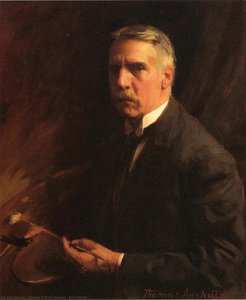
Portret Thomas Pollock Anshutz

69 najsłynniejszych obrazów artysty Thomas Pollock Anshutz – wybór z galerii

Aktualizacja: Listopad 2026 · ranking według naszego wskaźnika popularności (liczba wyszukiwań, wizyt i zamówień dla każdego dzieła) · 87 dzieł Thomas Pollock Anshutz w naszym katalogu

W skrócie

Z wszystkich oryginałów pozostawionych przez Thomas Pollock Anshutz, najsłynniejszym jest a passing glance. Tuż za nimi znajdują się Boy in Brown, study for The Ironworkers' Noontime (1880) oraz The Farmer and His Son at Harvesting (1879). Nasz katalog zawiera 87 dzieł autorstwa Thomas Pollock Anshutz; galeria zachowała 69 najbardziej podziwianych na świecie prac, z których każda została przedstawiona wraz z datą powstania, informacją o muzeum oraz jej historią.

1851 – 1912, Newport Contemporary realism Najwięcej dzieł: Pennsylvania Academy of Fine Arts

10 najlepszych obrazów artysty Thomas Pollock Anshutz: wybór galerii

1
a passing glance autorstwa Thomas Pollock Anshutz

a passing glance

Oil On Canvas

Thomas Pollock Anshutz, a central figure in American realism, presents a quiet moment of introspection in a passing glance. The work focuses on a woman positioned in profile, her attention directed toward a mirror. This arrangement creates a dual presence, capturing a fleeting instance of self-reflection through the mirrored image.

4
The Chore (1888) autorstwa Thomas Pollock Anshutz

The Chore

1888 · Oil On Canvas

Thomas Pollock Anshutz painted The Chore about 1888. The work focuses on the quiet realities of everyday domestic life, centering on a woman engaged in household tasks. Through this subject, Anshutz moves away from romanticized imagery to capture a moment of routine labor.

5
Sand Burr (1894) autorstwa Thomas Pollock Anshutz

Sand Burr

1894 · Oil On Canvas · Smithsonian American Art Museum, Waszyngton

In the 1894 painting Sand Burr, Thomas Pollock Anshutz presents an impressionistic landscape. The scene focuses on a shoreline where two young boys are positioned near a boat. The large, white hull of the vessel occupies the left side of the frame, creating a structural presence that directs the viewer toward the two figures on the right. The subjects are situated on a coast characterized by earthy greens and pale…

6
Two Boys by a Boat - Near Cape May (1894) autorstwa Thomas Pollock Anshutz

Two Boys by a Boat - Near Cape May

1894 · Oil On Canvas

The scene unfolds in "Two Boys by a Boat - Near Cape May," a work painted by Thomas Pollock Anshutz. Created about 1894, the image captures a quiet moment of childhood near the shoreline. The artist, who lived from 1851 to 1912, brings a sense of stillness to this specific coastal setting. One can almost feel the salt air and the weight of the afternoon sun as the boys occupy…

7
Two Boys by a Boat (1894) autorstwa Thomas Pollock Anshutz

Two Boys by a Boat

1894 · Watercolor

Two Boys by a Boat by Thomas Pollock Anshutz depicts a quiet scene on a shoreline or beach. The composition centers on two young figures positioned near a small boat. One boy stands beside the vessel, appearing to examine its structure, while the second boy sits on the ground nearby in a relaxed posture. The horizon line is placed high within the frame, which emphasizes the foreground elements of the…

8
The Harpist (1897) autorstwa Thomas Pollock Anshutz

The Harpist

1897 · Watercolor

In this watercolor, titled The Harpist, Thomas Pollock Anshutz presents a serene study of a female figure. Created about 1897, the work captures a quiet moment of musical contemplation. The subject is depicted in profile, her attention focused entirely upon the harp she holds. There is a sense of stillness in her posture, suggesting a private moment of artistic inspiration.

9
Portrait of Emily Fairchild Pollock (1905) autorstwa Thomas Pollock Anshutz

Portrait of Emily Fairchild Pollock

1905 · Oil On Canvas

In the Portrait of Emily Fairchild Pollock by Thomas Pollock Anshutz, the composition centers upon the sitter’s face and upper body. She sits facing forward, her hands clasped quietly in her lap. This formal pose, combined with her attire, suggests a sense of dignity and status. The perspective remains relatively shallow, offering minimal depth beyond the slight recession of the figure into a dark, muted background. A soft, diffused light…

10
The Fairy Tale (1902) autorstwa Thomas Pollock Anshutz

The Fairy Tale

1902 · Oil On Canvas

The room is anchored by a large, dark sofa, a heavy weight of fabric and shadow. Two children sit close, their bodies leaning into the stillness. They are motionless, caught in the gravity of a voice. A young woman holds a book, her gaze fixed upon the pages, her expression a study in focused intent. The light descends from an unseen height, washing over the scene in muted tones of…

Kontynuacja zestawienia Thomas Pollock Anshutz, od 11 do 69

11Steamboat on the Ohio (1900) autorstwa Thomas Pollock AnshutzSteamboat on the Ohio1900 · Carnegie Museum of Art 12Woman in Red (1907) autorstwa Thomas Pollock AnshutzWoman in Red1907 · Reading Public Museum 13Portrait of Rebecca H. Whelan (1910) autorstwa Thomas Pollock AnshutzPortrait of Rebecca H. Whelan1910 14Portrait of Margaret Perot (1908) autorstwa Thomas Pollock AnshutzPortrait of Margaret Perot1908 · Hirshhorn Museum and Sculpture Garden 15Dissecting Room (1879) autorstwa Thomas Pollock AnshutzDissecting Room1879 · Pennsylvania Academy of Fine Arts 16St. Cloud near Paris (1893) autorstwa Thomas Pollock AnshutzSt. Cloud near Paris1893 17Lumber Boat (1897) autorstwa Thomas Pollock AnshutzLumber Boat1897 18Incense Burner (1905) autorstwa Thomas Pollock AnshutzIncense Burner1905 · Pennsylvania Academy of Fine Arts 19Cast Study with Students autorstwa Thomas Pollock AnshutzCast Study with Students 20Man In Boat autorstwa Thomas Pollock AnshutzMan In Boat 21Portrait of Marthe Hientz autorstwa Thomas Pollock AnshutzPortrait of Marthe Hientz 22Advertisement For Ivory Soap autorstwa Thomas Pollock AnshutzAdvertisement For Ivory Soap 23The Ironworkers' Noontime autorstwa Thomas Pollock AnshutzThe Ironworkers' Noontime 24The Visit Of The Beggar And Her Child Steamboat On The Ohio autorstwa Thomas Pollock AnshutzThe Visit Of The Beggar And Her Child Steamboat On The Ohio 25the ironworker-s noontime autorstwa Thomas Pollock Anshutzthe ironworker-s noontime 26Boy Reading - Ned Anshutz autorstwa Thomas Pollock AnshutzBoy Reading - Ned Anshutz 27Woman In An Interior, Reading autorstwa Thomas Pollock AnshutzWoman In An Interior, Reading 28The Farmer And His Son At Harvesting autorstwa Thomas Pollock AnshutzThe Farmer And His Son At Harvesting 29Iron Workers at Noontime autorstwa Thomas Pollock AnshutzIron Workers at Noontime 30Woman Writting On A Table autorstwa Thomas Pollock AnshutzWoman Writting On A Table 31Aunt Hannah autorstwa Thomas Pollock AnshutzAunt HannahDetroit Institute of Arts 32Boys by a Fire autorstwa Thomas Pollock AnshutzBoys by a Fire 33Woman in a Rocking Chair autorstwa Thomas Pollock AnshutzWoman in a Rocking Chair 34Mrs. Anshutz and Her Son Edward autorstwa Thomas Pollock AnshutzMrs. Anshutz and Her Son Edward 35Lady with Bonnet autorstwa Thomas Pollock AnshutzLady with Bonnet 36Edwardian Woman On The Beach autorstwa Thomas Pollock AnshutzEdwardian Woman On The Beach 37Boys with a Boat, Ohio River, near Wheeling, West Virginia autorstwa Thomas Pollock AnshutzBoys with a Boat, Ohio River, near Wheeling, West Virginia 38Portrait of Mrs. Anschutz autorstwa Thomas Pollock AnshutzPortrait of Mrs. Anschutz 39A Challenge autorstwa Thomas Pollock AnshutzA Challenge 40Woman in a Rocking Chair autorstwa Thomas Pollock AnshutzWoman in a Rocking Chair 41Woman Writing at a Table autorstwa Thomas Pollock AnshutzWoman Writing at a Table 42Boys Playing with Crabs autorstwa Thomas Pollock AnshutzBoys Playing with Crabs 43a rose autorstwa Thomas Pollock Anshutza rose 44Indian On The Ohio autorstwa Thomas Pollock AnshutzIndian On The Ohio 45North East Weather autorstwa Thomas Pollock AnshutzNorth East Weather 46Checker Players autorstwa Thomas Pollock AnshutzChecker PlayersSmithsonian American Art Museum 47a flowered gown autorstwa Thomas Pollock Anshutza flowered gown 48Portrait of Katherine Rice (1908) autorstwa Thomas Pollock AnshutzPortrait of Katherine Rice1908 49Figure Piece (1909) autorstwa Thomas Pollock AnshutzFigure Piece1909 50Self Portrait (1909) autorstwa Thomas Pollock AnshutzSelf Portrait1909 51The Way They Live (1879) autorstwa Thomas Pollock AnshutzThe Way They Live1879 · Metropolitan Museum of Art 52Untitled (Portrait of a Man) autorstwa Thomas Pollock AnshutzUntitled (Portrait of a Man)Pennsylvania Academy of Fine Arts 53Unidentified Man autorstwa Thomas Pollock AnshutzUnidentified ManPennsylvania Academy of Fine Arts 54Tanker in Dock, Port Richmond autorstwa Thomas Pollock AnshutzTanker in Dock, Port RichmondReading Public Museum 55Sunset Glow - autorstwa Thomas Pollock AnshutzSunset Glow - 56New Jersey Shore autorstwa Thomas Pollock AnshutzNew Jersey Shore 57Pennsylvania Scene autorstwa Thomas Pollock AnshutzPennsylvania Scene 58On the Delaware at Tacony autorstwa Thomas Pollock AnshutzOn the Delaware at Tacony 59the summer house autorstwa Thomas Pollock Anshutzthe summer house 60Landscape with Grey Sky autorstwa Thomas Pollock AnshutzLandscape with Grey Sky 61Two Male Figures Wrestling autorstwa Thomas Pollock AnshutzTwo Male Figures Wrestling 62the lumber boat autorstwa Thomas Pollock Anshutzthe lumber boat 63Morning Mist autorstwa Thomas Pollock AnshutzMorning Mist 64Garden autorstwa Thomas Pollock AnshutzGarden 65Landscape with Grey Sky autorstwa Thomas Pollock AnshutzLandscape with Grey Sky 66Rooftops, St. Cloud autorstwa Thomas Pollock AnshutzRooftops, St. Cloud 67A Rose - autorstwa Thomas Pollock AnshutzA Rose -Metropolitan Museum of Art 68The Ironworker's Noontime autorstwa Thomas Pollock AnshutzThe Ironworker's NoontimeFine Arts Museums of San Francisco 69The Way They Live autorstwa Thomas Pollock AnshutzThe Way They LiveMetropolitan Museum of Art

Słynne obrazy Thomas Pollock Anshutz epoka po epoce

Tematy, które przyciągnęły wzrok Thomas Pollock Anshutz

Cztery motywy najczęściej powracające w tych oryginałach, z których każdy doczekał się swojego najdoskonalszego przykładu.

Muzea przechowujące oryginały Thomas Pollock Anshutz

8 muzeów, w których znajduje się najwięcej obrazów z tej strony.

Muzea Miasto Dzieła artysty Thomas Pollock Anshutz Obrazy z tej listy
Pennsylvania Academy of Fine Arts, FiladelfiaPennsylvania Academy of Fine Arts Filadelfia 4 Dissecting Room, Incense Burner, Untitled (Portrait of a Man)
Metropolitan Museum of Art, Nowy JorkMetropolitan Museum of Art Nowy Jork 3 The Way They Live, A Rose -, The Way They Live
Smithsonian American Art Museum, WaszyngtonSmithsonian American Art Museum Waszyngton 2 Sand Burr, Checker Players
Reading Public Museum, ReadingReading Public Museum Reading 2 Woman in Red, Tanker in Dock, Port Richmond
Carnegie Museum of Art, PittsburghCarnegie Museum of Art Pittsburgh 1 Steamboat on the Ohio
Hirshhorn Museum and Sculpture Garden, Washington, D.C.Hirshhorn Museum and Sculpture Garden Washington, D.C. 1 Portrait of Margaret Perot
Detroit Institute of Arts, DetroitDetroit Institute of Arts Detroit 1 Aunt Hannah
Fine Arts Museums of San Francisco, San FranciscoFine Arts Museums of San Francisco San Francisco 1 The Ironworker's Noontime

Thomas Pollock Anshutz dekada po dekadzie: oryginały definiujące każdy okres

Dzieła według dekad

Wybierz dekadę, aby zobaczyć dzieło, które ją definiuje.

Pytania kolekcjonerów o obrazy Thomas Pollock Anshutz

Z jakiego dzieła najbardziej znany jest Thomas Pollock Anshutz?Odkryj odpowiedź

a passing glance. Następne są Boy in Brown, study for The Ironworkers' Noontime (1880) oraz The Farmer and His Son at Harvesting (1879).

Jakie są dziesięć najsłynniejszych obrazów, których autorem jest Thomas Pollock Anshutz?Odkryj odpowiedź

a passing glance, Boy in Brown, study for The Ironworkers' Noontime, The Farmer and His Son at Harvesting, The Chore, Sand Burr, Two Boys by a Boat - Near Cape May, Two Boys by a Boat, The Harpist, Portrait of Emily Fairchild Pollock i The Fairy Tale. Powyższy ranking zawiera rok powstania oraz muzeum dla każdego z nich.

Ile obrazów pozostawił po sobie Thomas Pollock Anshutz?Odkryj odpowiedź

Nasz katalog zawiera 87 dzieł artysty Thomas Pollock Anshutz, datowanych od 1879 do 1910.

W których muzeach znajdują się arcydzieła Thomas Pollock Anshutz?Odkryj odpowiedź

W większości znajdują się w Pennsylvania Academy of Fine Arts (Filadelfia), Metropolitan Museum of Art (Nowy Jork) i Smithsonian American Art Museum (Waszyngton). Powyższa tabela muzeów zawiera ich pełną listę.

W których latach Thomas Pollock Anshutz namalował swoje najsłynniejsze dzieła?Odkryj odpowiedź

W 1900s: 9 z 69 dzieł na tej stronie powstało w tym czasie, w tym Portrait of Emily Fairchild Pollock.

Jakie są pierwsze i ostatnie słynne oryginały Thomas Pollock Anshutz?Odkryj odpowiedź

Na tej stronie najwcześniejszy to The Farmer and His Son at Harvesting (1879), a najpóźniejszy Portrait of Rebecca H. Whelan (1910).

Jakie tematy Thomas Pollock Anshutz wybierał najczęściej?Odkryj odpowiedź

Woman (7), Women (7) i Boys (6), w ramach 69 dzieł na tej stronie.

Której techniki Thomas Pollock Anshutz używał najczęściej?Odkryj odpowiedź

Oil On Canvas, dla 12 z 69 dzieł na tej stronie.

Do jakiego nurtu artystycznego należy Thomas Pollock Anshutz?Odkryj odpowiedź

Contemporary realism i Impressionism, sądząc po oryginałach na tej stronie.

Które dzieła Thomas Pollock Anshutz znajdują się w Pennsylvania Academy of Fine Arts?Odkryj odpowiedź

Dissecting Room, Incense Burner i Untitled (Portrait of a Man): Pennsylvania Academy of Fine Arts, Filadelfia posiada 4 dzieł widocznych na tej stronie.

Thomas Pollock Anshutz: życie i twórczość

A Life Dedicated to Realism: The World of Thomas Pollock Anshutz

Thomas Pollock Anshutz, born in Newport News, Virginia, on October 5th, 1851, and passing away in Philadelphia on July 16th, 1912, stands as a monumental figure in the evolution of American realism. His artistic journey wasn’t merely one of depicting scenes; it was a profound engagement with the realities of his time – the burgeoning industrial landscape, the lives of working-class individuals, and the evolving role of photography within the art world. Anshutz's early years were marked by formal training at the National Academy of Design in New York City, under the tutelage of Lemuel Wilmarth, providing him with a foundational understanding of academic techniques. However, it was his relocation to Philadelphia in 1875 and subsequent mentorship under Thomas Eakins at the Philadelphia Sketch Club that truly ignited his artistic spirit and shaped his distinctive approach. This relationship wasn’t simply one of instruction; it represented a philosophical alignment – a shared belief in observing the world with unflinching honesty, stripping away romanticized notions and focusing on tangible truths. Eakins' influence extended beyond stylistic considerations, instilling in Anshutz a commitment to capturing the essence of everyday life, a principle that would become central to his artistic identity.

The Shaping of a Style: Influences and Artistic Development

Anshutz’s artistic development was a complex tapestry woven from diverse threads. Undoubtedly, Thomas Eakins remained his most significant mentor, not only imparting technical skills but also shaping his worldview. The realist movement itself provided fertile ground for Anshutz's burgeoning talent, rejecting the idealized representations prevalent in academic art and embracing a commitment to portraying subjects as they truly appeared – with all their imperfections and complexities. During this period, photography played an increasingly vital role in Anshutz’s artistic process. Eakins’ innovative approach of incorporating photographic studies into his teaching practice profoundly influenced Anshutz, who readily adopted this method as a valuable tool for capturing accurate details and compositions. This wasn't merely about copying photographs; it was about using them to enhance observation and understanding – a crucial element in his pursuit of realism. A memorable honeymoon trip to Paris in 1892 exposed him to European art trends at the Académie Julian, yet this experience ultimately reinforced his dedication to American realism rather than leading him down an alternative path. He absorbed what he could from the European masters, but remained steadfast in his commitment to portraying American life with authenticity and a distinctly American perspective. This period witnessed Anshutz refining his skills in both portraiture and landscape painting, while simultaneously grappling with the social realities of industrializing America – themes that would become recurring motifs in his most impactful works.

Landscapes of Labor and Leisure: Major Works

While Anshutz achieved recognition across various genres, he is perhaps best known for Ironworkers' Noontime (1880), a painting now residing in the collection of the Fine Arts Museums of San Francisco. This powerful work offers a stark and compelling portrayal of industrial laborers during their brief midday break – a scene far removed from romanticized depictions of labor. It’s not a celebration of manual strength; instead, it presents a raw, unvarnished glimpse into the lives of these workers, highlighting both their physical resilience and their evident weariness. The painting is imbued with a sense of quiet dignity amidst hardship, capturing a moment of respite within a demanding existence. Beyond this iconic work, Anshutz participated in Eakins’ controversial photographic studies of nude models – an unusual undertaking that demonstrated his willingness to push artistic boundaries and explore unconventional practices. He also found solace and inspiration in the landscapes of Holly Beach, New Jersey, where he experimented with watercolors and a brighter palette, hinting at an emerging Impressionistic sensibility. His skill as a portraitist was equally notable, earning him numerous awards for his realistic depictions of individuals – capturing not just their likeness but also something of their inner character. Mrs. Anshutz and Her Son Edward exemplifies this intimate approach to portraiture, revealing the tender bond between mother and child with remarkable sensitivity and detail. St. Cloud near Paris showcases his watercolor skills and a lighter touch, demonstrating his versatility as an artist and his ability to adapt his style to different subjects and mediums.

A Legacy in Education: The Darby School and Beyond

Anshutz’s influence extended far beyond his own artistic creations; he became a highly respected educator, shaping the next generation of American artists. He held various teaching positions at the Pennsylvania Academy of Fine Arts, eventually succeeding Eakins as chief demonstrator – a position that allowed him to directly impart his knowledge and philosophy to aspiring artists. However, it was the co-founding of The Darby School in 1898, alongside Hugh Breckenridge, that cemented his legacy as an educator. This summer art school emphasized plein air painting and fostered artistic experimentation, attracting a remarkable cohort of students who would go on to become leading figures in American modernism. Among them were George Luks, Charles Demuth, John Sloan, Charles Sheeler, Everett Shinn, John Marin, William Glackens, and Robert Henri – a veritable who’s who of early 20th-century American art. Anshutz was known for his approachable yet subtly sarcastic teaching style, encouraging students to observe closely, develop their own artistic voices, and embrace the challenges of representing the world around them with honesty and integrity. He believed in fostering individual expression while grounding it in rigorous technical skill – a philosophy that profoundly impacted his students’ artistic trajectories.

A Pioneer Remembered: Historical Significance

Thomas Pollock Anshutz stands as a true pioneer of American realism. His work played a crucial role in establishing and promoting this movement, challenging conventional artistic norms and paving the way for a more authentic and socially conscious art landscape. He wasn't simply documenting what he saw; his paintings often carried social commentary, addressing issues such as industrialization and labor conditions – prompting viewers to confront the realities of their time. Anshutz’s dedication to truthfulness, his mastery of technique, and his commitment to education have secured his place as a significant figure in American art history – an artist whose legacy continues to inspire and resonate today. He remains a vital link between the traditions of 19th-century realism and the innovations of early 20th-century modernism, a testament to his enduring artistic vision.