Portret Theodore Clement Steele

100 najsłynniejszych obrazów artysty Theodore Clement Steele – wybór z galerii

Aktualizacja: Listopad 2026 · ranking według naszego wskaźnika popularności (liczba wyszukiwań, wizyt i zamówień dla każdego dzieła) · 490 dzieł Theodore Clement Steele w naszym katalogu

W skrócie

Z wszystkich oryginałów pozostawionych przez Theodore Clement Steele, najsłynniejszym jest Świerki. Tuż za nimi znajdują się Ukośny bieg (1885) oraz In the Whitewater Valley near Metamora (1894). Nasz katalog zawiera 490 dzieł autorstwa Theodore Clement Steele; galeria zachowała 100 najbardziej podziwianych na świecie prac, z których każda została przedstawiona wraz z datą powstania, informacją o muzeum oraz jej historią.

1847 – 1926, Hrabstwo Owen Impressionist landscape Najwięcej dzieł: Indianapolis Museum of Art

10 najlepszych obrazów artysty Theodore Clement Steele: wybór galerii

1
Świerki autorstwa Theodore Clement Steele

Świerki

Obraz olejny na płótnie

Imagine stepping into a hushed forest, where sunlight filters through a canopy of emerald leaves and the air is thick with the scent of damp earth and pine. This feeling – this profound sense of tranquility – is precisely what Theodore Clement Steele masterfully captures in his iconic painting, "Beech Trees." More than just a landscape, it’s an invitation to pause, reflect, and connect with the enduring power of nature,…

2
Ukośny bieg (1885) autorstwa Theodore Clement Steele

Ukośny bieg

1885 · Obraz olejny na płótnie · Indianapolis Museum of Art, Indianapolis

Theodore Clement Steele’s “Pleasant Run,” painted in 1885, is more than just a landscape; it's an immersion into a world of quiet contemplation and the subtle beauty of the American Midwest. This evocative work, now beautifully reproduced on wahooart.com, transports us to a misty autumn scene – a stream meandering through a dense woodland, reflecting the muted light of a gray sky. Steele’s genius lies in his ability to capture…

3
In the Whitewater Valley near Metamora (1894) autorstwa Theodore Clement Steele

In the Whitewater Valley near Metamora

1894 · Oil On Canvas

The scene unfolds within the quiet expanse of the Whitewater Valley near Metamora. Here, in Franklin County, Indiana, the landscape breathes with a sense of stillness. Theodore Clement Steele captures this specific corner of the American Midwest, focusing his attention on the rolling terrain that defines this region. The work, titled In the Whitewater Valley near Metamora, emerges from the year 1894. It offers a glimpse into a rural existence…

4
Cumberland Mountains (1899) autorstwa Theodore Clement Steele

Cumberland Mountains

1899 · Oil On Canvas

Theodore Clement Steele captures a quiet moment in the Tennessee landscape within his 1899 work, Cumberland Mountains. This oil on canvas presents a view of a small village nestled among the peaks, where the air feels heavy with the stillness of rural life. The scene unfolds across a surface measuring 45.72 cm x 71.12 cm | 18 in x 28 in, inviting a close look at the figures and animals…

5
Roan Mountain (1899) autorstwa Theodore Clement Steele

Roan Mountain

1899 · Oil On Canvas

The sun hangs heavy over a field of lush, green grass. In this corner of the landscape, time seems to slow to the pace of grazing animals. Cows move through the pasture, their forms scattered across the verdant expanse, while two horses find their own stillness near the center and the edge of the frame. The background is a soft wall of trees, their leaves catching the light of a…

6
Study of male nude autorstwa Theodore Clement Steele

Study of male nude

Charcoal

The artwork titled Study of male nude is a drawing by the artist Theodore Clement Steele. This specific piece focuses on the anatomical study of a male nude figure. The subject is positioned in a seated pose atop a rectangular block, with one arm raised toward the head while the other hand rests upon the structure. The composition centers on the back and side view of the man.

7
study of male nude 2 autorstwa Theodore Clement Steele

study of male nude 2

Charcoal

The charcoal lines of study of male nude 2 capture a quiet moment of anatomical observation. This work, titled study of male nude 2, emerges from the hands of Theodore Clement Steele. The artist, Theodore Clement Steele, focuses his attention on the raw, unadorned form of the human body, seeking to understand the tension and grace of muscle and bone through quick, decisive marks.

8
The Creek autorstwa Theodore Clement Steele

The Creek

Oil On Canvas

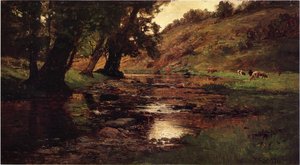
In The Creek, Theodore Clement Steele presents a quiet moment within a natural landscape. The scene captures a creek as it winds through a wooded area, its surface reflecting the soft light of the surroundings. It is a composition that invites a sense of stillness, focusing on the gentle movement of water amidst the dense foliage of the forest.

10
Winter Afternoon - Old Munich (1883) autorstwa Theodore Clement Steele

Winter Afternoon - Old Munich

1883 · Oil On Canvas

The air feels heavy with the stillness of a frozen afternoon. In this small oil painting from 1883, a wintry urban scene unfolds through a veil of muted tones and soft, diffused light. Snow clings to the rooftops and the skeletal branches of trees, softening the hard edges of the architecture. A central fountain, now blanketed in white, sits as a silent anchor amidst the surrounding buildings. To the left,…

Kontynuacja zestawienia Theodore Clement Steele, od 11 do 100

11A Corner in the Old Kitchen of the Mittenheim Cloister (1883) autorstwa Theodore Clement SteeleA Corner in the Old Kitchen of the Mittenheim Cloister1883 12The Pierce Children (1887) autorstwa Theodore Clement SteeleThe Pierce Children1887 · Indianapolis Museum of Art 13Portrait of a Man (1889) autorstwa Theodore Clement SteelePortrait of a Man1889 · Indianapolis Museum of Art 14Flower Mart (1890) autorstwa Theodore Clement SteeleFlower Mart1890 15Portrait of William J. Holliday (1903) autorstwa Theodore Clement SteelePortrait of William J. Holliday1903 · Indianapolis Museum of Art 16The Girl by the Window (1910) autorstwa Theodore Clement SteeleThe Girl by the Window1910 · Indianapolis Museum of Art 17Girl at the Piano (also known as The Piano) (1893) autorstwa Theodore Clement SteeleGirl at the Piano (also known as The Piano)1893 18Blue Range in Afternoon (Early Autumn) autorstwa Theodore Clement SteeleBlue Range in Afternoon (Early Autumn) 19Indiana University Campus, Bloomington autorstwa Theodore Clement SteeleIndiana University Campus, Bloomington 20Chicken Yard (The Chicken Lot) autorstwa Theodore Clement SteeleChicken Yard (The Chicken Lot) 21Portrait of James Whitcomb Riley (1891) autorstwa Theodore Clement SteelePortrait of James Whitcomb Riley1891 · Indianapolis Museum of Art 22Still Life of Fruit and Urn (1878) autorstwa Theodore Clement SteeleStill Life of Fruit and Urn1878 · Indianapolis Museum of Art 23Winter in Munich (1885) autorstwa Theodore Clement SteeleWinter in Munich1885 · Indianapolis Museum of Art 24Haying Scene (1884) autorstwa Theodore Clement SteeleHaying Scene1884 25Village Scene (1885) autorstwa Theodore Clement SteeleVillage Scene1885 26Village Scene (1885) autorstwa Theodore Clement SteeleVillage Scene1885 27Evening, Poplars (1885) autorstwa Theodore Clement SteeleEvening, Poplars1885 28Canal, Schlessheim (1884) autorstwa Theodore Clement SteeleCanal, Schlessheim1884 29Evening, Poplars and Roadway near Schleissheim (1884) autorstwa Theodore Clement SteeleEvening, Poplars and Roadway near Schleissheim1884 30Road to Schleissheim (1882) autorstwa Theodore Clement SteeleRoad to Schleissheim1882 31The Christ Child and the Infant St. John after Rubens (1883) autorstwa Theodore Clement SteeleThe Christ Child and the Infant St. John after Rubens1883 32Landscape (Laura's Nook) (1889) autorstwa Theodore Clement SteeleLandscape (Laura's Nook)1889 · Indianapolis Museum of Art 33Sunrise (1886) autorstwa Theodore Clement SteeleSunrise1886 · Indianapolis Museum of Art 34Morning--Old Schofield's Mill (1889) autorstwa Theodore Clement SteeleMorning--Old Schofield's Mill1889 · Indianapolis Museum of Art 35Morning – Old Schofield's Mill (1889) autorstwa Theodore Clement SteeleMorning – Old Schofield's Mill1889 · Indianapolis Museum of Art 36In the Berry Field ) (1890) autorstwa Theodore Clement SteeleIn the Berry Field )1890 37Okemo Mountain, Ludlow, Vermont (1887) autorstwa Theodore Clement SteeleOkemo Mountain, Ludlow, Vermont1887 38Summer Days at Vernon (1892) autorstwa Theodore Clement SteeleSummer Days at Vernon1892 39Meridian Street, Thawing Weather (1887) autorstwa Theodore Clement SteeleMeridian Street, Thawing Weather1887 40On the Muscatatuck (1886) autorstwa Theodore Clement SteeleOn the Muscatatuck1886 41Street in Vernon (1886) autorstwa Theodore Clement SteeleStreet in Vernon1886 · Indianapolis Museum of Art 42The Shades (1888) autorstwa Theodore Clement SteeleThe Shades1888 43September ) (1892) autorstwa Theodore Clement SteeleSeptember )1892 44An Indiana Road (1889) autorstwa Theodore Clement SteeleAn Indiana Road1889 45Tinker Place (1891) autorstwa Theodore Clement SteeleTinker Place1891 46Daisy by the River (1891) autorstwa Theodore Clement SteeleDaisy by the River1891 47Portrait of Daisy (1891) autorstwa Theodore Clement SteelePortrait of Daisy1891 48The Oaks of Vernon (1887) autorstwa Theodore Clement SteeleThe Oaks of Vernon1887 · Indianapolis Museum of Art 49The Ohio river from the College Campus, Hanover (1892) autorstwa Theodore Clement SteeleThe Ohio river from the College Campus, Hanover1892 50Vernon Beeches (1892) autorstwa Theodore Clement SteeleVernon Beeches1892 51Landscape (1893) autorstwa Theodore Clement SteeleLandscape1893 · Indianapolis Museum of Art 52Street Scene with Carriage (1894) autorstwa Theodore Clement SteeleStreet Scene with Carriage1894 53Street Scene (1896) autorstwa Theodore Clement SteeleStreet Scene1896 54The Whitewater Valley (1896) autorstwa Theodore Clement SteeleThe Whitewater Valley1896 55The Muscatatuck (also known as Afternoon at the Ford) (1898) autorstwa Theodore Clement SteeleThe Muscatatuck (also known as Afternoon at the Ford)1898 56Mysterious (1895) autorstwa Theodore Clement SteeleMysterious1895 57The Mysterious River (1895) autorstwa Theodore Clement SteeleThe Mysterious River1895 58Gordon Hill (1897) autorstwa Theodore Clement SteeleGordon Hill1897 59C the bloom of grape (1893) autorstwa Theodore Clement SteeleC the bloom of grape1893 60November's Harmony (1893) autorstwa Theodore Clement SteeleNovember's Harmony1893 61Cows by the Stream (1895) autorstwa Theodore Clement SteeleCows by the Stream1895 62Morning by the Stream (1893) autorstwa Theodore Clement SteeleMorning by the Stream1893 63Hills of Vernon (1894) autorstwa Theodore Clement SteeleHills of Vernon1894 64Brookville (1903) autorstwa Theodore Clement SteeleBrookville1903 · Brauer Museum of Art 65Landscape (1899) autorstwa Theodore Clement SteeleLandscape1899 · Indianapolis Museum of Art 66Hills Near Redlands, California (1902) autorstwa Theodore Clement SteeleHills Near Redlands, California1902 · Indianapolis Museum of Art 67Brookville Landscape (1904) autorstwa Theodore Clement SteeleBrookville Landscape1904 · Indianapolis Museum of Art 68Clam Diggers (1902) autorstwa Theodore Clement SteeleClam Diggers1902 69The Old Mills (1903) autorstwa Theodore Clement SteeleThe Old Mills1903 70Flower Garden at Brookville (1901) autorstwa Theodore Clement SteeleFlower Garden at Brookville1901 71Puget Sound (1903) autorstwa Theodore Clement SteelePuget Sound1903 72The Old Mill (1901) autorstwa Theodore Clement SteeleThe Old Mill1901 73November Morning (1904) autorstwa Theodore Clement SteeleNovember Morning1904 74Lost Cove, Tennessee (1899) autorstwa Theodore Clement SteeleLost Cove, Tennessee1899 75The Grist Mill (1901) autorstwa Theodore Clement SteeleThe Grist Mill1901 76Creek in Winter (1899) autorstwa Theodore Clement SteeleCreek in Winter1899 77Tennessee Scene (1899) autorstwa Theodore Clement SteeleTennessee Scene1899 78On the Oregon Coast (1902) autorstwa Theodore Clement SteeleOn the Oregon Coast1902 79Mount San Bernardino, from Smiley's Heights, Redlands (1902) autorstwa Theodore Clement SteeleMount San Bernardino, from Smiley's Heights, Redlands1902 80On the Road to Belmont (1910) autorstwa Theodore Clement SteeleOn the Road to Belmont1910 · Indianapolis Museum of Art 81Landscape (1909) autorstwa Theodore Clement SteeleLandscape1909 · Indianapolis Museum of Art 82Indiana Landscape (1909) autorstwa Theodore Clement SteeleIndiana Landscape1909 · Indianapolis Museum of Art 83The River (1906) autorstwa Theodore Clement SteeleThe River1906 · Indianapolis Museum of Art 84Landscape 18 autorstwa Theodore Clement SteeleLandscape 18 85Study of a Male Nude 4 autorstwa Theodore Clement SteeleStudy of a Male Nude 4 86Libbie Standing autorstwa Theodore Clement SteeleLibbie Standing 87Sculpture in relief autorstwa Theodore Clement SteeleSculpture in relief 88Hunting Rock Oysters (The Oregon Coast) autorstwa Theodore Clement SteeleHunting Rock Oysters (The Oregon Coast) 89Study of a Male Nude 7 autorstwa Theodore Clement SteeleStudy of a Male Nude 7 90Landscape with figure autorstwa Theodore Clement SteeleLandscape with figure 91Portrait of man reading autorstwa Theodore Clement SteelePortrait of man reading 92Study of a Male Nude 3 autorstwa Theodore Clement SteeleStudy of a Male Nude 3 93Streetscape 3 autorstwa Theodore Clement SteeleStreetscape 3 94Figures studies of male nude autorstwa Theodore Clement SteeleFigures studies of male nude 95Daisy Steele autorstwa Theodore Clement SteeleDaisy Steele 96The Steps of the Monument, Indianapolis autorstwa Theodore Clement SteeleThe Steps of the Monument, Indianapolis 97Study of a Male Nude 5 autorstwa Theodore Clement SteeleStudy of a Male Nude 5 98St. Michaels autorstwa Theodore Clement SteeleSt. Michaels 99Study of a Male Nude 9 autorstwa Theodore Clement SteeleStudy of a Male Nude 9 100Portrait of a man 1 autorstwa Theodore Clement SteelePortrait of a man 1

Słynne obrazy Theodore Clement Steele epoka po epoce

Late Medieval

1884 – 1901 · 3 dzieł na tej liście

Tematy, które przyciągnęły wzrok Theodore Clement Steele

Cztery motywy najczęściej powracające w tych oryginałach, z których każdy doczekał się swojego najdoskonalszego przykładu.

Muzea przechowujące oryginały Theodore Clement Steele

2 muzeów, w których znajduje się najwięcej obrazów z tej strony.

Muzea Miasto Dzieła artysty Theodore Clement Steele Obrazy z tej listy
Indianapolis Museum of Art, IndianapolisIndianapolis Museum of Art Indianapolis 35 Ukośny bieg, The Munich Model, The Pierce Children
Brauer Museum of Art, Porter CountyBrauer Museum of Art Porter County 1 Brookville

Theodore Clement Steele dekada po dekadzie: oryginały definiujące każdy okres

Dzieła według dekad

Wybierz dekadę, aby zobaczyć dzieło, które ją definiuje.

Pytania kolekcjonerów o obrazy Theodore Clement Steele

Z jakiego dzieła najbardziej znany jest Theodore Clement Steele?Odkryj odpowiedź

Świerki. Następne są Ukośny bieg (1885) oraz In the Whitewater Valley near Metamora (1894).

Jakie są dziesięć najsłynniejszych obrazów, których autorem jest Theodore Clement Steele?Odkryj odpowiedź

Świerki, Ukośny bieg, In the Whitewater Valley near Metamora, Cumberland Mountains, Roan Mountain, Study of male nude, study of male nude 2, The Creek, The Munich Model i Winter Afternoon - Old Munich. Powyższy ranking zawiera rok powstania oraz muzeum dla każdego z nich.

Ile obrazów pozostawił po sobie Theodore Clement Steele?Odkryj odpowiedź

Nasz katalog zawiera 490 dzieł artysty Theodore Clement Steele, datowanych od 1878 do 1910.

W których muzeach znajdują się arcydzieła Theodore Clement Steele?Odkryj odpowiedź

W większości znajdują się w Indianapolis Museum of Art (Indianapolis) i Brauer Museum of Art (Porter County). Powyższa tabela muzeów zawiera ich pełną listę.

W których latach Theodore Clement Steele namalował swoje najsłynniejsze dzieła?Odkryj odpowiedź

W 1890s: 31 z 100 dzieł na tej stronie powstało w tym czasie, w tym In the Whitewater Valley near Metamora.

Jakie są pierwsze i ostatnie słynne oryginały Theodore Clement Steele?Odkryj odpowiedź

Na tej stronie najwcześniejszy to Still Life of Fruit and Urn (1878), a najpóźniejszy The Girl by the Window (1910).

Jakie tematy Theodore Clement Steele wybierał najczęściej?Odkryj odpowiedź

Men (7), Roads (6) i Nudes (6), w ramach 100 dzieł na tej stronie.

Której techniki Theodore Clement Steele używał najczęściej?Odkryj odpowiedź

Oil On Canvas, dla 7 z 100 dzieł na tej stronie.

Do jakiego nurtu artystycznego należy Theodore Clement Steele?Odkryj odpowiedź

Impressionist landscape, sądząc po oryginałach na tej stronie.

Które dzieła Theodore Clement Steele znajdują się w Indianapolis Museum of Art?Odkryj odpowiedź

Ukośny bieg, The Munich Model i The Pierce Children: Indianapolis Museum of Art, Indianapolis posiada 23 dzieł widocznych na tej stronie.

Theodore Clement Steele: życie i twórczość

A Luminary of the American Landscape: The Life and Art of Theodore Clement Steele

Theodore Clement Steele, a name inextricably linked to the flourishing of American Impressionism, stands as a pivotal figure in our nation’s artistic heritage. Born in 1847 amidst the serene beauty of Owen County, Indiana, his journey was one marked by dedicated study, transatlantic influences, and an unwavering commitment to translating the soul of his native land onto canvas. His life unfolded during a period of profound transformation – a time when American art sought to break free from mere imitation of European masters, forging its own distinct visual language rooted in the experiences of its people. From humble beginnings sketching in the rolling hills of Indiana, Steele embarked on a path that led him to Munich’s prestigious Royal Academy and back again, forever shaped by his experiences yet deeply connected to the landscapes he held dear. He wasn't simply painting what he saw; he was conveying an emotional resonance with nature, imbuing each work with a sense of quiet contemplation and profound beauty.

European Training and the Embrace of Impressionism

Steele’s artistic inclinations were nurtured early on through initial studies at Indiana State University, providing him with a solid foundation in drawing and painting techniques. However, recognizing the need for more rigorous training and exposure to contemporary artistic trends, he ventured to Europe in 1880, settling in Munich – a vibrant hub of artistic innovation during that era. It was here, amidst the bustling studios and galleries of Germany, that Steele truly blossomed, immersing himself fully in the burgeoning Impressionist movement. The influence of French masters like Monet and Pissarro is undeniably present in his evolving style; a shift away from the darker, more academic palettes prevalent in earlier art towards brighter, more luminous colors and broken brushstrokes – a technique designed to capture the fleeting effects of light and atmosphere. This wasn’t merely a superficial adoption; it represented a fundamental philosophical change. Steele began prioritizing the *feeling* of being present in a particular moment, striving to convey not just what he saw but also how it *felt* to experience that scene. He meticulously studied the way sunlight danced through leaves, the subtle shifts in color as clouds drifted across the sky, and the interplay of light and shadow on landscapes – skills he would later bring back to his beloved Indiana.

The Hoosier Group and a Distinctly American Vision

Upon returning to Indiana in 1885, Steele became an integral part of the “Hoosier Group,” a collective of artists dedicated to establishing a uniquely American style of landscape painting. Alongside fellow artists like William Forsyth, J. Ottis Adams, Richard B. Gruelle, and Otto Stark, he championed the depiction of Midwestern landscapes – the rolling hills, lush forests, and tranquil waterways of his homeland. While deeply influenced by European techniques and artistic principles, Steele and his colleagues were determined to create a distinctly *American* vision. They sought to capture the spirit of their region, its rugged beauty, and its quiet charm, moving beyond mere topographical representation. This synthesis resulted in works that possessed both technical sophistication – honed through years of study abroad – and an authentic sense of place, reflecting the unique character of Indiana’s natural world. Steele's portraits also garnered recognition, including commissions to paint official portraits of several Indiana governors, demonstrating his versatility as an artist.

The House of the Singing Winds and a Legacy of Inspiration

Steele’s artistic journey reached its zenith in 1907 when he purchased a vast tract of land in Brown County, Indiana, and built “The House of the Singing Winds” – a home and studio that became both his personal sanctuary and a beacon for future generations of artists. This idyllic setting, surrounded by rolling hills and dense forests, provided him with endless inspiration and allowed him to fully immerse himself in his artistic pursuits. The house quickly became a gathering place for fellow artists, fostering a vibrant community known as the Brown County Art Colony – a testament to Steele’s generosity and vision. He later married Selma Neubacher, the sister of his son-in-law, solidifying this creative haven. In 1922, Steele accepted an honorary professorship at Indiana University in Bloomington, further cementing his role as a mentor and advocate for the arts within his state. His legacy extends beyond his paintings; he was a dedicated educator, lecturer, and champion of artistic expression.

A Lasting Impression on American Art

Theodore Clement Steele’s work continues to captivate audiences today, not only for its aesthetic beauty but also for its historical significance. He played a crucial role in bridging the gap between European traditions and American innovation, helping to forge a uniquely American artistic identity. His paintings are held in prestigious collections across the country – including those of the Indianapolis Museum of Art, the Los Angeles County Museum of Art, and the Indiana University Art Museum – serving as enduring reminders of his talent and vision. Steele’s ability to translate light, color, and emotion onto canvas ensures his place as a true luminary in the history of American art, inspiring generations of artists to embrace their own unique perspectives and capture the beauty that surrounds them. His work stands as a testament to the power of observation, dedication, and a profound connection with the natural world.