Portret Sol Lewitt

40 najsłynniejszych obrazów artysty Sol Lewitt – wybór z galerii

Aktualizacja: Październik 2026 · ranking według naszego wskaźnika popularności (liczba wyszukiwań, wizyt i zamówień dla każdego dzieła) · 42 dzieł Sol Lewitt w naszym katalogu

W skrócie

Spośród wszystkich dzieł oryginalnych, które pozostawił Sol Lewitt, najsłynniejszym jest Serial Project #1 ABCD (1966), znajdujący się w kolekcji MoMA - Museum of Modern Art w Nowy Jork. Tuż za nimi znajdują się Wall drawing #1091: arcs, circles and bands (room) (2003) oraz Distorted Cubes Bozuk Küpler. Nasz katalog zawiera 42 dzieł autorstwa Sol Lewitt; galeria zachowała 40 najbardziej podziwianych na świecie prac, z których każda została przedstawiona wraz z datą powstania, informacją o muzeum oraz jej historią.

1928 – 2007, Hartford Minimalism Najwięcej dzieł: MASS MoCA

10 najlepszych obrazów artysty Sol Lewitt: wybór galerii

1
Serial Project #1 ABCD (1966) autorstwa Sol Lewitt

Serial Project #1 ABCD

1966 · Sculpture · MoMA - Museum of Modern Art, Nowy Jork

A systematic arrangement of white cubes and rectangular prisms occupies a grid-like base, set against a stark black void. This geometric composition, titled Serial Project #1 ABCD, functions as an architectural exploration of structure and seriality. Rather than representing a specific building, the work investigates the permutations of simple shapes. The arrangement follows a predetermined algorithm, where the placement of each element is dictated by a logical sequence rather than…

2
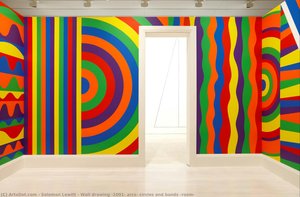
Wall drawing #1091: arcs, circles and bands (room) (2003) autorstwa Sol Lewitt

Wall drawing #1091: arcs, circles and bands (room)

2003 · Installation Art · Art Gallery of New South Wales, Sydney

To stand before Wall drawing #1091: arcs, circles and bands (room) is to witness not merely an arrangement of pigment on a surface, but the vibrant echo of artistic reinvention. This monumental piece by Solomon Lewitt captures a moment of profound resurgence in his later career. Where earlier works might have favored a more restrained palette, this drawing explodes with exuberant color—a joyous chromatic symphony applied across the architectural expanse…

3
Distorted Cubes Bozuk Küpler autorstwa Sol Lewitt

Distorted Cubes Bozuk Küpler

Painting · Borusan Contemporary, Istanbul

In the realm of conceptual mastery, few works capture the rhythmic pulse of modern abstraction as vibrantly as Sol LeWitt’s Distorted Cubes Bozuk Küpler. This captivating piece serves as a brilliant testament to the artist's ability to transform rigid mathematical precision into a dance of visual delight. At first glance, the viewer is greeted by an intricate mosaic of fourteen distinct colored squares, each meticulously arranged to create a sense…

4
Wall Drawing #391 (1983) autorstwa Sol Lewitt

Wall Drawing #391

1983 · Indian Ink · MASS MoCA, Adams

Wall Drawing #391 is an artwork by Solomon Lewitt. Created in April 1983, this two-part drawing occupies a specific space within the MASS MoCA in Adams. The work exists as a structural dialogue between two adjacent surfaces, mapping out a logic that relies on the intersection of planes and the direction of the line.

5
Wall Drawing #831 (1997) autorstwa Sol Lewitt

Wall Drawing #831

1997 · Drawing · Guggenheim Museum Bilbao, Bilbao

In the vast landscape of twentieth-century modernism, few names resonate with as much intellectual rigor as Solomon Lewitt. His Wall Drawing #831, created in 1997, serves as a breathtaking testament to the power of the idea over the hand. As a pioneer of both Minimalism and Conceptual Art, Lewitt famously posited that the concept itself is the machine that makes the art. This particular work is not merely a painting…

6
Wall Drawing #915 (1999) autorstwa Sol Lewitt

Wall Drawing #915

1999 · Installation Art · MASS MoCA, Adams

Wall Drawing #915 exists as an installation of mathematical precision. Created in 1999, the work utilizes a palette of pastels, anchored by a primary tone of steel blue. The composition relies on geometric patterns and interlocking shapes that transform architectural surfaces into active participants in the art. Through the use of arcs and circles, the piece establishes a rhythmic movement across the wall.

7
Incomplete open cube 5/6 (1974) autorstwa Sol Lewitt

Incomplete open cube 5/6

1974 · Metal · Art Gallery of New South Wales, Sydney

Incomplete Open Cube No.5-6 – A Testament to Minimalist Geometry The ‘Incomplete open cubes’ represent a pivotal moment in Sol LeWitt's artistic trajectory, encapsulating the core tenets of his conceptual approach and solidifying his position as one of the pioneers of Minimalism. Created in 1974, this sculpture—a precisely crafted aluminum structure—isn’t merely an object; it’s an embodiment of intellectual rigor distilled into a deceptively simple form. LeWitt himself famously articulated…

8
Kaldor Public Art Project 06: Sol LeWitt 1977 (1977) autorstwa Sol Lewitt

Kaldor Public Art Project 06: Sol LeWitt 1977

1977 · Drawing · Kaldor Public Art Projects, Sydney

In the quiet, transformative moment captured in this 1977 photograph, we witness more than just the documentation of a mural; we see the physical manifestation of an idea. Part of the prestigious Kaldor Public Art Project, this work by Solomon LeWitt serves as a profound testament to the power of Conceptualism. The image presents a stark, monochromatic dialogue between two observers and a monumental wall drawing that consumes the architectural…

9
Wall Drawing #146A (2000) autorstwa Sol Lewitt

Wall Drawing #146A

2000 · Crayon · MASS MoCA, Adams

In the realm of contemporary minimalism, few names resonate with as much intellectual authority as Solomon LeWitt. His work, particularly the mesmerizing Wall Drawing #14 6A, serves as a profound testament to the power of the concept over the physical object. This particular piece, captured in its striking blue crayon medium, transcends the boundaries of traditional painting to become an immersive environment. As one gazes upon the composition, the distinction…

The Sol Lewitt selection continues, 11 to 40

11Pyramid (2005) autorstwa Sol LewittPyramid2005 · Art Gallery of New South Wales 12Black with White Lines, Vertical Not Touching (1970) autorstwa Sol LewittBlack with White Lines, Vertical Not Touching1970 · MoMA - Museum of Modern Art 13Cubo autorstwa Sol LewittCuboCAMUSAC Cassino Museum of Contemporary Art 14Vertical Lines, Not Touching (1970) autorstwa Sol LewittVertical Lines, Not Touching1970 · MoMA - Museum of Modern Art 15Objectivity (1962) autorstwa Sol LewittObjectivity1962 16Irregular Grid autorstwa Sol LewittIrregular GridElgiz Museum of Contemporary Art 17Wall Drawing #822 (1997) autorstwa Sol LewittWall Drawing #8221997 · MASS MoCA 18Four Color Woodcuts-Curvy Bands I-IV (1996) autorstwa Sol LewittFour Color Woodcuts-Curvy Bands I-IV1996 · Borusan Contemporary 19Kaldor Public Art Project 11: Sol LeWitt 1998 (1998) autorstwa Sol LewittKaldor Public Art Project 11: Sol LeWitt 19981998 · Kaldor Public Art Projects 20Blue Vertical (2000) autorstwa Sol LewittBlue Vertical2000 21Wal Drawing #999 (2001) autorstwa Sol LewittWal Drawing #9992001 · MASS MoCA 22Isometric Figures in Five and Six Colors (2002) autorstwa Sol LewittIsometric Figures in Five and Six Colors2002 · Borusan Contemporary 23Wall Drawing #1171 (2005) autorstwa Sol LewittWall Drawing #11712005 · MASS MoCA 24Wall Drawing #1185 (2005) autorstwa Sol LewittWall Drawing #11852005 · MASS MoCA 25brushstrokes 2 autorstwa Sol Lewittbrushstrokes 2CAMUSAC Cassino Museum of Contemporary Art 26Lincoln Center Print autorstwa Sol LewittLincoln Center PrintBorusan Contemporary 27brushstrokes autorstwa Sol LewittbrushstrokesCAMUSAC Cassino Museum of Contemporary Art 28Wall drawing #338: Two part drawing. The wall is divided vertically into two parts. Each part is divided horizontally and vertically into four equal parts. 1st part: Lines in four directions, one direction in each quarter. 2nd part: Lines in four dir.... (1971) autorstwa Sol LewittWall drawing #338: Two part drawing. The wall is divided vertically into two parts. Each part is divided horizontally and vertically into four equal parts. 1st part: Lines in four directions, one direction in each quarter. 2nd part: Lines in four dir....1971 · Art Gallery of New South Wales 29Wall Drawing #340 (1980) autorstwa Sol LewittWall Drawing #3401980 · MASS MoCA 30Untitled autorstwa Sol LewittUntitled 31Untitled from Squares with a Different Line Direction in Each Half Square (3) autorstwa Sol LewittUntitled from Squares with a Different Line Direction in Each Half Square (3) 32Untitled from Squares with a Different Line Direction in Each Half Square autorstwa Sol LewittUntitled from Squares with a Different Line Direction in Each Half Square 33Untitled from Squares with a Different Line Direction in Each Half Square (2) autorstwa Sol LewittUntitled from Squares with a Different Line Direction in Each Half Square (2) 34Wall Drawing #154, #155, #162, #163, #157, #158 autorstwa Sol LewittWall Drawing #154, #155, #162, #163, #157, #158Modern Art Oxford 35Distorted Cubes from Distorted Cubes autorstwa Sol LewittDistorted Cubes from Distorted Cubes 36Distorted Cubes from Distorted Cubes (2) autorstwa Sol LewittDistorted Cubes from Distorted Cubes (2) 37Irregular tower autorstwa Sol LewittIrregular towerCAMUSAC Cassino Museum of Contemporary Art 38Irregular tower autorstwa Sol LewittIrregular towerCAMUSAC Cassino Museum of Contemporary Art 39Irregular Arcs, Bands and Loops autorstwa Sol LewittIrregular Arcs, Bands and LoopsBorusan Contemporary 40Eight-Pointed Stars autorstwa Sol LewittEight-Pointed StarsChrysler Museum of Art

Słynne obrazy Sol Lewitt epoka po epoce

Tematy, które przyciągnęły wzrok Sol Lewitt

Cztery motywy najczęściej powracające w tych oryginałach, z których każdy doczekał się swojego najdoskonalszego przykładu.

Muzea przechowujące oryginały Sol Lewitt

8 muzeów, w których znajduje się najwięcej obrazów z tej strony.

Muzea Miasto Dzieła artysty Sol Lewitt Obrazy z tej listy
MASS MoCA, AdamsMASS MoCA Adams 9 Wall Drawing #391, Wall Drawing #915, Wall Drawing #146A
Borusan Contemporary, IstanbulBorusan Contemporary Istanbul 5 Distorted Cubes Bozuk Küpler, Four Color Woodcuts-Curvy Bands I-IV, Isometric Figures in Five and Six Colors
CAMUSAC Cassino Museum of Contemporary Art, CassinoCAMUSAC Cassino Museum of Contemporary Art Cassino 5 Cubo, brushstrokes 2, brushstrokes
Art Gallery of New South Wales, SydneyArt Gallery of New South Wales Sydney 4 Wall drawing #1091: arcs, circles and bands (room), Incomplete open cube 5/6, Pyramid
MoMA - Museum of Modern Art, Nowy JorkMoMA - Museum of Modern Art Nowy Jork 3 Serial Project #1 ABCD, Black with White Lines, Vertical Not Touching, Vertical Lines, Not Touching
Kaldor Public Art Projects, SydneyKaldor Public Art Projects Sydney 2 Kaldor Public Art Project 06: Sol LeWitt 1977, Kaldor Public Art Project 11: Sol LeWitt 1998
Guggenheim Museum Bilbao, BilbaoGuggenheim Museum Bilbao Bilbao 1 Wall Drawing #831
Elgiz Museum of Contemporary Art, İstanbulElgiz Museum of Contemporary Art İstanbul 1 Irregular Grid

Sol Lewitt dekada po dekadzie: oryginały definiujące każdy okres

Dzieła według dekad

Wybierz dekadę, aby zobaczyć dzieło, które ją definiuje.

Pytania kolekcjonerów o obrazy Sol Lewitt

Z jakiego dzieła najbardziej znany jest Sol Lewitt?Odkryj odpowiedź

Serial Project #1 ABCD (1966), MoMA - Museum of Modern Art, Nowy Jork. Następne są Wall drawing #1091: arcs, circles and bands (room) (2003) oraz Distorted Cubes Bozuk Küpler.

W jakim wieku był Sol Lewitt, gdy powstało Serial Project #1 ABCD?Odkryj odpowiedź

38 lat: Serial Project #1 ABCD pochodzi z 1966, a Sol Lewitt urodził(a) się w 1928.

Jakie są dziesięć najsłynniejszych obrazów, których autorem jest Sol Lewitt?Odkryj odpowiedź

Serial Project #1 ABCD, Wall drawing #1091: arcs, circles and bands (room), Distorted Cubes Bozuk Küpler, Wall Drawing #391, Wall Drawing #831, Wall Drawing #915, Incomplete open cube 5/6, Kaldor Public Art Project 06: Sol LeWitt 1977, Wall Drawing #146A i Wall Drawing #793B Certificate. Powyższy ranking zawiera rok powstania oraz muzeum dla każdego z nich.

Ile obrazów pozostawił po sobie Sol Lewitt?Odkryj odpowiedź

Nasz katalog zawiera 42 dzieł artysty Sol Lewitt, datowanych od 1962 do 2005.

W których muzeach znajdują się arcydzieła Sol Lewitt?Odkryj odpowiedź

W większości znajdują się w MASS MoCA (Adams), Borusan Contemporary (Istanbul) i CAMUSAC Cassino Museum of Contemporary Art (Cassino). Powyższa tabela muzeów zawiera ich pełną listę.

W których latach Sol Lewitt namalował swoje najsłynniejsze dzieła?Odkryj odpowiedź

W 2000s: 8 z 40 dzieł na tej stronie powstało w tym czasie, w tym Wall drawing #1091: arcs, circles and bands (room).

Jakie są pierwsze i ostatnie słynne oryginały Sol Lewitt?Odkryj odpowiedź

Na tej stronie najwcześniejszy to Objectivity (1962), a najpóźniejszy Pyramid (2005).

Jakie tematy Sol Lewitt wybierał najczęściej?Odkryj odpowiedź

Geometric abstraction (8), Conceptual art (7) i Wall drawing (5), w ramach 40 dzieł na tej stronie.

Której techniki Sol Lewitt używał najczęściej?Odkryj odpowiedź

Sculpture, dla 2 z 40 dzieł na tej stronie.

Do jakiego nurtu artystycznego należy Sol Lewitt?Odkryj odpowiedź

Minimalism, sądząc po oryginałach na tej stronie.

Które dzieła Sol Lewitt znajdują się w MASS MoCA?Odkryj odpowiedź

Wall Drawing #391, Wall Drawing #915 i Wall Drawing #146A: MASS MoCA, Adams posiada 9 dzieł widocznych na tej stronie.

Sol Lewitt: życie i twórczość

Architekt Idei: Życie i Dziedzictwo Sol LeWitta

W rozległym krajobrazie modernizmu XX wieku niewiele postaci rzuca tak długi lub tak intelektualnie głęboki cień jak Solomon LeWitt. Urodzony 9 września 1928 roku w Hartford w stanie Connecticut, w rodzinie żydowskich imigrantów z Rosji, LeWitt przeszedł drogę zdefiniowaną przez dążenie do czystej myśli ponad samą fizyczną egzekucję. Jego wczesne lata kształtowała rygorystyczna, analityczna ciekawość – cecha pielęgnowana podczas studiów na Uniwersytecie Syracuse w latach 1945–1949. Ta akademicka podstawa w dziedzinie matematyki i geometrii stała się później samym sercem jego języka artystycznego, pozwalając mu odrzucić dekoracyjne nadmiary tradycyjnej sztuki, aby odsłonić szkieletowe piękno logiki i struktury.

Ewolucja LeWitta jako artysty nie była nagłym zerwaniem, lecz świadomą migracją od tego, co namacalne, ku temu, co konceptualne. Choć jego wczesne poszukiwania obejmowały dotykową naturę malarstwa i rysunku, wkrótce poczuł on coraz silniejsze przyciąganie do idei stojącej za śladem, a nie do samego śladu. Ta zmiana zapoczątkowała narodziny pioniera, który połączył przepaść między minimalizmem a sztuką konceptualną. Zaczął postrzegać artystę nie jako rzemieślnika ograniczonego przez dłoń, lecz jako architekta instrukcji. Nadając priorytet mentalnemu projektowi ponad gotowym obiektem, LeWitt zakwestionował samą definicję autorstwa, sugerując, że gdy tylko idea zostanie zrodzona, jej fizyczna manifestacja jest jedynie wtórną konsekwencją.

Rewolucja Rysunku Ściennego

Koniec lat 60. XX wieku był świadkiem jednej z najbardziej radykalnych transformacji w sztuce współczesnej wraz z pojawieniem się ikonicznych rysunków ściennych LeWitta. Odrzucając trwałość i drogocenność tradycyjnej rzeźby, wprowadził on „struktury” – termin, który preferował zamiast słowa „rzeźby”, aby podkreślił ich matematyczną istotę – oraz serię instrukcji, które mogły zostać wykonane przez każdego, kto został przeszkolony w ich przestrzeganiu. Dzieła te nie były jedynie dekoracjami, lecz przeżyciami, często składającymi się z precyzyjnych geometrycznych wzorów, łuków i zazębiających się kształtów, które tchnęły życie w przestrzenie architektoniczne, w których przebywały.

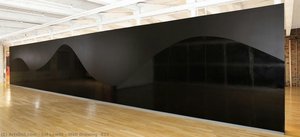
Obcowanie z rysunkiem ściennym LeWitta to widzenie logiki przekształconej w poezję. Bez względu na to, czy była to surowa, rytmiczna powtarzalność odnaleziona w Black with White Lines, Vertical Not Touching, czy też wibrująca, pełna energii moc Wall Drawing #1091: arcs, circles and bands, jego twórczość wykorzystywała potęgę linii do panowania nad przestrzenią. Te dzieła często opierały się na systemie logicznych, często matematycznych instrukcji, które prowadziły asystentów lub pracowników muzealnych podczas ich tworzenia. Metoda ta zdemokratyzowała akt kreacji, jednocześnie podnosząc rangę konceptu, zapewniając, że dzieło sztuki istnieje fundamentalnie jako intelektualna iskra, zanim jeszcze dotknie ściany.

Trwałe Piętno na Nowoczesności

W ciągu swojej płodnej kariery, która trwała dziesetyлетия i obejmowała mistrzostwo w grafice, fotografii oraz instalacji, LeWitt pozostał nieugięty w swoim dążeniu do klarowności i precyzji. Jego zdolność do odnajdywania głębokiego piękna w najprostszych formach – takich jak uderzająca biała Piramida czy złożone, kolorowe rytmy jego prac ściennych wykonanych kredkami – przedefiniowała granice estetyczne późnego XX wieku. Udowodnił, że sztuka może zostać odarta z ego i ornamentu, a mimo to zachować duszę, która głęboko rezonuje z ludzką potrzebą ładu i odkrywania.

Historycznego znaczenia Sol LeWitta nie można przecenić. Dostarczył on słownictwa kolejnym pokoleniom artystów, aby mogli oni badać granice między myślą a materią. Jego dziedzictwo trwa w każdym muzeum i galerii, gdzie zaciera się linia między twórcą a wykonawcą, a siła idei jest uznawana za ostateczne medium. Patrząc wstecz na jego życie, od początków w Hartford po ostatnie dni w Nowym Jorku w 2007 roku, widzimy człowieka, który nie tylko tworzył sztukę, ale nauczył nas, jak dostrzegać głęboką architekturę samej myśli.