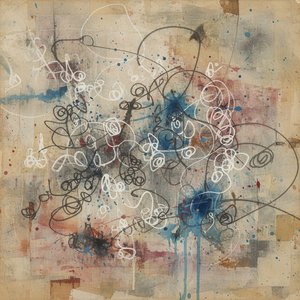
Shakir Hassan Al Said: A Pioneer of Modern Iraqi Art
Early Life and Education
- Born: 1925 in Samawah, Iraq.
- Shakir Hassan Al Said was a multifaceted artist – painter, sculptor, writer, philosopher, art critic, and historian.
- He received his degree in Social Science from the Higher Institute of Teachers in Baghdad (1948).
- Furthered his artistic training with a diploma in painting from the Institute of Fine Arts in Baghdad (1954).
- Continued studies at the École Nationale Supérieure des Beaux-Arts in Paris until 1959, broadening his exposure to international art movements.
Artistic Development and Influences
- Upon returning to Baghdad, Al Said immersed himself in the study of Yahya ibn Mahmud al-Wasiti’s work, a significant figure in Islamic miniature painting.
- Sufism, with its mystical and philosophical underpinnings, profoundly influenced his artistic vision.
- The poetry and philosophy of Mansur al-Hallaj, a controversial Sufi mystic, also played a crucial role in shaping his aesthetic sensibilities.
- His early style was initially figurative but gradually transitioned towards an emphasis on Arabic calligraphy as a central artistic element.
Founding of Art Groups and Collaborative Efforts
- Jama'et Baghdad lil Fann al-Hadith (The Baghdad Modern Art Group) – Co-founded in 1951, this group aimed to synthesize modern artistic approaches with Iraq’s rich cultural heritage.
- Al Bu'd al Wahad (The One Dimension Group) – Established in 1971, this collective explored the expressive potential of Arabic script within a contemporary art context. It championed the Hurufiyya movement.
Key Artistic Contributions and Style
- Notable Works: Include “Quaternary Rhythm” (ibrahimi collection, Amman, Jordan), demonstrating his unique blend of modernity and tradition; “Woman in Profile (turned to the left)”, showcasing stylistic experimentation.
- Al Said’s work is characterized by a distinctive fusion of abstract forms, calligraphic elements, and symbolic imagery.
- He often employed earthy tones and textured surfaces, evoking a sense of history and cultural depth.
Legacy and Historical Significance
- Al Said’s theoretical writings and artistic practice charted a new course for Arabic art aesthetics.
- He advocated for evaluating regional art through uniquely Arabic lenses, challenging Western-centric perspectives.
- His contributions had a profound impact on the modern Iraqi art movement and continue to inspire artists today.
- His work is held in collections such as The Museum Ruskin Library (Lancaster, United States).
- Died in 2004, leaving behind a lasting legacy as a pivotal figure in the development of modern art in Iraq and beyond.
Pytania i odpowiedzi
Gdzie można znaleźć dzieła Shakir Hassan Al-Said pogrupowane według techniki?
Aby znaleźć wszystkie dzieła artysty Shakir Hassan Al-Said wykonane w danej technice, odwiedź stronę Wszystkie techniki.
Czy mogę sortować dzieła Shakir Hassan Al-Said według koloru?
Prace Shakir Hassan Al-Said można przeglądać według kolorów na stronie Indeks kolorystyczny artysty.
Gdzie można znaleźć dzieła Shakir Hassan Al-Said pogrupowane według tematów?
Atlas tematów artysty Shakir Hassan Al-Said to strona, która grupuje dzieła artysty według ich tematyki.