


1


Aktualizacja: Październik 2026 · ranking według naszego wskaźnika popularności (liczba wyszukiwań, wizyt i zamówień dla każdego dzieła) · 44 dzieł Robert Hope w naszym katalogu
W skrócie
Według galerii najsłynniejszym obrazem Robert Hope jest The Presentation by King James III and Queen Margaret of the Banner Known as the Blue Blanket to the Craftsmen in the Year 1482 (1912). Kilmeny i Edinburgh from Craiglockhart dopełniają trio, które zna każde oko. Z 44 dzieł Robert Hope w naszym katalogu, galeria prezentuje poniżej 40 najsłynniejszych prac – każda z nich jest oryginałem z podaniem roku powstania, muzeum oraz cech wyróżniających ją na tle innych.


In the quiet intimacy of 1924, Robert Hope captured a scene of profound serenity that transcends the mere depiction of a person. Glints of Gold (Miss Dorothy Salvesen) is more than a portrait; it is an invitation into a private sanctuary of thought and repose. The painting presents a woman draped in a luminous yellow dress, reclining gracefully upon a bed with her head resting softly against a pillow. As…


 Portrait of a Lady with a Motoring Veil1915 · Harris Museum - Art Gallery
12
 A Victorian Debutante1922
13
 A Pageant of the Sea1929
14
 Alderman Eaton1944
15
 Lord Leverhulme and Alderman R. Williams, Mayor of Bebington1945
16
 Melrose
17
 Idle Hours
18
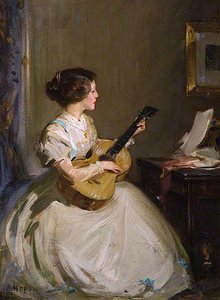 The Guitar Lesson
19
 The Fountain, Princes Street Gardens, EdinburghMcmanus: Dundee's Art Galleries And Museums
20
 A Quiet Pool, Evening
21
 Edinburgh from the ArboretumCity Art Centre
22
 Melrose
23
 The Guitar Lesson
24
 The Blue Veil
25
 Stream in Galloway
26
 An Old Herd
27
 No.8 Howard Place, Edinburgh, 1914
28
 Back of Standing Female NudeEdinburgh College of Art
29
 The Silken Gown
30
 The Glee Maiden
31
 Willows, East LintonJohn Muir House
32
 The Charm
33
 Before the Looking GlassThe Stirling Smith Art Gallery - Museum
34
 The Vanity GlassThe National Trust For Scotland
35
 The Return of the Sardine Fishers, Concarneau
36
 Swanston Cottage, Edinburgh
37
 The Green Door, CulrossThe Stewartry Museum
38
 The Remnant Stall
39
 Woman with BasketJohn Muir House
40
 Workers in a Hay FieldThe Stewartry Museum
Cztery motywy najczęściej powracające w tych oryginałach, z których każdy doczekał się swojego najdoskonalszego przykładu.
8 muzeów, w których znajduje się najwięcej obrazów z tej strony.
| Muzea | Miasto | Dzieła artysty Robert Hope | Obrazy z tej listy |
|---|---|---|---|
 City Art Centre |
Edinburgh | 2 | Edinburgh from Craiglockhart, Edinburgh from the Arboretum |
 John Muir House |
Haddington | 2 | Willows, East Linton, Woman with Basket |
 The Stewartry Museum |
Cairns | 2 | The Green Door, Culross, Workers in a Hay Field |
 Borders Textile Townhouse |
Hawick | 1 | Kilmeny |
 Royal Scottish Academy of Art - Architecture |
Edynburg | 1 | Glints of Gold (Miss Dorothy Salvesen) |
 Paisley Art Institute Collection |
Paisley | 1 | The Golden Apple |
 Harris Museum - Art Gallery |
Preston | 1 | Portrait of a Lady with a Motoring Veil |
 Mcmanus: Dundee's Art Galleries And Museums |
Dundee | 1 | The Fountain, Princes Street Gardens, Edinburgh |
Wybierz dekadę, aby zobaczyć dzieło, które ją definiuje.
In the quiet intimacy of 1924, Robert Hope captured a scene of profound serenity that transcends the mere depiction of a person. Glints of Gold (Miss Dorothy Salvesen) is more than a portrait; it is an invitation into a private sanctuary of thought and repose. The painting presents a woman draped in a luminous yellow dress, reclining gracefully upon a bed with her head resting softly against a pillow. As…
The Presentation by King James III and Queen Margaret of the Banner Known as the Blue Blanket to the Craftsmen in the Year 1482 (1912). Następne są Kilmeny oraz Edinburgh from Craiglockhart.
43 lat: The Presentation by King James III and Queen Margaret of the Banner Known as the Blue Blanket to the Craftsmen in the Year 1482 pochodzi z 1912, a Robert Hope urodził(a) się w 1869.
The Presentation by King James III and Queen Margaret of the Banner Known as the Blue Blanket to the Craftsmen in the Year 1482, Kilmeny, Edinburgh from Craiglockhart, Glints of Gold (Miss Dorothy Salvesen), Inverkeithing, Inverkeithing, The Fountain, Princes Street Gardens, Edinburgh, The Glee Maiden, The Golden Apple i Swanston Farm, Edinburgh. Powyższy ranking zawiera rok powstania oraz muzeum dla każdego z nich.
Nasz katalog zawiera 44 dzieł artysty Robert Hope, datowanych od 1905 do 1929.
W większości znajdują się w City Art Centre (Edinburgh), John Muir House (Haddington) i The Stewartry Museum (Cairns). Powyższa tabela muzeów zawiera ich pełną listę.
W 1910s: 3 z 40 dzieł na tej stronie powstało w tym czasie, w tym The Presentation by King James III and Queen Margaret of the Banner Known as the Blue Blanket to the Craftsmen in the Year 1482.
Na tej stronie najwcześniejszy to Inverkeithing (1905), a najpóźniejszy A Pageant of the Sea (1929).
Elegant woman (3), Victorian era (3) i Scottish landscape (2), w ramach 40 dzieł na tej stronie.
Academic realism i Impressionism, sądząc po oryginałach na tej stronie.
Edinburgh from Craiglockhart i Edinburgh from the Arboretum: City Art Centre, Edinburgh posiada 2 dzieł widocznych na tej stronie.

