The Luminous Legacy of Peter Hemmel von Andlau
In the flickering light of the late Gothic era, few artists captured the divine essence as vibrantly as Peter Hemmel von Andlau. A master of stained glass whose workshop in Strasbourg flourished between 1447 and 1501, Hemmel was more than a mere craftsman; he was a weaver of light and color. His work, though fragmented by the relentless passage of centuries, continues to illuminate our understanding of the spiritual and aesthetic ambitions of the fifteenth century. Though his origins trace back to Landau in der Pfalz, France, it was within the bustling, cosmopolitan atmosphere of Strasbourg that his artistic identity truly crystallized, allowing him to command a workshop that supplied religious institutions across much of modern-day Germany, Austria, and Northern Italy.
The life of Hemmel von Andlau was one of both artistic passion and civic distinction. Beyond the glow of the glass furnace, he was recognized as a landowner and a counselor, positions that suggest a man of significant social standing and intellectual depth. His personal history is also intertwined with the very fabric of the Strasbourg art scene; by marrying the widow of the painter Hans Hirtz, he entered into a collaborative lineage that likely expanded his technical repertoire and workshop reach. This spirit of collaboration was central to his success, as he often worked alongside other skilled artisans to realize grand ecclesiastical visions, ensuring that his stylistic fingerprints were spread across the most prestigious cathedrals and chapels of the Holy Roman Empire.
A Symphony of Glass and Technique
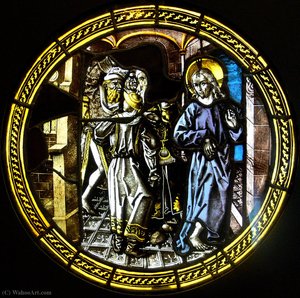
To gaze upon a surviving fragment of Hemmel’s work is to witness a profound dialogue between meticulous realism and ornamental splendor. His technique was a sophisticated marriage of tradition and innovation, heavily influenced by the expressive draughtsmanship of masters like Martin Schongauer and the emotive depth of Rogier van der Weyden. He possessed a singular ability to manipulate glass as if it were fine silk or heavy brocade, utilizing two-colored glass alongside black enamel and silver yellow to create textures that seemed almost tactile. Through the clever use of silver salts, he could achieve a luminous brilliance that brought faces to life and rendered the intricate patterns of liturgical vestments with astonishing fidelity.
His artistic signature is perhaps most evident in his approach to composition and detail:
- Intricate Frame Work: One of his most recognizable trademarks was the use of highly decorative, complex frame shapes that acted as windows within windows, guiding the viewer's eye toward the sacred narrative.
- Naturalistic Detail: Beyond the human figures, Hemmel displayed a deep reverence for the natural world, meticulously depicting flora and fauna—a characteristic famously seen in the Guild Window of Ulm Münster.
- Chromatic Vibrancy: The strategic use of bright iron reds and deep blues allowed his windows to transform the interior atmosphere of churches, turning sunlight into a medium for theological storytelling.
Historical Significance and Enduring Influence
While it is a poignant tragedy of history that so few of his complete windows survive today, the impact of Peter Hemmel von Andlau remains undeniable. He stood at a transformative crossroads in art history, bridging the gap between the rigid structures of the Middle Ages and the burgeoning naturalism of the Renaissance. His workshop served as a vital conduit for stylistic exchange, carrying the aesthetic values of the Rhineland into the heart of Europe. By integrating the fine details of contemporary engravings into the medium of glass, he elevated stained glass from decorative architectural element to a sophisticated form of high art.
Today, the fragments that remain—whether in the hands of museums like the Getty or tucked within the quiet corners of European cathedrals—serve as enduring testaments to his genius. He remains a pivotal figure whose mastery of light and color helped define the visual language of late Gothic devotion, leaving behind a legacy that continues to inspire awe in all who behold the brilliance of his reconstructed visions.
Pytania i odpowiedzi
Do jakiej epoki należał/a Peter Hemmel von Andlau?
Peter Hemmel von Andlau tworzył w okresie Renaissance. Epoka ta osadza twórczość artysty w kontekście historycznym.
Czy mogę przeglądać dzieła Peter Hemmel von Andlau według nurtów artystycznych?
Dzieła artysty Peter Hemmel von Andlau można przeglądać według nurtów na stronie Wszystkie nurty artystyczne.
Gdzie można znaleźć dzieła Peter Hemmel von Andlau pogrupowane według słów kluczowych?
Dzieła artysty Peter Hemmel von Andlau można przeglądać według słów kluczowych na stronie Według słów kluczowych. Każde słowo kluczowe grupuje powiązane ze sobą dzieła.