Portret Otto Mueller

94 najsłynniejszych obrazów artysty Otto Mueller – wybór z galerii

Aktualizacja: Październik 2026 · ranking według naszego wskaźnika popularności (liczba wyszukiwań, wizyt i zamówień dla każdego dzieła) · 114 dzieł Otto Mueller w naszym katalogu

W skrócie

Spośród wszystkich dzieł oryginalnych, które pozostawił Otto Mueller, najsłynniejszym jest Self-Portrait (1921), znajdujący się w kolekcji Saint Louis Art Museum w Saint Louis. Tuż za nimi znajdują się Large bathers oraz Bathers (1913). Nasz katalog zawiera 114 dzieł autorstwa Otto Mueller; galeria zachowała 94 najbardziej podziwianych na świecie prac, z których każda została przedstawiona wraz z datą powstania, informacją o muzeum oraz jej historią.

1874 – 1930, Lubawka Expressionism Najwięcej dzieł: Museum Folkwang

10 najlepszych obrazów artysty Otto Mueller: wybór galerii

1
Self-Portrait (1921) autorstwa Otto Mueller

Self-Portrait

1921 · Tempera · Saint Louis Art Museum, Saint Louis

A man stares from the shadows, his eyes fixed on a point just beyond the viewer. The face is a landscape of bone and light, carved by a heavy, directional glow that leaves half the features in a deep, murky darkness. This is not a casual glance but a piercing, psychological confrontation. The skin appears textured, built up through thick, visible brushstrokes that suggest the physical struggle of the artist…

The Otto Mueller selection continues, 11 to 94

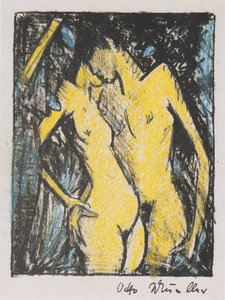
11Three Huts, One with Red Roof (Gypsy Huts) (1928) autorstwa Otto MuellerThree Huts, One with Red Roof (Gypsy Huts)1928 12Two Girls in the Forest (1923) autorstwa Otto MuellerTwo Girls in the Forest1923 · Staatliche Kunsthalle Karlsruhe 13Two Nudes on the Grass (1924) autorstwa Otto MuellerTwo Nudes on the Grass1924 14Seated Gypsy Girl (1926) autorstwa Otto MuellerSeated Gypsy Girl1926 15Am Ufer Sitzendes Mädchen (1926) autorstwa Otto MuellerAm Ufer Sitzendes Mädchen1926 16Stehende Zigeunerkinder (1927) autorstwa Otto MuellerStehende Zigeunerkinder1927 · Germanisches Nationalmuseum 17Badende (1914) autorstwa Otto MuellerBadende1914 · Museum Folkwang 18Three girls in profile autorstwa Otto MuellerThree girls in profile 19A tree autorstwa Otto MuellerA tree 20Two sitting in dunes girl autorstwa Otto MuellerTwo sitting in dunes girlThyssen-Bornemisza Museum 21Family of Gypsies (1915) autorstwa Otto MuellerFamily of Gypsies1915 · Museum Folkwang 22Three Nudes (1910) autorstwa Otto MuellerThree Nudes1910 · Kunstpalast 23Nudes Under Three Trees (1900) autorstwa Otto MuellerNudes Under Three Trees1900 24Stehender Maedchenakt mit Dolch (Lukretia) (1903) autorstwa Otto MuellerStehender Maedchenakt mit Dolch (Lukretia)1903 25Neger und Taenzerin (1903) autorstwa Otto MuellerNeger und Taenzerin1903 26Taenzerin mit Schleier (1903) autorstwa Otto MuellerTaenzerin mit Schleier1903 27Portrait of Maschka Mueller autorstwa Otto MuellerPortrait of Maschka MuellerWallraf-Richartz-Museum 28Boy in front of two standing nudes and a seated nudes (1910) autorstwa Otto MuellerBoy in front of two standing nudes and a seated nudes1910 29Badende (1911) autorstwa Otto MuellerBadende1911 30Adam and Eve autorstwa Otto MuellerAdam and EveStädel Museum 31Bathers (1916) autorstwa Otto MuellerBathers1916 · National Gallery of Art 32Liegendes Mädchen (1914) autorstwa Otto MuellerLiegendes Mädchen1914 33Badeszene Mit Vier Figuren, Haus Und Boot (nach Rechts) (1914) autorstwa Otto MuellerBadeszene Mit Vier Figuren, Haus Und Boot (nach Rechts)1914 34Mädchen Am See (1916) autorstwa Otto MuellerMädchen Am See1916 35Drei Badende Im Wasser (1913) autorstwa Otto MuellerDrei Badende Im Wasser1913 36Paar Mit Grünem Fächer (1913) autorstwa Otto MuellerPaar Mit Grünem Fächer1913 37Landschaft Mit Badenden (1915) autorstwa Otto MuellerLandschaft Mit Badenden1915 · Kirchner Museum Davos 38Five Bathers in Lake Landscape (1918) autorstwa Otto MuellerFive Bathers in Lake Landscape1918 39Forest Stream with Bathers (1919) autorstwa Otto MuellerForest Stream with Bathers1919 40Landscape with Yellow Nudes (1919) autorstwa Otto MuellerLandscape with Yellow Nudes1919 · MoMA - Museum of Modern Art 41Doppelbildnis (1922) autorstwa Otto MuellerDoppelbildnis1922 42Polnische Familie (1919) autorstwa Otto MuellerPolnische Familie1919 43Badende Am Waldsee (1919) autorstwa Otto MuellerBadende Am Waldsee1919 44Mädchen Und Knabe Am Waldteich (1922) autorstwa Otto MuellerMädchen Und Knabe Am Waldteich1922 45Marischka Mit Maske (1919) autorstwa Otto MuellerMarischka Mit Maske1919 · Museum Folkwang 46Waldstück Mit Stein Und Gebüsch (1919) autorstwa Otto MuellerWaldstück Mit Stein Und Gebüsch1919 47Liebespaar (1919) autorstwa Otto MuellerLiebespaar1919 · Museum der bildenden Künste 48Two Girls by the Lake (Seated and Standing Nude in Forest Landscape) (1926) autorstwa Otto MuellerTwo Girls by the Lake (Seated and Standing Nude in Forest Landscape)1926 49Self-Portrait with the Rooster (1927) autorstwa Otto MuellerSelf-Portrait with the Rooster1927 50Two Girls (1927) autorstwa Otto MuellerTwo Girls1927 51Bathers in the Reed Trench (1924) autorstwa Otto MuellerBathers in the Reed Trench1924 52Two Girls in the Grass (1926) autorstwa Otto MuellerTwo Girls in the Grass1926 · Bawarskie Państwowe Zbiory Malarstwa 53Zwei Zigeunerinnen (1923) autorstwa Otto MuellerZwei Zigeunerinnen1923 54Akt Im Wald (1923) autorstwa Otto MuellerAkt Im Wald1923 55Zigeunerwagen (1927) autorstwa Otto MuellerZigeunerwagen1927 56Sitzender Akt in Landschaft (1927) autorstwa Otto MuellerSitzender Akt in Landschaft1927 57Zigeunermadonna (1926) autorstwa Otto MuellerZigeunermadonna1926 58Waldstück Mit Blumen Und Teich (1925) autorstwa Otto MuellerWaldstück Mit Blumen Und Teich1925 59Stehende Zigeunerin Mit Kind (1926) autorstwa Otto MuellerStehende Zigeunerin Mit Kind1926 60Große Kniende (1926) autorstwa Otto MuellerGroße Kniende1926 61Waldlandschaft Mit Akt (1924) autorstwa Otto MuellerWaldlandschaft Mit Akt1924 · Aargauer Kunsthaus 62Zwischen Bäumen Stehendes Mädchen (1925) autorstwa Otto MuellerZwischen Bäumen Stehendes Mädchen1925 63Stehender Weiblicher Akt Zwischen Bäumen (1927) autorstwa Otto MuellerStehender Weiblicher Akt Zwischen Bäumen1927 64Stehende Zigeunerin mit Kind (1927) autorstwa Otto MuellerStehende Zigeunerin mit Kind1927 65Seated Nude in the Countryside (1925) autorstwa Otto MuellerSeated Nude in the Countryside1925 66Two Nude Girls in a Sand Dune, One Sitting, One Lying (1924) autorstwa Otto MuellerTwo Nude Girls in a Sand Dune, One Sitting, One Lying1924 · Scottish National Gallery of Modern Art 67Gypsy Child with Donkey (1929) autorstwa Otto MuellerGypsy Child with Donkey1929 68Zigeunerkind Im Dorf (1929) autorstwa Otto MuellerZigeunerkind Im Dorf1929 69Zigeunerin Im Garten (1929) autorstwa Otto MuellerZigeunerin Im Garten1929 70Stehender Mädchenakt Im Grünen (1929) autorstwa Otto MuellerStehender Mädchenakt Im Grünen1929 71Zwei Akte Im Freien (1927) autorstwa Otto MuellerZwei Akte Im Freien1927 · Albertina 72Three Nudes in the Forest autorstwa Otto MuellerThree Nudes in the Forest 73Negerpaar autorstwa Otto MuellerNegerpaar 74Selbstbildnis mit Pentagramm autorstwa Otto MuellerSelbstbildnis mit Pentagramm 75Bildnis des Malers Otto Mueller autorstwa Otto MuellerBildnis des Malers Otto Mueller 76Three Girls in a Wood autorstwa Otto MuellerThree Girls in a WoodSaint Louis Art Museum 77Three nudes in landscape autorstwa Otto MuellerThree nudes in landscape 78Landscape with Bathers autorstwa Otto MuellerLandscape with Bathers 79Three acts autorstwa Otto MuellerThree acts 80Naked woman sitting on branch autorstwa Otto MuellerNaked woman sitting on branch 81Landscape with forked tree autorstwa Otto MuellerLandscape with forked tree 82Standing couple autorstwa Otto MuellerStanding couple 83Cowering in the Forest Act autorstwa Otto MuellerCowering in the Forest Act 84Lovers autorstwa Otto MuellerLovers 85Five acts on water autorstwa Otto MuellerFive acts on water 86Bathers im Schilfgraben autorstwa Otto MuellerBathers im Schilfgraben 87Blue bathers autorstwa Otto MuellerBlue bathers 88Farmstead in France autorstwa Otto MuellerFarmstead in France 89Gypsy lovers autorstwa Otto MuellerGypsy lovers 90Gypsy Horse at Black Water autorstwa Otto MuellerGypsy Horse at Black WaterGermanisches Nationalmuseum 91Evening landscape (forest landscape) autorstwa Otto MuellerEvening landscape (forest landscape) 92Zwei Akte Im Freien (1923) autorstwa Otto MuellerZwei Akte Im Freien1923 · Albertina 93Half-Length Portrait of Two Nude Women (1919) autorstwa Otto MuellerHalf-Length Portrait of Two Nude Women1919 · Museum Ludwig 94Liebespaar (1920) autorstwa Otto MuellerLiebespaar1920 · Sprengel Museum Hannover

Słynne obrazy Otto Mueller epoka po epoce

Tematy, które przyciągnęły wzrok Otto Mueller

Cztery motywy najczęściej powracające w tych oryginałach, z których każdy doczekał się swojego najdoskonalszego przykładu.

Muzea przechowujące oryginały Otto Mueller

8 muzeów, w których znajduje się najwięcej obrazów z tej strony.

Muzea Miasto Dzieła artysty Otto Mueller Obrazy z tej listy
Museum Folkwang, EssenMuseum Folkwang Essen 4 Two Nudes in the Thicket, Badende, Family of Gypsies
Saint Louis Art Museum, Saint LouisSaint Louis Art Museum Saint Louis 2 Self-Portrait, Three Girls in a Wood
Germanisches Nationalmuseum, NorymbergaGermanisches Nationalmuseum Norymberga 2 Stehende Zigeunerkinder, Gypsy Horse at Black Water
Albertina, WiedeńAlbertina Wiedeń 2 Zwei Akte Im Freien, Zwei Akte Im Freien
Westfälisches Landesmuseum, MünsterWestfälisches Landesmuseum Münster 1 Bathers
Staatliche Kunsthalle Karlsruhe, KarlsruheStaatliche Kunsthalle Karlsruhe Karlsruhe 1 Two Girls in the Forest
Thyssen-Bornemisza Museum, MadrytThyssen-Bornemisza Museum Madryt 1 Two sitting in dunes girl
Kunstpalast, DüsseldorfKunstpalast Düsseldorf 1 Three Nudes

Otto Mueller dekada po dekadzie: oryginały definiujące każdy okres

Dzieła według dekad

Wybierz dekadę, aby zobaczyć dzieło, które ją definiuje.

Pytania kolekcjonerów o obrazy Otto Mueller

Z jakiego dzieła najbardziej znany jest Otto Mueller?Odkryj odpowiedź

Self-Portrait (1921), Saint Louis Art Museum, Saint Louis. Następne są Large bathers oraz Bathers (1913).

W jakim wieku był Otto Mueller, gdy powstało Self-Portrait?Odkryj odpowiedź

47 lat: Self-Portrait pochodzi z 1921, a Otto Mueller urodził(a) się w 1874.

Jakie są dziesięć najsłynniejszych obrazów, których autorem jest Otto Mueller?Odkryj odpowiedź

Self-Portrait, Large bathers, Bathers, Two bathing girls, Two Nudes in the Thicket, Nudes in Dunes, Two Sisters (Russian Pair of Girls), Three Nudes Before a Mirror, Liebespaar i Olympia. Powyższy ranking zawiera rok powstania oraz muzeum dla każdego z nich.

Ile obrazów pozostawił po sobie Otto Mueller?Odkryj odpowiedź

Nasz katalog zawiera 114 dzieł artysty Otto Mueller, datowanych od 1900 do 1929.

W których muzeach znajdują się arcydzieła Otto Mueller?Odkryj odpowiedź

W większości znajdują się w Museum Folkwang (Essen), Saint Louis Art Museum (Saint Louis) i Germanisches Nationalmuseum (Norymberga). Powyższa tabela muzeów zawiera ich pełną listę.

W których latach Otto Mueller namalował swoje najsłynniejsze dzieła?Odkryj odpowiedź

W 1920s: 39 z 94 dzieł na tej stronie powstało w tym czasie, w tym Self-Portrait.

Jakie są pierwsze i ostatnie słynne oryginały Otto Mueller?Odkryj odpowiedź

Na tej stronie najwcześniejszy to Nudes Under Three Trees (1900), a najpóźniejszy Gypsy Child with Donkey (1929).

Jakie tematy Otto Mueller wybierał najczęściej?Odkryj odpowiedź

Landscape (7), Nude figures (5) i German art (5), w ramach 94 dzieł na tej stronie.

Której techniki Otto Mueller używał najczęściej?Odkryj odpowiedź

Tempera, dla 3 z 94 dzieł na tej stronie.

Do jakiego nurtu artystycznego należy Otto Mueller?Odkryj odpowiedź

Expressionism, sądząc po oryginałach na tej stronie.

Które dzieła Otto Mueller znajdują się w Museum Folkwang?Odkryj odpowiedź

Two Nudes in the Thicket, Badende i Family of Gypsies: Museum Folkwang, Essen posiada 4 dzieł widocznych na tej stronie.

Otto Mueller: życie i twórczość

Wędrowna Dusza: Życie i Sztuka Otto Muellera

Otto Mueller, nazwisko często szepczane w towarzystwie pionierów niemieckiego ekspresjonizmu, był artystą głęboko nastrojonym na rytmy natury i życie toczące się na jej obrzeżach. Urodzony w 1874 roku w Liebau, Śląsk – obecnie Lubawka, Polska – jego podróż rozpoczęła się wśród krajobrazu, który na zawsze odcisnął piętno na jego wizji artystycznej. Wczesne szkolenie w litografii w Görlitz i Breslau dostarczyło mu solidnych umiejętności, mistrzostwa linii i tekstury, które charakteryzowały wiele z jego późniejszych prac. Kontynuował studia w prestiżowych akademiach w Dreźnie i Monachium, choć krytyczna ocena Franza von Stucka w tym drugim miejscu doprowadziła do okresu samokształcenia. Te formacyjne lata widziały Muellera przyswajającego wpływy impresjonizmu, Jugendstilu i symbolizmu, a mimo to pozostawał niespokojny, poszukując głosu wyjątkowego dla siebie.

Harmonia w Zniekształceniu: Ekspresjonistyczna Droga

Przełom nastąpił wraz z przeprowadzką Muellera do Berlina w 1908 roku. Tam, wśród rozwijającego się artystycznego fermentu miasta, jego styl zaczął ulegać dramatycznej transformacji. Interakcje z takimi postaciami jak Wilhelm Lehmbruck i Rainer Maria Rilke rozpaliły rosnące zainteresowanie eksploracją głębi emocjonalnych ludzkiego doświadczenia. W 1910 roku formalnie dołączył do grupy artystycznej ‘Die Brücke’ (Most), której członkowie dążyli do odrzucenia konwencji akademickich i stworzenia nowego języka wizualnego zakorzenionego w surowych emocjach i subiektywnej percepcji. Podczas gdy jego współpracownicy często sięgali po jaskrawe palety kolorów i agresywne pociągnięcia pędzla, Mueller obrał nieco inne ścieżki. Szukał harmonii w zniekształceniu, upraszczając formy i kontury, aby ujawnić podległą jedność między człowiekiem a światem naturalnym. Jego krajobrazy, nacechowane cichą intensywnością, odbijają ducha Vincenta van Gogha, podczas gdy jego postacie – zwłaszcza kobiety z pochodzenia romskiego – posiadają przejmującą grację. Ten okres utrwalił przydomek „Gypsy Müller”, choć to nazwa rodzona bardziej z fascynacji tematyką jego prac niż ze sprawdzonego pokrewieństwa.

Unikalna Technika i Powtarzające się Motywy

Proces artystyczny Muellera był równie odmienny jak jego wizja. Preferował distemper – farbę na bazie wody – nakładaną na szorstką tkaninę, tworząc matową powierzchnię, która nadawała jego pracm ziemski, niemal prymitywny charakter. Ta technika w znacznym stopniu przyczyniła się do ogólnego nastroju jego obrazów, wywołując poczucie intymności i wrażliwości. Jego tematyka stale krążyła wokół kilku kluczowych tematów: spokojne krajobrazy często przypominające gwiaździste noce, ekspresyjne nagie ciała uosabiające zarówno zmysłowość, jak i melancholię oraz, co rzuca się w oczy, przedstawienia ludzi z pochodzenia romskiego. Te postacie nie były jedynie portretami; reprezentowały tęsknotę za wolnością, więź z naturą i alternatywny sposób życia poza ograniczeniami mieszczańskiego społeczeństwa. Był także płodnym grafikiem, a litografia była jego preferowanym medium, obok kilku drzeworytów i akwafort. Prostota linii w tych grafikach dodatkowo podkreślała emocjonalne sedno jego tematów.

Cienie Wojny i Dziedzictwo

Podobnie jak wielu z jego pokolenia, życie Muellera było głęboko naznaczone I wojną światową. Służył jako żołnierz na froncie francuskim i rosyjskim, doświadczenie to niewątpliwie pozostawiło ślad, choć nie zmieniło dramatycznie jego stylu artystycznego. Po wojnie przyjął stanowisko profesora w Akademii Sztuk Pięknych we Wrocławiu, poświęcając się nauczaniu aż do śmierci w 1930 roku. Tragicznie, jego praca padła ofiarą ideologicznych czystek nazistowskiego reżimu w 1937 roku, kiedy to ponad trzysta prac zostało skonfiskowanych z niemieckich muzeów i oznaczonych jako „sztuka zdegenerowana”. Pomimo tej represji, artystyczne dziedzictwo Muellera przetrwało. Dziś jest uznawany za kluczową postać ekspresjonizmu, artystę, którego wrażliwe przedstawienia ludzkości i natury nadal rezonują z odbiorcami na całym świecie. Jego praca służy jako przejmujące przypomnienie o sile sztuki w przekraczaniu granic politycznych i mówieniu do uniwersalnego stanu człowieczeństwa.