Portret Nikolai Astrup

96 najsłynniejszych obrazów artysty Nikolai Astrup – wybór z galerii

Aktualizacja: Listopad 2026 · ranking według naszego wskaźnika popularności (liczba wyszukiwań, wizyt i zamówień dla każdego dzieła) · 96 dzieł Nikolai Astrup w naszym katalogu

W skrócie

Spośród wszystkich dzieł oryginalnych, które pozostawił Nikolai Astrup, najsłynniejszym jest Early Snow (1926), znajdujący się w kolekcji Bergen Kunstmuseum w Bergen. Tuż za nimi znajdują się Foxgloves (1920) oraz Landscape with Seated Woman (1892). Nasz katalog zawiera 96 dzieł autorstwa Nikolai Astrup; galeria zachowała 96 najbardziej podziwianych na świecie prac, z których każda została przedstawiona wraz z datą powstania, informacją o muzeum oraz jej historią.

1880 – 1928, Bremanger Neo-romanticism Najwięcej dzieł: Bergen Kunstmuseum

10 najlepszych obrazów artysty Nikolai Astrup: wybór galerii

1
Early Snow (1926) autorstwa Nikolai Astrup

Early Snow

1926 · Oil On Canvas · Bergen Kunstmuseum, Bergen

In Early Snow, Nikolai Astrup captures a quiet moment within a winter landscape. The scene focuses on a rustic wooden cabin nestled in a snowy environment, where the weight of the season begins to settle over the terrain. It is a depiction of rural life, showing a profound connection to the natural world through the presence of a simple dwelling amidst the elements. The subject matter suggests a stillness that…

2
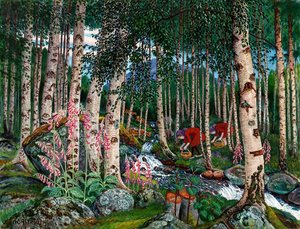
Foxgloves (1920) autorstwa Nikolai Astrup

Foxgloves

1920 · Painting · Bergen Kunstmuseum, Bergen

In the heart of the Norwegian landscape, where the mist clings to the valleys of Vestlandet, Nikolai Astrup captured a world that feels simultaneously grounded in reality and touched by magic. His 1920 masterpiece, Foxgloves, is far more than a mere botanical study; it is an immersive journey into a thriving, breathing ecosystem. The canvas unfolds as a lush forest sanctuary, where the dense canopy of healthy green leaves creates…

3
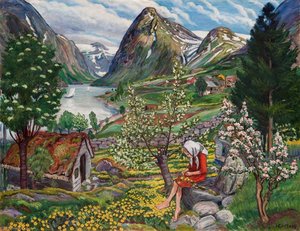
Landscape with Seated Woman (1892) autorstwa Nikolai Astrup

Landscape with Seated Woman

1892 · Oil On Panel · Sogn og Fjordane Kunstmuseum, Førde

In Landscape with Seated Woman, Nikolai Astrup presents a serene rural scene that invites a quiet contemplation of the Norwegian countryside. Painted in 1892, the work captures a moment of stillness within the natural world. The landscape unfolds with a sense of calm, focusing on the quietude of a remote setting. It is a scene that feels lived-in and deeply connected to the earth.

5
Cowshed Courting (1903) autorstwa Nikolai Astrup

Cowshed Courting

In this oil painting, Cowshed Courting by Nikolai Astrup, we find ourselves drawn into a private, dimly lit space. Created about 1903, the work captures a romantic encounter held within the rustic confines of a cowshed. On the left side of the foreground, a young man and woman are locked in an embrace. Their figures form a quiet, vertical focal point amidst the shadows of the barn. The man is…

6
The Artist's Father (1900) autorstwa Nikolai Astrup

The Artist's Father

1900 · Oil On Canvas · Sogn og Fjordane Kunstmuseum, Førde

In this intimate oil portrait, Nikolai Astrup turns his gaze toward a deeply personal subject: his father. Painted about 1900, the work captures an older man in a moment of quiet presence. It is a study of character and lineage, rendered with a focus on the individual's physical presence and the weight of years. The portrait moves beyond a mere likeness to offer a glimpse into the artist's own domestic…

10
Sandalstrand (1926) autorstwa Nikolai Astrup

Sandalstrand

1926 · Oil On Canvas · KODE Art museums and composer homes, Bergen

Executed in 1926, Sandalstrand by Nikolai Astrup presents a serene rural scene in Norway. The work captures a specific moment of pastoral life, focusing on the quietude of the Norwegian countryside. It reflects the artist's deep connection to the landscape of Vestlandet, specifically the area around Jølster.

Kontynuacja zestawienia Nikolai Astrup, od 11 do 96

11In Paradise autorstwa Nikolai AstrupIn ParadiseBergen Kunstmuseum 12Job autorstwa Nikolai AstrupJobBergen Kunstmuseum 13From Sunde (1921) autorstwa Nikolai AstrupFrom Sunde1921 · Bergen Kunstmuseum 14June Night and Old West Country Farmyard (1908) autorstwa Nikolai AstrupJune Night and Old West Country Farmyard1908 · Bergen Kunstmuseum 15Gethsemane (1926) autorstwa Nikolai AstrupGethsemane1926 · Bergen Kunstmuseum 16Svanøybukta (1905) autorstwa Nikolai AstrupSvanøybukta1905 · KODE Art museums and composer homes 17Landscape with Children (1903) autorstwa Nikolai AstrupLandscape with Children1903 · National Museum of Art, Architecture and Design 18Autumnrain in the Mountain Valley (1899) autorstwa Nikolai AstrupAutumnrain in the Mountain Valley1899 · National Museum of Art, Architecture and Design 19Night (1902) autorstwa Nikolai AstrupNight1902 · Sogn og Fjordane Kunstmuseum 20Going to the Mill (1905) autorstwa Nikolai AstrupGoing to the Mill1905 · Bergen Kunstmuseum 21Landscape in Spring (1908) autorstwa Nikolai AstrupLandscape in Spring1908 · National Museum of Art, Architecture and Design 22Mountainlandscape (1908) autorstwa Nikolai AstrupMountainlandscape1908 · National Museum of Art, Architecture and Design 23Foxgloves (1909) autorstwa Nikolai AstrupFoxgloves1909 · National Museum of Art, Architecture and Design 24Landscape in Moonlight (1907) autorstwa Nikolai AstrupLandscape in Moonlight1907 · National Museum of Art, Architecture and Design 25Landscape with Figures autorstwa Nikolai AstrupLandscape with FiguresNational Museum of Art, Architecture and Design 26The white Horse in Spring (1910) autorstwa Nikolai AstrupThe white Horse in Spring1910 · National Museum of Art, Architecture and Design 27Warmth Enters the Earth (1908) autorstwa Nikolai AstrupWarmth Enters the Earth1908 · Lillehammer Art Museum 28Rhubarb autorstwa Nikolai AstrupRhubarbKODE Art museums and composer homes 29Spring night in the garden (1909) autorstwa Nikolai AstrupSpring night in the garden1909 · KODE Art museums and composer homes 30Midsummer Eve Bonfire by Lake Jølstravatnet (1909) autorstwa Nikolai AstrupMidsummer Eve Bonfire by Lake Jølstravatnet1909 31Night in Spring (1909) autorstwa Nikolai AstrupNight in Spring1909 · Bergen Kunstmuseum 32Old Man with Beard autorstwa Nikolai AstrupOld Man with BeardSogn og Fjordane Kunstmuseum 33The Farewell autorstwa Nikolai AstrupThe FarewellBergen Kunstmuseum 34Head, Old Man with Beard autorstwa Nikolai AstrupHead, Old Man with BeardBergen Kunstmuseum 35Man Plowing (also known as Ploughman) autorstwa Nikolai AstrupMan Plowing (also known as Ploughman)Bergen Kunstmuseum 36The Fisherman autorstwa Nikolai AstrupThe FishermanBergen Kunstmuseum 37Bird on Stone (1912) autorstwa Nikolai AstrupBird on Stone1912 · KODE Art museums and composer homes 38Downy Night (1912) autorstwa Nikolai AstrupDowny Night1912 · Bergen Kunstmuseum 39Mill Water (1916) autorstwa Nikolai AstrupMill Water1916 · Bergen Kunstmuseum 40Midsummer Night Bonfire (1915) autorstwa Nikolai AstrupMidsummer Night Bonfire1915 · Bergen Kunstmuseum 41Corn Store (1920) autorstwa Nikolai AstrupCorn Store1920 · KODE Art museums and composer homes 42March Morning (1920) autorstwa Nikolai AstrupMarch Morning1920 · Bergen Kunstmuseum 43Kari Motif from Sunde (1918) autorstwa Nikolai AstrupKari Motif from Sunde1918 · Bergen Kunstmuseum 44Spring in Jølster (1925) autorstwa Nikolai AstrupSpring in Jølster1925 · National Museum of Art, Architecture and Design 45Interior with Cradle (1925) autorstwa Nikolai AstrupInterior with Cradle1925 · Bergen Kunstmuseum 46The Goose (1926) autorstwa Nikolai AstrupThe Goose1926 · Bergen Kunstmuseum 47Clear June Night autorstwa Nikolai AstrupClear June NightKODE Art museums and composer homes 48The Parsonage Garden autorstwa Nikolai AstrupThe Parsonage GardenKODE Art museums and composer homes 49At 2 PM July 14th autorstwa Nikolai AstrupAt 2 PM July 14th 50The Old Woman with the Lantern autorstwa Nikolai AstrupThe Old Woman with the LanternKODE Art museums and composer homes 51Grain Stacks autorstwa Nikolai AstrupGrain StacksSogn og Fjordane Kunstmuseum 52Storehouse in Jølster autorstwa Nikolai AstrupStorehouse in JølsterNational Museum of Art, Architecture and Design 53Wood in Winter autorstwa Nikolai AstrupWood in WinterNational Museum of Art, Architecture and Design 54Myklebust autorstwa Nikolai AstrupMyklebustSogn og Fjordane Kunstmuseum 55Fisherman autorstwa Nikolai AstrupFisherman 56Landscape from Ålhus autorstwa Nikolai AstrupLandscape from ÅlhusBergen Kunstmuseum 57Naked Trees autorstwa Nikolai AstrupNaked TreesBergen Kunstmuseum 58The Farmer autorstwa Nikolai AstrupThe FarmerBergen Kunstmuseum 59Girl Spinning autorstwa Nikolai AstrupGirl SpinningBergen Kunstmuseum 60Marigold Night (also known as Soleienatt) autorstwa Nikolai AstrupMarigold Night (also known as Soleienatt) 61Menu 9 7.22 autorstwa Nikolai AstrupMenu 9 7.22Bergen Kunstmuseum 62Jølster Woman with Hood autorstwa Nikolai AstrupJølster Woman with HoodBergen Kunstmuseum 63Juninatt i haven (A Night in June in the Garden) autorstwa Nikolai AstrupJuninatt i haven (A Night in June in the Garden) 64Man's Head with Cap autorstwa Nikolai AstrupMan's Head with CapBergen Kunstmuseum 65Ålhustunet, Jølster autorstwa Nikolai AstrupÅlhustunet, Jølster 66Landscape Ålhusdalen autorstwa Nikolai AstrupLandscape ÅlhusdalenBergen Kunstmuseum 67Landscape with Pine autorstwa Nikolai AstrupLandscape with PineBergen Kunstmuseum 68Men Binding Hay Racks autorstwa Nikolai AstrupMen Binding Hay RacksBergen Kunstmuseum 69Kari paa Sunde autorstwa Nikolai AstrupKari paa Sunde 70Inger Grimsbø, Old Jølster Girl autorstwa Nikolai AstrupInger Grimsbø, Old Jølster GirlBergen Kunstmuseum 71The Hat Thief autorstwa Nikolai AstrupThe Hat ThiefBergen Kunstmuseum 72May Moon autorstwa Nikolai AstrupMay MoonBergen Kunstmuseum 73Man Cutting Branches from Sallow autorstwa Nikolai AstrupMan Cutting Branches from SallowBergen Kunstmuseum 74Landscape with Hay Rack and House autorstwa Nikolai AstrupLandscape with Hay Rack and HouseBergen Kunstmuseum 75Elements from Spring and Will autorstwa Nikolai AstrupElements from Spring and WillBergen Kunstmuseum 76The Godly Cobbler autorstwa Nikolai AstrupThe Godly CobblerBergen Kunstmuseum 77Landscape with White House autorstwa Nikolai AstrupLandscape with White HouseBergen Kunstmuseum 78Knitting Woman autorstwa Nikolai AstrupKnitting WomanBergen Kunstmuseum 79Great Grandfather of Half the Village autorstwa Nikolai AstrupGreat Grandfather of Half the VillageBergen Kunstmuseum 80The Eager Suitor autorstwa Nikolai AstrupThe Eager SuitorBergen Kunstmuseum 81June Night autorstwa Nikolai AstrupJune NightBergen Kunstmuseum 82Jølster Tale autorstwa Nikolai AstrupJølster TaleBergen Kunstmuseum 83Early Summer in Jølster autorstwa Nikolai AstrupEarly Summer in JølsterBergen Kunstmuseum 84Home from Work autorstwa Nikolai AstrupHome from WorkBergen Kunstmuseum 85Marigold Night autorstwa Nikolai AstrupMarigold NightBergen Kunstmuseum 86Growing Weather in Sandalstrand autorstwa Nikolai AstrupGrowing Weather in SandalstrandBergen Kunstmuseum 87Large Stook autorstwa Nikolai AstrupLarge StookBergen Kunstmuseum 88Midsummer Night Bonfire (sketch) autorstwa Nikolai AstrupMidsummer Night Bonfire (sketch)Bergen Kunstmuseum 89Mill Water (woodcut) autorstwa Nikolai AstrupMill Water (woodcut)Bergen Kunstmuseum 90The Gypsy Girl autorstwa Nikolai AstrupThe Gypsy GirlBergen Kunstmuseum 91May Moon, Winter Night autorstwa Nikolai AstrupMay Moon, Winter NightBergen Kunstmuseum 92Haymaking autorstwa Nikolai AstrupHaymakingBergen Kunstmuseum 93Midsummer Night Bonfire (woodcut) autorstwa Nikolai AstrupMidsummer Night Bonfire (woodcut)Bergen Kunstmuseum 94The Doll House autorstwa Nikolai AstrupThe Doll HouseBergen Kunstmuseum 95Mother and Child(ren ) by the Garden Table autorstwa Nikolai AstrupMother and Child(ren ) by the Garden TableBergen Kunstmuseum 96Bonfire celebrating Midsummer Night (1912) autorstwa Nikolai AstrupBonfire celebrating Midsummer Night1912 · National Museum of Art, Architecture and Design

Słynne obrazy Nikolai Astrup epoka po epoce

Tematy, które przyciągnęły wzrok Nikolai Astrup

Cztery motywy najczęściej powracające w tych oryginałach, z których każdy doczekał się swojego najdoskonalszego przykładu.

Muzea przechowujące oryginały Nikolai Astrup

5 muzeów, w których znajduje się najwięcej obrazów z tej strony.

Muzea Miasto Dzieła artysty Nikolai Astrup Obrazy z tej listy
Bergen Kunstmuseum, BergenBergen Kunstmuseum Bergen 56 Early Snow, Foxgloves, In Paradise
National Museum of Art, Architecture and Design, OsloNational Museum of Art, Architecture and Design Oslo 15 Portrait of a young Girl, Landscape with Figures, Spring Evening in Jølster
KODE Art museums and composer homes Bergen 10 Cowshed Courting, Sandalstrand, Svanøybukta
Sogn og Fjordane Kunstmuseum, FørdeSogn og Fjordane Kunstmuseum Førde 7 Landscape with Seated Woman, The Artist's Father, The Artist's Mother
Lillehammer Art Museum, LillehammerLillehammer Art Museum Lillehammer 1 Warmth Enters the Earth

Nikolai Astrup dekada po dekadzie: oryginały definiujące każdy okres

Dzieła według dekad

Wybierz dekadę, aby zobaczyć dzieło, które ją definiuje.

Pytania kolekcjonerów o obrazy Nikolai Astrup

Z jakiego dzieła najbardziej znany jest Nikolai Astrup?Odkryj odpowiedź

Early Snow (1926), Bergen Kunstmuseum, Bergen. Następne są Foxgloves (1920) oraz Landscape with Seated Woman (1892).

W jakim wieku był Nikolai Astrup, gdy powstało Early Snow?Odkryj odpowiedź

46 lat: Early Snow pochodzi z 1926, a Nikolai Astrup urodził(a) się w 1880.

Jakie są dziesięć najsłynniejszych obrazów, których autorem jest Nikolai Astrup?Odkryj odpowiedź

Early Snow, Foxgloves, Landscape with Seated Woman, Portrait of a young Girl, Cowshed Courting, The Artist's Father, The Artist's Mother, Landscape with Figures, Spring Evening in Jølster i Sandalstrand. Powyższy ranking zawiera rok powstania oraz muzeum dla każdego z nich.

Ile obrazów pozostawił po sobie Nikolai Astrup?Odkryj odpowiedź

Nasz katalog zawiera 96 dzieł artysty Nikolai Astrup, datowanych od 1892 do 1926.

W których muzeach znajdują się arcydzieła Nikolai Astrup?Odkryj odpowiedź

W większości znajdują się w Bergen Kunstmuseum (Bergen), National Museum of Art, Architecture and Design (Oslo) i KODE Art museums and composer homes (Bergen). Powyższa tabela muzeów zawiera ich pełną listę.

W których latach Nikolai Astrup namalował swoje najsłynniejsze dzieła?Odkryj odpowiedź

W 1900s: 18 z 96 dzieł na tej stronie powstało w tym czasie, w tym Portrait of a young Girl.

Jakie są pierwsze i ostatnie słynne oryginały Nikolai Astrup?Odkryj odpowiedź

Na tej stronie najwcześniejszy to Landscape with Seated Woman (1892), a najpóźniejszy Early Snow (1926).

Jakie tematy Nikolai Astrup wybierał najczęściej?Odkryj odpowiedź

Trees (6), Woman (5) i Landscape (4), w ramach 96 dzieł na tej stronie.

Której techniki Nikolai Astrup używał najczęściej?Odkryj odpowiedź

Oil On Canvas, dla 7 z 96 dzieł na tej stronie.

Do jakiego nurtu artystycznego należy Nikolai Astrup?Odkryj odpowiedź

Neo-romanticism, sądząc po oryginałach na tej stronie.

Które dzieła Nikolai Astrup znajdują się w Bergen Kunstmuseum?Odkryj odpowiedź

Early Snow, Foxgloves i In Paradise: Bergen Kunstmuseum, Bergen posiada 56 dzieł widocznych na tej stronie.

Nikolai Astrup: życie i twórczość

Wizjoner norweskiej dziczy

Nikolai Astrup jawi się jako postać niezwykła w historii sztuki norweskiej – malarz, którego głęboka więź z krajobrazem i tradycjami regionu Vestlandet zapewniła mu miejsce wśród najbardziej wyrazistych artystów neoromantycznych swoich czasów. Urodzony 30 sierpnia 1880 roku w nadmorskiej wiosce Kalvåg, w surowym regionie Bremanger, Astrup spędził wczesne lata zanurzony w atmosferycznym pięknie fiordów i gór. Jako najstarszy syn proboszcza, dorastał w atmosferze rodzinnej pobożności, jednak jego serce zostało nieodwołalnie przyciągnięte przez tętniący życiem, witalny puls świata natury. Ta głęboka więź z korzeniami ostatecznie popchnęła go ku stylowi charakteryzującemu się intensywną paletą barw oraz niezłomnym oddaniem w portretowaniu codziennego życia i folkloru wiejskiej Norwegii.

Jego droga ku artystycznemu mistrzostwu nie była prostym szlakiem, lecz raczej pełną pasji eksploracją tradycji i nowoczesności. Choć początkowe skłonności sugerowały życie poświęcone studiom teologicznym, pasja do rysunku wyprowadziła Astrupa z katedry w Trondheim ku rozkwitającej scenie artystycznej w Kristianii (dzisiejszym Oslo). To właśnie tam, pod wpływowym okiem Harriet Backer, zaczął szlifować swoje umiejętności techniczne. Krótki, lecz przełomowy pobyt w Paryżu jeszcze bardziej wzbogacił jego wizję, otwierając go na awangardowe ruchy epoki i nawiązując relacje z artystami takimi jak Christian Krohg. Te spotkania z technikami impresjonistycznymi oraz szerszą, europejską perspektywą dostarczyły mu narzędzi, by ostatecznie splotło tradycję z innowacją w spójny, unikalny język artystyczny.

Dusza Jølster i magia realizmu

W 1902 roku Astrup podjął kluczową decyzję o powrocie do rodzinnego domu w Jølster, osiadając w posiadłości Sandalstrand. Powrót ten był czymś więcej niż powrotem do korzeni; był to proces całkowitego zanurzenia się w świecie, który stał się jego dożywotnią muzą. Wraz z żoną, Engel Sunde, wychowywał ośmioro dzieci pośród trudnych realiów ekonomicznych wiejskiego życia, jednak to właśnie te niedobory stały się paliwem dla jego twórczej energii. Stał się mistrzem chwytania magicznego realizmu norweskiego krajobrazu, w którym soczysta zieleń lata i surowa, cicha samotność zimy były oddane z niemal nadprzyrodzoną intensywnością. Jego dzieła często wykraczają poza zwykłą reprezentację, wykorzystując żywą, kolorową paletę do przywołania mistycznej atmosfery gór i sezonowych przemian fiordów.

Technika Astrupa opierała się na emocjach w równym stopniu, co na uważnej obserwacji. Był utalentowanym grafikiem i ogrodnikiem, co znajdowało odzwierciedlenie w jego złożonym podejściu do kompozycji. W jego drzeworytach i obrazach można dostrzec, jak modyfikował nastroje poprzez subtelne zmiany koloru oraz strategiczne dodawanie lub usuwanie motywów. Jego dorobek słynie z umiejętności uchwycenia wzniosłości – tego zapierającego dech w piersiach styku piękna i grozy. Bez względu na to, czy przedstawiał spokojną zimową scenę, taką jak Mill Water, czy przejmująco piękne, monochromatyczne krajobrazy z Naked Trees, prace Astrupa zapraszają widza do świata, w którym granice między fizycznym krajobrazem a sferą duchową ulegają pięknemu zatarciu.

Dziedzictwo narodowego języka wizualnego

Poza jego indywidualnymi płótnami, historyczne znaczenie Nikolaja Astrupa tkwi w jego pionierskim wysiłku uchwycenia narodowego języka wizualnego. Nie malował on jedynie pejzaży; dokumentował samą esencję norweskiej tożsamości, celebrując tradycyjny styl życia i folklor definiujący region Vestlandet. Jego zdolność do łączenia lokalności z uniwersalizmem sprawiła, że jego twórczość rezonowała daleko poza granicami Norwegii, nawet jeśli za życia pozostawał w dużej mierze nieznany międzynarodowej społeczności. Pozostaje filarem norweskiego modernizmu – artystą, który odnalazł nieskończoność w tym, co intymne.

Trwały wpływ jego życia i twórczości można podsumować poprzez te kluczowe elementy:

  • Innowacja artystyczna: płynna integracja impresjonistycznego duktu pędzla z tematyką neoromantyczną.
  • Zachowanie kultury: oddane skupienie na tradycjach, zwyczajach i krajobrazach regionu Jølster.
  • Mistrzostwo techniczne: niezwykła biegłość w operowaniu kolorem i technikami graficznymi, pozwalająca na głęboki rezonans emocjonalny.
  • Więź ekologiczna: jego życie w Sandalstrand stanowiło wczesny przejaw głębokiego szacunku dla środowiska naturalnego i ochrony przyrody.

Choć jego życie było tragicznie krótkie i zakończyło się w 1928 roku w wieku czterdziestu siedmiu lat, dziedzictwo Nikolaja Astrupa wciąż rozkwita. Jego obrazy pozostają tętniącymi życiem oknami na minioną epokę, oferując ponadczasowy wgląd w samo serce norweskiej dziczy.