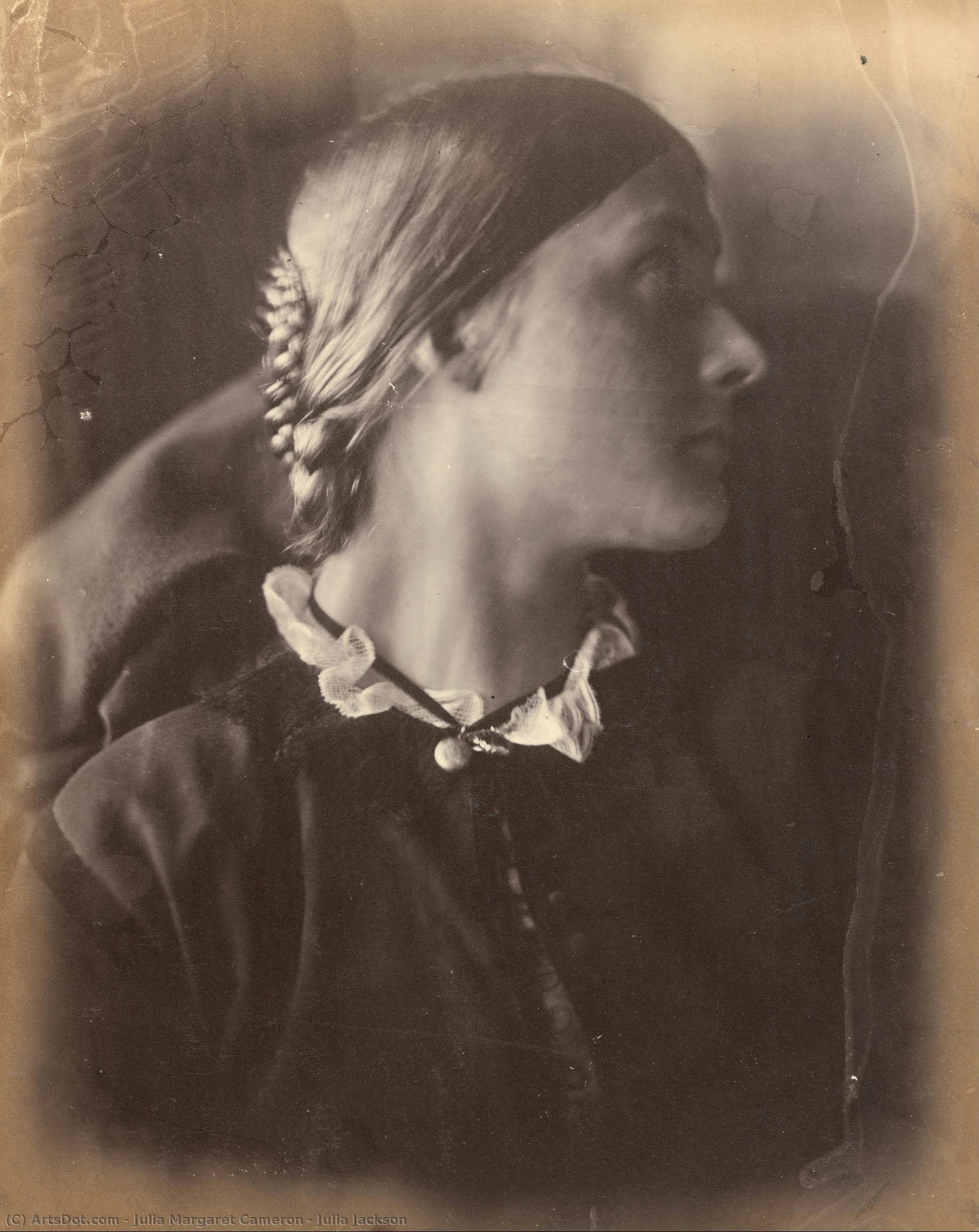
Portret Julia Margaret Cameron

Obrazy: 39 najsłynniejszych dzieł artysty Julia Margaret Cameron – spojrzenie galerii

Aktualizacja: Listopad 2026 · ranking według naszego wskaźnika popularności (liczba wyszukiwań, wizyt i zamówień dla każdego dzieła) · 39 dzieł Julia Margaret Cameron w naszym katalogu

W skrócie

Według opinii kuratorów galerii, najsłynniejszym obrazem Julia Margaret Cameron jest Julia Jackson (1864), którego oryginał znajduje się w National Gallery of Victoria w Melbourne. St Agnes (Alice Liddell) (1872) i H. W. Longfellow\n\n(Main View) (1893) dopełniają trio, które zna każde oko. Z 39 dzieł Julia Margaret Cameron w naszym katalogu, galeria prezentuje poniżej 39 najsłynniejszych prac – każda z nich jest oryginałem z podaniem roku powstania, muzeum oraz cech wyróżniających ją na tle innych.

1815 – 1879, Kolkata Romanticism Najwięcej dzieł: Muzeum J. Paula Getty'ego

10 najlepszych obrazów artysty Julia Margaret Cameron w galerii

1
Julia Jackson (1864) autorstwa Julia Margaret Cameron

Julia Jackson

1864 · Black and White Photography · National Gallery of Victoria, Melbourne

In the soft, silvered shadows of 1864, Julia Margaret Cameron captured more than just a likeness; she captured an essence. This profound portrait of Julia Jackson stands as a testament to a unique bond between photographer and subject—a relationship defined by kinship and artistic obsession. As Cameron’s niece and godchild, the young Jackson was not merely a sitter but a muse, appearing in over fifty of the photographer's most celebrated…

2
St Agnes (Alice Liddell) (1872) autorstwa Julia Margaret Cameron

St Agnes (Alice Liddell)

1872 · Black and White Photography · Art Gallery of South Australia, Adelaide

In the evocative realm of 19th-century photography, few images capture the ethereal intersection of childhood innocence and spiritual gravity as profoundly as Julia Margaret Cameron’s St Agnes (Alice Liddell). Created in 1872, this masterpiece is far more than a mere photographic record; it is a carefully orchestrated window into the Victorian soul. By casting Alice Liddell—the young inspiration behind Lewis Carroll’s iconic Alice’s Adventures in Wonderland—in the role of Saint…

3
H. W. Longfellow\n\n(Main View) (1893) autorstwa Julia Margaret Cameron

H. W. Longfellow\n\n(Main View)

1893 · Black and White Photography · Muzeum J. Paula Getty'ego, Los Angeles

The photograph H. W. Longfellow\n\n(Main View) by Julia Margaret Cameron captures the celebrated American poet in a moment of stillness. Taken about 1893, the image presents a man defined by a thick beard and mustache. He wears glasses that catch the light, framing a gaze that remains fixed and contemplative. This portrait is held within the J. Paul Getty Museum collection in Los Angeles, United States.

4
Alfred, Lord Tennyson, 1865 (Dirty Monk)\n\n(Main View) (1893) autorstwa Julia Margaret Cameron

Alfred, Lord Tennyson, 1865 (Dirty Monk)\n\n(Main View)

1893 · Black and White Photography · Muzeum J. Paula Getty'ego, Los Angeles

In this intimate portrait, titled Alfred, Lord Tennyson, 1865 (Dirty Monk)\n\n(Main View), the artist Julia Margaret Cameron captures the poet Alfred Lord Tennyson. Taken in May 1865, the image presents a departure from the formal, polished portraiture typical of the mid-Victorian era. It is a study of character that moves beyond a simple likeness, focusing instead on the presence of the man himself.

5
Portrait of Julia Jackson (1867) autorstwa Julia Margaret Cameron

Portrait of Julia Jackson

1867 · Photography · Metropolitan Museum of Art, Nowy Jork

The portrait presents a close-up view of a young woman, positioned centrally but slightly offset within the frame. Her head and shoulders occupy the majority of the space. The image is rendered in a monochromatic palette of deep sepia, warm browns, and muted blacks. Light enters from the side, illuminating one half of the subject's face while the other half remains in deep shadow. This directional lighting creates a sense…

6
Portrait of Charles Darwin (1868) autorstwa Julia Margaret Cameron

Portrait of Charles Darwin

1868 · Photography

A profile of an elderly man emerges from a dark, undifferentiated void. The light falls from the upper left, catching the ridge of a high forehead and the bridge of a nose. It is a study in sepia and deep brown, where the shadows cling to the folds of a heavy, matte frock coat. The texture of the image is tactile, tracing the wiry, white strands of a voluminous beard…

7
Madonna with Children (1864) autorstwa Julia Margaret Cameron

Madonna with Children

1864 · Photography

is a photographic print by Julia Margaret Cameron, created in 1864. The image captures a tender, maternal moment between a woman and two children. This composition evokes the classical Madonna and Child motif, presenting the subject as The Virgin Mary. The figures are held within a circular, tondo-style arrangement.

8
My Grand Child Archie Son of Eugene Cameron R.A. Aged 2 Years & 3 Months (1865) autorstwa Julia Margaret Cameron

My Grand Child Archie Son of Eugene Cameron R.A. Aged 2 Years & 3 Months

1865 · Photography

In this intimate photographic portrait, titled My Grand Child Archie Son of Eugene Cameron R.A. Aged 2 Years & 3 Months, the lens captures a quiet moment of connection. The image, created about 1865, centers on the tender bond between a grandmother and her grandchild. It is a scene that feels suspended in time, focusing on the soft presence of a young child and the watchful gaze of an adult…

9
Annie (1864) autorstwa Julia Margaret Cameron

Annie

1864 · Photography

Annie is a portrait by Julia Margaret Cameron. The subject is Annie Philpot, the daughter of a local resident. Cameron described the girl as her "best & fairest sitter."

10
Alfred Lord Tennyson (1869) autorstwa Julia Margaret Cameron

Alfred Lord Tennyson

1869 · Photography

In this portrait of Alfred Lord Tennyson, Julia Margaret Cameron captures the poet in a moment of quietude. Created about 1869, the image focuses on the man's face and upper torso. He gazes slightly off to his right. His expression carries a weight of thoughtfulness and a hint of melancholy. The subject sits still, his presence defined by a contemplative gaze that looks beyond the frame.

Obrazy artysty Julia Margaret Cameron, uszeregowane od 11 do 39 miejsca

Słynne obrazy Julia Margaret Cameron epoka po epoce

Tematy, które przyciągnęły wzrok Julia Margaret Cameron

Cztery motywy najczęściej powracające w tych oryginałach, z których każdy doczekał się swojego najdoskonalszego przykładu.

Muzea przechowujące oryginały Julia Margaret Cameron

6 muzeów, w których znajduje się najwięcej obrazów z tej strony.

Muzea Miasto Dzieła artysty Julia Margaret Cameron Obrazy z tej listy
Muzeum J. Paula Getty'ego, Los AngelesMuzeum J. Paula Getty'ego Los Angeles 14 H. W. Longfellow\n\n(Main View), Alfred, Lord Tennyson, 1865 (Dirty Monk)\n\n(Main View), The Red and White Roses
Metropolitan Museum of Art, Nowy JorkMetropolitan Museum of Art Nowy Jork 4 Portrait of Julia Jackson, The Parting of Lancelot and Guinevere, The Mountain Nymph Sweet Liberty
National Gallery of Victoria, MelbourneNational Gallery of Victoria Melbourne 1 Julia Jackson
Art Gallery of South Australia, AdelaideArt Gallery of South Australia Adelaide 1 St Agnes (Alice Liddell)
Muzeum George’a Eastmana, RochesterMuzeum George’a Eastmana Rochester 1 Ophelia Study No. 2
National Portrait Gallery, CanberraNational Portrait Gallery Canberra 1 Edward John Eyre

Julia Margaret Cameron, flagowe dzieła każdego roku

Kariera Julia Margaret Cameron prezentowana na tej stronie obejmuje 12 lata, od 1864 do 1875: każdy rok został zestawiony z jego najsłynniejszymi oryginalnymi dziełami.

Dzieła według lat

Wybierz rok, aby zobaczyć oryginały.

Obrazy artysty Julia Margaret Cameron: odpowiedzi galerii

Który obraz Julia Margaret Cameron jest najsłynniejszy ze wszystkich?Odkryj odpowiedź

Julia Jackson (1864), National Gallery of Victoria, Melbourne. Następne są St Agnes (Alice Liddell) (1872) oraz H. W. Longfellow\n\n(Main View) (1893).

Ile lat miał Julia Margaret Cameron, gdy ukończył Julia Jackson?Odkryj odpowiedź

49 lat: Julia Jackson pochodzi z 1864, a Julia Margaret Cameron urodził(a) się w 1815.

Które to 10 najlepszych obrazów Julia Margaret Cameron?Odkryj odpowiedź

Julia Jackson, St Agnes (Alice Liddell), H. W. Longfellow\n\n(Main View), Alfred, Lord Tennyson, 1865 (Dirty Monk)\n\n(Main View), Portrait of Julia Jackson, Portrait of Charles Darwin, Madonna with Children, My Grand Child Archie Son of Eugene Cameron R.A. Aged 2 Years & 3 Months, Annie i Alfred Lord Tennyson. Powyższy ranking zawiera rok powstania oraz muzeum dla każdego z nich.

Ile dzieł stworzył/a Julia Margaret Cameron?Odkryj odpowiedź

Nasz katalog zawiera 39 dzieł artysty Julia Margaret Cameron, datowanych od 1864 do 1875.

Gdzie można znaleźć najsłynniejsze oryginały autorstwa Julia Margaret Cameron?Odkryj odpowiedź

W większości znajdują się w Muzeum J. Paula Getty'ego (Los Angeles), Metropolitan Museum of Art (Nowy Jork) i National Gallery of Victoria (Melbourne). Powyższa tabela muzeów zawiera ich pełną listę.

Kiedy Julia Margaret Cameron stworzył swoje najsłynniejsze obrazy?Odkryj odpowiedź

W 1867: 8 z 39 dzieł na tej stronie powstało w tym czasie, w tym Portrait of Julia Jackson.

Które z najsłynniejszych dzieł Julia Margaret Cameron należą do jego najwcześniejszych i najpóźniejszych prac?Odkryj odpowiedź

Na tej stronie najwcześniejszy to Julia Jackson (1864), a najpóźniejszy [Ellen Terry at Age Sixteen] (1875).

Do jakich tematów Julia Margaret Cameron powracał najczęściej?Odkryj odpowiedź

Victorian era (17), Photography (12) i Woman (9), w ramach 39 dzieł na tej stronie.

W jakiej technice najczęściej tworzył Julia Margaret Cameron?Odkryj odpowiedź

Photography, dla 15 z 39 dzieł na tej stronie.

Z jakim nurtem związany jest Julia Margaret Cameron?Odkryj odpowiedź

Romanticism, sądząc po oryginałach na tej stronie.

Które oryginały artysty Julia Margaret Cameron znajdują się w zbiorach Muzeum J. Paula Getty'ego?Odkryj odpowiedź

H. W. Longfellow\n\n(Main View), Alfred, Lord Tennyson, 1865 (Dirty Monk)\n\n(Main View) i The Red and White Roses: Muzeum J. Paula Getty'ego, Los Angeles posiada 14 dzieł widocznych na tej stronie.

Julia Margaret Cameron: artysta

Julia Margaret Cameron (1815–1879): A Pioneering Vision

Julia Margaret Cameron, a name synonymous with the evocative power of 19th-century photography, emerged as a significant artistic voice remarkably late in life. Born Julia Pattle on June 11, 1815, in Kolkata, India, her early years were steeped in the vibrant cultural tapestry of Anglo-Indian society and shaped by a lineage that connected her to both British colonial administration and French aristocracy. This unique heritage instilled within her a cosmopolitan sensibility and an appreciation for beauty that would later permeate her artistic endeavors. Her upbringing was further enriched by extended periods spent in France, fostering a deep engagement with art, literature, and the intellectual currents of the time. The Pattle sisters were known for their unconventional spirit and embrace of Indian aesthetics, setting Julia apart from conventional Victorian expectations even before she picked up a camera.

It wasn’t until 1863, at the age of 48, that Cameron discovered her passion for photography. A gift from her daughter and son-in-law—a wet collodion camera—ignited a creative fire within her. This was not merely a hobby; it became an all-consuming pursuit that would define the next eleven years of her life. She quickly established herself within a circle of prominent Victorian intellectuals and artists, drawn to the artistic possibilities of this relatively new medium. Her home on the Isle of Wight transformed into a haven for creativity, attracting luminaries such as Alfred Lord Tennyson, Charles Darwin, and George Frederic Watts—all of whom would become subjects of her iconic portraits.

Artistic Innovation and Technical Mastery

Cameron’s photographic style was immediately distinctive, and often controversial. Rejecting the prevailing emphasis on sharp focus and meticulous detail favored by many of her contemporaries, she deliberately embraced a soft-focus aesthetic. This wasn't due to technical limitations but rather a conscious artistic choice. She believed that softening the image allowed her to capture not merely the likeness of her subjects, but their inner essence—their character, emotions, and spiritual depth. Her closely cropped compositions further intensified this intimacy, drawing viewers into a direct and profoundly personal encounter with those portrayed.

Cameron’s mastery extended beyond aesthetic choices; she was also a skilled manipulator of the wet collodion process itself. This complex technique, requiring immediate development after exposure, allowed her to experiment with various effects, including blurring, double exposures, and dramatic lighting. She treated photography not as a purely mechanical reproduction of reality, but as an art form akin to painting—a means of expressing her own artistic vision. Her willingness to push the boundaries of photographic technique challenged conventional norms and paved the way for future generations of artists who sought to explore the expressive potential of the medium.

Themes and Influences: Mythology, Literature, and the Human Spirit

While Cameron is celebrated for her penetrating portraits, her artistic vision extended far beyond capturing likenesses. She was deeply fascinated by mythology, literature, and religious allegory, themes that frequently appeared in her work. Inspired by the Pre-Raphaelite movement’s interest in medieval romance and Arthurian legends, she staged elaborate tableaux vivants—living pictures—depicting scenes from Tennyson's *Idylls of the King* and other literary sources. These allegorical images were not simply illustrations; they were imbued with a profound sense of emotion and spiritual yearning.

Her artistic influences were diverse, ranging from Renaissance painting to contemporary literature and theatre. She admired the dramatic lighting and emotional intensity of Italian masters like Correggio and sought to emulate their effects in her own work. The influence of her close friend, poet Alfred Lord Tennyson, is particularly evident in her numerous portraits of him and her interpretations of his poetry. However, at the heart of Cameron’s art lay a deep fascination with the human spirit—a desire to capture the beauty, complexity, and vulnerability of individuals from all walks of life.

Life and Career

Julia Margaret Cameron urodziła się w Indiach, gdzie pracował jej ojciec, Anglik James Pattle. Matka, Thérèse l’Etang, była Francuzką. Z dziewięciorga rodzeństwa Julii Margaret dzieciństwo przeżyło tylko sześć jej sióstr, wraz z którymi kształciła się w Europie. Podczas rekonwalescencji w południowej Afryce Julia Margaret poznała swojego przyszłego męża, Charlesa Haya Camerona, którego poślubiła w 1838 r. w Kalkucie. Cameronowie zamieszkali w Indiach, utrzymując się z przychodów z plantacji kawy na Cejlonie. W Anglii weszli w kręgi artystów (takich jak George Frederick Watts, Alfred Tennyson), naukowców i polityków. Gdy Tennysonowie zostali właścicielami posiadłości we Freshwater, Cameronowie kupili w pobliżu domek nazwany „Dimbola”. W 1863 r. Cameron otrzymała swój pierwszy aparat fotograficzny i odtąd z sukcesem zajmowała się fotografowaniem. W październiku roku 1875 Cameronowie nagle wyjechali na Cejlon, co w zasadzie przerwało jej karierę (na Cejlonie fotografowała niewiele). Cztery lata później Cameron zmarła.

Legacy and Recognition

Despite facing criticism during her lifetime for her unconventional style, Julia Margaret Cameron's work has endured as a testament to her artistic vision and technical skill. Her pioneering use of soft focus, close-up compositions, and allegorical themes profoundly influenced the development of pictorial photography—a movement that emphasized artistic expression over strict realism. Her portraits continue to captivate viewers with their psychological depth and emotional resonance.

Today, Cameron’s photographs are held in prestigious collections around the world, including The Museum of Modern Art in New York, the J. Paul Getty Museum, and the Ingram Collection of Modern British and Contemporary Art in London. Her legacy extends beyond the realm of photography; she is recognized as a trailblazing female artist who challenged societal norms and paved the way for future generations of women photographers.