Portret Joseph Francis Gilbert

13 najsłynniejszych obrazów artysty Joseph Francis Gilbert, każdy niepowtarzalny

Aktualizacja: Listopad 2026 · ranking według naszego wskaźnika popularności (liczba wyszukiwań, wizyt i zamówień dla każdego dzieła) · 14 dzieł Joseph Francis Gilbert w naszym katalogu

W skrócie

Leigh Park House, Havant (1831) to obraz autorstwa Joseph Francis Gilbert, który przyciąga najwięcej spojrzeń. Następnie wzrok kieruje się na Figures and animals in a rural landscape i View From Hill House (1812). Spośród 14 dzieł Joseph Francis Gilbert w naszym katalogu, tych 13 jest najbardziej znanych – każde z nich to unikatowy oryginał, przedstawiony wraz z rokiem powstania, muzeum oraz powodem, dla którego przetrwało próbę czasu.

1792 – 1855 Najwięcej dzieł: West Sussex Record Office

10 najlepszych obrazów autorstwa Joseph Francis Gilbert według oka galerii

1
Leigh Park House, Havant (1831) autorstwa Joseph Francis Gilbert

Leigh Park House, Havant

1831 · Oil On Canvas

Leigh Park House, Havant is an oil on canvas painting by Joseph Francis Gilbert. Created in 1831, this work offers a quiet glimpse into the English landscape of the early nineteenth century. The artist, Joseph Francis Gilbert, was a painter of rural beauty, often finding his subject matter in the rolling hills and historic estates of Sussex.

2
Figures and animals in a rural landscape autorstwa Joseph Francis Gilbert

Figures and animals in a rural landscape

Oil On Canvas

A group of travelers moves along a dirt road, cutting through the quiet expanse of the English countryside. The scene captures a moment of transit, where figures walk in conversation or quiet contemplation, accompanied by a horse that adds a sense of purposeful movement to the landscape. This composition focuses on the intersection of human presence and the natural world, portraying a routine journey through a rural setting.

3
View From Hill House (1812) autorstwa Joseph Francis Gilbert

View From Hill House

1812 · Oil On Canvas

The sun hangs softly over the rolling terrain as a group of riders moves along a dirt path. There is a gentle rhythm to the scene, a sense of steady movement through the countryside. Horses navigate the uneven ground, their forms silhouetted against the light, while a dog trots closely by, adding a touch of spontaneous life to the procession. Nearby, a body of water reflects the sky, its presence…

4
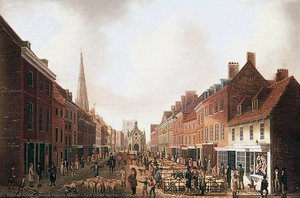
East Street Market, Chichester, West Sussex (1813) autorstwa Joseph Francis Gilbert

East Street Market, Chichester, West Sussex

1813 · Oil · West Sussex Record Office, Chichester

The bustling energy of a bygone era finds its way onto the canvas in East Street Market, Chichester, West Sussex. Painted by Joseph Francis Gilbert about 1813, this work captures a lively moment within the heart of the Sussex town. The scene unfolds with the movement of a market in full swing, where the daily rhythms of commerce and community intersect under the open sky. It is a window into…

5
East Street Market, Chichester, West Sussex (1813) autorstwa Joseph Francis Gilbert

East Street Market, Chichester, West Sussex

1813 · Oil On Canvas · West Sussex Record Office, Chichester

The scene captures a bustling street in Chichester, West Sussex, during the early 19th century. In this 1813 composition, the narrow thoroughfare is alive with the movement of people engaged in the commerce of daily existence. Vendors and shoppers populate the cobblestone street, creating a sense of constant motion. Tall, narrow buildings with pitched roofs line the sides of the road, their small, evenly spaced windows reflecting the architectural uniformity…

6
Landscape with River and Ruined Castle (1825) autorstwa Joseph Francis Gilbert

Landscape with River and Ruined Castle

1825 · Charcoal · Government Art Collection, Londyn

The composition centers on a river that winds through a valley, leading the eye toward a ruined castle situated on a distant hill. In the foreground, trees frame the scene, their forms rendered with dense, leafy textures. The river's edge is defined by a series of short, broken lines, while the water reflects light through subtle variations in tone. A bridge spans the water in the middle ground, acting as…

7
The Temple, 28 January 1830 (1830) autorstwa Joseph Francis Gilbert

The Temple, 28 January 1830

1830 · Oil On Canvas

The air feels crisp and still on this January afternoon in 1830. Sunlight filters through the skeletal branches of trees, casting long, soft shadows across the manicured grass of a public park. In the distance, a large white building rises against the sky, its pale facade acting as a silent anchor for the entire scene. People move through the landscape with a quiet purpose, their silhouettes drifting through the open…

8
Chichester Cathedral (1833) autorstwa Joseph Francis Gilbert

Chichester Cathedral

1833 · Oil On Canvas · Yale Center for British Art, New Haven

In this 1833 oil painting, Joseph Francis Gilbert presents a view of Chichester Cathedral that integrates the grand scale of religious architecture with the quiet rhythms of rural life. The work captures the cathedral alongside its surrounding cityscape, situating the structure within a lived-in, pastoral landscape. It is a scene that feels settled and certain, portraying the building not as an isolated monument, but as a central part of the…

9
A Lakland Landscape (1834) autorstwa Joseph Francis Gilbert

A Lakland Landscape

1834 · Oil On Canvas

The painting presents a landscape centered on a lake, framed by a range of mountains in the background. On a hillside in the foreground, a group of people is positioned, observing the water. Several horses occupy the scene: one is situated near the center, another is toward the right, and two others are located on the left side. A single dog is placed in the middle-right area of the composition.…

10
Ullswater Head, Cumberland (1834) autorstwa Joseph Francis Gilbert

Ullswater Head, Cumberland

1834 · Oil On Canvas · Abbot Hall Art Gallery, Kendal

The oil painting titled Ullswater Head, Cumberland, was created by Joseph Francis Gilbert. This work emerged from the artist's brush about 1834. It captures a specific moment of stillness within the English landscape, rendered during a period when Gilbert was establishing his presence in the art world.

Słynne obrazy artysty Joseph Francis Gilbert, od 11 do 13

Słynne obrazy Joseph Francis Gilbert epoka po epoce

Tematy, które przyciągnęły wzrok Joseph Francis Gilbert

Cztery motywy najczęściej powracające w tych oryginałach, z których każdy doczekał się swojego najdoskonalszego przykładu.

Muzea przechowujące oryginały Joseph Francis Gilbert

6 muzeów, w których znajduje się najwięcej obrazów z tej strony.

Muzea Miasto Dzieła artysty Joseph Francis Gilbert Obrazy z tej listy
West Sussex Record Office, ChichesterWest Sussex Record Office Chichester 2 East Street Market, Chichester, West Sussex, East Street Market, Chichester, West Sussex
Government Art Collection, LondynGovernment Art Collection Londyn 1 Landscape with River and Ruined Castle
Yale Center for British Art, New HavenYale Center for British Art New Haven 1 Chichester Cathedral
Abbot Hall Art Gallery, KendalAbbot Hall Art Gallery Kendal 1 Ullswater Head, Cumberland
UpparkUppark 1 View of Harting
The Council House, ChichesterThe Council House Chichester 1 Winter Scene (Landscape with a Village and Figures Skating)

Joseph Francis Gilbert na przestrzeni dekad: jeden unikatowy oryginał dla każdego

Dzieła według dekad

Wybierz dekadę, aby zobaczyć dzieło, które ją definiuje.

Obrazy artysty Joseph Francis Gilbert: pytania do galerii

Jakie jest najsłynniejsze dzieło artysty Joseph Francis Gilbert?Odkryj odpowiedź

Leigh Park House, Havant (1831). Następne są Figures and animals in a rural landscape oraz View From Hill House (1812).

W jakim wieku Joseph Francis Gilbert stworzył/a Leigh Park House, Havant?Odkryj odpowiedź

39 lat: Leigh Park House, Havant pochodzi z 1831, a Joseph Francis Gilbert urodził(a) się w 1792.

Które dziesięć obrazów Joseph Francis Gilbert jest najbardziej znanych?Odkryj odpowiedź

Leigh Park House, Havant, Figures and animals in a rural landscape, View From Hill House, East Street Market, Chichester, West Sussex, East Street Market, Chichester, West Sussex, Landscape with River and Ruined Castle, The Temple, 28 January 1830, Chichester Cathedral, A Lakland Landscape i Ullswater Head, Cumberland. Powyższy ranking zawiera rok powstania oraz muzeum dla każdego z nich.

Ile znanych dzieł stworzył Joseph Francis Gilbert?Odkryj odpowiedź

Nasz katalog zawiera 14 dzieł artysty Joseph Francis Gilbert, datowanych od 1812 do 1834.

Gdzie można zobaczyć najsłynniejsze oryginały Joseph Francis Gilbert?Odkryj odpowiedź

W większości znajdują się w West Sussex Record Office (Chichester), Government Art Collection (Londyn) i Yale Center for British Art (New Haven). Powyższa tabela muzeów zawiera ich pełną listę.

W jakim okresie Joseph Francis Gilbert stworzył/a swoje najsłynniejsze obrazy?Odkryj odpowiedź

W 1830s: 8 z 13 dzieł na tej stronie powstało w tym czasie, w tym Leigh Park House, Havant.

Który z najsłynniejszych obrazów artysty Joseph Francis Gilbert powstał najwcześniej, a który najpóźniej?Odkryj odpowiedź

Na tej stronie najwcześniejszy to View From Hill House (1812), a najpóźniejszy A Lakland Landscape (1834).

Jakie tematy preferował Joseph Francis Gilbert?Odkryj odpowiedź

People (9), Trees (6) i Horse (5), w ramach 13 dzieł na tej stronie.

Jakich materiałów Joseph Francis Gilbert używał najczęściej?Odkryj odpowiedź

Oil On Canvas, dla 10 z 13 dzieł na tej stronie.

Jakie oryginały Joseph Francis Gilbert można zobaczyć w West Sussex Record Office?Odkryj odpowiedź

East Street Market, Chichester, West Sussex i East Street Market, Chichester, West Sussex: West Sussex Record Office, Chichester posiada 2 dzieł widocznych na tej stronie.

Joseph Francis Gilbert: portret artysty

Joseph Francis Gilbert: A Sussex Painter of Rural Beauty

Joseph Francis Gilbert (1792 – 1855) emerges from the mist of early Victorian England as a quietly significant landscape painter, primarily associated with the rolling hills and historic estates of Sussex. Born into a family steeped in inventive ingenuity—his father was an inventor of ingenious bomb designs—Gilbert’s artistic journey began amidst personal hardship, shaping his perspective on the world and informing the serene yet subtly melancholic quality of his work. He wasn't a flamboyant figure, nor did he seek grand recognition; instead, Gilbert dedicated himself to capturing the essence of rural England, particularly the landscapes surrounding Chichester and Goodwood Racecourse, creating images that resonate with a timeless beauty.

Early Life and Artistic Beginnings

Details regarding Gilbert’s formal artistic training remain somewhat elusive, shrouded in the typical obscurity of artists working outside the established academies. However, it's believed he honed his skills through observation and perhaps informal instruction, absorbing influences from earlier Sussex landscape painters like George Smith and William Pether – artists known for their depictions of local scenes and a focus on the “sublime” and “picturesque.” He began exhibiting his work in 1813 at the Royal Academy and subsequently at institutions such as the British Institution and the Society of Artists, steadily building a reputation for capturing the light and atmosphere of the Sussex countryside. His early works demonstrate a clear debt to these predecessors, utilizing similar compositional techniques and a focus on depicting the natural world with a degree of romanticism.

The Goodwood Years and Regional Style

Gilbert’s most celebrated period unfolded during his residence in Chichester and his frequent depictions of Goodwood Racecourse. These paintings aren't merely topographical records; they are imbued with a sense of place, capturing the drama of the races, the grandeur of the estate, and the quiet beauty of the surrounding landscape. The meticulous detail evident in works like “Priam winning the Gold Cup” reveals a keen eye for observation and an ability to translate complex scenes onto canvas. His style during this time developed into a distinct regional aesthetic – characterized by a muted palette, a sensitivity to light and shadow, and a focus on capturing the subtle nuances of rural life. He wasn’t interested in dramatic vistas or heroic figures; instead, he sought to portray the everyday beauty of Sussex, its fields, farms, and historic buildings.

Technique and Influences

Gilbert's technique was rooted in traditional landscape painting practices, employing oil paints on canvas with a careful attention to detail and atmospheric perspective. He demonstrated a mastery of light and shadow, skillfully rendering the changing conditions of Sussex weather. While he undoubtedly drew inspiration from his predecessors, Gilbert’s work also reflects the broader artistic trends of the early Victorian era – a growing interest in nature, a celebration of rural life, and a desire to capture the beauty of the British landscape. The influence of the Romantic movement is evident in his emphasis on emotion and imagination, though he tempered this with a more restrained and observational approach.

Legacy and Historical Significance

Joseph Francis Gilbert’s contribution to English landscape painting may not be widely recognized today, but his work holds considerable historical significance. He represents a vital link between the earlier generations of Sussex artists and the development of Victorian landscape painting. His paintings offer valuable insights into the social and cultural life of 19th-century England, capturing a sense of place and time that is both evocative and enduring. His depictions of Goodwood Racecourse, in particular, provide a fascinating glimpse into the leisure activities and social customs of the landed gentry. Furthermore, his work resides within the collection of the Government Art Collection, ensuring its continued preservation and accessibility for future generations of art enthusiasts. Gilbert’s legacy lies not in grand pronouncements or revolutionary innovations, but in the quiet beauty and enduring charm of his Sussex landscapes – a testament to the power of observation and the timeless appeal of the English countryside.