The Dual Legacy of Joseph Barnard Davis: Science and Sentiment
In the annals of the Victorian era, few figures embody the period's profound tension between empirical discovery and romantic observation as poignantly as Joseph Barnard Davis. A man whose life was defined by a remarkable duality, Davis navigated the cold, analytical realms of craniology and medicine while simultaneously capturing the soft, nostalgic light of the English countryside through his art. Born in York on June 13, 1801, his early years were shaped by a rigorous apprenticeship in surgery and apothecary, yet the seeds of a much broader intellectual curiosity were sown during his transformative voyage as a surgeon aboard a whaling vessel to the Arctic seas in 1820. This exposure to the vast, untamed reaches of the world instilled in him a lifelong fascination with the diversity of human anatomy and the quiet majesty of the natural landscape.
Davis’s professional trajectory was one of relentless scholarly pursuit. After qualifying through the Society of Apothecaries and eventually earning his medical doctorate from the University of St Andrews in 1862, he established a prominent practice in Hanley, Staffordshire. However, it was his role as a collector that would cement his place in scientific history. Driven by an almost obsessive passion for human osteology, Davis meticulously amassed a collection of over 1,474 skulls and skeletons. This extraordinary assemblage, which at its peak surpassed the holdings of most British public museums, served as a monumental study of racial lineages and human variation. His work as a craniologist was not merely a hobby but a significant contribution to the scientific discourse of his time, earning him the prestigious distinction of being elected a Fellow of the Royal Society in 1868.
A Visionary Eye: From Anatomy to Landscape
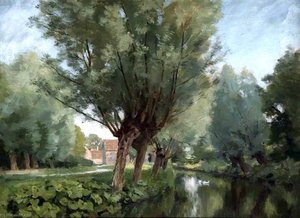
While the world recognized him for the meticulous documentation of bone and sinew, Davis possessed an artist's soul that sought refuge in the pastoral. His paintings offer a striking contrast to the clinical precision of his scientific endeavors. In his landscapes, one finds an atmospheric quality reminiscent of the Impressionist movement, where the focus shifts from the structural rigidity of anatomy to the fluid, ephemeral beauty of light and atmosphere. He had a particular talent for rendering the serene English countryside, imbuing scenes such as his Cotswold River Scene with a sense of profound tranquility and a palpable nostalgia for a vanishing rural way of life.
The technique employed in his works suggests a deep appreciation for the textures of nature—the lushness of riverbanks, the soft haze over distant hills, and the play of light upon water. This artistic development can be viewed as an emotional counterbalance to his scientific life; where craniology sought to categorize and define the permanent structures of humanity, his art celebrated the transient and the beautiful. Through his brush, the landscapes of England became more than mere topographical records; they became emotive vessels for the Victorian sentimentality that valued the spiritual connection between man and his environment.
Historical Significance and Lasting Impression
The historical significance of Joseph Barnard Davis lies in his ability to bridge two seemingly disparate worlds. He was a pivotal figure in the civic and intellectual life of Stoke-on-Trent, playing a foundational role in the establishment of the Museum of Natural History, Pottery and Antiquities. His commitment to disseminating knowledge ensured that his scientific passions contributed to the broader cultural heritage of his community. Even as he pursued the complexities of human physiognomy, he remained deeply rooted in the local landscape, both as a resident physician and an observer of nature.
Ultimately, Davis remains a captivating subject for historians and art enthusiasts alike. His life serves as a testament to the Victorian spirit of inquiry—a period when the boundaries between science, medicine, and art were often porous and interconnected. To study his work is to encounter a man who looked deeply into the very structure of human existence through the lens of a microscope, yet never lost the ability to look upward at the shifting clouds with the wonder of a poet. His legacy endures in the dual echoes of his scientific contributions and his evocative, enduring landscapes.