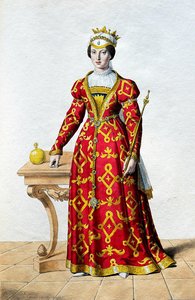
Portret Josef Kriehuber

Obrazy: 100 najsłynniejszych dzieł artysty Josef Kriehuber – spojrzenie galerii

Aktualizacja: Listopad 2026 · ranking według naszego wskaźnika popularności (liczba wyszukiwań, wizyt i zamówień dla każdego dzieła) · 134 dzieł Josef Kriehuber w naszym katalogu

W skrócie

Według galerii najsłynniejszym obrazem Josef Kriehuber jest Karoline Auguste. Fanny Elssler, Austrian ballerina (1830) i Prince Friedrich of Schwarzenberg (1847) dopełniają trio, które zna każde oko. Z 134 dzieł Josef Kriehuber w naszym katalogu, galeria prezentuje poniżej 100 najsłynniejszych prac – każda z nich jest oryginałem z podaniem roku powstania, muzeum oraz cech wyróżniających ją na tle innych.

1800 – 1876, Wiedeń Biedermeier Najwięcej dzieł: National Portrait Gallery of Sweden

10 najlepszych obrazów artysty Josef Kriehuber w galerii

1
Karoline Auguste autorstwa Josef Kriehuber

Karoline Auguste

Lithograph

In this portrait of Karoline Auguste, we encounter a formal depiction of a woman whose attire and crown suggest a position of significant status. Josef Kriehuber, an Austrian lithographer and painter, captured the subject with a focus on the dignity inherent in her pose. The work presents a quiet, composed presence, emphasizing the details of her clothing and the subtle features of her face. It is a study of character…

2
Fanny Elssler, Austrian ballerina (1830) autorstwa Josef Kriehuber

Fanny Elssler, Austrian ballerina

1830 · Lithography

The lithograph captures a moment of stillness in a life of movement. Fanny Elssler sits in a three-quarter view, her gaze drifting slightly away from the viewer toward an unseen point. She is an Austrian ballerina, frozen in a monochromatic world of silver and charcoal. Her posture is upright, a column of poise that suggests the quiet discipline behind the public spectacle of dance. The light is diffused, washing over…

3
Prince Friedrich of Schwarzenberg (1847) autorstwa Josef Kriehuber

Prince Friedrich of Schwarzenberg

1847 · Lithograph · Metropolitan Museum of Art, Nowy Jork

This striking portrait captures Prince Friedrich of Schwarzenberg in the charged atmosphere of 1847. The subject is presented not merely as an individual, but as an embodiment of military bearing and societal importance during a pivotal era in European history. Clad in the formal accoutrements of his station—the crisp lines of his uniform, the authoritative gleam of the sword held at hand—he commands attention. The monochrome quality of the piece…

4
Josef Lanner, Austrian Composer (1825) autorstwa Josef Kriehuber

Josef Lanner, Austrian Composer

1825 · Lithograph

This monochrome portrait, titled Josef Lanner, Austrian Composer, was created by the artist Josef Kriehuber. The work depicts the Austrian composer Josef Lanner in a bust-length composition. The subject is presented as a gentleman of the era, shown from the chest up and facing slightly toward the viewer's left. The image is rendered in grayscale, utilizing varying shades of gray to define the form of the figure against a simple,…

5
Anton Bernhard Fürstenau, German flutist and composer (1830) autorstwa Josef Kriehuber

Anton Bernhard Fürstenau, German flutist and composer

1830 · Engraving

This monochrome engraving presents a bust-length portrait of Johann Baptist Forster, identified as the First Royal Magistrate of Saxony. The subject is positioned centrally against a dark, undifferentiated background, which focuses attention on the facial features and the formal attire. The composition follows a Neoclassical structure, emphasizing a realistic depiction of the man's physical presence. Light originates from above and slightly in front, casting highlights onto the forehead and the…

6
Ernst and Eduard Eichhorn, violin prodigies (1831) autorstwa Josef Kriehuber

Ernst and Eduard Eichhorn, violin prodigies

1831 · Lithograph

Josef Kriehuber produced Ernst and Eduard Eichhorn, violin prodigies, a black and white lithograph portrait. The work dates to about 1831. It captures the likeness of the two young musicians, Ernst and Eduard Eichhorn, who are identified as violin prodigies.

7
Karl von Rothkirch-Panthen, Bohemian-Austrian politician (1828) autorstwa Josef Kriehuber

Karl von Rothkirch-Panthen, Bohemian-Austrian politician

1828 · Lithography

The gaze of Karl von Rothkirch-Panthen, Bohemian-Austrian politician, meets the viewer through this striking lithograph. Josef Kriehuber captures the man in a moment of quiet dignity, presenting a figure of significant social and political weight. This portrait offers a window into the life of a man who navigated the complex corridors of power, eventually serving as a member of the Chamber of Deputies of the Imperial Council of Austria. Even…

8
Joseph Böhm, Hungarian Violinist and a director of the Vienna Conservatory (1830) autorstwa Josef Kriehuber

Joseph Böhm, Hungarian Violinist and a director of the Vienna Conservatory

1830 · Lithograph

This lithograph, titled "Joseph Böhm, Hungarian Violinist and a director of the Vienna Conservatory" by Josef Kriehuber, depicts the subject in a formal bust-length view. The portrait captures Joseph Böhm, a Hungarian violinist who held the position of professor at the Vienna Conservatory from 1819 to 1848. The image is rendered in a monochrome grayscale palette, utilizing fine lines to define the contours of the subject's face and attire. He…

9
Bulcs (1828) autorstwa Josef Kriehuber

Bulcs

1828 · Lithograph

A man stands centered against a muted, mountainous landscape, his gaze fixed and stern. He is a figure of history, or perhaps a memory of one, draped in the heavy textures of a warrior's attire. The light falls evenly across his face, revealing the fine, etched lines of his features and the sharp edges of his weaponry. He holds an axe, a bow, and arrows, tools of a life defined…

10
Ferdinand III (1828) autorstwa Josef Kriehuber

Ferdinand III

1828 · Lithograph

This portrait of Ferdinand III, executed by Josef Kriehuber, offers a quiet study of authority from the early nineteenth century. Created in 1828, the work captures the subject in a moment of formal repose. Kriehuber focuses on the dignity of the sitter, presenting him in full regal attire that signals his high status. The portrait provides a clear, direct encounter with a figure of historical significance.

Obrazy artysty Josef Kriehuber, uszeregowane od 11 do 100 miejsca

11Vladislav II (1828) autorstwa Josef KriehuberVladislav II1828 12Leopold I (1828) autorstwa Josef KriehuberLeopold I1828 13Joseph II (1828) autorstwa Josef KriehuberJoseph II1828 14Karl VI (1828) autorstwa Josef KriehuberKarl VI1828 15Koloman (1828) autorstwa Josef KriehuberKoloman1828 16Ferdinand I of Austria (1828) autorstwa Josef KriehuberFerdinand I of Austria1828 17Taksony (1828) autorstwa Josef KriehuberTaksony1828 18Lehel (1828) autorstwa Josef KriehuberLehel1828 19Bela III (1828) autorstwa Josef KriehuberBela III1828 20Ludwig I (1828) autorstwa Josef KriehuberLudwig I1828 21Geza (1828) autorstwa Josef KriehuberGeza1828 22Franz II (1828) autorstwa Josef KriehuberFranz II1828 23Johann Zapolya (1828) autorstwa Josef KriehuberJohann Zapolya1828 24Keve, legendary Hungarian military leader (1828) autorstwa Josef KriehuberKeve, legendary Hungarian military leader1828 25Geza I (1828) autorstwa Josef KriehuberGeza I1828 26Austrian Family, The Mother (1827) autorstwa Josef KriehuberAustrian Family, The Mother1827 27Austrian Family, the Father (1827) autorstwa Josef KriehuberAustrian Family, the Father1827 28Stephan V (1828) autorstwa Josef KriehuberStephan V1828 29Ladislaus IV (1828) autorstwa Josef KriehuberLadislaus IV1828 30Stephan II (1828) autorstwa Josef KriehuberStephan II1828 31Matthias Corvinus (1828) autorstwa Josef KriehuberMatthias Corvinus1828 32Ladislaus (1828) autorstwa Josef KriehuberLadislaus1828 33Austrian Family, The Son (1827) autorstwa Josef KriehuberAustrian Family, The Son1827 34Stephan IV (1828) autorstwa Josef KriehuberStephan IV1828 35Emmerich (1828) autorstwa Josef KriehuberEmmerich1828 36Stephan III (1828) autorstwa Josef KriehuberStephan III1828 37Ladislaus V (1828) autorstwa Josef KriehuberLadislaus V1828 38Ladislaus III (1828) autorstwa Josef KriehuberLadislaus III1828 39Karl I (1828) autorstwa Josef KriehuberKarl I1828 40Austrian Family, The Daughters (1827) autorstwa Josef KriehuberAustrian Family, The Daughters1827 41Ladislaus II (1828) autorstwa Josef KriehuberLadislaus II1828 42Andreas II (c.1177-1235), King on Hungary from 1205 to 1235 (1828) autorstwa Josef KriehuberAndreas II (c.1177-1235), King on Hungary from 1205 to 12351828 43Keme, legendary Hungarian military leader (1828) autorstwa Josef KriehuberKeme, legendary Hungarian military leader1828 44Attila, King of the Huns (1828) autorstwa Josef KriehuberAttila, King of the Huns1828 45Wenzel III (1828) autorstwa Josef KriehuberWenzel III1828 46Sabolch, legendary Hungarian military leader (1828) autorstwa Josef KriehuberSabolch, legendary Hungarian military leader1828 47Kadicha, legendary Hungarian military leader (1828) autorstwa Josef KriehuberKadicha, legendary Hungarian military leader1828 48Andreas I (c.1015-1060), King on Hungary from 1046 to 1060 (1828) autorstwa Josef KriehuberAndreas I (c.1015-1060), King on Hungary from 1046 to 10601828 49Wladislaw I (1828) autorstwa Josef KriehuberWladislaw I1828 50Elizabeth of Luxembourg (1828) autorstwa Josef KriehuberElizabeth of Luxembourg1828 51Samuel Aba (1828) autorstwa Josef KriehuberSamuel Aba1828 52Buda, legendary Hungarian military leader, namesake of Budapest (1828) autorstwa Josef KriehuberBuda, legendary Hungarian military leader, namesake of Budapest1828 53Andreas III (c.1265-1301), King on Hungary from 1290 to 1301 (1828) autorstwa Josef KriehuberAndreas III (c.1265-1301), King on Hungary from 1290 to 13011828 54Maria I (1828) autorstwa Josef KriehuberMaria I1828 55Arpad, Grand Prince of the Hungarians (1828) autorstwa Josef KriehuberArpad, Grand Prince of the Hungarians1828 56Karl Gustav Löwenhielm (1790-1858), count, lieutenant general, governor, married to 1. countess Gustava Charlotta Jacobina Aurora Gyldenstolpe 2. countess Natalie Alexandra von Buxhoeweden (1836) autorstwa Josef KriehuberKarl Gustav Löwenhielm (1790-1858), count, lieutenant general, governor, married to 1. countess Gustava Charlotta Jacobina Aurora Gyldenstolpe 2. countess Natalie Alexandra von Buxhoeweden1836 · National Portrait Gallery of Sweden 57Natalie Alexandra von Buxhoeweden (1814-1867), countess, maid of honour of Alexandra Fjodorovna of Russia, married to count Karl Gustav Löwenhielm (1839) autorstwa Josef KriehuberNatalie Alexandra von Buxhoeweden (1814-1867), countess, maid of honour of Alexandra Fjodorovna of Russia, married to count Karl Gustav Löwenhielm1839 · National Portrait Gallery of Sweden 58Josef Zinner Forstmeister, Matthias Zinner Hofjäger, Ferdinand Zinner Hofjäger (1835) autorstwa Josef KriehuberJosef Zinner Forstmeister, Matthias Zinner Hofjäger, Ferdinand Zinner Hofjäger1835 59Robert Schumann, Austrian Composer (1839) autorstwa Josef KriehuberRobert Schumann, Austrian Composer1839 60Christoph Graf Cavriani with his son Franz (1836) autorstwa Josef KriehuberChristoph Graf Cavriani with his son Franz1836 61Karl Josef Lipinsky, Polish music composer and virtuoso violinist (1837) autorstwa Josef KriehuberKarl Josef Lipinsky, Polish music composer and virtuoso violinist1837 62Countess Ludmilla Csaky, née Lazansky Von Bukowa with her son Ladislaus Csaky Graf Von Körösszegh U. Adorjan, politician (1839) autorstwa Josef KriehuberCountess Ludmilla Csaky, née Lazansky Von Bukowa with her son Ladislaus Csaky Graf Von Körösszegh U. Adorjan, politician1839 63Le Comte Guillaume Isidore De Montbel (1836) autorstwa Josef KriehuberLe Comte Guillaume Isidore De Montbel1836 64Children (1836) autorstwa Josef KriehuberChildren1836 65Gentleman in riding costume (1838) autorstwa Josef KriehuberGentleman in riding costume1838 66A Morning with Liszt (Hungarian Composer) (1846) autorstwa Josef KriehuberA Morning with Liszt (Hungarian Composer)1846 67Giorgio Ronconi, Italian Baritone (1840) autorstwa Josef KriehuberGiorgio Ronconi, Italian Baritone1840 68Thomas Lederer, Doctor and homeopath (1846) autorstwa Josef KriehuberThomas Lederer, Doctor and homeopath1846 69Filippo Coletti, Italian Baritone (1841) autorstwa Josef KriehuberFilippo Coletti, Italian Baritone1841 70Aloius Rubana, civil servant and councilor (1841) autorstwa Josef KriehuberAloius Rubana, civil servant and councilor1841 71Aloisia Eleonore Schönburg-Hartstein With children (1841) autorstwa Josef KriehuberAloisia Eleonore Schönburg-Hartstein With children1841 72Maria, née Czernin, and her daughter Wilhelmine Kinsky. Countess. (1844) autorstwa Josef KriehuberMaria, née Czernin, and her daughter Wilhelmine Kinsky. Countess.1844 73The Counts Jaromir, Rudolf, Herrmann and Humbert Czernin (1847) autorstwa Josef KriehuberThe Counts Jaromir, Rudolf, Herrmann and Humbert Czernin1847 74Eduard Woyna (1840) autorstwa Josef KriehuberEduard Woyna1840 75Franz Schubert, Austrian Composer (Posthumous Lithography) (1846) autorstwa Josef KriehuberFranz Schubert, Austrian Composer (Posthumous Lithography)1846 76Count Georg Esterházy Von Galántha (1840) autorstwa Josef KriehuberCount Georg Esterházy Von Galántha1840 77The Archdukes Franz Joseph, Ferdinand Max and Carl Ludwig (1844) autorstwa Josef KriehuberThe Archdukes Franz Joseph, Ferdinand Max and Carl Ludwig1844 78Portrait of Emperor Franz Joseph I at 23 Years of Age (1853) autorstwa Josef KriehuberPortrait of Emperor Franz Joseph I at 23 Years of Age1853 79Baron Heinrich von Hess, Austrian General (Field Marshal) (1854) autorstwa Josef KriehuberBaron Heinrich von Hess, Austrian General (Field Marshal)1854 80Brothers Kleins (1849) autorstwa Josef KriehuberBrothers Kleins1849 81Baron Carl von Ghega, Austrian railway engineer (1851) autorstwa Josef KriehuberBaron Carl von Ghega, Austrian railway engineer1851 82Antonie Countess Batthyany, bourn Zichy. Wife of Ludwig Graf Batthyany (1849) autorstwa Josef KriehuberAntonie Countess Batthyany, bourn Zichy. Wife of Ludwig Graf Batthyany1849 83Josef Kriehuber, Austrian Lithographer and Artist (Self-Portrait) (1852) autorstwa Josef KriehuberJosef Kriehuber, Austrian Lithographer and Artist (Self-Portrait)1852 84Karl Von Giskra, Austrian Politician (1861) autorstwa Josef KriehuberKarl Von Giskra, Austrian Politician1861 85Ludwig Gabillon, German actor of the Burgtheater and theatre director (1860) autorstwa Josef KriehuberLudwig Gabillon, German actor of the Burgtheater and theatre director1860 86Josef Unger, Austrian jurist and statesman (1861) autorstwa Josef KriehuberJosef Unger, Austrian jurist and statesman1861 87Franz Joseph I of Austria, Emperor of Austria (1860) autorstwa Josef KriehuberFranz Joseph I of Austria, Emperor of Austria1860 88Max Von Gomperz, Austrian industrialist and banker (1860) autorstwa Josef KriehuberMax Von Gomperz, Austrian industrialist and banker1860 89Josef Kriehuber, Austrian Lithographer (Self-portrait) (1860) autorstwa Josef KriehuberJosef Kriehuber, Austrian Lithographer (Self-portrait)1860 90Gabriele Saaint-Genois, b. Countess Stolberg with her daughter Anna (1858) autorstwa Josef KriehuberGabriele Saaint-Genois, b. Countess Stolberg with her daughter Anna1858 91Sir Julius Benedict, German-born composer and conductor (1861) autorstwa Josef KriehuberSir Julius Benedict, German-born composer and conductor1861 92Duchess Elisabeth of Bavaria, Empress of Austria (Sisi / Sissi) (1863) autorstwa Josef KriehuberDuchess Elisabeth of Bavaria, Empress of Austria (Sisi / Sissi)1863 93August Förster, German actor and theatre director (1863) autorstwa Josef KriehuberAugust Förster, German actor and theatre director1863 94Johann Emanuel Veith, Bohemian, Roman Catholic preacher (1860) autorstwa Josef KriehuberJohann Emanuel Veith, Bohemian, Roman Catholic preacher1860 95Portrait of a young woman with a rose (1859) autorstwa Josef KriehuberPortrait of a young woman with a rose1859 96Empress Elisabeth of Austria with her children Rudolf and Gisela (1858) autorstwa Josef KriehuberEmpress Elisabeth of Austria with her children Rudolf and Gisela1858 97Portrait of a gentleman with a top hat (1863) autorstwa Josef KriehuberPortrait of a gentleman with a top hat1863 98Portrait of a lady in a blue dress (1856) autorstwa Josef KriehuberPortrait of a lady in a blue dress1856 99Portrait of a country lady in a brown dress (1862) autorstwa Josef KriehuberPortrait of a country lady in a brown dress1862 100Vuk Karadžić, Serbian philologist, linguist and one of the most important reformers of the modern Serbian language (1865) autorstwa Josef KriehuberVuk Karadžić, Serbian philologist, linguist and one of the most important reformers of the modern Serbian language1865

Słynne obrazy Josef Kriehuber epoka po epoce

Tematy, które przyciągnęły wzrok Josef Kriehuber

Cztery motywy najczęściej powracające w tych oryginałach, z których każdy doczekał się swojego najdoskonalszego przykładu.

Muzea przechowujące oryginały Josef Kriehuber

2 muzeów, w których znajduje się najwięcej obrazów z tej strony.

Muzea Miasto Dzieła artysty Josef Kriehuber Obrazy z tej listy
National Portrait Gallery of Sweden, SträngnäsNational Portrait Gallery of Sweden Strängnäs 2 Karl Gustav Löwenhielm (1790-1858), count, lieutenant general, governor, married to 1. countess Gustava Charlotta Jacobina Aurora Gyldenstolpe 2. countess Natalie Alexandra von Buxhoeweden, Natalie Alexandra von Buxhoeweden (1814-1867), countess, maid of honour of Alexandra Fjodorovna of Russia, married to count Karl Gustav Löwenhielm
Metropolitan Museum of Art, Nowy JorkMetropolitan Museum of Art Nowy Jork 1 Prince Friedrich of Schwarzenberg

Josef Kriehuber, jedno kultowe dzieło na dekadę

Dzieła według dekad

Wybierz dekadę, aby zobaczyć dzieło, które ją definiuje.

Obrazy artysty Josef Kriehuber: odpowiedzi galerii

Który obraz Josef Kriehuber jest najsłynniejszy ze wszystkich?Odkryj odpowiedź

Karoline Auguste. Następne są Fanny Elssler, Austrian ballerina (1830) oraz Prince Friedrich of Schwarzenberg (1847).

Które to 10 najlepszych obrazów Josef Kriehuber?Odkryj odpowiedź

Karoline Auguste, Fanny Elssler, Austrian ballerina, Prince Friedrich of Schwarzenberg, Josef Lanner, Austrian Composer, Anton Bernhard Fürstenau, German flutist and composer, Ernst and Eduard Eichhorn, violin prodigies, Karl von Rothkirch-Panthen, Bohemian-Austrian politician, Joseph Böhm, Hungarian Violinist and a director of the Vienna Conservatory, Bulcs i Ferdinand III. Powyższy ranking zawiera rok powstania oraz muzeum dla każdego z nich.

Ile dzieł stworzył/a Josef Kriehuber?Odkryj odpowiedź

Nasz katalog zawiera 134 dzieł artysty Josef Kriehuber, datowanych od 1825 do 1865.

Gdzie można znaleźć najsłynniejsze oryginały autorstwa Josef Kriehuber?Odkryj odpowiedź

W większości znajdują się w National Portrait Gallery of Sweden (Strängnäs) i Metropolitan Museum of Art (Nowy Jork). Powyższa tabela muzeów zawiera ich pełną listę.

Kiedy Josef Kriehuber stworzył swoje najsłynniejsze obrazy?Odkryj odpowiedź

W 1820s: 49 z 100 dzieł na tej stronie powstało w tym czasie, w tym Josef Lanner, Austrian Composer.

Które z najsłynniejszych dzieł Josef Kriehuber należą do jego najwcześniejszych i najpóźniejszych prac?Odkryj odpowiedź

Na tej stronie najwcześniejszy to Josef Lanner, Austrian Composer (1825), a najpóźniejszy Vuk Karadžić, Serbian philologist, linguist and one of the most important reformers of the modern Serbian language (1865).

Do jakich tematów Josef Kriehuber powracał najczęściej?Odkryj odpowiedź

Man (62), Portrait (31) i Crown (25), w ramach 100 dzieł na tej stronie.

W jakiej technice najczęściej tworzył Josef Kriehuber?Odkryj odpowiedź

Lithograph, dla 56 z 100 dzieł na tej stronie.

Z jakim nurtem związany jest Josef Kriehuber?Odkryj odpowiedź

Biedermeier, sądząc po oryginałach na tej stronie.

Które oryginały artysty Josef Kriehuber znajdują się w zbiorach National Portrait Gallery of Sweden?Odkryj odpowiedź

Karl Gustav Löwenhielm (1790-1858), count, lieutenant general, governor, married to 1. countess Gustava Charlotta Jacobina Aurora Gyldenstolpe 2. countess Natalie Alexandra von Buxhoeweden i Natalie Alexandra von Buxhoeweden (1814-1867), countess, maid of honour of Alexandra Fjodorovna of Russia, married to count Karl Gustav Löwenhielm: National Portrait Gallery of Sweden, Strängnäs posiada 2 dzieł widocznych na tej stronie.

Josef Kriehuber: artysta

A Chronicler of Viennese Society: The Life and Art of Josef Kriehuber

Josef Kriehuber, born in Vienna on December 14th, 1800, wasn’t a revolutionary artist seeking to shatter conventions. Instead, he quietly became one of the most prolific and insightful chroniclers of 19th-century Viennese society through his extraordinary mastery of lithography. His life was a testament to dedication—a relentless pursuit of capturing the essence of everyday life, from the opulent salons of the aristocracy to the bustling streets of the city’s working class. Kriehuber's legacy isn’t defined by grand pronouncements or dramatic gestures; it resides in the thousands of meticulously rendered portraits and scenes that offer an unparalleled glimpse into a rapidly changing world.

The Biedermeier Portraitist: A Window into an Era

Kriehuber’s artistic journey unfolded within the context of the Biedermeier period, a reaction against the excesses of the preceding era. Following the tumultuous years of Napoleon's reign, Viennese society embraced a philosophy of domesticity, simplicity, and a deep appreciation for the familiar. This ethos profoundly shaped Kriehuber’s artistic sensibilities. He initially experimented with landscape lithography, but it was portraiture that truly ignited his passion and established his reputation. The Biedermeier style, characterized by its intimate scale, realistic depiction of subjects, and avoidance of overt sentimentality, perfectly suited his approach. Unlike the idealized portraits of earlier periods, Kriehuber’s works presented a remarkably honest reflection of his sitters – their status, personality, and even their quiet dignity. He wasn't interested in creating romantic fantasies; he sought to capture the truth of human experience within the confines of his medium.

Prolific Output and Diverse Clientele

What truly distinguishes Kriehuber is the sheer volume of his output—over 3000 lithographs accumulated throughout his career. This astonishing number speaks not only to his exceptional skill but also to the immense demand for his work. His clientele was remarkably diverse, encompassing members of the Viennese nobility, government officials, prominent merchants, and ordinary citizens eager to preserve a lasting image of themselves or their loved ones. Kriehuber’s portraits weren't merely likenesses; they were carefully constructed visual records, imbued with a sense of character and social standing. He possessed an uncanny ability to discern the subtle nuances of personality—a slight tilt of the head, a flicker of amusement in the eyes – and translate these observations onto the lithographic stone. His meticulous attention to detail, combined with his understanding of human psychology, created portraits that felt remarkably alive.

Beyond Portraits: Documenting Vienna’s Cultural Landscape

While celebrated for his portraits, Kriehuber's artistic vision extended beyond individual representation. Recognizing the importance of capturing the spirit of his city, he increasingly focused on documenting the urban landscape, particularly the vibrant atmosphere of the Prater park. His lithographs depicting scenes from the Prater offer invaluable insights into 19th-century Viennese life and culture. These weren’t simply picturesque views; they were snapshots of a society at leisure, revealing details about fashion, social interactions, and the recreational habits of the time. He captured the energy and excitement of the Prater, showcasing its diverse attractions – from carousel horses to fortune tellers – and the people who flocked to enjoy them. Through these studies, Kriehuber transformed himself into a visual historian, preserving for posterity the sights and sounds of a rapidly changing city.

Influences and Artistic Style

Pinpointing specific artistic influences on Kriehuber proves challenging; he wasn’t overtly imitating a particular master or adhering to a strict stylistic school. However, his dedication to realism aligns with broader artistic trends of the time, reflecting a growing desire for accurate representation in art. He was a contemporary of other portrait artists, but distinguished himself through the sheer volume and consistency of his output, as well as his mastery of lithography. His style is characterized by meticulous detail, precise draftsmanship, and an ability to convey both physical likeness and psychological depth. He wasn’t interested in grand gestures or dramatic compositions; instead, he focused on capturing the subtle nuances of expression and personality. This understated approach, combined with his technical skill, made his portraits highly sought after by those seeking a flattering yet truthful representation of themselves.

Legacy and Recognition

Kriehuber's influence extended beyond his prolific output. He served as a teacher at the Theresianum Academy in Vienna, nurturing future generations of artists and passing on his technical expertise. In 1860, he received significant recognition with the Franz Joseph Order, acknowledging his contributions to Austrian art. However, the rise of photography towards the end of his life presented a challenge to his profession. As photographic portraiture became more accessible and affordable, demand for lithographic portraits declined, leading to financial hardship in his later years. Despite this, Kriehuber continued to work until his death on May 30th, 1876, leaving behind an extraordinary body of work that continues to captivate and inform us today. His legacy lies not only in the sheer number of portraits he created but also in their historical significance as a visual record of 19th-century Central European society. Collections of his works are held at the Albertina museum and the Austrian National Library, ensuring his art will continue to be appreciated for generations to come. *His work remains a testament to the power of observation and the enduring appeal of capturing the human spirit.*