Portret John French Sloan

Obrazy: 100 najsłynniejszych dzieł artysty John French Sloan – spojrzenie galerii

Aktualizacja: Październik 2026 · ranking według naszego wskaźnika popularności (liczba wyszukiwań, wizyt i zamówień dla każdego dzieła) · 238 dzieł John French Sloan w naszym katalogu

W skrócie

Według opinii kuratorów galerii, najsłynniejszym obrazem John French Sloan jest McSorley's Bar (1912), którego oryginał znajduje się w Detroit Institute of Arts w Detroit. The Lafayette (1927) i Wake of the Ferry (1907) dopełniają trio, które zna każde oko. Z 238 dzieł John French Sloan w naszym katalogu, galeria prezentuje poniżej 100 najsłynniejszych prac – każda z nich jest oryginałem z podaniem roku powstania, muzeum oraz cech wyróżniających ją na tle innych.

1871 – 1951, Lock Haven Ashcan school Najwięcej dzieł: The Phillips Collection

10 najlepszych obrazów artysty John French Sloan w galerii

1
McSorley's Bar (1912) autorstwa John French Sloan

McSorley's Bar

1912 · Oil On Canvas · Detroit Institute of Arts, Detroit

The Artist and His Work John Sloan, a prominent American artist, was a founding member of The Eight, a group of painters known for their realistic depictions of urban life. He played a significant role in the Ashcan School of realism artists, which aimed to capture the essence of New York City and its residents during the early 20th century. The Painting: McSorley's Bar McSorley's Bar, painted in 1912, is…

2
The Lafayette (1927) autorstwa John French Sloan

The Lafayette

1927 · Oil On Canvas

The scene unfolds at the intersection of 9th Street and University Place in New York City, centered on the entrance of the Hotel Lafayette. A group of pedestrians descends the double awning-covered stairways, their forms caught in mid-motion as they engage in conversation. The ground appears wet, reflecting the artificial light of a damp evening. In the foreground, a yellow Checker taxicab occupies a significant portion of the lower frame,…

3
Wake of the Ferry (1907) autorstwa John French Sloan

Wake of the Ferry

1907 · Oil On Canvas · Detroit Institute of Arts, Detroit

To stand before Wake of the Ferry is to step across a threshold into a moment suspended between worlds—a quiet breath taken on the vast, indifferent expanse of water. This painting does not shout its drama; rather, it whispers secrets carried upon the fog. The scene, captured from the deck of a ferry, immediately envelops the viewer in an atmosphere of muted contemplation. One feels the chill dampness rising from…

4
Girl in Fur Hat (1909) autorstwa John French Sloan

Girl in Fur Hat

1909 · Oil On Canvas · New Britain Museum of American Art, New Britain

A young woman emerges from a deep, velvet darkness, her presence defined by the way light catches the soft textures of her attire. She sits in a moment of stillness, her gaze turned inward as if lost in a private thought. The light falls across her face with a gentle, directional touch, illuminating the warmth of her skin and the pale, ruffled folds of a white scarf that rests against…

5
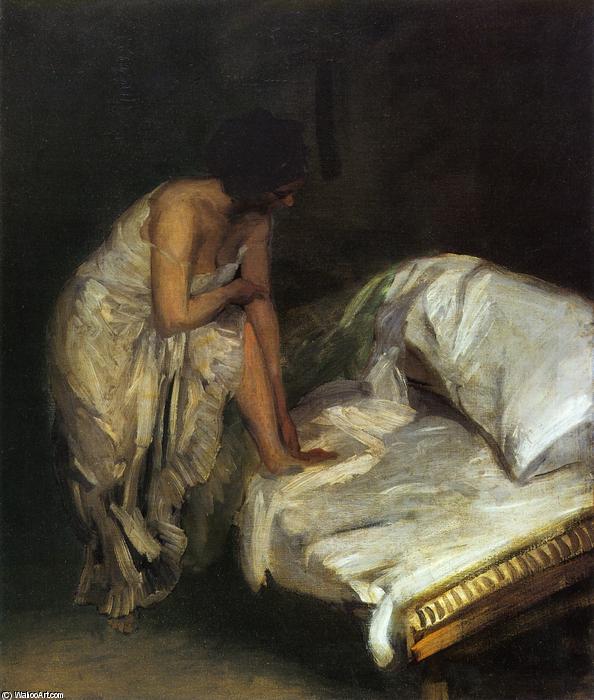
The Cot (1907) autorstwa John French Sloan

The Cot

1907 · Oil

In the quiet intimacy of a bedroom, a woman sits on the edge of her bed in The Cot. Painted by John Sloan about 1907, the scene captures a private moment of stillness. She looks down, her attention fixed on something unseen, while the soft textures of white sheets and pillows surround her. The atmosphere feels heavy with the weight of a lived-in space, a room where the mundane becomes…

6
Edgar Varèse (1924) autorstwa John French Sloan

Edgar Varèse

1924 · Oil On Canvas · National Portrait Gallery, Waszyngton

The air in the room feels heavy, thick with the scent of oil and the weight of unspoken thought. A man sits before us, his presence commanding the space through a quiet, intense gravity. This is Edgar Varèse, caught in a moment of profound stillness that seems to vibrate with an internal rhythm. His dark, wavy hair frames a face etched with seriousness, a countenance that refuses to offer easy…

7
A mechanical Baa-Baa! (1906) autorstwa John French Sloan

A mechanical Baa-Baa!

1906 · Acrylic · Amon Carter Museum of American Art, Fort Worth

John French Sloan’s “A Mechanical Baa-Baa!” isn't merely a depiction of an antique shop; it’s a meticulously crafted narrative frozen in time, offering a poignant window into the burgeoning fascination with industrial innovation and the quiet rhythms of everyday life at the turn of the 20th century. Painted in 1906, during his tenure as a key figure within the Ashcan School movement – an American realist style that championed the…

Obrazy artysty John French Sloan, uszeregowane od 11 do 100 miejsca

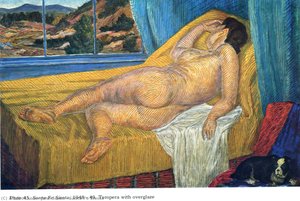
11Dramatic Music (1897) autorstwa John French SloanDramatic Music1897 · Pennsylvania Academy of Fine Arts 12Henrietta with Red Book (1913) autorstwa John French SloanHenrietta with Red Book1913 · Reading Public Museum 13Evening, Rocky Neck (1916) autorstwa John French SloanEvening, Rocky Neck1916 14Nude At Piano (1928) autorstwa John French SloanNude At Piano1928 15Nude, Red Hair, Standing (1928) autorstwa John French SloanNude, Red Hair, Standing1928 16Nude, Terra Cotta (1933) autorstwa John French SloanNude, Terra Cotta1933 17Fishing Port, Gloucester autorstwa John French SloanFishing Port, Gloucester 18Nude with Red Hand Mirror (1950) autorstwa John French SloanNude with Red Hand Mirror1950 19Santa Fe Siesta (1949) autorstwa John French SloanSanta Fe Siesta1949 20The Sewing Woman (1901) autorstwa John French SloanThe Sewing Woman1901 · Metropolitan Museum of Art 21The Haymarket (1907) autorstwa John French SloanThe Haymarket1907 · Brooklyn Museum 22Three A.M. (1909) autorstwa John French SloanThree A.M.1909 · Philadelphia Museum of Art 23The Mountains, September autorstwa John French SloanThe Mountains, September 24Dust Storm, Fifth Avenue autorstwa John French SloanDust Storm, Fifth Avenue 25East Entrance, City Hall, Philadelphia autorstwa John French SloanEast Entrance, City Hall, Philadelphia 26Passing Schooner (1917) autorstwa John French SloanPassing Schooner1917 27The Rathskeller autorstwa John French SloanThe RathskellerCleveland Museum of Art 28Gwendolyn autorstwa John French SloanGwendolynSmithsonian American Art Museum 29Election Night autorstwa John French SloanElection Night 30Throbbing Fountain, Madison Square (1907) autorstwa John French SloanThrobbing Fountain, Madison Square1907 · Thyssen-Bornemisza Museum 31Chinese Restaurant (1909) autorstwa John French SloanChinese Restaurant1909 32Clown Making Up (1910) autorstwa John French SloanClown Making Up1910 · The Phillips Collection 33Stein and Press (1906) autorstwa John French SloanStein and Press1906 · Art Gallery of Hamilton 34Daisy (1905) autorstwa John French SloanDaisy1905 35Green's Cat (1900) autorstwa John French SloanGreen's Cat1900 36Young Woman in Black and White (Mary Kerr) (1902) autorstwa John French SloanYoung Woman in Black and White (Mary Kerr)1902 37The Wake of the Ferry II (1907) autorstwa John French SloanThe Wake of the Ferry II1907 · The Phillips Collection 38Prone Nude autorstwa John French SloanProne Nude 39Woman brushing her hair autorstwa John French SloanWoman brushing her hair 40Sketch for the Lafayette autorstwa John French SloanSketch for the Lafayette 41Reading in the Subway autorstwa John French SloanReading in the Subway 42Seated Woman autorstwa John French SloanSeated Woman 43Nude and Arch autorstwa John French SloanNude and Arch 44Atlantic City Beach autorstwa John French SloanAtlantic City Beach 45The Day on the Roof autorstwa John French SloanThe Day on the Roof 46Portrait of Paul de Kock autorstwa John French SloanPortrait of Paul de Kock 47Robert Henri, Painter autorstwa John French SloanRobert Henri, Painter 48Picture Racks At The Macbeth Gallery autorstwa John French SloanPicture Racks At The Macbeth Gallery 49Fun, One Cent, from the series New York City Life autorstwa John French SloanFun, One Cent, from the series New York City Life 50Nude On Blanket autorstwa John French SloanNude On Blanket 51Rendezvous (Angna Enters in ''Rendezvous'') autorstwa John French SloanRendezvous (Angna Enters in ''Rendezvous'') 526th Avenue and 30th Street autorstwa John French Sloan6th Avenue and 30th Street 53Nude autorstwa John French SloanNude 54Nude at Piano autorstwa John French SloanNude at Piano 5514th Street, The Wigwam autorstwa John French Sloan14th Street, The Wigwam 56Mother autorstwa John French SloanMother 57untitled (3863) autorstwa John French Sloanuntitled (3863) 58untitled (6051) autorstwa John French Sloanuntitled (6051) 59untitled (6892) autorstwa John French Sloanuntitled (6892) 60untitled (3766) autorstwa John French Sloanuntitled (3766) 61Coytesville, New Jersey autorstwa John French SloanCoytesville, New Jersey 62Rainy Night autorstwa John French SloanRainy Night 63Anshutz on Anatomy autorstwa John French SloanAnshutz on Anatomy 64Nude on Stairs autorstwa John French SloanNude on Stairs 65Fifth Avenue Critics 1 autorstwa John French SloanFifth Avenue Critics 1 66Shine, Washington Square, New York City autorstwa John French SloanShine, Washington Square, New York City 67untitled (6941) autorstwa John French Sloanuntitled (6941) 68untitled (5375) autorstwa John French Sloanuntitled (5375) 69untitled (746) autorstwa John French Sloanuntitled (746) 70The Picture Buyer autorstwa John French SloanThe Picture Buyer 71Back to Market, Santa Fe autorstwa John French SloanBack to Market, Santa Fe 72back room autorstwa John French Sloanback room 73Woman Hanging Clothes autorstwa John French SloanWoman Hanging Clothes 74Easter Eve (1907) autorstwa John French SloanEaster Eve1907 75the ferrys wake (1907) autorstwa John French Sloanthe ferrys wake1907 76Movies, Five Cents autorstwa John French SloanMovies, Five Cents 77Gray and Brass (1907) autorstwa John French SloanGray and Brass1907 78Hairdresser's Window (1907) autorstwa John French SloanHairdresser's Window1907 79Poster and cover for February 15, 1896, The Echo autorstwa John French SloanPoster and cover for February 15, 1896, The Echo 80Country Road (1908) autorstwa John French SloanCountry Road1908 81South Beach Bathers (1907) autorstwa John French SloanSouth Beach Bathers1907 82Ferry Slip, Winter (1906) autorstwa John French SloanFerry Slip, Winter1906 83Movies (1913) autorstwa John French SloanMovies1913 · Toledo Museum of Art 84Pile Driver (1916) autorstwa John French SloanPile Driver1916 · Brauer Museum of Art 85Six O'Clock, Winter (1912) autorstwa John French SloanSix O'Clock, Winter1912 · The Phillips Collection 86Seacoast, Gloucester (1915) autorstwa John French SloanSeacoast, Gloucester1915 · Birmingham Museum of Art 87Main Street, Gloucester (1917) autorstwa John French SloanMain Street, Gloucester1917 · New Britain Museum of American Art 88Pink and Blue (1915) autorstwa John French SloanPink and Blue1915 89Wonson's Rocks and Ten Pound Island (1915) autorstwa John French SloanWonson's Rocks and Ten Pound Island1915 90A Gloucester Day (1915) autorstwa John French SloanA Gloucester Day1915 91Humoresque (1915) autorstwa John French SloanHumoresque1915 92A Woman's Work (1912) autorstwa John French SloanA Woman's Work1912 · Cleveland Museum of Art 93Gloucester Inlet (1914) autorstwa John French SloanGloucester Inlet1914 94Carol with Red Curls (1913) autorstwa John French SloanCarol with Red Curls1913 95Rain, Rooftops, West 4th Street (1913) autorstwa John French SloanRain, Rooftops, West 4th Street1913 96The New Blue Dress (1913) autorstwa John French SloanThe New Blue Dress1913 97Carmine Theater (1912) autorstwa John French SloanCarmine Theater1912 98Evening Arroyo (1919) autorstwa John French SloanEvening Arroyo1919 99Cornelia Street (1920) autorstwa John French SloanCornelia Street1920 100Travelling Carnival, Santa Fe (1924) autorstwa John French SloanTravelling Carnival, Santa Fe1924 · Smithsonian American Art Museum

Słynne obrazy John French Sloan epoka po epoce

Tematy, które przyciągnęły wzrok John French Sloan

Cztery motywy najczęściej powracające w tych oryginałach, z których każdy doczekał się swojego najdoskonalszego przykładu.

Muzea przechowujące oryginały John French Sloan

8 muzeów, w których znajduje się najwięcej obrazów z tej strony.

Muzea Miasto Dzieła artysty John French Sloan Obrazy z tej listy
The Phillips Collection, WaszyngtonThe Phillips Collection Waszyngton 4 Clown Making Up, The Wake of the Ferry II, Six O'Clock, Winter
Detroit Institute of Arts, DetroitDetroit Institute of Arts Detroit 3 McSorley's Bar, Wake of the Ferry
New Britain Museum of American Art, New BritainNew Britain Museum of American Art New Britain 2 Girl in Fur Hat, Main Street, Gloucester
Cleveland Museum of Art, ClevelandCleveland Museum of Art Cleveland 2 The Rathskeller, A Woman's Work
Smithsonian American Art Museum, WaszyngtonSmithsonian American Art Museum Waszyngton 2 Gwendolyn, Travelling Carnival, Santa Fe
National Gallery of Art, WaszyngtonNational Gallery of Art Waszyngton 2 Yeats at Petitpas
National Portrait Gallery, WaszyngtonNational Portrait Gallery Waszyngton 1 Edgar Varèse
Amon Carter Museum of American Art, Fort WorthAmon Carter Museum of American Art Fort Worth 1 A mechanical Baa-Baa!

John French Sloan, jedno kultowe dzieło na dekadę

Dzieła według dekad

Wybierz dekadę, aby zobaczyć dzieło, które ją definiuje.

Obrazy artysty John French Sloan: odpowiedzi galerii

Który obraz John French Sloan jest najsłynniejszy ze wszystkich?Odkryj odpowiedź

McSorley's Bar (1912), Detroit Institute of Arts, Detroit. Następne są The Lafayette (1927) oraz Wake of the Ferry (1907).

Ile lat miał John French Sloan, gdy ukończył McSorley's Bar?Odkryj odpowiedź

41 lat: McSorley's Bar pochodzi z 1912, a John French Sloan urodził(a) się w 1871.

Które to 10 najlepszych obrazów John French Sloan?Odkryj odpowiedź

McSorley's Bar, The Lafayette, Wake of the Ferry, Girl in Fur Hat, The Cot, Edgar Varèse, A mechanical Baa-Baa!, Yeats at Petitpas, Bleecker Street, Saturday Night i Self-portrait. Powyższy ranking zawiera rok powstania oraz muzeum dla każdego z nich.

Ile dzieł stworzył/a John French Sloan?Odkryj odpowiedź

Nasz katalog zawiera 238 dzieł artysty John French Sloan, datowanych od 1890 do 1950.

Gdzie można znaleźć najsłynniejsze oryginały autorstwa John French Sloan?Odkryj odpowiedź

W większości znajdują się w The Phillips Collection (Waszyngton), Detroit Institute of Arts (Detroit) i New Britain Museum of American Art (New Britain). Powyższa tabela muzeów zawiera ich pełną listę.

Kiedy John French Sloan stworzył swoje najsłynniejsze obrazy?Odkryj odpowiedź

W 1910s: 22 z 100 dzieł na tej stronie powstało w tym czasie, w tym McSorley's Bar.

Które z najsłynniejszych dzieł John French Sloan należą do jego najwcześniejszych i najpóźniejszych prac?Odkryj odpowiedź

Na tej stronie najwcześniejszy to Self-portrait (1890), a najpóźniejszy Nude with Red Hand Mirror (1950).

Do jakich tematów John French Sloan powracał najczęściej?Odkryj odpowiedź

Urban scene (9), People (8) i American art (6), w ramach 100 dzieł na tej stronie.

W jakiej technice najczęściej tworzył John French Sloan?Odkryj odpowiedź

Oil On Canvas, dla 14 z 100 dzieł na tej stronie.

Z jakim nurtem związany jest John French Sloan?Odkryj odpowiedź

Ashcan school, sądząc po oryginałach na tej stronie.

Które oryginały artysty John French Sloan znajdują się w zbiorach The Phillips Collection?Odkryj odpowiedź

Clown Making Up, The Wake of the Ferry II i Six O'Clock, Winter: The Phillips Collection, Waszyngton posiada 3 dzieł widocznych na tej stronie.

John French Sloan: artysta

Early Life and Artistic Awakening

John French Sloan, born August 2, 1871, in Lock Haven, Pennsylvania, emerged from humble beginnings that profoundly shaped his artistic vision. His childhood was marked by a familial need for support; his father’s struggles with mental health necessitated young John taking on responsibilities beyond his years. This early exposure to the realities of working-class life—a world often overlooked by the established art circles—would become a defining characteristic of his oeuvre. He moved with his family to Philadelphia, where he honed his skills initially not through formal academic training, but as an assistant cashier at Porter and Coates, a bookstore brimming with prints and illustrations. This environment proved formative; it allowed him to study masters like Dürer and Rembrandt, fostering a deep appreciation for draftsmanship and etching techniques. It was here, amidst the commerce of printed images, that Sloan began creating his own art, quietly developing a style rooted in observation and meticulous detail. His early work wasn’t born from privilege or leisure, but from necessity and a keen eye for the world around him—a foundation upon which he would build a remarkable career.

The Ashcan School and Urban Realism

Sloan's trajectory shifted dramatically with his encounter with Robert Henri, a charismatic painter who championed artistic independence and a commitment to portraying everyday life. This connection led Sloan to the heart of what became known as the Ashcan School—a group of artists dedicated to depicting the gritty realities of turn-of-the-century New York City. Alongside William Glackens, George Luks, Everett Shinn, and others, Sloan rejected the idealized landscapes and portraits favored by many of their contemporaries, instead turning their attention to the bustling streets, crowded tenements, and vibrant social life of the city’s poorer neighborhoods. His work became a visual chronicle of this often-ignored world—capturing scenes from McSorley's Bar to women drying their hair on rooftops. Sloan wasn’t merely documenting; he was imbuing these scenes with a sense of empathy and dignity, elevating the lives of ordinary people onto the canvas. He possessed an uncanny ability to capture the *essence* of neighborhood life, the subtle gestures and fleeting moments that revealed the character of a place and its inhabitants. This commitment to realism wasn’t simply aesthetic; it was also informed by his socialist leanings, though he always maintained a distinction between his art and his political beliefs.

Style and Influences

Sloan's artistic style is characterized by a distinctive blend of influences. While rooted in realism, his work wasn’t devoid of stylistic nuance. He employed dark, rich hues—often emphasizing the contrast between light and shadow—to create a sense of drama and atmosphere. His compositions were carefully constructed, often utilizing strong diagonals to draw the viewer's eye into the scene. The influence of etching is evident in his precise linework and attention to detail, even in his paintings. Beyond Henri, Sloan drew inspiration from European masters like Edgar Degas and Honoré Daumier, admiring their ability to capture movement and social commentary. However, he forged a uniquely American voice, one that resonated with the energy and dynamism of New York City. His work wasn’t about grand narratives or historical events; it was about the small moments, the everyday experiences that constituted the fabric of urban life. He found beauty in the mundane, transforming ordinary scenes into compelling works of art. Wake of the Ferry, for example, exemplifies his ability to imbue a seemingly simple scene with emotional depth and symbolic resonance.

Major Achievements and Career Development

Sloan’s career spanned several decades, marked by consistent output and evolving artistic interests. Initially working as a commercial illustrator—a necessity given the challenges of establishing himself as an artist—he gradually shifted his focus to painting and etching. His illustrations for newspapers like *The Philadelphia Press* provided invaluable experience in capturing fleeting moments and conveying narratives through visual means. A pivotal moment came with his collaboration with Robert Henri, leading him to join the Charcoal Club and ultimately become a key figure in the Ashcan School. The 1908 exhibition of young artists, organized by Henri, solidified Sloan’s position within this groundbreaking movement. He continued to exhibit his work throughout the early 20th century, gaining recognition for his depictions of New York City life. Notably, he played a significant role in the Armory Show of 1913, introducing European modern art to American audiences. Later in his career, Sloan became involved with socialist politics, though he maintained a separation between his artistic expression and his political affiliations. He remained active as an artist and teacher until his death in 1951, leaving behind a substantial body of work that continues to be celebrated for its honesty, empathy, and unique perspective on American life.

Legacy and Lasting Impact

John French Sloan’s legacy extends far beyond his contributions to the Ashcan School. He was a prolific artist who worked in various mediums—painting, etching, lithography, drawing—and consistently explored themes of urban life, social justice, and human connection. His commitment to portraying the realities of working-class America paved the way for future generations of artists who sought to challenge conventional artistic norms and engage with social issues. He was a dedicated teacher, sharing his knowledge and passion with countless students throughout his career. Even as artistic tastes evolved, Sloan remained true to his vision, continuing to paint scenes that reflected his deep connection to New York City and its people. His work continues to resonate today, offering a poignant glimpse into a bygone era and reminding us of the enduring power of art to illuminate the human condition. His paintings are not merely historical documents; they are timeless portraits of life, love, and loss. Sloan’s influence can be seen in the works of subsequent realist painters and continues to inspire artists who seek to find beauty and meaning in the everyday world.