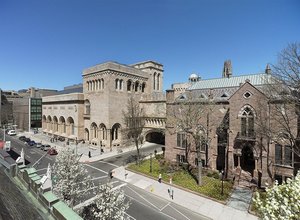
Portret John Ferguson Weir

Obrazy: 29 najsłynniejszych dzieł artysty John Ferguson Weir – spojrzenie galerii

Aktualizacja: Listopad 2026 · ranking według naszego wskaźnika popularności (liczba wyszukiwań, wizyt i zamówień dla każdego dzieła) · 31 dzieł John Ferguson Weir w naszym katalogu

W skrócie

Według galerii najsłynniejszym obrazem John Ferguson Weir jest The Gun Foundry (1866). The Morning Paper (1868) i Forging the Shaft (1874) dopełniają trio, które zna każde oko. Z 31 dzieł John Ferguson Weir w naszym katalogu, galeria prezentuje poniżej 29 najsłynniejszych prac – każda z nich jest oryginałem z podaniem roku powstania, muzeum oraz cech wyróżniających ją na tle innych.

1841 – 1926, West Point Najwięcej dzieł: Yale University Art Gallery

10 najlepszych obrazów artysty John Ferguson Weir w galerii

1
The Gun Foundry (1866) autorstwa John Ferguson Weir

The Gun Foundry

1866 · Oil On Canvas

The Gun Foundry is an oil on canvas painting by the American artist John Ferguson Weir. Executed in 1866, the work depicts the interior of the West Point Iron and Cannon Foundry located in Cold Spring, New York. The scene captures a specific moment of industrial production during the mid-19th century, focusing on the casting of a Parrott gun. The composition centers on the movement of molten iron as workers…

2
The Morning Paper (1868) autorstwa John Ferguson Weir

The Morning Paper

1868 · Oil On Canvas · Metropolitan Museum of Art, Nowy Jork

In the quietude of a dimly lit study, John Ferguson Weir’s 1868 masterpiece, “The Morning Paper,” invites the viewer into a sanctuary of profound stillness. This is not merely a portrait of an elderly gentleman lost in his morning reading; it is a masterful distillation of the American spirit during its formative years. As the eyes wander across the canvas, one feels the weight of a singular, private moment—a study…

3
Forging the Shaft (1874) autorstwa John Ferguson Weir

Forging the Shaft

1874 · Oil On Canvas · Metropolitan Museum of Art, Nowy Jork

John Ferguson Weir's "Forging the Shaft," painted in 1874, isn’t merely a depiction of a blacksmith’s workshop; it’s a powerful testament to America’s burgeoning industrial age. Born at West Point Military Academy, Weir possessed a unique vantage point – his father was a long-standing professor there, and his family history intertwined with the nation's rapid transformation. This painting, created ten years after “The Gun Foundry,” reflects a shift from wartime…

5
Daniel Cady Eaton (1834-1895) (1892) autorstwa John Ferguson Weir

Daniel Cady Eaton (1834-1895)

1892 · Oil On Canvas · Harvard Art Museums, Cambridge

A man sits in the quiet gravity of 1892. Daniel Cady Eaton is rendered in oil, his form emerging from a dark, indistinct background that offers no distraction from his steady gaze. He is positioned slightly off-center, looking toward the left of the frame with an expression of quiet contemplation. The light falls from the upper left, carving the contours of his face and the texture of his mustache with…

6
Elihu Vedder (1902) autorstwa John Ferguson Weir

Elihu Vedder

1902 · Oil On Canvas · Museum of Fine Arts, Boston

This oil on canvas portrait by John Ferguson Weir captures Elihu Vedder in a moment of quietude. Created about 1902, the work presents the subject as an older man, his presence defined by a thick, drooping mustache and hair of white. He is dressed in formal attire, including a dark jacket, a waistcoat, and a patterned tie, which anchors him within the studio setting.

7
The Rest (1900) autorstwa John Ferguson Weir

The Rest

1900 · Oil On Canvas

A woman sits in a moment of stillness, her form anchored by the weight of a violin. She wears a dress of bright yellow, a sudden burst of light against a background of muted, dark green. The fabric of her gown is voluminous, its folds captured through thick, layered oil paint that suggests a heavy, tactile presence. Her expression is serious, a steady gaze that looks inward rather than at…

8
Christmas Eve (1865) autorstwa John Ferguson Weir

Christmas Eve

1865 · Oil · Yale University Art Gallery, Nowe Havane

There is a profound stillness here, even amidst the swirling spirits. The work captures a sense of quiet enchantment, as if the viewer has stumbled upon a private, sacred moment in the dead of night. The organic curves of the vines and the rounded shape of the bell create a visual harmony that balances the verticality of the stone structure. Every brushstroke seems to contribute to a feeling of awe,…

9
His Favorite Model (1880) autorstwa John Ferguson Weir

His Favorite Model

1880 · Oil On Canvas · Yale University Art Gallery, Hartford

In the quiet stillness of an art gallery, the gaze of John Ferguson Weir meets our own. His Favorite Model, an oil on canvas completed in 1880, presents a moment of profound stillness. Within this frame, the artist John Ferguson Weir turns his attention inward, offering us a self-portrait that feels less like a formal record and more like a private observation. He captures himself not merely as a man,…

Obrazy artysty John Ferguson Weir, uszeregowane od 11 do 29 miejsca

Słynne obrazy John Ferguson Weir epoka po epoce

Tematy, które przyciągnęły wzrok John Ferguson Weir

Cztery motywy najczęściej powracające w tych oryginałach, z których każdy doczekał się swojego najdoskonalszego przykładu.

Muzea przechowujące oryginały John Ferguson Weir

8 muzeów, w których znajduje się najwięcej obrazów z tej strony.

Muzea Miasto Dzieła artysty John Ferguson Weir Obrazy z tej listy
Yale University Art Gallery, Nowe HavaneYale University Art Gallery Nowe Havane 5 Christmas Eve, Lake Como, Niagara Fall
Metropolitan Museum of Art, Nowy JorkMetropolitan Museum of Art Nowy Jork 3 The Morning Paper, Forging the Shaft, The Alhambra, Granada, Spain
Yale University Art Gallery, HartfordYale University Art Gallery Hartford 2 His Favorite Model, Lake Como
Smithsonian American Art Museum, WaszyngtonSmithsonian American Art Museum Waszyngton 2 Kalorama Cottage, Roses
Los Angeles County Museum of Art, Los AngelesLos Angeles County Museum of Art Los Angeles 1 An Artist's Studio
Harvard Art Museums, CambridgeHarvard Art Museums Cambridge 1 Daniel Cady Eaton (1834-1895)
Museum of Fine Arts, BostonMuseum of Fine Arts Boston 1 Elihu Vedder
New Britain Museum of American Art, New BritainNew Britain Museum of American Art New Britain 1 Early Morning Light

John Ferguson Weir, jedno kultowe dzieło na dekadę

Dzieła według dekad

Wybierz dekadę, aby zobaczyć dzieło, które ją definiuje.

Obrazy artysty John Ferguson Weir: odpowiedzi galerii

Który obraz John Ferguson Weir jest najsłynniejszy ze wszystkich?Odkryj odpowiedź

The Gun Foundry (1866). Następne są The Morning Paper (1868) oraz Forging the Shaft (1874).

Ile lat miał John Ferguson Weir, gdy ukończył The Gun Foundry?Odkryj odpowiedź

25 lat: The Gun Foundry pochodzi z 1866, a John Ferguson Weir urodził(a) się w 1841.

Które to 10 najlepszych obrazów John Ferguson Weir?Odkryj odpowiedź

The Gun Foundry, The Morning Paper, Forging the Shaft, An Artist's Studio, Daniel Cady Eaton (1834-1895), Elihu Vedder, The Rest, Christmas Eve, His Favorite Model i Kalorama Cottage. Powyższy ranking zawiera rok powstania oraz muzeum dla każdego z nich.

Ile dzieł stworzył/a John Ferguson Weir?Odkryj odpowiedź

Nasz katalog zawiera 31 dzieł artysty John Ferguson Weir, datowanych od 1860 do 1906.

Gdzie można znaleźć najsłynniejsze oryginały autorstwa John Ferguson Weir?Odkryj odpowiedź

W większości znajdują się w Yale University Art Gallery (Nowe Havane), Metropolitan Museum of Art (Nowy Jork) i Yale University Art Gallery (Hartford). Powyższa tabela muzeów zawiera ich pełną listę.

Kiedy John Ferguson Weir stworzył swoje najsłynniejsze obrazy?Odkryj odpowiedź

W 1860s: 10 z 29 dzieł na tej stronie powstało w tym czasie, w tym The Gun Foundry.

Które z najsłynniejszych dzieł John Ferguson Weir należą do jego najwcześniejszych i najpóźniejszych prac?Odkryj odpowiedź

Na tej stronie najwcześniejszy to Kalorama Cottage (1860), a najpóźniejszy East Rock (1906).

Do jakich tematów John Ferguson Weir powracał najczęściej?Odkryj odpowiedź

Mountains (4), Man (3) i Machinery (2), w ramach 29 dzieł na tej stronie.

W jakiej technice najczęściej tworzył John Ferguson Weir?Odkryj odpowiedź

Oil On Canvas, dla 8 z 29 dzieł na tej stronie.

Które oryginały artysty John Ferguson Weir znajdują się w zbiorach Yale University Art Gallery?Odkryj odpowiedź

Christmas Eve, Lake Como i Niagara Fall: Yale University Art Gallery, Nowe Havane posiada 5 dzieł widocznych na tej stronie.

John Ferguson Weir: artysta

John Ferguson Weir - A Legacy Forged in Fire and Light

John Ferguson Weir (1841 – 1926) stands as a pivotal figure in American art history, embodying the spirit of innovation and artistic dedication that characterized the late nineteenth century. Born at West Point Military Academy, New York, he inherited not only an ancestral connection to painting—his father, Robert Walter Weir, was a celebrated professor of drawing—but also a unique perspective shaped by witnessing the transformative upheavals of the Civil War era. This formative experience profoundly influenced his artistic vision and cemented his place as one of Yale University’s most influential educators and artists. Alongside his brother, J. Alden Weir, he established a remarkable family tradition of artistic excellence, contributing significantly to the burgeoning Impressionist movement in America.

Early Artistic Training and Industrial Visions

Weir's artistic journey commenced with meticulous instruction under his father, Robert Walter Weir—a respected figure at West Point known for his masterful landscapes—and continued through formal studies at the National Academy of Design in New York City. These foundational experiences instilled within him a profound understanding of technique and composition, equipping him to tackle ambitious projects that would capture the dynamism of the industrial revolution. Notably, he responded to a commission from Robert Leighton Stuart with *Hudson Highlands, West Point, Summer Afternoon*, a breathtaking panorama depicting the Hudson Valley bathed in golden sunlight—a seminal work demonstrating Weir’s early mastery of Impressionist principles and establishing his presence within New York's artistic circles. Simultaneously, his fascination with the West Point Iron and Cannon Foundry fueled an unparalleled creative impulse. He embarked on a series of monumental paintings—*The Gun Foundry* (1866) and *Forging the Shaft* (1868)—that transcended mere documentation; they served as powerful declarations about American ingenuity, labor, and the nation’s capacity for dramatic change during wartime. The sheer scale and expressive chiaroscuro effects employed in these canvases—figures illuminated by the fiery glow of furnaces—were groundbreaking for their time, marking Weir as a pioneer in portraying industrial scenes with both artistic sensitivity and technical precision. *Forging the Shaft*, tragically destroyed by fire in 1869, was painstakingly recreated between 1874 and 1877, reaffirming Weir’s unwavering commitment to these evocative visual narratives.

Academic Leadership at Yale and European Influences

Following his successes with the foundry paintings, Weir pursued intensive artistic studies abroad—primarily in Paris—where he immersed himself in the teachings of École des Beaux-Arts masters and absorbed the stylistic innovations of Impressionism. This transatlantic education profoundly shaped his artistic sensibilities and informed his approach to teaching at Yale University, where he served as Director (later Dean) for an astounding forty-four years from 1869 to 1913. Recognizing the importance of blending traditional academic rigor with contemporary European methods, Weir championed a curriculum that fostered both foundational skills and experimental creativity—a testament to his visionary leadership. He actively encouraged women artists within Yale’s faculty and student body, acknowledging their potential at a time when opportunities for female artistic training were scarce. His dedication extended beyond pedagogical innovation; he oversaw the creation of Yale’s School of Fine Arts as a beacon of artistic excellence in America.

Notable Paintings and Artistic Style

Weir's oeuvre encompasses a diverse range of subjects—from serene landscapes of the Hudson River Valley to portraits capturing the essence of prominent figures—each imbued with meticulous detail and infused with Impressionist light and color palettes. His paintings exemplify a masterful command of technique, reflecting his unwavering pursuit of artistic perfection. Among his most celebrated works are *Hudson Highlands*, *The Gun Foundry*, *Forging the Shaft*, *An Artist's Studio* and *The Rest*. These pieces stand as enduring symbols of American industrial heritage and artistic achievement. Weir’s distinctive style—characterized by a harmonious blend of Impressionist aesthetics and academic precision—continues to inspire artists today, securing his legacy as one of America’s foremost painters of the late nineteenth century.

Legacy and Enduring Influence

John Ferguson Weir's contribution to American art extends far beyond his individual paintings; he profoundly shaped Yale University’s School of Fine Arts and championed artistic education for generations. His unwavering belief in fostering creativity and nurturing talent ensured that Yale remained a bastion of artistic excellence—a testament to his enduring influence on the cultural landscape of America. He died peacefully in Providence, Rhode Island, in 1926, leaving behind an indelible mark on art history as a visionary educator and a masterful artist who captured the spirit of his time with unparalleled grace and conviction.