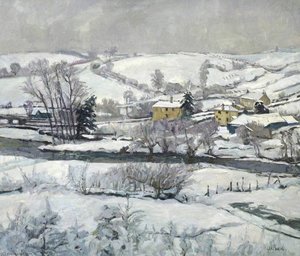
John Anthony Park: A Cornish Master of Light and Landscape
Born in Preston, Lancashire, in 1878, John Anthony Park’s artistic journey began far from the rugged coastlines that would ultimately define his most celebrated work. Initially employed in a cotton mill, Park’s innate talent for observation and representation led him to pursue painting as a vocation, initially studying under Julius Olsson and Algernon Talmage, absorbing the principles of Impressionism and early Modernism. A pivotal move to Paris in 1905 provided further refinement at the Académie Colarossi, under Auguste Joseph Delecluse, exposing him to French artistic techniques and broadening his palette. This period marked a crucial shift towards capturing fleeting moments of light and atmosphere – a hallmark that would become inextricably linked with his name.
Park’s early career saw him exhibiting at the Royal Academy in 1905, showcasing works like “Summer Evening,” “Low Tide,” and “The Bay Cloudy Day.” These pieces demonstrated an emerging ability to translate the vibrant hues of the Cornish landscape onto canvas. However, it was his relocation to St Ives, Cornwall, around 1927, that truly ignited his artistic fire. The town’s dramatic light, its bustling harbour, and the surrounding coastline provided a constant source of inspiration – a palette of blues, greens, and golds waiting to be rendered with bold brushstrokes and an intuitive understanding of colour.
The Cornish Vision: Light, Colour, and Coastal Scenes
Park’s style in St Ives evolved into a distinctive brand of Impressionism, deeply rooted in the local environment. He wasn't merely depicting scenes; he was capturing the *feeling* of Cornwall – its ever-changing light, the salty tang of the air, and the rhythmic movement of the sea. His paintings are characterized by loose, expressive brushwork, vibrant colour palettes, and a focus on atmospheric effects. Unlike many landscape artists who sought to create photographic realism, Park prioritized conveying an emotional response to his subject matter.
His most famous subjects were the harbour scenes – the boats bobbing in the water, the fishermen unloading their catch, the quaint cottages nestled amongst the hills. These weren’t idealized depictions; they were honest portrayals of everyday life, imbued with a sense of warmth and tranquility. He frequently depicted the iconic St Ives Harbour, immortalizing its beauty through countless paintings, each capturing a slightly different mood or moment in time. Works like “St Ives Harbour (to commemorate the visit of HMS Howe to St Ives, July 1947)” exemplify this skill, showcasing his ability to capture both the grandeur and intimacy of the scene.
Influences and Artistic Development
Park’s artistic development was shaped by a confluence of influences. The Impressionist movement, with its emphasis on capturing fleeting moments and using colour to convey emotion, undoubtedly played a significant role. He also drew inspiration from the Cornish landscape itself – the dramatic light, the rugged coastline, and the vibrant local culture. Furthermore, his time in Paris exposed him to French techniques and perspectives, while his later years were marked by a growing interest in tonal painting, evident in works like “Monday Morning,” where he employed subtle gradations of colour to create a sense of depth and atmosphere.
It’s important to note that Park's style evolved over time. Early works demonstrate a more academic approach, while later paintings reflect a greater freedom and spontaneity. This evolution is reflected in his increasing use of bold colours and expressive brushwork, culminating in the luminous and evocative landscapes that define his legacy.
Legacy and Recognition
John Anthony Park’s work gained recognition throughout his career, with exhibitions held both in Britain and abroad. He became a founding member of the St Ives Society of Artists, contributing to the flourishing artistic community that thrived in Cornwall during the early 20th century. His paintings are now highly sought after by collectors worldwide, appreciated for their beauty, technical skill, and evocative portrayal of the Cornish landscape.
Beyond his artistic achievements, Park’s legacy extends to his contribution to the St Ives art scene. He helped establish the town as a center for artistic innovation and inspired generations of artists to capture its unique charm on canvas. His work continues to resonate with viewers today, offering a glimpse into a bygone era and reminding us of the enduring power of landscape painting.
Further Exploration
To delve deeper into John Anthony Park’s life and work, consider exploring these resources: