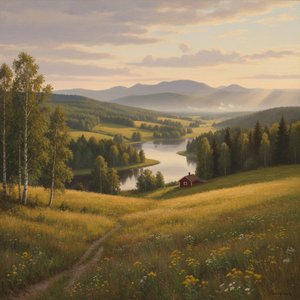
The Advocate’s Spiritual Awakening
Johann Christian Schröder’s life was a profound study in duality, a journey that began not with the brush, but with the gavel and the law book. Born in the historic German city of Rostock in 1760, his early path seemed destined for the halls of justice and civic administration. His formal education at the University of Rostock instilled in him an intellectual rigor and a deep sense of responsibility, leading him to a successful career as an advocate and eventually as a respected member of the city council. Yet, beneath this veneer of legal authority, a different kind of passion was simmering—a spiritual conviction that would eventually lead him to abandon the courtroom for the sanctuary of the studio.The Sacred Canvas and the Mastery of Light
As Schröder transitioned into the world of fine art, his work became a vessel for profound religious expression. He did not seek the fleeting fame of secular portraiture; instead, he dedicated his talent to the eternal narratives of the Bible, finding beauty in the divine struggle. His most celebrated achievement, The Flagellation of Christ, stands as a testament to his ability to marry technical precision with raw, emotional depth. His aesthetic was deeply informed by the masters of the past, specifically:- The dramatic use of light and shadow found in the works of Rembrandt
- The dynamic compositions and muscular energy of Rubens
A Legacy of Curation and Compassion
Schröder’s influence extended far beyond his own easel, as he acted as both a custodian of art history and a champion for social welfare. His profound understanding of the artistic past was further refined through his pivotal involvement with the Christian Museum in Hungary, where he curated a collection of medieval treasures. This role allowed him to bridge the gap between ancient traditions and contemporary Romanticism. Furthermore, his commitment to humanity was reflected in his civic life; he believed that art and compassion were inextricably linked, famously establishing the first almshouses to support the vulnerable members of society. His legacy remains a beautiful tapestry of legal intellect, artistic mastery, and an enduring devotion to the soul.Pytania i odpowiedzi
Gdzie można znaleźć dzieła Johann Christian Schröder pogrupowane według słów kluczowych?
Dzieła artysty Johann Christian Schröder można przeglądać według słów kluczowych na stronie Według słów kluczowych. Każde słowo kluczowe grupuje powiązane ze sobą dzieła.
Ile dzieł Johann Christian Schröder można przejrzeć w katalogu?
Możesz przeglądać 1 dzieł sztuki dzieł autorstwa Johann Christian Schröder na stronie Wszystkie dzieła.
Jak popularne są dzieła artysty Johann Christian Schröder?
Statystyki dotyczące dzieł artysty Johann Christian Schröder można znaleźć na jego stronie Statystyki odwiedzin.