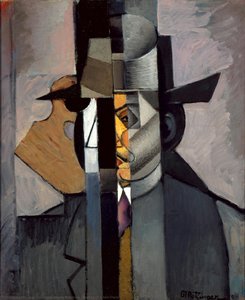
Jean Dominique Antony Metzinger: A Revolutionary of Cubism
Jean Dominique Antony Metzinger, a name often intertwined with the genesis and evolution of Cubism, was far more than just a painter; he was a theorist, writer, poet, and a pivotal figure in reshaping our understanding of visual representation. Born in Nantes in 1883 into a family steeped in military tradition – his great-grandfather served under Napoleon Bonaparte – Metzinger’s artistic journey began with a grounding in traditional academic training before swiftly embracing the radical innovations of the early 20th century. His life, marked by intellectual curiosity and a relentless pursuit of new artistic languages, ultimately cemented his place as one of the most influential figures in modern art.Early Influences and the Seeds of Cubism
Metzinger’s formative years were deeply influenced by the vibrant currents of early 20th-century French painting. Initially drawn to Neo-Impressionism, he found himself captivated by the meticulous pointillist techniques of Georges Seurat and Henri-Edmond Cross – a fascination rooted in their exploration of color theory and optical effects. However, Metzinger’s artistic spirit quickly outgrew these established styles. Between 1904 and 1907, he experimented with Divisionism and Fauvism, absorbing the bold colors and expressive brushstrokes of artists like Paul Gauguin, while simultaneously developing his own unique approach to fragmentation and geometric abstraction. This period witnessed the emergence of some of his earliest proto-Cubist works – paintings characterized by a deliberate dismantling of form and a nascent interest in presenting multiple viewpoints within a single composition. Crucially, Metzinger’s relocation to Paris in 1903, fueled by the sale of three exhibited pieces at the Salon des Indépendants, thrust him into the heart of the Parisian avant-garde – a crucible where artistic ideas were forged and disseminated with unprecedented speed.The Birth of Cubism: Theory and Collaboration
Metzinger’s most enduring contribution to art history lies in his collaboration with Albert Gleizes on *Du Cubisme* (1912), a seminal theoretical treatise that provided the first comprehensive explanation of this revolutionary movement. Prior to Cubism, artists typically depicted objects from a single, fixed perspective – a convention dictated by centuries of artistic tradition. Metzinger and Gleizes challenged this fundamental assumption, arguing that an object could be truly understood only through its various facets and viewpoints. Their work explored how an observer’s experience of an object is shaped by successive perceptions within space and time. This concept—the idea of “simultaneity”—was groundbreaking and fundamentally altered the way artists approached representation. The publication of *Du Cubisme* wasn't merely a theoretical exercise; it was a catalyst for the widespread adoption of Cubist principles, transforming the movement from a small circle of experimentalists into a dominant force in the international art world. Metzinger’s own paintings during this period reflected these theoretical developments, showcasing his mastery of faceting and fragmentation – techniques that would become hallmarks of Cubism.Crystal Cubism and Beyond
Following World War I, Metzinger embarked on a new phase of artistic exploration known as “crystal cubism.” This style represented a radical departure from the earlier, more fragmented forms of Cubism, emphasizing geometric clarity and architectural precision. Influenced by Niels Bohr’s work in quantum mechanics – a field exploring the nature of reality at its most fundamental level – Metzinger sought to express underlying symmetries and mathematical relationships within his paintings. He believed that art could reveal hidden structures and patterns inherent in the natural world. This period saw the creation of iconic works such as *La Femme au Cheval*, which, through its meticulous geometric construction, captured a sense of dynamic movement and spatial complexity. Beyond crystal cubism, Metzinger continued to experiment with various styles throughout his career, demonstrating an adaptability and intellectual curiosity that defined his artistic practice.Legacy and Enduring Influence
Jean Metzinger’s legacy extends far beyond the confines of his own paintings. He was not simply a painter; he was a theorist, a writer, and a key architect of the Cubist movement. His theoretical writings, particularly *Du Cubisme*, provided the intellectual framework for understanding this revolutionary approach to art. His exploration of simultaneity—the idea that an object can be perceived from multiple viewpoints simultaneously—profoundly influenced subsequent generations of artists. Metzinger’s work is now recognized as a cornerstone of modern art, and his contributions continue to inspire artists and scholars alike. His paintings are held in prestigious collections worldwide, including the MoMA in New York, the Metropolitan Museum of Art, and the Tate Gallery in London, ensuring that his revolutionary vision will endure for generations to come.Pytania i odpowiedzi
Czy mogę przeanalizować sposób użycia koloru przez Jean Dominique Antony Metzinger we wszystkich jego/jej dziełach?
Sposób wykorzystania koloru przez Jean Dominique Antony Metzinger w pracach wymienionych na niniejsza strona można przestudiować na stronie Genom Palety artysty.
W jakim mieście i kraju urodził(a) się Jean Dominique Antony Metzinger?
Jean Dominique Antony Metzinger urodził się w Nantes w Francja.
Skąd pochodzi Jean Dominique Antony Metzinger?
Jean Dominique Antony Metzinger urodził się w Francja.