A Pioneer of Urban Landscapes: The Life and Art of Jan van der Heyden
Jan van der Heyden, born in 1637 in the bustling Dutch town of Gorinchem, wasn’t merely a painter; he was a multifaceted figure who profoundly shaped the visual landscape of his era. His story is one woven with threads of artistic innovation, engineering ingenuity, and a deep engagement with the realities of urban life. Emerging during the height of the Dutch Golden Age, Van der Heyden defied conventional artistic boundaries, becoming renowned for his meticulously rendered townscapes – not just static depictions of buildings and streets, but vibrant windows into the heart of 17th-century cities. His legacy extends far beyond the canvas, encompassing groundbreaking contributions to firefighting technology and urban planning, solidifying his place as a true pioneer.Early Influences and Artistic Training
Van der Heyden’s early life was steeped in craftsmanship and precision. Born into a family of Mennonite merchants – his father involved in the trade of grain – he received an education that emphasized both artistic skill and practical knowledge. While details about his formal training remain somewhat elusive, it's believed he initially honed his abilities within the familial sphere, possibly under the guidance of his brother, Goris van der Heyden, a skilled craftsman specializing in mirrors. This early exposure to intricate detail and reflective surfaces undoubtedly influenced Van der Heyden’s characteristic clarity and precision in his paintings. Some scholars suggest an apprenticeship with Jacob van der Ulft, a respected glass painter from Gorinchem, further refining his draftsmanship and understanding of color application – skills initially employed in creating *verre eglomisé*, decorative paintings on glass, a technique that likely instilled in him a deep appreciation for layering and texture. This early foundation laid the groundwork for his later success as an architectural painter.From Decorative Arts to Architectural Precision
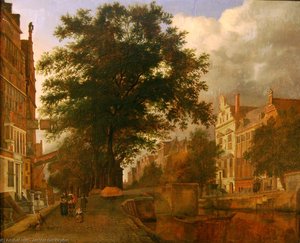
Van der Heyden’s artistic trajectory gradually shifted towards a specialization that would secure his place in art history: the depiction of townscapes. He was among the first Dutch artists to dedicate himself almost entirely to this genre, becoming a leading architectural painter of his time. Unlike many of his contemporaries who focused on portraits or historical scenes, Van der Heyden turned his gaze to the bustling streets and stately canals of Amsterdam and beyond. His canvases offer meticulously detailed views not only of his adopted city but also of other Dutch, Flemish, and German urban centers. Works like *View of Oudezijds Voorburgwal with the Oude Kerk in Amsterdam* exemplify this dedication to realism, capturing the play of light on brickwork, the textures of cobblestone streets, and the lively atmosphere of 17th-century life. He didn’t limit himself to existing locales; Van der Heyden also created “architectural fantasies,” imaginative compositions blending elements from different structures, anticipating artistic trends that would emerge in later centuries. These works demonstrate a playful creativity alongside his technical mastery. Beyond city views, he occasionally ventured into still life painting, as seen in *Still-Life with Globe, Books and Chinese Silk*, showcasing his versatility and attention to detail across various subjects.An Engineer’s Vision: Innovation Beyond the Canvas
Van der Heyden's ingenuity extended far beyond the realm of art. He was a practical inventor and engineer who actively sought solutions to real-world problems, most notably in the area of firefighting. In 1672, collaborating with his brother Nicolaes – a hydraulic engineer – he devised improvements to the fire hose, addressing a critical need in densely populated urban areas. This wasn’t merely a minor adjustment; it was a significant advancement in firefighting technology. He didn't stop there. Van der Heyden reorganized Amsterdam’s volunteer fire brigade in 1685, implementing more efficient strategies and protocols. His dedication culminated in the publication of *Brandspuiten-boek*, widely considered the first comprehensive firefighting manual, complete with his own detailed illustrations. This work wasn’t just a technical guide; it was a testament to his commitment to public safety. Furthermore, he designed and implemented an innovative street lighting scheme for Amsterdam, which illuminated the city's streets for over a century, dramatically improving nighttime visibility and security.Legacy and Lasting Influence
Jan van der Heyden died in 1712 as a wealthy man, leaving behind a substantial estate that included over seventy of his own paintings – a testament to both his productivity and the value placed on his work during his lifetime. His only known pupil was his son, Jan, who continued some aspects of his father’s artistic legacy. Van der Heyden's influence resonated through subsequent generations of artists, particularly those specializing in architectural painting. He provided valuable insights into 17th-century urban life and architecture, offering a visual record of cities as they existed during that period. His detailed depictions serve as invaluable historical documents for modern scholars. His innovative approach to townscapes, combined with his practical engineering contributions, cemented his position as a unique and multifaceted figure in Dutch history. He wasn’t simply an artist capturing the world around him; he was actively shaping it, improving the lives of those who inhabited it. Van der Heyden's legacy endures not only through his captivating paintings but also through the enduring impact of his inventions on urban safety and infrastructure.Notable Works
* *View of Oudezijds Voorburgwal with the Oude Kerk in Amsterdam* * *Still-Life with Globe, Books and Chinese Silk* * *Architectural Fantasies* (various compositions) * *Views of Cologne, Bonn, Düsseldorf, Xanten, Akwizgranu and Delft* * *Brandspuiten-boek* (Firefighting Manual)Pytania i odpowiedzi
Gdzie i w którym roku urodził(a) się Jan van der Heyden?
Jan van der Heyden urodził się w Gorinchem w 1637.
W jakiej epoce historycznej tworzył/a Jan van der Heyden?
Jan van der Heyden tworzył w okresie – Wczesna nowożytność. Epoka ta osadza twórczość artysty w kontekście historycznym.
Jakich kolorów Jan van der Heyden używał najczęściej?
Profil kolorystyczny twórczości Jan van der Heyden można zobaczyć na stronie Genom Palety artysty.