1


Aktualizacja: Listopad 2026 · ranking według naszego wskaźnika popularności (liczba wyszukiwań, wizyt i zamówień dla każdego dzieła) · 29 dzieł Jack Davis w naszym katalogu
W skrócie
Według galerii najsłynniejszym obrazem Jack Davis jest Watergate Breaks Wide Open (1973). Joe Namath (1972) i Britain Balancing (1976) dopełniają trio, które zna każde oko. Z 29 dzieł Jack Davis w naszym katalogu, galeria prezentuje poniżej 29 najsłynniejszych prac – każda z nich jest oryginałem z podaniem roku powstania, muzeum oraz cech wyróżniających ją na tle innych.

A Vibrant Portrait of an Icon: Jack Davis’s “Joe Namath” (1972) This dynamic watercolor illustration by acclaimed American artist Jack Davis captures the charisma and cultural impact of Joe Namath, the legendary quarterback who led the New York Jets to a stunning Super Bowl III victory. Created in 1972, this piece isn’t simply a portrait; it's a vibrant snapshot of an era, brimming with energy and nostalgia for a golden…


 Henry Kissinger1973
12
 Richard Nixon and Leonid Brezhnev1973
13
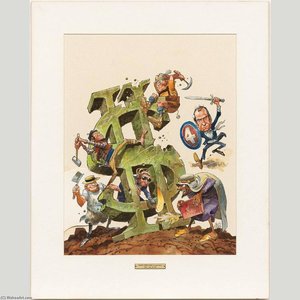 Richard Nixon1973
14
 Nixon II1973
15
 Ailing Alliance1973
16
 Scrambling to Break Clear1973
17
 Food Prices Big Beef1973
18
 Agnew on Tightrope1973
19
 Economy1974
20
 Abraham David Beame1975
21
 China vs. Russia1975
22
 Henry Kissinger and Gerald Ford1975
23
 Superbowl1976
24
 Exxon Testing Tiger1974
25
 Last Pitch1976
26
 Republican Rumble1976
27
 The Great Kissinger1974
28
 Testing Detente1974
29
 Plight of the GOP1976
Cztery motywy najczęściej powracające w tych oryginałach, z których każdy doczekał się swojego najdoskonalszego przykładu.
5 lat, od 1972 do 1976, przedstawionych na tej stronie jako pełna, ułożona chronologicznie kariera Jack Davis: krótka historia ukazana rok po roku poprzez jej najsłynniejsze oryginały.
Wybierz rok, aby zobaczyć oryginały.
A Vibrant Portrait of an Icon: Jack Davis’s “Joe Namath” (1972) This dynamic watercolor illustration by acclaimed American artist Jack Davis captures the charisma and cultural impact of Joe Namath, the legendary quarterback who led the New York Jets to a stunning Super Bowl III victory. Created in 1972, this piece isn’t simply a portrait; it's a vibrant snapshot of an era, brimming with energy and nostalgia for a golden…
Watergate Breaks Wide Open (1973). Następne są Joe Namath (1972) oraz Britain Balancing (1976).
49 lat: Watergate Breaks Wide Open pochodzi z 1973, a Jack Davis urodził(a) się w 1924.
Watergate Breaks Wide Open, Joe Namath, Britain Balancing, Britain Adrift, Europe and the Mideast, Baseball Springs Eternal, Recession's Greetings, Carter and Opponents, My Guys i Gerald Ford. Powyższy ranking zawiera rok powstania oraz muzeum dla każdego z nich.
Nasz katalog zawiera 29 dzieł artysty Jack Davis, datowanych od 1972 do 1976.
W 1973: 9 z 29 dzieł na tej stronie powstało w tym czasie, w tym Watergate Breaks Wide Open.
Na tej stronie najwcześniejszy to Joe Namath (1972), a najpóźniejszy Britain Balancing (1976).
John Burton Davis Jr., known to the world as Jack Davis, was a man whose pen captured the very heartbeat of twentieth-century America. Born in Atlanta, Georgia, on December 2nd, 1924, he entered a world transitioning into the vibrant, chaotic energy of the Jazz Age. This early exposure to a rapidly changing cultural landscape would later become the foundation of his artistic identity. Davis was not merely an observer of history; he was its visual biographer, possessing a rare ability to distill the complex social, political, and athletic triumphs of his era into singular, unforgettable images. His journey from a young boy sketching for high school newspapers to becoming a titan of American illustration is a testament to a lifelong devotion to the art of the caricature.
His formal education at the Pratt Institute in Brooklyn provided him with the technical rigor necessary to master the diverse mediums he would later employ. While his training focused on drawing and printmaking, his creative spirit was profoundly shaped by the avant-garde movements of his time, specifically Surrealism and Dada. These influences instilled in him an experimental approach to composition, allowing him to move beyond mere imitation toward a style that embraced the absurd and the exaggerated. This stylistic evolution was further enriched by early collaborations with Walt Disney, where he honed his skills as a visual storyteller, contributing to the magic of legendary animated features such as Sleeping Beauty and Fantasia.
The true brilliance of Jack Davis lay in his ability to marry technical precision with an infectious, often humorous, energy. His work was characterized by a distinctive anatomical exaggeration—large heads, spindly limbs, and expressive features that made his characters leap off the page. This technique allowed him to navigate seamlessly between different realms of American life, from the gritty horror of EC Comics like Tales from the Crypt to the satirical wit of MAD Magazine, where he stood as a founding figure. His lines were bold and dynamic, capable of conveying both the tension of a political standoff and the exuberant motion of an athletic feat.
In his later career, Davis became a ubiquitous presence in mainstream American media. He transformed the landscape of advertising, movie posters, and record album covers, making him one of the most visible creators of his generation. His mastery of watercolor brought a new dimension to his work, as seen in his iconic 1972 portrait of Joe Namath. In this piece, Davis utilized illustrative realism blended with fluid watercolor washes to capture the charisma of the legendary quarterback. The artwork does not merely depict a man; it captures an era of American football, using layered compositions and vibrant textures to evoke the nostalgia and excitement of a golden age.
Beyond the individual portraits and comic strips, Davis’s work served as a profound social commentary. Through his contributions to Time Magazine, he utilized political cartooning to dissect the hypocrisies of power and the shifting tides of American politics. Whether satirizing figures like Henry Kissinger or capturing the tension of presidential campaigns, his art provoked reflection and engaged the public consciousness. He had a unique gift for making the heavy weight of political discourse feel accessible through the lens of wit and caricature.
The historical significance of Jack Davis cannot be overstated. His career, spanning from the 1950s until his passing in 2016, mirrored the evolution of American pop culture itself. He left behind an astonishing body of work that serves as a visual archive of the mid-century period and beyond. To look at a Jack Davis illustration is to see the American spirit—its triumphs, its absurdities, and its enduring vitality—rendered with a masterful hand that remains as captivating today as it was decades ago.