The Soul of the Skagen Coast: The Life and Legacy of Holger Drachmann
Holger Henrik Herholdt Drachmann was far more than a mere practitioner of the arts; he was a vital pulse within the Scandinavian Modern Breakthrough, a man whose creative spirit bridged the worlds of lyrical poetry and evocative painting. Born in Copenhagen in 1846, his early years were shadowed by the profound loss of his mother, an event that many scholars believe nurtured a lifelong sensitivity to drama and the heroic. Growing up as the son of a naval surgeon, Drachmann often retreated into imaginative realms, organizing theatrical games where he embodied the legendary exploits of Danish maritime heroes like Peder Tordenskjold. This early fascination with narrative and the grandeur of the sea would later become the cornerstone of his artistic identity, manifesting in both his sweeping verses and his turbulent seascapes.
As his creative journey unfolded, Drachmann found himself drawn away from the academic constraints of the city toward the rugged, luminous landscapes of the north. A pivotal moment occurred in 1872 when a visit to Skagen, alongside the artist Frits Thaulow, ignited a lifelong devotion to the Skagen artistic colony. This remote corner of Denmark, where the Skagerrak Strait meets the North Sea, provided him with an inexhaust and dramatic muse. In this unique environment, Drachmann moved away from meticulous, rigid realism, instead embracing a style that prioritized emotional resonance and the raw, atmospheric truth of the Nordic landscape. His work began to reflect a beautiful tension between the lyrical sentimentality of his poetic soul and the rugged, impressionistic observations of the natural world.
A Dual Mastery of Verse and Canvas
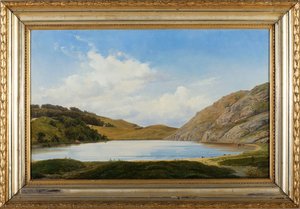
While history often remembers Drachmann as one of Denmark's most celebrated poets and dramatists, his contributions to the visual arts are equally profound in their emotional depth. He viewed his painting as a secondary pursuit to his writing, yet this very relationship allowed his canvases to possess a unique, poetic quality. His brushwork was rarely concerned with mere topographical accuracy; rather, he sought to capture the intangible essence of the sea—its power, its light, and its mystery. In masterpieces such as
“Hammersø,” one can observe the influence of Impressionism, where bold strokes and a vibrant palette work in harmony to depict the coastline not just as land and water, but as a living, breathing entity of drama and wonder.
The breadth of his creative output is best understood through the themes that unified his various disciplines:
- Maritime Grandeur: His fascination with naval history and the sea provided a consistent subject matter for both his epic poems and his maritime paintings.
- Naturalism and Light: Through his association with the Skagen painters, he mastered the art of capturing the fleeting, ethereal light characteristic of the Danish coast.
- The Modern Breakthrough: His work embodied the movement's shift toward realism, social awareness, and a departure from romanticized academic traditions.
Historical Significance and Enduring Spirit
Drachmann’s legacy is inextricably linked to the cultural identity of Denmark and the broader Scandinavian movement. He was a central figure in a community of artists—including Michael and Anna Ancher and P.S. Krøyer—who transformed a small fishing village into a world-renowned sanctuary of light and innovation. His ability to blend the literary with the visual helped define an era where art became a tool for exploring both national identity and the human condition. Even as he navigated the complexities of fame and the shifting tides of artistic fashion, his dedication to capturing the spirit of his surroundings remained unshakable.
Though he passed away in 1908, the echoes of his creativity continue to resonate through the halls of the Skagens Museum and within the hearts of those moved by his evocative imagery. Drachmann remains a symbol of the artist as a storyteller, a man who could find the epic within a single wave and the profound within a line of verse. His life stands as a testament to the power of the Scandinavian landscape to inspire a movement that forever changed the trajectory of Northern European art.