Portret Henry Lark Pratt

Obrazy: 26 najsłynniejszych dzieł artysty Henry Lark Pratt – spojrzenie galerii

Aktualizacja: Listopad 2026 · ranking według naszego wskaźnika popularności (liczba wyszukiwań, wizyt i zamówień dla każdego dzieła) · 26 dzieł Henry Lark Pratt w naszym katalogu

W skrócie

Według opinii kuratorów galerii, najsłynniejszym obrazem Henry Lark Pratt jest Chatsworth House, Derbyshire (1852), którego oryginał znajduje się w Buxton Museum - Art Gallery w Buxton. St Editha's Church and the Old Paregoric Shop, Tamworth (1856) i View of Wordsley, Stourbridge, from Dob Hill (1846) dopełniają trio, które zna każde oko. Z 26 dzieł Henry Lark Pratt w naszym katalogu, galeria prezentuje poniżej 26 najsłynniejszych prac – każda z nich jest oryginałem z podaniem roku powstania, muzeum oraz cech wyróżniających ją na tle innych.

1805 – 1873, Derby Najwięcej dzieł: Brampton Museum

10 najlepszych obrazów artysty Henry Lark Pratt w galerii

1
Chatsworth House, Derbyshire (1852) autorstwa Henry Lark Pratt

Chatsworth House, Derbyshire

1852 · Oil · Buxton Museum - Art Gallery, Buxton

The sun hangs softly over the landscape, casting a gentle light across the sprawling grounds of Chatsworth House. In this quiet moment, the grand architecture of the house rests amidst a sea of lush greenery, framed by the rising silhouettes of distant mountains. The air feels still, as if the very earth is holding its breath. Near the foreground, the grass is alive with subtle movement; several deer graze peacefully,…

3
View of Wordsley, Stourbridge, from Dob Hill (1846) autorstwa Henry Lark Pratt

View of Wordsley, Stourbridge, from Dob Hill

1846 · Oil On Canvas

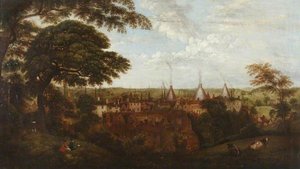
In this 1846 oil on canvas, we find ourselves positioned on the heights of Dob Hill, looking down upon the settlement of Wordsley and Stourbridge. The composition is anchored by a large, commanding tree in the foreground, which provides a sense of scale and depth against the sprawling town below. It is a scene of quiet industry and movement, where the architecture of the buildings spreads across the landscape, nestled…

4
View of Derby from Nottingham Road (1850) autorstwa Henry Lark Pratt

View of Derby from Nottingham Road

1850 · Oil On Canvas · Museum of Fine Arts, Boston

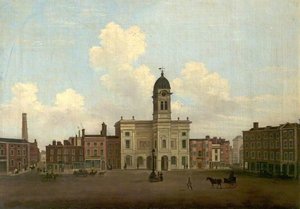
We are looking at View of Derby from Nottingham Road, a work by Henry Lark Pratt. This landscape captures a specific moment in the English countryside, rendered in oil on canvas. The scene depicts a tranquil road lined with trees, where horses and a horse-drawn carriage move through the landscape alongside scattered figures. It is a quiet study of rural life and topographical detail.

5
Haddon Hall, Derbyshire (1852) autorstwa Henry Lark Pratt

Haddon Hall, Derbyshire

1852 · Oil On Canvas · Buxton Museum - Art Gallery, Buxton

The oil painting depicts Haddon Hall in Derbyshire, a large stone structure situated within a landscape of green fields and dense clusters of trees. A moat surrounds the primary building, its surface reflecting the light and the surrounding vegetation. Near the water, a small boat rests, positioned close to the castle walls. The architecture of the hall features multiple levels and various smaller structures visible in the background. Scattered figures…

6
King Street, Newcastle under Lyme (1865) autorstwa Henry Lark Pratt

King Street, Newcastle under Lyme

1865 · Oil On Canvas · Brampton Museum, New South Wales

Henry Lark Pratt captured a bustling street scene in King Street, Newcastle under Lyme, in 1865. The composition emphasizes the length of the thoroughfare and the architecture of the buildings lining its edge. A church with a prominent steeple anchors the skyline, rising above various residences that define the urban landscape. This topographical view provides a detailed record of the town's layout and structural character.

7
View of Etruria from Basford Bank autorstwa Henry Lark Pratt

View of Etruria from Basford Bank

Oil On Canvas

The work before us is titled View of Etruria from Basford Bank, a landscape rendered by the artist Henry Lark Pratt. This specific piece captures a scene of the Trent Valley, focusing on the landscape surrounding the Wedgwood pottery works. It is a quiet observation of the intersection between the natural environment and the emerging industrial character of the Staffordshire region.

9
Red Lion Square (1854) autorstwa Henry Lark Pratt

Red Lion Square

1854 · Brampton Museum, New South Wales

The painting Red Lion Square by Henry Lark I Pratt is a captivating oil on canvas piece that showcases the artist's skill in capturing the essence of a quaint village. Created in 1854, this artwork measures 38 x 57 cm and is currently housed at the Brampton Museum in Newcastle, Australia. A Glimpse into the Past The scene depicted in Red Lion Square transports viewers to a bygone era, where…

Obrazy artysty Henry Lark Pratt, uszeregowane od 11 do 26 miejsca

Tematy, które przyciągnęły wzrok Henry Lark Pratt

Cztery motywy najczęściej powracające w tych oryginałach, z których każdy doczekał się swojego najdoskonalszego przykładu.

Muzea przechowujące oryginały Henry Lark Pratt

5 muzeów, w których znajduje się najwięcej obrazów z tej strony.

Muzea Miasto Dzieła artysty Henry Lark Pratt Obrazy z tej listy
Brampton Museum, New South WalesBrampton Museum New South Wales 5 King Street, Newcastle under Lyme, Red Lion Square, Trentham Hall
Buxton Museum - Art Gallery, BuxtonBuxton Museum - Art Gallery Buxton 2 Chatsworth House, Derbyshire, Haddon Hall, Derbyshire
Derby Museum and Art GalleryDerby Museum and Art Gallery 2 View of Derby, Showing the Derwent, St Peter's Church, Derby, by Moonlight
Tamworth Castle, TamworthTamworth Castle Tamworth 1 St Editha's Church and the Old Paregoric Shop, Tamworth
Museum of Fine Arts, BostonMuseum of Fine Arts Boston 1 View of Derby from Nottingham Road

Henry Lark Pratt, jedno kultowe dzieło na dekadę

Dzieła według dekad

Wybierz dekadę, aby zobaczyć dzieło, które ją definiuje.

Obrazy artysty Henry Lark Pratt: odpowiedzi galerii

Który obraz Henry Lark Pratt jest najsłynniejszy ze wszystkich?Odkryj odpowiedź

Chatsworth House, Derbyshire (1852), Buxton Museum - Art Gallery, Buxton. Następne są St Editha's Church and the Old Paregoric Shop, Tamworth (1856) oraz View of Wordsley, Stourbridge, from Dob Hill (1846).

Ile lat miał Henry Lark Pratt, gdy ukończył Chatsworth House, Derbyshire?Odkryj odpowiedź

47 lat: Chatsworth House, Derbyshire pochodzi z 1852, a Henry Lark Pratt urodził(a) się w 1805.

Które to 10 najlepszych obrazów Henry Lark Pratt?Odkryj odpowiedź

Chatsworth House, Derbyshire, St Editha's Church and the Old Paregoric Shop, Tamworth, View of Wordsley, Stourbridge, from Dob Hill, View of Derby from Nottingham Road, Haddon Hall, Derbyshire, King Street, Newcastle under Lyme, View of Etruria from Basford Bank, Trent Vale from Penkhull, Red Lion Square i A View of Derby from Rowditch. Powyższy ranking zawiera rok powstania oraz muzeum dla każdego z nich.

Ile dzieł stworzył/a Henry Lark Pratt?Odkryj odpowiedź

Nasz katalog zawiera 26 dzieł artysty Henry Lark Pratt, datowanych od 1846 do 1865.

Gdzie można znaleźć najsłynniejsze oryginały autorstwa Henry Lark Pratt?Odkryj odpowiedź

W większości znajdują się w Brampton Museum (New South Wales), Buxton Museum - Art Gallery (Buxton) i Derby Museum and Art Gallery. Powyższa tabela muzeów zawiera ich pełną listę.

Kiedy Henry Lark Pratt stworzył swoje najsłynniejsze obrazy?Odkryj odpowiedź

W 1850s: 9 z 26 dzieł na tej stronie powstało w tym czasie, w tym Chatsworth House, Derbyshire.

Które z najsłynniejszych dzieł Henry Lark Pratt należą do jego najwcześniejszych i najpóźniejszych prac?Odkryj odpowiedź

Na tej stronie najwcześniejszy to View of Wordsley, Stourbridge, from Dob Hill (1846), a najpóźniejszy King Street, Newcastle under Lyme (1865).

Do jakich tematów Henry Lark Pratt powracał najczęściej?Odkryj odpowiedź

Landscape (6), People (5) i Trees (4), w ramach 26 dzieł na tej stronie.

W jakiej technice najczęściej tworzył Henry Lark Pratt?Odkryj odpowiedź

Oil On Canvas, dla 5 z 26 dzieł na tej stronie.

Które oryginały artysty Henry Lark Pratt znajdują się w zbiorach Brampton Museum?Odkryj odpowiedź

King Street, Newcastle under Lyme, Red Lion Square i Trentham Hall: Brampton Museum, New South Wales posiada 5 dzieł widocznych na tej stronie.

Henry Lark Pratt: artysta

Henry Lark I Pratt: A Derbyshire Porcelain Painter

Henry Lark I Pratt (1805 – 1873) stands as a testament to the intersection of craft and artistic vision—a painter inextricably linked to the legacy of Derby’s porcelain industry. Born in St Peter's Parish, Derby, his early life was shaped by an apprenticeship at the prestigious Derby Manufactory, where he honed skills crucial not only for shaping clay but also for capturing its beauty on canvas. This formative experience instilled a meticulous attention to detail and a profound understanding of texture and form that would permeate his oeuvre.
  • Early Life & Training: Pratt’s dedication to mastering the craft began at a young age, providing him with invaluable insight into material properties and artistic representation. The Derby factory wasn't merely a workplace; it was an incubator for aesthetic sensibilities.
  • Career in Porcelain & Initial Artistic Pursuits: Following his apprenticeship, Pratt worked briefly at Mintons before embarking on a solo artistic journey. His marriage to Margaret Windsor solidified his life in Stoke-on-Trent and fostered a family rooted in the region’s artistic traditions.
Pratt's artistic style evolved significantly over time, transitioning from decorative porcelain painting to landscapes imbued with topographical accuracy. He found particular inspiration in Dovedale Valley, Derbyshire—a location that would become synonymous with his artistic output. The Duke of Devonshire and Queen Victoria recognized Pratt’s talent, commissioning him to depict Windsor Castle views, demonstrating the esteem in which he was held by Victorian society.
  • Notable Paintings & Patronage: His landscapes—characterized by meticulous observation and a commitment to realism—became celebrated for their evocative portrayal of the English countryside. Commissions from aristocratic patrons underscored his reputation as a respected artist.
  • Royal Recognition & Artistic Development: Pratt’s acceptance into the Royal Academy in 1867 and subsequent exhibitions with the Society of British Artists signaled a blossoming artistic career, fueled by an unwavering passion for capturing the essence of nature.

Technique & Influences

Pratt's paintings demonstrate a masterful command of oil paint—a medium favored for its ability to render subtle tonal variations and textural nuances. He meticulously blended pigments to achieve luminous effects, mirroring the delicate glaze surfaces of Derby porcelain. While biographical details remain somewhat sparse, Pratt’s artistic sensibilities clearly absorbed influences from Romantic landscape painting, prioritizing emotional resonance alongside precise topographical representation.
  • Derbyshire Landscape Tradition: Pratt's work aligns with Derbyshire’s burgeoning landscape tradition—a movement that sought to elevate rural vistas into subjects of artistic contemplation.

Legacy & Recognition

Today, Henry Lark I Pratt’s paintings reside in galleries across Newcastle-under-Lyme and Derby—testaments to his enduring contribution to British art history. His son, Hilton Pratt, continued the family artistic legacy, exhibiting his own work and cementing Pratt's place as a figure of considerable renown within his hometown.
  • Contemporary Exhibitions: Pratt’s paintings continue to inspire admiration for their beauty and technical skill—a lasting reminder of a Derbyshire artist who bridged the gap between craft and artistic expression.