Henrietta Georgiana Maria Lascelles Iremonger Chatterton: A Victorian Portraitist of Intrigue and Grace
The art world often reveals its most compelling stories through the lives of those who created, and Henrietta Georgiana Maria Lascelles Iremonger Chatterton (1806-1876) is a prime example. Born into a privileged yet somewhat turbulent family – her father, Reverend Lascelles Iremonger, was a prebendary at Winchester Cathedral – she navigated the social landscape of 19th-century England with remarkable grace and artistic talent, ultimately becoming one of its most intriguing portraitists. Her life intertwined with some of the era’s most prominent figures, from literary giants to members of the royal family, leaving behind a legacy of exquisitely rendered portraits that offer glimpses into a vanished world.
Chatterton's early years were marked by a refined education, primarily overseen by private tutors and governesses. While lacking formal artistic training in the traditional sense, she possessed an innate eye for detail and a deep appreciation for beauty – qualities honed through exposure to her family’s extensive collection of art and literature. Her marriage to Sir William Chatterton in 1824 brought her into the vibrant social circles of Cork, Ireland, where she developed a keen interest in travel and observation. This period proved formative, shaping her artistic sensibilities and fostering a desire to capture the essence of her subjects – not merely their physical likenesses, but also their personalities and inner lives.
Upon returning to England, Chatterton’s life took an even more captivating turn. She became intimately involved with the literary scene, befriending figures like Robert Browning, Charles Dickens, and Anna Jameson. Her diary entries reveal a constant stream of social engagements, intellectual discussions, and artistic collaborations. Notably, she developed a close relationship with Rebecca Dulcibella Orpen, a talented amateur artist who served as her primary portraitist. Orpen’s skill was crucial in bringing Chatterton's visions to life on canvas, resulting in the remarkably lifelike portraits that define her oeuvre. The collaboration between Chatterton and Orpen is often referred to as “The Quartet,” reflecting their shared social circle which included Marmion Edward Ferrers and his wife.
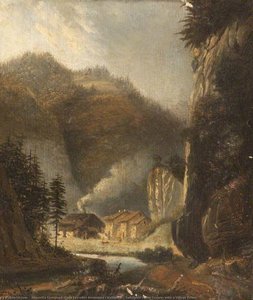
Chatterton’s artistic style can be characterized by a delicate balance of realism and romanticism, heavily influenced by the prevailing trends of the Victorian era. Her portraits are notable for their meticulous attention to detail – from the texture of fabrics to the subtle nuances of expression – yet they also possess an undeniable sense of warmth and intimacy. She skillfully employed light and shadow to create depth and atmosphere, drawing viewers into the subjects’ world. Her compositions often feature elegant settings and luxurious details, reflecting the wealth and status of her clientele. A key element in her work is a remarkable ability to capture the psychological state of her sitters, conveying their emotions with subtle gestures and expressions. Her most famous works include “Subalpine Mountain Scenery with a Village Below,” which showcases her talent for capturing landscapes, and “Salome with the Head of John the Baptist (after Guido Reni),” demonstrating her willingness to engage with classical themes and artistic influences.
Beyond portraiture, Chatterton also dabbled in travel writing and poetry. Her 1839 publication, *Rambles in the South of Ireland*, offered a romanticized yet insightful portrayal of Irish life, challenging prevailing stereotypes and revealing her keen observational skills. Later in life, she collaborated with her husband, Edward Heneage Dering, on fiction, including *Grey’s Court*. Despite facing personal challenges – including the loss of her husband and financial difficulties stemming from the Irish famine – Chatterton remained a vibrant and engaged member of society until her death in 1876. Her memoirs, published posthumously, provide valuable insights into her life and artistic philosophy.
Key Works & Artistic Techniques
Chatterton’s artistic output is relatively modest but remarkably consistent in quality. Her most celebrated works include:
- “Subalpine Mountain Scenery with a Village Below” (1839): Demonstrates her ability to capture the grandeur of nature and create atmospheric landscapes.
- “Salome with the Head of John the Baptist (after Guido Reni)” (c. 1850s): Highlights her engagement with classical art and her skill in replicating complex compositions.
- “Henrietta Georgiana Marcia Lascelles Iremonger, Lady Chatterton” (1859): A quintessential example of her portraiture style – characterized by its intimacy, realism, and psychological depth.
Her technique involved careful observation, meticulous sketching, and a masterful use of oil paints to achieve subtle gradations of tone and color. She favored a loose, expressive brushstroke that allowed for a sense of spontaneity and immediacy, while still maintaining a high level of technical precision.
Historical Context & Influences
Chatterton’s artistic career unfolded during a period of significant social and cultural change in Britain. The Victorian era was marked by rapid industrialization, urbanization, and the rise of the middle class – all of which profoundly influenced art and society. Her work reflects these trends, incorporating elements of Romanticism, Realism, and Pre-Raphaelitism. She was influenced by artists such as William Holman Hunt, John Ruskin, and the Italian master Guido Reni, whose works she admired and emulated.
Furthermore, Chatterton’s life coincided with a period of intense intellectual ferment, fueled by the rise of Romanticism and the burgeoning field of psychology. Her diaries reveal her interest in philosophy, literature, and the human psyche – all of which informed her artistic practice. The social circles she frequented were at the forefront of these developments, exposing her to new ideas and perspectives.
Legacy & Significance
Despite not achieving widespread fame during her lifetime, Henrietta Georgiana Maria Lascelles Iremonger Chatterton’s portraits are now recognized as significant examples of Victorian art. Her ability to capture the essence of her subjects – both their outward appearance and inner lives – has earned her a place in the canon of British portraitists. Her work offers valuable insights into the social, cultural, and intellectual landscape of 19th-century England, revealing the complexities of a world undergoing rapid transformation. The National Trust’s collection of her works continues to be studied and appreciated by art historians and enthusiasts alike, ensuring that her legacy endures.