


1


Aktualizacja: Listopad 2026 · ranking według naszego wskaźnika popularności (liczba wyszukiwań, wizyt i zamówień dla każdego dzieła) · 28 dzieł Henri Evenepoel w naszym katalogu
W skrócie
Man in Red (1894) to obraz autorstwa Henri Evenepoel, który przyciąga najwięcej spojrzeń; oryginał znajduje się w Musées Royaux Des Beaux, Bruksela. Następnie wzrok kieruje się na My Ill Grandfather (1892) i Charles Milcendeau (1899). Spośród 28 dzieł Henri Evenepoel w naszym katalogu, tych 28 jest najbardziej znanych – każde z nich to unikatowy oryginał, przedstawiony wraz z rokiem powstania, muzeum oraz powodem, dla którego przetrwało próbę czasu.


This portrait, titled Charles Milcendeau, was painted by Henri Evenepoel in 1899. It captures a specific individual, Charles Edmond Théodore Soullans, who is known to us through this work as Charles Milcendeau. The painting offers a direct encounter with the subject, presented in a way that feels both personal and quiet.


 Count Aymer de la Chevalerie1896 · Królewskie Muzeum Sztuk Pięknych Antwerpia
12
 The running girl1895 · Królewskie Muzeum Sztuk Pięknych Antwerpia
13
 Wrestling Barrack at a Fair1898 · Królewskie Muzeum Sztuk Pięknych Antwerpia
14
 The Poulterer1897 · Królewskie Muzeum Sztuk Pięknych Antwerpia
15
 The Box1896 · Królewskie Muzeum Sztuk Pięknych Antwerpia
16
 Portrait of Edward Tuck, Vice-Consul of the United States in Paris1899 · Museum of Fine Arts Ghent (MSK)
17
 Sunday at the Bois de Boulogne1899 · Królewskie Muzeum Sztuk Pięknych Antwerpia
18
 Sunday in the Bois de Boulogne1891
19
 Portrait with the Green Chair1897 · Królewskie Muzeum Sztuk Pięknych Antwerpia
20
 Orange Market at Blida1898 · Królewskie Muzea Sztuk Pięknych w Belgii
21
 Avenue de la Motte-Picquet in Paris1897 · Królewskie Muzeum Sztuk Pięknych Antwerpia
22
 Sunday Fair at Les Invalides1897 · Królewskie Muzeum Sztuk Pięknych Antwerpia
23
 Mendiant. Algerie1897
24
 Veterans' Festival1898 · Musées Royaux des Beaux-Arts
25
 Henriette in a Large Hat1899 · Musées Royaux Des Beaux
26
 La chambre de l'artiste
27
 Charles in a Striped Jersey1898
28
 The Spaniard in Paris1899 · Museum of Fine Arts Ghent (MSK)
8 muzeów, w których znajduje się najwięcej obrazów z tej strony.
| Muzea | Miasto | Dzieła artysty Henri Evenepoel | Obrazy z tej listy |
|---|---|---|---|
 Królewskie Muzeum Sztuk Pięknych Antwerpia |
Antwerpia | 12 | My Ill Grandfather, Louise in Mourning, Returning from Work at Sunset |
 Museum of Fine Arts Ghent (MSK) |
Gandawa | 4 | Portrait of Hélène Roulet, the Wife of the Artist Adolphe Crespin, The Clown, Portrait of Edward Tuck, Vice-Consul of the United States in Paris |
 Musées Royaux Des Beaux |
Bruksela | 2 | Man in Red, Henriette in a Large Hat |
 Królewskie Muzea Sztuk Pięknych w Belgii |
Bruksela | 2 | Pictures - Portrait of Louis Charles Crespin, Orange Market at Blida |
 Musée d'Orsay |
Paryż | 1 | Charles Milcendeau |
 Städel Museum |
Frankfurt nad Menem | 1 | In the Café d'Harcourt in Paris |
 Museum of Fine Arts |
Houston | 1 | At the Moulin Rouge |
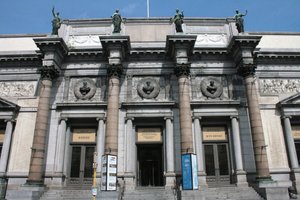 Musées Royaux des Beaux-Arts |
Bruksela | 1 | Veterans' Festival |
Oryginały Henri Evenepoel datowane na lata z zakresu około dziesięciu lat, od 1891 do 1899, pozwalają śledzić ewolucję twórczości rok po roku.
Wybierz rok, aby zobaczyć oryginały.

Więcej od 1896
This portrait, titled Charles Milcendeau, was painted by Henri Evenepoel in 1899. It captures a specific individual, Charles Edmond Théodore Soullans, who is known to us through this work as Charles Milcendeau. The painting offers a direct encounter with the subject, presented in a way that feels both personal and quiet.
Więcej od 1899
Man in Red (1894), Musées Royaux Des Beaux, Bruksela. Następne są My Ill Grandfather (1892) oraz Charles Milcendeau (1899).
22 lat: Man in Red pochodzi z 1894, a Henri Evenepoel urodził(a) się w 1872.
Man in Red, My Ill Grandfather, Charles Milcendeau, In the Café d'Harcourt in Paris, Pictures - Portrait of Louis Charles Crespin, At the Moulin Rouge, Portrait of Hélène Roulet, the Wife of the Artist Adolphe Crespin, The Clown, Louise in Mourning i Returning from Work at Sunset. Powyższy ranking zawiera rok powstania oraz muzeum dla każdego z nich.
Nasz katalog zawiera 28 dzieł artysty Henri Evenepoel, datowanych od 1891 do 1899.
W większości znajdują się w Królewskie Muzeum Sztuk Pięknych Antwerpia (Antwerpia), Museum of Fine Arts Ghent (MSK) (Gandawa) i Musées Royaux Des Beaux (Bruksela). Powyższa tabela muzeów zawiera ich pełną listę.
W 1897: 7 z 28 dzieł na tej stronie powstało w tym czasie, w tym In the Café d'Harcourt in Paris.
Na tej stronie najwcześniejszy to Sunday in the Bois de Boulogne (1891), a najpóźniejszy Charles Milcendeau (1899).
My Ill Grandfather, Louise in Mourning i Returning from Work at Sunset: Królewskie Muzeum Sztuk Pięknych Antwerpia, Antwerpia posiada 12 dzieł widocznych na tej stronie.


