Portret Heinrich Zille

Obrazy: 53 najsłynniejszych dzieł artysty Heinrich Zille – spojrzenie galerii

Aktualizacja: Listopad 2026 · ranking według naszego wskaźnika popularności (liczba wyszukiwań, wizyt i zamówień dla każdego dzieła) · 53 dzieł Heinrich Zille w naszym katalogu

W skrócie

Według galerii najsłynniejszym obrazem Heinrich Zille jest Restoration (1910). Untitled (AQREDC) (1909) i Untitled (AQRECJ) (1919) dopełniają trio, które zna każde oko. Z 53 dzieł Heinrich Zille w naszym katalogu, galeria prezentuje poniżej 53 najsłynniejszych prac – każda z nich jest oryginałem z podaniem roku powstania, muzeum oraz cech wyróżniających ją na tle innych.

1859 – 1933, Kassel Contemporary realism Najwięcej dzieł: Augustiner Museum

10 najlepszych obrazów artysty Heinrich Zille w galerii

1
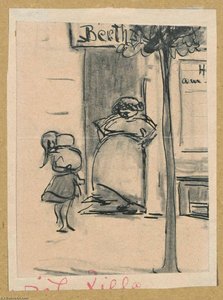
Restoration (1910) autorstwa Heinrich Zille

Restoration

1910 · Ink On Paper

Restoration is a black and white illustration created by Heinrich Hoffmann. The work dates to about 1910 and presents a monochromatic view of an urban environment. The scene focuses on a bustling city street, capturing a specific moment of daily activity within a metropolitan setting. The central subject involves a restaurant that is currently undergoing restoration work, providing a focal point for the surrounding movement.

2
Untitled (AQREDC) (1909) autorstwa Heinrich Zille

Untitled (AQREDC)

1909 · Etching

Untitled (AQREDC) by Heinrich Hoffmann depicts a bustling scene within a modest, crowded living space. The composition is dynamic and somewhat chaotic, with figures clustered together to fill most of the frame. A central grouping of people is arranged around a table, while other individuals are scattered throughout the room. Some figures are standing, while others are seated or lying down. In the background, a window provides a glimpse of…

3
Untitled (AQRECJ) (1919) autorstwa Heinrich Zille

Untitled (AQRECJ)

1919 · Drawing

This black and white drawing, dated 1919, depicts a group of at least twelve children positioned in a shared space. The figures are arranged in layers, with several children standing in the immediate foreground while others are situated further back in the composition. These children appear to be engaged in conversation or play. Two teddy bears are placed within the scene: one is located near the center, and the other…

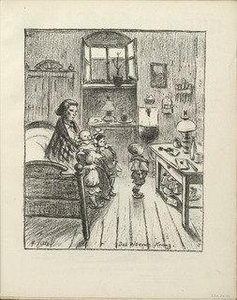
4
Untitled (AQREBC) (1917) autorstwa Heinrich Zille

Untitled (AQREBC)

1917 · Drawing

In this black and white drawing, Untitled (AQREBC) by Heinrich Hoffmann presents a quiet, domestic scene from about 1917. The composition centers on a woman seated in a chair, surrounded by her children. She holds a baby in her arms, while the other children settle onto her lap or gather closely around her. There is a palpable sense of intimacy in the way the figures are clustered together, creating a…

5
Untitled (AQREDE) (1884) autorstwa Heinrich Zille

Untitled (AQREDE)

1884 · Pencil

In this work from 1884, Heinrich Hoffmann invites us into the quiet, lived-in atmosphere of a traditional German tavern or beer hall. The scene captures a specific moment of social interaction and conviviality, focusing on a group of figures gathered around a long table. There is a sense of shared experience here, as patrons engage in conversation and drink within the interior space. It is a glimpse into a communal…

6
Going to Church in the Black Forest (1905) autorstwa Heinrich Zille

Going to Church in the Black Forest

1905 · Oil On Canvas · Augustiner Museum, Freiburg

In "Going to Church in the Black Forest" by Heinrich Hoffmann, we find ourselves observing a quiet moment of communal devotion. The scene, painted about 1905, centers on a group of women gathered at the entrance of a rustic stone church. They are dressed in traditional German folk costume, their attire providing a focal point of deep blues, blacks, and intricate patterns. This central gathering is framed by the environment:…

7
Untitled (AQREC6) (1900) autorstwa Heinrich Zille

Untitled (AQREC6)

1900 · Black and White Photography

Untitled (AQREC6) by Heinrich Hoffmann features a monochrome photographic study of a nude female figure. The composition is centered on the human subject, who is positioned in the foreground within an indoor studio setting. To the left of the central figure, a marble statue of a draped woman is placed, creating a juxtaposition between the living model and the carved stone. The background is composed of dark fabric draped over…

8
Untitled (AQREDJ) (1905) autorstwa Heinrich Zille

Untitled (AQREDJ)

1905 · Pencil

This 1905 pencil drawing on paper presents a spontaneous, quick sketch of two figures, appearing to be women, within a garden setting. The composition is asymmetrical and dynamic, with the figures positioned diagonally across the frame; one figure is taller than the other, and they seem to be engaged in conversation or a shared activity. The artwork is characterized by a loose, energetic quality, utilizing expressive lines, hatching, and cross-hatching…

9
Untitled (AQRECN) (1903) autorstwa Heinrich Zille

Untitled (AQRECN)

1903 · Etching

The scene unfolds within the lines of Untitled (AQRECN), an etching created by Heinrich Hoffmann. This work captures a specific, unvarnished moment from 1903, freezing a wrestling match in a state of constant motion. The figures strain against one another, caught in a struggle that feels immediate and raw. Onlookers gather around, their presence adding a layer of communal energy to the central conflict.

10
Untitled (AQREBN) (1905) autorstwa Heinrich Zille

Untitled (AQREBN)

1905 · Woodcut

This monochrome woodcut print, created in 1905, presents a densely packed and realistic portrayal of a crowded marketplace. The scene is set within an indoor environment, appearing to be a covered bazaar or market, where a multitude of figures are engaged in various activities such as buying, selling, and observing. The composition is tightly structured, utilizing strong, directional lines to define both the individual forms of the people and the…

Obrazy artysty Heinrich Zille, uszeregowane od 11 do 53 miejsca

11Untitled (AQRECC) (1900) autorstwa Heinrich ZilleUntitled (AQRECC)1900 12Untitled (AQRECL) (1910) autorstwa Heinrich ZilleUntitled (AQRECL)1910 13Untitled (AQRECY) (1910) autorstwa Heinrich ZilleUntitled (AQRECY)1910 14Untitled (AQRECE) (1910) autorstwa Heinrich ZilleUntitled (AQRECE)1910 15The Iron Cross (Das eiserne Kreuz) (plate, folio 17) from the periodical Der Bildermann, vol. 1, no. 8 (June 1916) (1916) autorstwa Heinrich ZilleThe Iron Cross (Das eiserne Kreuz) (plate, folio 17) from the periodical Der Bildermann, vol. 1, no. 8 (June 1916)1916 16Standing in Line for Potatoes (Kartoffelstehen) (plate, folio 25) from the periodical Der Bildermann, vol. 1, no. 12 (September 1916) (1916) autorstwa Heinrich ZilleStanding in Line for Potatoes (Kartoffelstehen) (plate, folio 25) from the periodical Der Bildermann, vol. 1, no. 12 (September 1916)1916 17Untitled (AQREBW) (1919) autorstwa Heinrich ZilleUntitled (AQREBW)1919 18Untitled (AQRECA) (1919) autorstwa Heinrich ZilleUntitled (AQRECA)1919 19Untitled (AQREBE) (1930) autorstwa Heinrich ZilleUntitled (AQREBE)1930 20Untitled (AQREB6) (1898) autorstwa Heinrich ZilleUntitled (AQREB6)1898 21Untitled (AQREBL) (1905) autorstwa Heinrich ZilleUntitled (AQREBL)1905 22Untitled (AQRECU) (1902) autorstwa Heinrich ZilleUntitled (AQRECU)1902 23Untitled (AQRED4) (1903) autorstwa Heinrich ZilleUntitled (AQRED4)1903 24Untitled (AQREC4) (1901) autorstwa Heinrich ZilleUntitled (AQREC4)1901 25Spinning Room in the Black Forest autorstwa Heinrich ZilleSpinning Room in the Black ForestAugustiner Museum 26Untitled (AQREAU) (1910) autorstwa Heinrich ZilleUntitled (AQREAU)1910 27Untitled (AQREC2) (1909) autorstwa Heinrich ZilleUntitled (AQREC2)1909 28Untitled (AQREB2) (1910) autorstwa Heinrich ZilleUntitled (AQREB2)1910 29Untitled (AQRECS) (1911) autorstwa Heinrich ZilleUntitled (AQRECS)1911 30Untitled (AQREC8) (1910) autorstwa Heinrich ZilleUntitled (AQREC8)1910 31Untitled (AQREAS) (1910) autorstwa Heinrich ZilleUntitled (AQREAS)1910 32Untitled (AQRED2) (1916) autorstwa Heinrich ZilleUntitled (AQRED2)1916 33Untitled (AQRED6) (1913) autorstwa Heinrich ZilleUntitled (AQRED6)1913 34Untitled (AQREBA) (1914) autorstwa Heinrich ZilleUntitled (AQREBA)1914 35Untitled (AQRECW) (1916) autorstwa Heinrich ZilleUntitled (AQRECW)1916 36Untitled (AQREBJ) (1915) autorstwa Heinrich ZilleUntitled (AQREBJ)1915 37Untitled (AQREB4) (1915) autorstwa Heinrich ZilleUntitled (AQREB4)1915 38On Vacation (Auf Urlaub) (front cover, folio 26) from the periodical Der Bildermann, vol. 1, no. 13 (October 1916) (1916) autorstwa Heinrich ZilleOn Vacation (Auf Urlaub) (front cover, folio 26) from the periodical Der Bildermann, vol. 1, no. 13 (October 1916)1916 39Schnapps Saloon (Schnapsdestille) (plate, folio 33) from the periodical Der Bildermann, vol. 1, no. 16 (November 1916) (1916) autorstwa Heinrich ZilleSchnapps Saloon (Schnapsdestille) (plate, folio 33) from the periodical Der Bildermann, vol. 1, no. 16 (November 1916)1916 40Study with Singing Children (Studienblatt mit singenden Kindern) (plate, folio 11) from the periodical Der Bildermann, vol. 1, no. 5 (June 1916) (1916) autorstwa Heinrich ZilleStudy with Singing Children (Studienblatt mit singenden Kindern) (plate, folio 11) from the periodical Der Bildermann, vol. 1, no. 5 (June 1916)1916 41Untitled (AQREBU) (1919) autorstwa Heinrich ZilleUntitled (AQREBU)1919 42Untitled (AQREBQ) (1919) autorstwa Heinrich ZilleUntitled (AQREBQ)1919 43Untitled (AQRECG) (1919) autorstwa Heinrich ZilleUntitled (AQRECG)1919 44Untitled (AQREAW) (1919) autorstwa Heinrich ZilleUntitled (AQREAW)1919 45Untitled (AQREDA) (1919) autorstwa Heinrich ZilleUntitled (AQREDA)1919 46Untitled (AQRED8) (1919) autorstwa Heinrich ZilleUntitled (AQRED8)1919 47Untitled (AQRECQ) (1920) autorstwa Heinrich ZilleUntitled (AQRECQ)1920 48Untitled (AQREB8) (1919) autorstwa Heinrich ZilleUntitled (AQREB8)1919 49Untitled (AQREAY) (1924) autorstwa Heinrich ZilleUntitled (AQREAY)1924 50Untitled (AQREAQ) (1960) autorstwa Heinrich ZilleUntitled (AQREAQ)1960 51Alte Frau mit Hundefuhrwerk (1910) autorstwa Heinrich ZilleAlte Frau mit Hundefuhrwerk1910 52Untitled (AQREBY) autorstwa Heinrich ZilleUntitled (AQREBY) 53Untitled (AQREDG) autorstwa Heinrich ZilleUntitled (AQREDG)

Tematy, które przyciągnęły wzrok Heinrich Zille

Cztery motywy najczęściej powracające w tych oryginałach, z których każdy doczekał się swojego najdoskonalszego przykładu.

Muzea przechowujące oryginały Heinrich Zille

Muzeum, w którym znajduje się najwięcej obrazów prezentowanych na tej stronie.

Muzea Miasto Dzieła artysty Heinrich Zille Obrazy z tej listy
Augustiner Museum, FreiburgAugustiner Museum Freiburg 2 Going to Church in the Black Forest, Spinning Room in the Black Forest

Heinrich Zille, jedno kultowe dzieło na dekadę

Dzieła według dekad

Wybierz dekadę, aby zobaczyć dzieło, które ją definiuje.

Obrazy artysty Heinrich Zille: odpowiedzi galerii

Który obraz Heinrich Zille jest najsłynniejszy ze wszystkich?Odkryj odpowiedź

Restoration (1910). Następne są Untitled (AQREDC) (1909) oraz Untitled (AQRECJ) (1919).

Ile lat miał Heinrich Zille, gdy ukończył Restoration?Odkryj odpowiedź

51 lat: Restoration pochodzi z 1910, a Heinrich Zille urodził(a) się w 1859.

Które to 10 najlepszych obrazów Heinrich Zille?Odkryj odpowiedź

Restoration, Untitled (AQREDC), Untitled (AQRECJ), Untitled (AQREBC), Untitled (AQREDE), Going to Church in the Black Forest, Untitled (AQREC6), Untitled (AQREDJ), Untitled (AQRECN) i Untitled (AQREBN). Powyższy ranking zawiera rok powstania oraz muzeum dla każdego z nich.

Ile dzieł stworzył/a Heinrich Zille?Odkryj odpowiedź

Nasz katalog zawiera 53 dzieł artysty Heinrich Zille, datowanych od 1884 do 1930.

Gdzie można znaleźć najsłynniejsze oryginały autorstwa Heinrich Zille?Odkryj odpowiedź

W większości znajdują się w Augustiner Museum (Freiburg). Powyższa tabela muzeów zawiera ich pełną listę.

Kiedy Heinrich Zille stworzył swoje najsłynniejsze obrazy?Odkryj odpowiedź

W 1910s: 32 z 53 dzieł na tej stronie powstało w tym czasie, w tym Restoration.

Które z najsłynniejszych dzieł Heinrich Zille należą do jego najwcześniejszych i najpóźniejszych prac?Odkryj odpowiedź

Na tej stronie najwcześniejszy to Untitled (AQREDE) (1884), a najpóźniejszy Untitled (AQREBE) (1930).

Do jakich tematów Heinrich Zille powracał najczęściej?Odkryj odpowiedź

People (7), Social commentary (6) i Figures (5), w ramach 53 dzieł na tej stronie.

W jakiej technice najczęściej tworzył Heinrich Zille?Odkryj odpowiedź

Ink On Paper, dla 3 z 53 dzieł na tej stronie.

Z jakim nurtem związany jest Heinrich Zille?Odkryj odpowiedź

Contemporary realism, sądząc po oryginałach na tej stronie.

Które oryginały artysty Heinrich Zille znajdują się w zbiorach Augustiner Museum?Odkryj odpowiedź

Going to Church in the Black Forest i Spinning Room in the Black Forest: Augustiner Museum, Freiburg posiada 2 dzieł widocznych na tej stronie.

Heinrich Zille: artysta

A Chronicler of Berlin’s Soul: The Life and Art of Heinrich Zille

Rudolf Heinrich Zille, affectionately known as “Pinselheinrich” – Brush Heinrich – to the people of Berlin, wasn't merely an artist; he was a visual historian, a compassionate observer, and a satirical chronicler of a city undergoing seismic change. Born in 1858 in Radeburg, Germany, Zille’s life mirrored the burgeoning industrialization and social upheaval that defined late 19th and early 20th-century Berlin. His family's relocation to the capital in 1867 proved pivotal, immersing him in a world of stark contrasts – opulent growth alongside grinding poverty. This duality would become the defining characteristic of his artistic vision. Initially apprenticed as a lithographer in 1872, Zille’s early training instilled in him a mastery of line and form that would serve as the foundation for his later work. Though his father envisioned a more conventional trade – perhaps butchery – young Heinrich's passion for draughtsmanship was undeniable, nurtured by an encouraging teacher who recognized his burgeoning talent. This dedication to art, however, wasn’t immediate; it evolved from necessity after losing his job in 1910, with the encouragement of Max Liebermann, allowing him to fully embrace his artistic calling.

The “Milljöh” and a City Revealed

Zille's enduring legacy rests upon his ability to capture the essence of Berlin’s "Milljöh" – a uniquely German term encompassing the everyday life, atmosphere, and social fabric of the city, particularly within its working-class neighborhoods. He didn’t romanticize or idealize; instead, he presented an unvarnished portrayal of tenement buildings ("Mietskaserne"), crowded streets, and the lives of those struggling to survive within them. His drawings weren't simply depictions of poverty; they were empathetic studies of human resilience, humor, and dignity in the face of hardship. Beggars, prostitutes, laborers, and their children populated his world, rendered with a keen eye for detail and an often-biting wit. He portrayed recognizable stereotypes, yes, but always with a sense of understanding, avoiding caricature that descended into cruelty. Zille’s preferred mediums – lithography, pencil sketches, and occasional woodcuts – lent themselves perfectly to this intimate style. His masterful use of hatching and cross-hatching created texture, depth, and a palpable sense of atmosphere in his monochromatic works, drawing the viewer directly into the heart of Berlin's underbelly. He meticulously observed the nuances of human interaction, capturing fleeting expressions and gestures that revealed both vulnerability and strength.

Recognition and Artistic Evolution

For years, Zille’s work found its audience primarily through publications like the satirical German weekly *Simplicissimus*, where his drawings resonated with a growing readership eager for social commentary. The sharp wit of his dialogue, often incorporating the distinctive Berlin dialect, added another layer of authenticity to his depictions. This exposure gradually brought him wider recognition, culminating in an invitation from Max Liebermann to join the Berlin Secession in 1903 – a watershed moment that aligned him with a group of artists challenging traditional artistic norms. The Secession provided a platform for Zille’s work and solidified his position within the avant-garde art scene. His ability to blend realism with subtle humor, combined with his keen understanding of urban life, made him a popular figure among both critics and the public. In 1921, the National Gallery purchased several of his drawings, a significant validation of his artistic merit. This recognition continued with a professorship at the Academy of the Arts in 1924, cementing his status as a respected figure within the German art world. Even popular culture embraced Zille’s characters and stories; *Die Verrufenen* (The Disreputable), a film adaptation of his work, was released in 1925, further extending his reach beyond the confines of galleries and museums.

Beyond the Surface: A Complex Legacy

Heinrich Zille's artistic output wasn’t limited to social realism; a lesser-known facet of his oeuvre reveals a series of erotic drawings depicting everyday life. These works, now housed in the Beate Uhse Erotic Museum in Berlin, offer a glimpse into a more private and playful side of the artist, demonstrating his willingness to explore the full spectrum of human experience. These images, often portraying intimate moments within the context of the working-class environment he so meticulously documented, provide a fascinating counterpoint to his more overtly critical social commentary. However, it is his broader body of work that secures his place as a pivotal figure in German art history. Zille’s ability to capture both the humor and hardship of working-class life with empathy and skill provided invaluable insight into 19th and early 20th-century Berlin society. He gave voice to those often overlooked by mainstream society, offering a poignant and enduring portrait of a rapidly changing urban landscape.

Lasting Impact

  • Social Commentary: Zille’s work served as a potent form of social commentary, exposing the harsh realities of urban poverty and inequality.
  • Artistic Influence: His distinctive style influenced subsequent generations of artists interested in depicting everyday life and social issues.
  • Historical Documentation: Zille’s drawings provide invaluable historical documentation of Berlin during a period of rapid transformation.
  • Cultural Icon: He remains a beloved cultural icon in Berlin, celebrated for his ability to capture the city's unique character and spirit.