Portret Girolamo P. Nerli

21 najsłynniejszych obrazów artysty Girolamo P. Nerli – wybór z galerii

Aktualizacja: Listopad 2026 · ranking według naszego wskaźnika popularności (liczba wyszukiwań, wizyt i zamówień dla każdego dzieła) · 24 dzieł Girolamo P. Nerli w naszym katalogu

W skrócie

Spośród wszystkich dzieł oryginalnych, które pozostawił Girolamo P. Nerli, najsłynniejszym jest Robert Louis Stevenson (1892), znajdujący się w kolekcji Scottish National Portrait Gallery w Edynburg. Tuż za nimi znajdują się Market day, Rome (1880) oraz The voyagers (1890). Nasz katalog zawiera 24 dzieł autorstwa Girolamo P. Nerli; galeria zachowała 21 najbardziej podziwianych na świecie prac, z których każda została przedstawiona wraz z datą powstania, informacją o muzeum oraz jej historią.

1860 – 1926, Siena Najwięcej dzieł: Museum of New Zealand Te Papa Tongarewa

10 najlepszych obrazów artysty Girolamo P. Nerli: wybór galerii

1
Robert Louis Stevenson (1892) autorstwa Girolamo P. Nerli

Robert Louis Stevenson

1892 · Oil On Canvas · Scottish National Portrait Gallery, Edynburg

This oil on canvas portrait by Girolamo P. Nerli captures the likeness of Robert Louis Stevenson. The artist, Girolamo P. Nerli, rendered the subject in 1892. The scene was painted in Samoa, located in the South Pacific. A quiet light settles upon the man who penned the tales of Treasure Island and The Strange Case of Dr Jekyll and Mr Hyde.

Kontynuacja zestawienia Girolamo P. Nerli, od 11 do 21

Tematy, które przyciągnęły wzrok Girolamo P. Nerli

Cztery motywy najczęściej powracające w tych oryginałach, z których każdy doczekał się swojego najdoskonalszego przykładu.

Gardens and parks 2 dzieł

Muzea przechowujące oryginały Girolamo P. Nerli

5 muzeów, w których znajduje się najwięcej obrazów z tej strony.

Muzea Miasto Dzieła artysty Girolamo P. Nerli Obrazy z tej listy
Museum of New Zealand Te Papa Tongarewa, WellingtonMuseum of New Zealand Te Papa Tongarewa Wellington 4 Market day, Rome, Girl in sunbonnet, Untitled [Bay landscape with Italian cities]
Auckland Art Gallery Toi o Tāmaki, AucklandAuckland Art Gallery Toi o Tāmaki Auckland 4 Lady in green, A study (Head of a girl), Portrait of Jane Eyre
Art Gallery of New South Wales, SydneyArt Gallery of New South Wales Sydney 2 The voyagers, An old woman (study)
Scottish National Portrait Gallery, EdynburgScottish National Portrait Gallery Edynburg 1 Robert Louis Stevenson
Te Whare O Rehua Sarjeant GalleryTe Whare O Rehua Sarjeant Gallery 1 Coastal Landscape

Girolamo P. Nerli rok po roku: oryginały, które definiują każdy z nich

Od 1880 do 1897, Girolamo P. Nerli tworzył przez 18 lat: zestawienie to ukazuje tę długą karierę rok po roku, poprzez jej najwspanialsze oryginały.

Dzieła według lat

Wybierz rok, aby zobaczyć oryginały.

Pytania kolekcjonerów o obrazy Girolamo P. Nerli

Z jakiego dzieła najbardziej znany jest Girolamo P. Nerli?Odkryj odpowiedź

Robert Louis Stevenson (1892), Scottish National Portrait Gallery, Edynburg. Następne są Market day, Rome (1880) oraz The voyagers (1890).

W jakim wieku był Girolamo P. Nerli, gdy powstało Robert Louis Stevenson?Odkryj odpowiedź

32 lat: Robert Louis Stevenson pochodzi z 1892, a Girolamo P. Nerli urodził(a) się w 1860.

Jakie są dziesięć najsłynniejszych obrazów, których autorem jest Girolamo P. Nerli?Odkryj odpowiedź

Robert Louis Stevenson, Market day, Rome, The voyagers, Girl in sunbonnet, Lady in green, A study (Head of a girl), Portrait of Jane Eyre, Hyde Park, Untitled [Bay landscape with Italian cities] i At Rotorua. Powyższy ranking zawiera rok powstania oraz muzeum dla każdego z nich.

Ile obrazów pozostawił po sobie Girolamo P. Nerli?Odkryj odpowiedź

Nasz katalog zawiera 24 dzieł artysty Girolamo P. Nerli, datowanych od 1880 do 1897.

W których muzeach znajdują się arcydzieła Girolamo P. Nerli?Odkryj odpowiedź

W większości znajdują się w Museum of New Zealand Te Papa Tongarewa (Wellington), Auckland Art Gallery Toi o Tāmaki (Auckland) i Art Gallery of New South Wales (Sydney). Powyższa tabela muzeów zawiera ich pełną listę.

W których latach Girolamo P. Nerli namalował swoje najsłynniejsze dzieła?Odkryj odpowiedź

W 1897: 4 z 21 dzieł na tej stronie powstało w tym czasie, w tym Girl in sunbonnet.

Jakie są pierwsze i ostatnie słynne oryginały Girolamo P. Nerli?Odkryj odpowiedź

Na tej stronie najwcześniejszy to Market day, Rome (1880), a najpóźniejszy Girl in sunbonnet (1897).

Które dzieła Girolamo P. Nerli znajdują się w Museum of New Zealand Te Papa Tongarewa?Odkryj odpowiedź

Market day, Rome, Girl in sunbonnet i Untitled [Bay landscape with Italian cities]: Museum of New Zealand Te Papa Tongarewa, Wellington posiada 4 dzieł widocznych na tej stronie.

Girolamo P. Nerli: życie i twórczość

The Bohemian Visionary: The Life and Legacy of Girolamo Pieri Nerli

Emerging from the ancient, sun-drenched streets of Siena, Italy, Girolamo Pieri Pecci Ballati Nerli carried with him a lineage of aristocratic distinction and an artistic spirit that would eventually reshape the landscapes of the Southern Hemisphere. Born in 1860 to a family of the Sienese patriciate, Nerli’s early life was steeped in the rich traditions of Italian art. He refined his craft in Florence under the tutelage of masters such as Antonio Ciseri and Giovanni Muzzioli, absorbing the essence of the Macchiaioli movement. This Italian precursor to Impressionism, characterized by its focus on "patches" of light and color, would become a foundational pillar of his technique, instilling in him a lifelong devotion to capturing the ephemeral interplay of atmosphere and emotion.

The trajectory of Nerli’s life took a dramatic turn when he migrated toward the burgeoning art scenes of Australia and New Zealand. Arriving in Melbourne in 1885, he brought a sophisticated, European sensibility that acted as a catalyst for local movements. His presence in Sydney around 1886 caused an immediate sensation; his exhibitions, which occasionally featured provocative themes such as bacchanalian orgies, challenged the more conservative academic conventions of the era. This bold, bohemian approach allowed him to forge deep connections with the luminaries of the Heidelberg School, including Arthur Streeton and Tom Roberts. Rather than merely documenting the Australian bush, Nerli sought to infuse the landscape with a psychological depth and a lyrical, luminous quality that felt both intimate and universal.

A Lyrical Palette and the Art of Intimacy

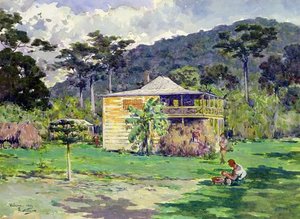
Nerli’s artistic development is most clearly seen in his masterful command of color and composition. He possessed a unique ability to utilize a palette dominated by soft blues, vibrant greens, and radiant light to evoke specific moods. While many of his contemporaries were preoccupied with the grand, sweeping vistas of the Australian outback, Nerli found profound beauty in the smaller, more delicate moments of existence. His work often drifted toward the intimate, capturing elegant figures wandering through Hyde Park or the serene, idyllic atmospheres of Vailima, the tropical retreat of the famed writer Robert Louis Stevenson.

His technical prowess was particularly evident in his portraiture and his ability to render texture and light. A defining moment in his career was his profound connection to Stevenson; Nerli’s portrait of the author is celebrated in the Scottish National Portrait Gallery as a deeply searching and soulful portrayal. This ability to capture the human essence, combined with his landscape work, allowed him to bridge the gap between the physical world and the internal emotional state of his subjects. His canvases serve as windows into a bygone era, where the boundaries between nature and humanity seem beautifully blurred.

Historical Significance and Enduring Influence

The historical importance of Girolamo Pieri Nerli extends far beyond the borders of Italy or the shores of Australia. He acted as a vital cultural conduit, bringing the experimental spirit of the Italian Macchiaioli to the Antipodes and influencing a generation of artists, most notably Charles Conder in Australia and Frances Hodgkins in New Zealand. His legacy is one of movement and transformation—a bridge between the classical traditions of Europe and the emerging modern identities of the Pacific.

Today, Nerli is remembered not merely as a painter of beautiful scenes, but as a visionary who helped define the aesthetic boundaries of late 19th-century art in the Southern Hemisphere. His life remains a testament to the power of artistic migration and the way a single, sensitive soul can leave an indelible mark on the cultural fabric of distant lands. Through his work, we continue to experience:

  • The mastery of light: A technique that brought a new dimension of atmosphere to Australian landscapes.
  • Cultural synthesis: The blending of Italian Impressionist influences with the unique light and subject matter of Oceania.
  • Emotional resonance: An enduring ability to capture the fleeting, poetic moments of everyday life.