Giovanni Paolo Panini (1691–1765): Master of Roman Vedute & Architectural Fantasies
Giovanni Paolo Pannini, a name synonymous with the grandeur and romantic allure of 18th-century Rome, was more than just a painter; he was a visual architect of memory. Born in Piacenza in 1691, his artistic journey began under the tutelage of Giuseppe Natali and Andrea Galluzzi, but it was his exposure to the theatrical designs of Francesco Galli-Bibiena that truly ignited his imagination. This early immersion in stagecraft would profoundly influence his later work, imbuing it with a sense of dramatic composition and illusionistic space. In 1711, Panini relocated to Rome, a city already steeped in artistic history, where he honed his skills under the guidance of Benedetto Luti, mastering the art of drawing and laying the foundation for his future mastery of perspective.Early Training & Influences: Shaping a Vision
Panini’s formative years were marked by rigorous training in Piacenza, where he studied under Giuseppe Natali and Andrea Galluzzi—artists known for their meticulous realism and attention to detail. However, it was Francesco Galli-Bibiena's theatrical productions that proved particularly transformative. Galli-Bibiena’s innovative use of perspective and dramatic staging instilled in Panini a fascination with illusionistic space—a technique he would later employ extensively in his paintings. This influence is evident in the monumental scale and theatrical grandeur of many of Panini’s frescoes, reflecting the spirit of Bolognese Baroque art. The early training also included instruction in *quadratura*, or scenic perspective, which further honed Panini's ability to create convincing illusions of depth and space—a skill that would become central to his distinctive artistic style.From Frescoes to Vedute: The Evolution of an Artistic Style
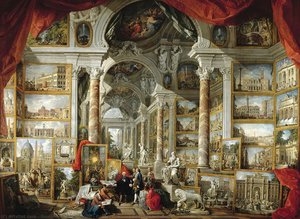
Panini’s initial success didn’t lie in easel painting but rather in decorating palaces. His frescoes adorned the walls of prominent Roman residences, including Villa Patrizi (1719–1725), Palazzo de Carolis (1720) and Seminario Romano (1721–1722). These commissions allowed him to develop his technical prowess and establish a reputation within Rome’s artistic circles. He skillfully employed *quadratura*, blending classical architectural elements with theatrical devices—a technique that would become synonymous with Panini's oeuvre. However, it was his embrace of the *veduta*, or view painting, that would ultimately define his legacy. Unlike earlier topographical artists who focused on precise documentation, Panini infused his depictions of Rome with a sense of imaginative reconstruction. He didn’t merely record what he saw; he re-imagined it, blending existing structures with fragments of ancient ruins and fanciful architectural elements. This approach—often referred to as *capriccio*—allowed him to create scenes that were both recognizable and dreamlike, capturing the spirit of Rome’s layered history.The Capriccio Technique & Architectural Fantasies
Panini's groundbreaking contribution to art history resides in his pioneering use of the *capriccio* technique. Rejecting the conventions of traditional landscape painting—which prioritized accuracy and realism—Panini sought to evoke emotion and imagination through fantastical compositions. He combined elements from different architectural styles, incorporating ruins of ancient monuments alongside idealized buildings and decorative flourishes. This approach was heavily influenced by Marco Ricci’s work, which similarly blended historical references with imaginative embellishments. Panini's *vedute* weren’t simply representations of Rome; they were expressions of his profound understanding of the city’s history and its enduring beauty—a perspective that anticipated the Romantic movement’s emphasis on emotion and subjective experience. His meticulous attention to detail—particularly in rendering architectural structures—combined with a masterful command of perspective created scenes that captivated viewers and cemented Panini's reputation as one of Rome’s most innovative artists.Legacy & Influence: Shaping Artistic Vision
Giovanni Paolo Pannini’s influence extended far beyond his own lifetime, shaping the artistic sensibilities of an entire generation. He was recognized as a leading teacher at the Accademia di San Luca and the Académie de France in Rome—institutions that fostered intellectual debate and artistic experimentation. Among his pupils was Hubert Robert, who would become equally renowned for his depictions of ruins—though with a more overtly romantic sensibility. Panini’s distinctive style resonated with other *vedutisti*, including Antonio Joli and Charles-Louis Clérisseau, inspiring them to explore the possibilities of architectural painting. His works are now held in prestigious collections worldwide, demonstrating his enduring appeal as an artist who captured the essence of Rome—a city that continues to inspire artists today. He is remembered not only for his technical skill but also for his visionary approach to artmaking—a legacy that secures his place among the titans of Baroque and Romantic painting.- Explore artworks: Interior of Saint Peter's, Rome, Pantheon Interior View
- Further research: Discover more about Panini’s life and work through resources like Wikipedia and the National Gallery of Art.
Pytania i odpowiedzi
Gdzie można znaleźć dzieła Giovanni Paolo Pannini pogrupowane według techniki?
Strona Wszystkie techniki grupuje dzieła Giovanni Paolo Pannini według techniki wykonania.
Czy mogę odwiedzić wirtualne muzeum dzieł Giovanni Paolo Pannini?
Muzeum 3D artysty Giovanni Paolo Pannini to strona prezentująca dzieła artysty w wirtualnej, trójwymiarowej galerii.
Gdzie i w którym roku urodził(a) się Giovanni Paolo Pannini?
Giovanni Paolo Pannini urodził się w Piacenza w 1691.