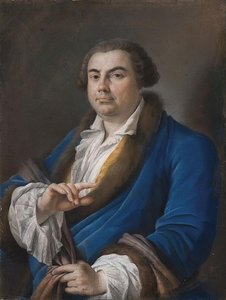
Giovanni Battista Cipriani - Biographical Overview
Giovanni Battista Cipriani, born in Florence in 1727, stands as a pivotal figure in the history of British decorative arts and a champion of Neoclassical aesthetics during the Georgian era. His artistic journey began under the tutelage of Ignatius Hugford, a Florentine artist deeply rooted in English cultural ties, establishing a foundation for his subsequent mastery of technique and compositional vision—skills honed further with Anton Domenico Gabbiani. These formative years instilled within him an appreciation for dramatic grandeur that would characterize much of his oeuvre, marking him as one of the first exponents of Neoclassicism to grace British artistic circles. Before venturing across the Channel in 1755, Cipriani had already garnered recognition in Italy through commissions such as *St Tesauro* and *St Peter Igneo*, undertaken for the Abbey of San Michele in Pelago, Pistoia—projects that showcased his burgeoning talent and foreshadowed his future prominence on an international stage.
His arrival in London was facilitated by connections forged in Rome between 1750 and 1753, notably with architect Sir William Chambers and sculptor Joseph Wilton – relationships that proved instrumental in unlocking doors to patronage and opportunity within the vibrant artistic milieu of Georgian society. Immediately recognizing Cipriani’s potential, Chambers swiftly enlisted his services on ambitious decorative undertakings, including the magnificent ceiling at the Albany—a project designed for Lord Holland—and contributions to the evolving splendor of Buckingham House. These commissions demanded a profound understanding of classical principles and an ability to translate them into visually arresting compositions—skills Cipriani expertly deployed, cementing his reputation as a visionary artist.
Early Artistic Training & Influences
Cipriani’s artistic education was profoundly shaped by Hugford's guidance, who instilled in him the stylistic conventions of Florentine Baroque art – characterized by rich color palettes, dynamic movement, and theatrical illusionism. Gabbiani’s mentorship complemented Hugford’s teachings, refining Cipriani’s technical prowess and fostering his appreciation for meticulous detail—qualities that would become hallmarks of his artistic style. These influences combined to cultivate a distinctive aesthetic sensibility that transcended regional boundaries, preparing him for the challenges posed by adapting Baroque grandeur to the restrained elegance demanded by Neoclassical taste. The connections he forged in Rome with Chambers and Wilton – individuals who championed classical ideals and served as conduits for artistic exchange—further broadened his horizons and solidified his position within the burgeoning European art scene.
Notable Commissions & Decorative Achievements
Cipriani’s career ascended to new heights upon his relocation to England, where he swiftly secured commissions from influential patrons such as Lord Tilney and the Duke of Richmond – securing invaluable access to resources and fostering collaborations that enriched his artistic output. His contributions to Somerset House—designed by Chambers—were particularly noteworthy, encompassing monumental decorative panels depicting allegorical figures and embodying the grandeur of Palladian architecture. Similarly, he played a crucial role in transforming Buckingham House into a symbol of royal splendor, overseeing the installation of opulent furnishings and adorning interior spaces with breathtaking frescoes that reflected Neoclassical principles. His involvement on the Gold State Coach project—a collaborative effort with Chambers and Wilton—further elevated his artistic stature, demonstrating his ability to execute monumental commissions while maintaining stylistic integrity.
Collaboration & Artistic Legacy
Cipriani’s partnership with Francesco Bartolozzi proved particularly fruitful, resulting in a prolific output of engravings after masterpieces by Cellini and Gabbiani—a testament to their shared commitment to preserving classical traditions and disseminating artistic ideals throughout England. His influence extended beyond his own creations; he nurtured the talents of numerous aspiring artists, fostering a generation of craftsmen who embraced Neoclassical aesthetics and contributed significantly to the cultural landscape of Georgian Britain. Cipriani’s legacy resides not merely in his impressive body of work—but also in his role as a catalyst for artistic innovation and a champion of classical ideals—a contribution that continues to resonate within the annals of British art history. His meticulous attention to detail, combined with his masterful command of color and composition, established him as one of the foremost decorative artists of his time—a figure whose influence endured long after his passing in 1785.