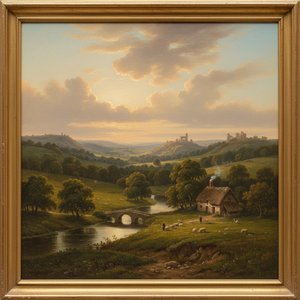
George Barret Senior

1730 - 1784

George Barret Senior (1730–1784) jest znany przede wszystkim z The Drive, Norbury Park; w katalogu znajduje się 122 dzieł tego artysty.

Kluczowe informacje

  • Mediums: obraz olejny na płótnie
  • Top 3 works:
    • The Drive, Norbury Park
    • Wooded Landscape with a Boy and his Dog
    • North Side of Danson
  • Nationality: Irlandia
  • Typical colors:
    • barwy ziemi
    • barwy neutralne
  • Creative periods: mature period
  • Died: 1784
  • Corpus themes:
    • classical landscape influence
    • burke’s philosophy
    • royal academy style
    • classical landscape
    • edmund burke's philosophy
  • Top-ranked work: The Drive, Norbury Park

George Barret Sr.: Life & Legacy

George Barret Sr., born between 1728 and 1732 in Libertyville, Ireland – the son of a cloth merchant – stands as a pivotal figure in the history of British landscape painting. His artistic journey began humbly, apprenticed initially as a staymaker before an unexpected discovery ignited his passion for drawing, ultimately shaping him into one of the foremost artists of his era and a founding member of the Royal Academy.

Early Life and Training

His formative years were marked by disciplined training at Robert West’s Academy in Dublin around 1747, generously supported by the Royal Dublin Society. This institution fostered his burgeoning talent and established him as a skilled draughtsman, laying the groundwork for his future artistic endeavors. Notably, he forged an enduring friendship with Edmund Burke during Burke's time at Trinity College, Dublin – a relationship that would prove invaluable throughout Barret’s life, influencing both his intellectual pursuits and artistic sensibilities.

Early Artistic Development & Influences

Barret’s early canvases frequently depicted idealized classical landscapes and mythological subjects—a stylistic choice profoundly impacted by the philosophical writings of Edmund Burke. Specifically, *A Philosophical Enquiry into the Origin of Our Ideas of the Sublime and Beautiful* instilled in him a deep appreciation for capturing emotions of awe and grandeur within his artistic vision. He commenced his artistic career by meticulously reworking engravings of Italianate scenes created by artists like Claude Lorrain – demonstrating an unwavering commitment to established conventions and mastering techniques honed by masters of the past. Despite portraying landscapes inspired by Italy, there’s no documented evidence that Barret ever undertook a personal voyage to explore its artistic heritage.

Move to London and Rise to Prominence

Driven by ambition and seeking greater creative opportunities, Barret relocated to London in 1762 – cementing his position as a rising star within the burgeoning art world. Within months, he garnered considerable acclaim for his landscape paintings, attracting the patronage of influential collectors and securing prominent exhibitions at the Society of Artists of Great Britain. Perhaps most significantly, in 1768, Barret joined forces with fellow artists to establish the Royal Academy – an audacious step that fundamentally reshaped British art history and propelled him into a position of leadership within the burgeoning artistic community.

Artistic Style and Themes

Barret’s stylistic evolution mirrored broader trends in eighteenth-century painting, transitioning from meticulously crafted Italianate landscapes to more nuanced depictions of English and Irish scenery. He undertook extensive expeditions across Britain, Wales, Scotland, and Ireland – diligently documenting breathtaking vistas and capturing the essence of diverse environments. Recurring motifs included tranquil meadows bathed in sunlight, dramatic waterfalls like *The Powerscourt Waterfall*, and expansive panoramas showcasing the grandeur of aristocratic estates. His paintings skillfully blended observation with artistic interpretation, conveying not merely visual representations but also a palpable sense of atmosphere and emotion. Furthermore, Barret’s compositions often incorporated figures within the landscape—a technique that added scale and narrative depth to his works.

Later Life & Patronage

Throughout his life, Barret faced personal challenges – notably asthma which prompted him to relocate to Westbourne Green in 1772 for improved health conditions. Despite achieving considerable financial success, he was described as “feckless” with money and occasionally experienced periods of hardship. However, his enduring friendship with Edmund Burke provided crucial support—both materially and professionally—ensuring Barret’s continued artistic vitality. In 1782, Burke championed Barret's candidacy for the role of Master Painter at Chelsea Hospital – a position he held until his untimely death in 1784, leaving behind a legacy as one of Britain’s most respected landscape artists and a champion of artistic excellence. His works continue to inspire admiration and offer invaluable insights into the aesthetic sensibilities of the era.

Quiz

Do każdego pytania dotyczy tylko jedna poprawna odpowiedź.

Pytanie 1:
Jaką technikę wykorzystywał George Barret Sr. do tworzenia obrazów krajobrazowych?
Pytanie 2:
Kto zainspirował Barreta filozoficznymi dziełami Edmunda Burke’a, szczególnie „Rozprawą filozoficzną o pochodzeniu naszych idei piękna i sublimacji?”, która wpłynęła na jego podejście do malowania krajobrazów?
Pytanie 3:
Dlaczego Barret przeniósł się do Londynu w roku 1762?
Pytanie 4:
W którym roku Barret został jednym z założycieli Royal Academy?
Pytanie 5:
Jakiego artysty George Barret Sr. często kopiował przy tworzeniu obrazów krajobrazowych na początku swojej kariery?

Pytania i odpowiedzi

Co George Barret Senior namalował jako pierwsze, a co jako ostatnie?

Spośród wymienionych tutaj prac datowanych, najwcześniejsza to Powerscourt, County Wicklow, Ireland (1760), a najpóźniejsza Broodmares and Colts in a Landscape (1783). Zobacz oś czasu twórczości George Barret Senior.

Z jakich obrazów znany jest George Barret Senior?

George Barret Senior jest znany z dzieł wymienionych w najsłynniejszych obrazach George Barret Senior.

Do jakiej epoki należał/a George Barret Senior?

George Barret Senior tworzył w okresie – Wczesna nowożytność. Epoka ta osadza twórczość artysty w kontekście historycznym.

Jak popularne są dzieła artysty George Barret Senior?

Zobacz najpopularniejsze obrazy George Barret Senior, uszeregowane według liczby wyświetleń na naszej stronie.

Do jakiego nurtu artystycznego należał/a George Barret Senior?

Czy prace George Barret Senior należą do domeny publicznej?

Tak. George Barret Senior zmarł(a) w 1784, a jego/jej dzieła znajdują się w domenie publicznej.

Gdzie i w którym roku urodził(a) się George Barret Senior?

George Barret Senior urodził się w Dublin w 1730 roku.

Jakich technik używał/a George Barret Senior?

Prace George Barret Senior wymienione na tej stronie to głównie obraz olejny na płótnie.

Ile lat żył/a George Barret Senior?

George Barret Senior żył(a) około 54 lat, od 1730 do 1784.