Portret François Barraud

Obrazy: 28 najsłynniejszych dzieł artysty François Barraud – spojrzenie galerii

Aktualizacja: Listopad 2026 · ranking według naszego wskaźnika popularności (liczba wyszukiwań, wizyt i zamówień dla każdego dzieła) · 28 dzieł François Barraud w naszym katalogu

W skrócie

Według galerii najsłynniejszym obrazem François Barraud jest The Workshop (1928). The Bread Cutter (1933) i Madame B (1932) dopełniają trio, które zna każde oko. Z 28 dzieł François Barraud w naszym katalogu, galeria prezentuje poniżej 28 najsłynniejszych prac – każda z nich jest oryginałem z podaniem roku powstania, muzeum oraz cech wyróżniających ją na tle innych.

1899 – 1934, La Chaux-de-Fonds Contemporary realism

10 najlepszych obrazów artysty François Barraud w galerii

1
The Workshop (1928) autorstwa François Barraud

The Workshop

1928 · Oil On Canvas

The studio is a vessel of stillness. In this 1928 oil painting, the air feels heavy with the scent of turpentine and the weight of a single, focused moment. A seated woman occupies the foreground, her form a soft anchor amidst the structured geometry of the workspace. Behind her, an artist is caught in the act of creation, brush meeting canvas on an easel. A third figure lingers in the…

2
The Bread Cutter (1933) autorstwa François Barraud

The Bread Cutter

1933 · Oil

There is a profound stillness in this 1933 oil painting, a moment captured in the soft, diffused light of a domestic afternoon. We find ourselves seated at a small, cloth-covered table, observing a scene of quiet nourishment. A woman, dressed in a heavy blue garment, leans into her task, slicing a large loaf of bread. Opposite her sits a young girl, her presence adding a sense of gentle companionship to…

3
Madame B (1932) autorstwa François Barraud

Madame B

1932 · Oil On Canvas

In this 1932 portrait, we find ourselves in the presence of Madame B, a woman who commands the space through a stillness that feels almost heavy. She is seated squarely, facing us with a directness that suggests a sharp, composed intelligence. There is no artifice in her posture; she occupies her chair with a quiet gravity, her figure filling the frame in a way that feels both intimate and formal.…

4
Untitled (AQTGLG) (1929) autorstwa François Barraud

Untitled (AQTGLG)

1929 · Oil On Canvas

The air in the room feels heavy with the scent of old paper and the soft, diffused light of a late afternoon. A man leans forward, his attention entirely consumed by the tiny, intricate details of a stamp held between his fingers. Beside him, a woman watches, her presence a gentle weight in the shared silence. She rests an arm around him, a gesture of quiet support that anchors the…

5
The Malcontent (1930) autorstwa François Barraud

The Malcontent

1930 · Oil On Canvas

A man and a woman sit side by side on a bench, suspended in a moment of heavy stillness. Between them rests an accordion, its bright red casing acting as the sole pulse of color in an otherwise muted world of beige, grey, and brown. The scene feels intimate, yet there is a palpable sense of distance between the two figures. They are close enough to touch, yet their expressions…

6
Girl at Work (1933) autorstwa François Barraud

Girl at Work

1933 · Oil On Canvas

A young woman stands before a large window, her figure centered within a composition defined by strong vertical lines. She holds a broom, engaged in the repetitive motion of cleaning, perhaps sweeping the glass or the area just beyond the frame. The scene is bathed in a soft, diffused light that enters through the window, casting a gentle illumination across her face and clothing while minimizing harsh shadows. In the…

Obrazy artysty François Barraud, uszeregowane od 11 do 28 miejsca

Tematy, które przyciągnęły wzrok François Barraud

Cztery motywy najczęściej powracające w tych oryginałach, z których każdy doczekał się swojego najdoskonalszego przykładu.

François Barraud, jedno kultowe dzieło na dekadę

Dzieła według dekad

Wybierz dekadę, aby zobaczyć dzieło, które ją definiuje.

Obrazy artysty François Barraud: odpowiedzi galerii

Który obraz François Barraud jest najsłynniejszy ze wszystkich?Odkryj odpowiedź

The Workshop (1928). Następne są The Bread Cutter (1933) oraz Madame B (1932).

Ile lat miał François Barraud, gdy ukończył The Workshop?Odkryj odpowiedź

29 lat: The Workshop pochodzi z 1928, a François Barraud urodził(a) się w 1899.

Które to 10 najlepszych obrazów François Barraud?Odkryj odpowiedź

The Workshop, The Bread Cutter, Madame B, Untitled (AQTGLG), The Malcontent, Girl at Work, François Barraud and Albert Locca at the piano, Untitled (AQTGL4), The Musicians i Untitled (AQTGKS). Powyższy ranking zawiera rok powstania oraz muzeum dla każdego z nich.

Ile dzieł stworzył/a François Barraud?Odkryj odpowiedź

Nasz katalog zawiera 28 dzieł artysty François Barraud, datowanych od 1918 do 1934.

Kiedy François Barraud stworzył swoje najsłynniejsze obrazy?Odkryj odpowiedź

W 1930s: 20 z 28 dzieł na tej stronie powstało w tym czasie, w tym The Bread Cutter.

Które z najsłynniejszych dzieł François Barraud należą do jego najwcześniejszych i najpóźniejszych prac?Odkryj odpowiedź

Na tej stronie najwcześniejszy to Untitled (AQTGL4) (1918), a najpóźniejszy Female Back (1934).

Do jakich tematów François Barraud powracał najczęściej?Odkryj odpowiedź

Woman (5), Man (2) i Books (2), w ramach 28 dzieł na tej stronie.

W jakiej technice najczęściej tworzył François Barraud?Odkryj odpowiedź

Oil On Canvas, dla 5 z 28 dzieł na tej stronie.

Z jakim nurtem związany jest François Barraud?Odkryj odpowiedź

Contemporary realism, sądząc po oryginałach na tej stronie.

François Barraud: artysta

A Swiss Realist’s Quiet Vision: The Life and Art of François Emile Barraud

François Emile Barraud, born in the small Swiss town of Le Locle in 1899, lived a tragically short life but left behind a compelling body of work that speaks to a dedication to traditional artistry amidst a rapidly changing world. Coming from a family steeped in craftsmanship – his father and brothers all worked as plasterers and house painters – Barraud’s artistic path wasn't one of formal privilege, but rather emerged organically from a practical understanding of materials and form. This grounding in the tangible would profoundly influence his meticulous approach to painting, imbuing his canvases with a quiet realism that distinguishes him within Swiss art history. The early exposure to artistry through evening classes at the local school in 1911 alongside his brothers laid the foundation for a lifelong pursuit, though initially interwoven with the demands of their family trade.

From Switzerland to Paris: Developing a Distinct Style

Barraud’s initial foray into the art world came with exhibitions in La Chaux-de-Fonds and Basel in 1919, providing encouragement that spurred a move to Reims, France, in 1922. There, he continued working as a house painter while honing his skills, a period of dual existence that speaks to his commitment and perseverance. His marriage to Marie in 1924 proved pivotal not only personally but artistically; she became a frequent and beloved model, appearing in numerous portraits and studies that capture an intimate connection between artist and muse. Around 1924 or 1925, Barraud relocated to Paris, securing work as both an artist and craftsman. This move marked a turning point, allowing him formal study at the prestigious École du Louvre. Immersing himself in the works of the Old Masters – particularly the Flemish and French painters – he absorbed their techniques, refining his own style towards a precise realism characterized by subtle light and shadow and a restrained palette. He wasn’t seeking to revolutionize art; instead, he aimed for masterful execution within established traditions, a deliberate choice that set him apart from many of his contemporaries embracing avant-garde movements.

Themes and Techniques: A World Rendered with Precision

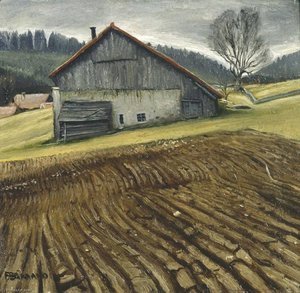
Barraud's artistic focus centered on three primary themes: still lifes, female nudes, and portraits – often intimate double portraits featuring himself and Marie. His paintings are not grand statements or dramatic narratives; rather, they offer glimpses into the quiet beauty of everyday life. Français Printemps, for example, depicts a serene barn scene with remarkable detail, capturing the essence of rural Switzerland. Similarly, his nudes possess a delicate sensuality, devoid of overt eroticism, focusing instead on form and light. His portraits, particularly those of Marie, are imbued with tenderness and psychological depth. The influence of the Old Masters is readily apparent in his meticulous attention to detail – the texture of fabrics, the play of light on skin, the precise rendering of objects. He employed a restrained color palette, favoring earth tones and muted hues, which contributes to the overall sense of calm and realism that pervades his work. This dedication to technical skill and observation elevates his paintings beyond mere representation; they become meditations on beauty, intimacy, and the passage of time.

A Legacy Cut Short: Historical Significance and Lasting Impact

François Barraud’s career was tragically cut short by tuberculosis in 1934, at the young age of 34. Despite his brief life, he created a significant body of work that demonstrates both technical mastery and artistic vision. While not widely known internationally during his lifetime, his paintings represent an important strand within Swiss Realism, particularly notable for its adherence to traditional techniques in an era dominated by experimentation. Today, his works are held in prominent museums such as the Musée des Beaux-Arts in La Chaux-de-Fonds, the Coninx Museum in Zurich, and the Foundation for Art, Culture and History in Winterthur, a testament to their enduring artistic merit. The major collection once belonging to Arthur Stoll further underscores his importance within Swiss art circles. Barraud’s legacy lies not in groundbreaking innovation but in his ability to capture the beauty of ordinary moments with extraordinary precision and sensitivity, offering viewers a poignant glimpse into the early 20th century through the eyes of a dedicated and gifted artist.