Portret Eva Hesse

13 najsłynniejszych obrazów artysty Eva Hesse – wybór z galerii

Aktualizacja: Październik 2026 · ranking według naszego wskaźnika popularności (liczba wyszukiwań, wizyt i zamówień dla każdego dzieła) · 13 dzieł Eva Hesse w naszym katalogu

W skrócie

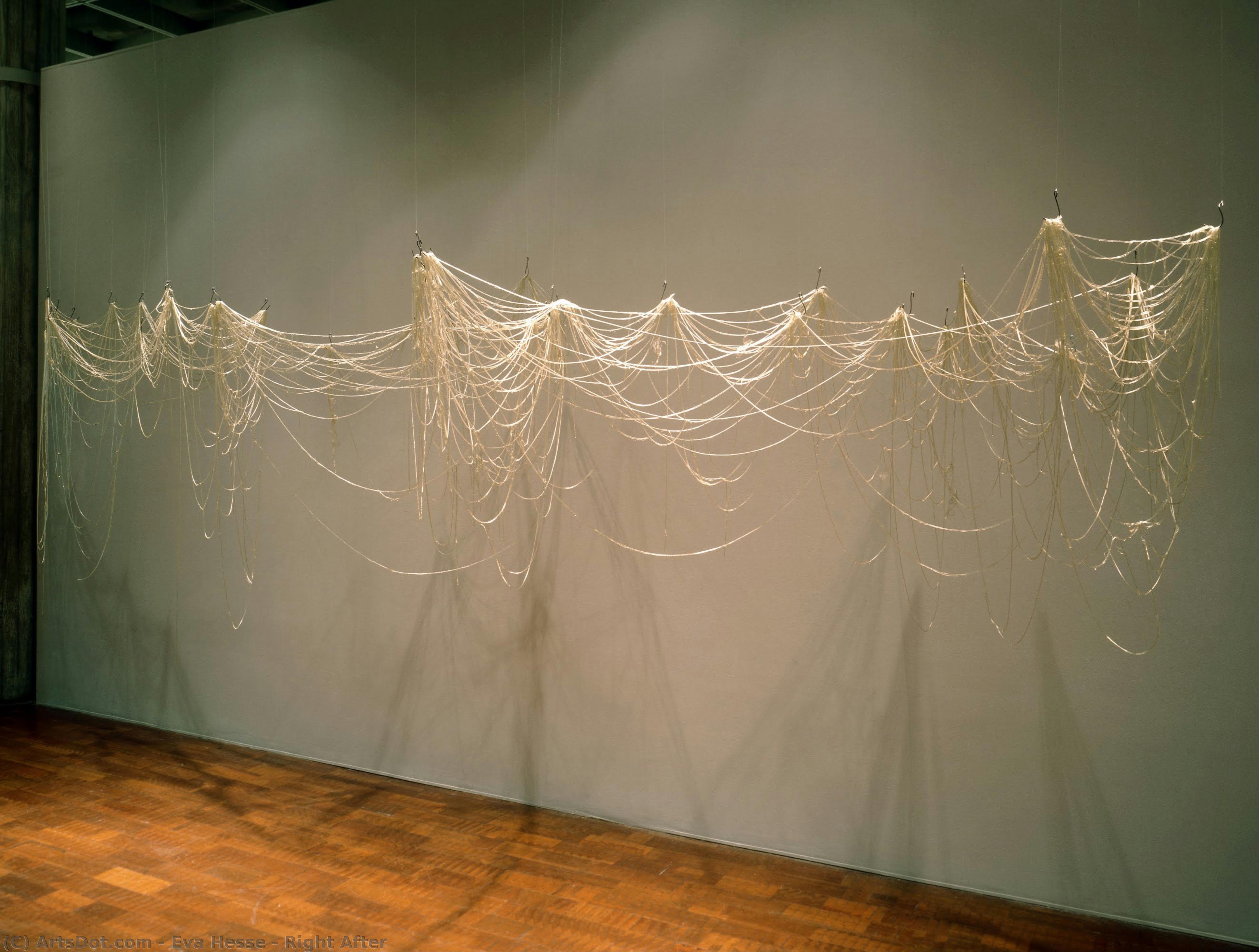
Spośród wszystkich dzieł oryginalnych, które pozostawił Eva Hesse, najsłynniejszym jest Repetition Nineteen III (1968), znajdujący się w kolekcji MoMA - Museum of Modern Art w Nowy Jork. Tuż za nimi znajdują się Tomorrow's Apples (5 in White) (1965) oraz Right After (1969). Nasz katalog zawiera 13 dzieł autorstwa Eva Hesse; galeria zachowała 13 najbardziej podziwianych na świecie prac, z których każda została przedstawiona wraz z datą powstania, informacją o muzeum oraz jej historią.

1936 – 1970, Hamburg Post-minimalism Najwięcej dzieł: Tate Modern

10 najlepszych obrazów artysty Eva Hesse: wybór galerii

1
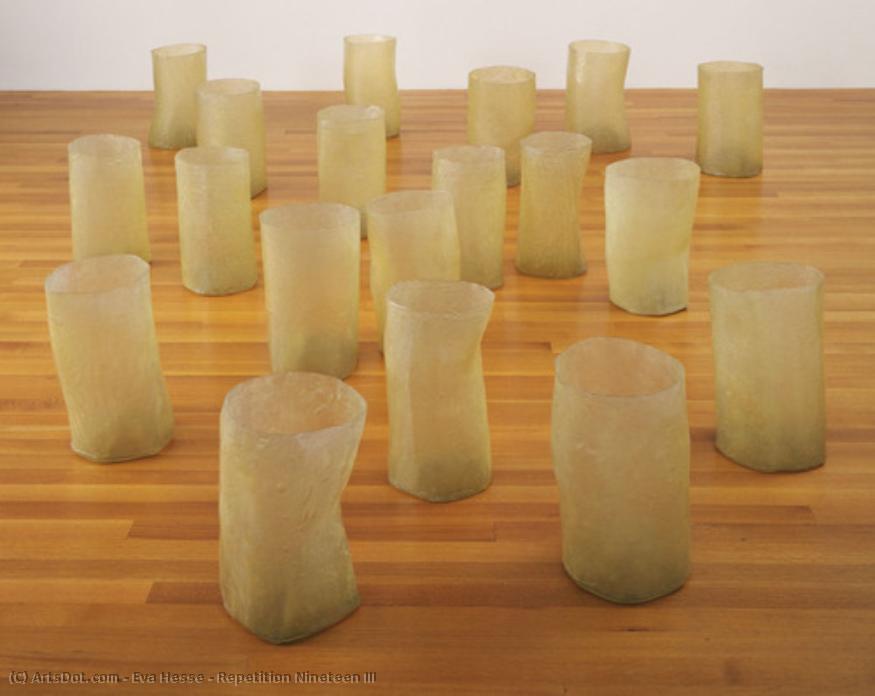
Repetition Nineteen III (1968) autorstwa Eva Hesse

Repetition Nineteen III

1968 · Resin · MoMA - Museum of Modern Art, Nowy Jork

To stand before Repetition Nineteen III is to encounter not merely an arrangement of objects, but a meditation on persistence and the beautiful imperfection of being. Eva Hesse’s work from this period pulses with a quiet, almost visceral energy. The sculpture presents a constellation of roughly hewn, organic forms resting upon a grounding plane of warm wood. These pieces, cast in a muted, pale green material—perhaps resin or fiberglass—reject the…

2
Tomorrow's Apples (5 in White) (1965) autorstwa Eva Hesse

Tomorrow's Apples (5 in White)

1965 · Sculpture · Tate Modern, Londyn

In the quiet, evocative realm of Eva Hesse, materiality speaks where words fail. Her 1965 masterpiece, Tomorrow's Apples (5 in White), stands as a profound testament to the beauty found in imperfection and the delicate balance between structure and decay. At first glance, the viewer is met with a minimalist landscape: five vibrant, rope-like forms—hues of blue, red, pink, yellow, and green—casually draped across a stark, textured white expanse. These…

5
Contingent (1968) autorstwa Eva Hesse

Contingent

1968 · Mixed Media · National Gallery of Australia, Canberra

Eva Hesse’s 1968 work, “Contingent,” isn't merely a sculpture; it’s an embodied meditation on vulnerability and the precarious nature of existence. Born from the tumultuous backdrop of post-war Germany and Hesse’s deeply personal experiences – displacement, loss, and the lingering shadow of her mother’s suicide – the piece speaks to a profound sense of uncertainty and reliance. Hesse, a pivotal figure in the emergence of Post-Minimalism, deliberately eschewed the rigid…

7
Hang Up (1966) autorstwa Eva Hesse

Hang Up

1966 · Art Institute of Chicago, Chicago

Eva Hesse’s “Hang Up,” created in 1966, isn't merely a sculpture; it’s an arresting meditation on the very nature of art and its relationship to space. Captured with remarkable clarity in this photograph, the work immediately commands attention with its stark simplicity – a rectangular frame, painted a subtly grayish-blue, suspended from a thick, black cord that descends dramatically to the floor. This seemingly austere composition belies a profound depth…

Kontynuacja zestawienia Eva Hesse, od 11 do 13

Słynne obrazy Eva Hesse epoka po epoce

Tematy, które przyciągnęły wzrok Eva Hesse

Cztery motywy najczęściej powracające w tych oryginałach, z których każdy doczekał się swojego najdoskonalszego przykładu.

Muzea przechowujące oryginały Eva Hesse

5 muzeów, w których znajduje się najwięcej obrazów z tej strony.

Muzea Miasto Dzieła artysty Eva Hesse Obrazy z tej listy
Tate Modern, LondynTate Modern Londyn 2 Tomorrow's Apples (5 in White), Untitled
Detroit Institute of Arts, DetroitDetroit Institute of Arts Detroit 2 Accession II, Accession II
MoMA - Museum of Modern Art, Nowy JorkMoMA - Museum of Modern Art Nowy Jork 1 Repetition Nineteen III
National Gallery of Australia, CanberraNational Gallery of Australia Canberra 1 Contingent
Art Institute of Chicago, ChicagoArt Institute of Chicago Chicago 1 Hang Up

Eva Hesse rok po roku: oryginały, które definiują każdy z nich

Zaledwie dekada, od 1960 do 1969, dostarczyła światu każdy datowany oryginał Eva Hesse w tym zestawieniu: oto one, rok po roku.

Dzieła według lat

Wybierz rok, aby zobaczyć oryginały.

Pytania kolekcjonerów o obrazy Eva Hesse

Z jakiego dzieła najbardziej znany jest Eva Hesse?Odkryj odpowiedź

Repetition Nineteen III (1968), MoMA - Museum of Modern Art, Nowy Jork. Następne są Tomorrow's Apples (5 in White) (1965) oraz Right After (1969).

W jakim wieku był Eva Hesse, gdy powstało Repetition Nineteen III?Odkryj odpowiedź

32 lat: Repetition Nineteen III pochodzi z 1968, a Eva Hesse urodził(a) się w 1936.

Jakie są dziesięć najsłynniejszych obrazów, których autorem jest Eva Hesse?Odkryj odpowiedź

Repetition Nineteen III, Tomorrow's Apples (5 in White), Right After, No Title (Spectres series), Contingent, Untitled, Hang Up, Untitled, Expanded Expansion i Addendum. Powyższy ranking zawiera rok powstania oraz muzeum dla każdego z nich.

Ile obrazów pozostawił po sobie Eva Hesse?Odkryj odpowiedź

Nasz katalog zawiera 13 dzieł artysty Eva Hesse, datowanych od 1960 do 1969.

W których muzeach znajdują się arcydzieła Eva Hesse?Odkryj odpowiedź

W większości znajdują się w Tate Modern (Londyn), Detroit Institute of Arts (Detroit) i MoMA - Museum of Modern Art (Nowy Jork). Powyższa tabela muzeów zawiera ich pełną listę.

W których latach Eva Hesse namalował swoje najsłynniejsze dzieła?Odkryj odpowiedź

W 1965: 3 z 13 dzieł na tej stronie powstało w tym czasie, w tym Tomorrow's Apples (5 in White).

Jakie są pierwsze i ostatnie słynne oryginały Eva Hesse?Odkryj odpowiedź

Na tej stronie najwcześniejszy to No Title (Spectres series) (1960), a najpóźniejszy Right After (1969).

Jakie tematy Eva Hesse wybierał najczęściej?Odkryj odpowiedź

Materiality (4), Fragility (4) i Organic forms (2), w ramach 13 dzieł na tej stronie.

Której techniki Eva Hesse używał najczęściej?Odkryj odpowiedź

Sculpture, dla 2 z 13 dzieł na tej stronie.

Do jakiego nurtu artystycznego należy Eva Hesse?Odkryj odpowiedź

Post-minimalism i Postminimalism, sądząc po oryginałach na tej stronie.

Które dzieła Eva Hesse znajdują się w Tate Modern?Odkryj odpowiedź

Tomorrow's Apples (5 in White) i Untitled: Tate Modern, Londyn posiada 2 dzieł widocznych na tej stronie.

Eva Hesse: życie i twórczość

Eva Hesse - A Life Interrupted: The Poetic Vulnerability of Eva Hesse

Eva Hesse’s story is one of profound displacement and a relentless pursuit of artistic expression in the face of personal tragedy. Born in 1936 in Hamburg, Germany, her early life was irrevocably altered by the looming shadow of Nazism. Fleeing persecution, her family sought refuge in the United States in 1938, an act that would forever shape Hesse’s identity as a displaced person navigating two worlds. This sense of rootlessness, coupled with the emotional trauma of her parents' separation and her mother’s subsequent suicide when Hesse was just ten years old, became a subtle yet powerful undercurrent in her art—a haunting exploration of fragility, loss, and the ephemeral nature of existence. Her formal artistic training began at Pratt Institute in Brooklyn, followed by studies at Cooper Union and Yale University School of Art and Architecture, where she encountered the rigorous material explorations championed by Josef Albers. However, it was not within the confines of traditional painting that Hesse found her true voice; rather, she embarked on a path of radical experimentation with materials and form, ultimately becoming a pivotal figure in the development of Postminimalism and Eccentric Abstraction.

Early Life: Displacement and Trauma

Eva Hesse’s formative years were marked by upheaval and loss. Born to an Orthodox Jewish family in Hamburg during the rise of Nazi Germany, she experienced firsthand the terror of antisemitic persecution. Her parents, fearing for their safety, emigrated to Amsterdam in 1938, relocating again to England shortly thereafter. The family endured immense hardship as they navigated the complexities of exile and faced the devastating loss of her maternal grandparents during World War II. Hesse’s father was an attorney specializing in criminal law, possessing two doctoral degrees—a testament to his intellectual pursuits. Her mother, a celebrated beauty who battled manic depression, profoundly impacted Hesse's emotional landscape. The family’s initial apartment in New York City resided across the street from Nazi headquarters, symbolizing the pervasive threat of fascism during her childhood. This early trauma instilled within Hesse a deep sensitivity to vulnerability and loss—themes that would permeate her artistic vision throughout her life. Her mother’s suicide at age ten left an indelible mark on Hesse's psyche, shaping her understanding of grief and fueling her desire to confront difficult emotions in her art.

The Embrace of Minimalism and Material Exploration

Hesse initially pursued painting, influenced by Abstract Expressionism and seeking to capture the dynamism of emotion on canvas. However, she quickly recognized the limitations of conventional techniques and yearned for a more direct engagement with materiality—a way to imbue her work with the raw immediacy of feeling and experience. This conviction led her to explore diverse artistic influences, ranging from Surrealist explorations of form and subconscious imagery to Hans Arp’s biomorphic sculptures and Jean Dubuffet’s textured surfaces. Her formative encounter with Louise Bourgeois’s psychologically charged sculptures resonated deeply with Hesse, demonstrating the potential for art to confront personal trauma and delve into complex emotional landscapes. Recognizing the significance of experimentation, Hesse enrolled at Pratt Institute and Cooper Union before transferring to Yale University School of Art and Architecture where she studied under Josef Albers—a teacher who championed precise geometric forms and color theory. This influence would shape her artistic approach and contribute to her embrace of minimalist principles.

A Sculptural Revolution: Challenging Formal Conventions

Rejecting the rigid formalism of Minimalism, Hesse embarked on a transformative journey into sculpture, prioritizing unconventional materials like latex rubber, plastic, lead, polythene, copper, felt, chicken-wire, dirt, sawdust, and paper pulp. Unlike many sculptors of her time who sought to conceal material evidence in their creations—a deliberate contrast to the polished surfaces of Minimalism—Hesse deliberately exposed the textures and imperfections inherent in these materials. She skillfully manipulated them using techniques traditionally associated with feminine occupations such as wrapping, winding, and threading—demonstrating a conscious rejection of masculine artistic conventions. Hesse’s sculptural explorations were driven by a desire to capture the essence of organic forms and explore themes of body and sexuality—a bold departure from prevailing aesthetic sensibilities. Her innovative use of materials allowed her to convey emotional depth without resorting to representational imagery, pushing the boundaries of sculpture and establishing herself as a pioneer in Postminimalism.

Legacy: Influence and Enduring Relevance

Eva Hesse’s tragically short life ended in 1970 at age thirty-four due to cancer—a devastating loss that curtailed her artistic ambitions but solidified her place in art history. Despite her untimely demise, Hesse’s influence continues to inspire artists today, particularly female sculptors who recognize in her work a powerful expression of feminine experience and a defiant rejection of patriarchal norms. Her exploration of vulnerability, repetition, and the body—themes central to Postminimalism—resonates with contemporary audiences and underscores the enduring relevance of her artistic vision. Hesse’s sculptures stand as testament to the transformative power of creativity—a celebration of imperfection and an invitation to contemplate profound emotional truths. She fundamentally altered the trajectory of sculpture by prioritizing material exploration over formal constraints, paving the way for new artistic approaches and cementing her legacy as one of the most innovative and influential sculptors of the 20th century. Hesse’s art remains a beacon of courage and vulnerability—a reminder that true artistry lies in confronting difficult emotions and embracing the complexities of human existence with honesty and conviction.