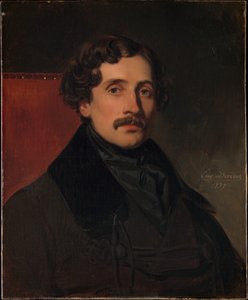
Portret Eugène Devéria

33 najsłynniejszych obrazów artysty Eugène Devéria, każdy niepowtarzalny

Aktualizacja: Listopad 2026 · ranking według naszego wskaźnika popularności (liczba wyszukiwań, wizyt i zamówień dla każdego dzieła) · 33 dzieł Eugène Devéria w naszym katalogu

W skrócie

Portrait of Monsieur Couche (1824) to obraz autorstwa Eugène Devéria, który przyciąga najwięcej spojrzeń; oryginał znajduje się w Detroit Institute of Arts, Detroit. Następnie wzrok kieruje się na Young Women Sitting (1827) i The Assassination (1828). Spośród 33 dzieł Eugène Devéria w naszym katalogu, tych 33 jest najbardziej znanych – każde z nich to unikatowy oryginał, przedstawiony wraz z rokiem powstania, muzeum oraz powodem, dla którego przetrwało próbę czasu.

1805 – 1865, Paryż Najwięcej dzieł: Musée des Beaux-Arts de Pau

10 najlepszych obrazów autorstwa Eugène Devéria według oka galerii

2
Young Women Sitting (1827) autorstwa Eugène Devéria

Young Women Sitting

1827 · Oil On Canvas

In the oil painting Young Women Sitting by Eugène Devéria, the composition is centered on a woman seated upon a large, gilded yellow chaise longue. To the left, a second woman reclines, her form partially obscured by heavy red drapery. The scene is set within an opulent interior where the color palette is dominated by deep reds, golds, and creams. This arrangement creates a shallow perspective that directs the viewer's…

3
The Assassination (1828) autorstwa Eugène Devéria

The Assassination

1828 · Oil On Canvas · Reading Public Museum, Reading

We find ourselves before The Assassination, a significant work by the French painter Eugène Devéria. This piece was executed about 1828, a period when the artist was beginning to establish his presence within the Parisian art scene. Devéria, who was born in Paris, France, in 1805, brought a specific sense of historical gravity to his compositions, a quality that is palpable in this particular canvas.

4
Portrait of General Joseph-Léopold Sigisbert Hugo (1835) autorstwa Eugène Devéria

Portrait of General Joseph-Léopold Sigisbert Hugo

1835 · Oil On Canvas · Musée Victor Hugo, Paryż

The subject is captured in a moment of quiet authority, positioned centrally against a somber, atmospheric landscape. He wears a dark blue military tunic, heavily detailed with gold braided aiguillettes, epaulettes, and medals that catch a sharp, directional light. This illumination, striking from the upper left, defines the contours of his face and the metallic textures of his uniform while casting the background into deep shadow. A sense of monumental…

5
Puget Presenting His Statue of Milon de Crotone to Louis XIV, in the Gardens of Versailles (1832) autorstwa Eugène Devéria

Puget Presenting His Statue of Milon de Crotone to Louis XIV, in the Gardens of Versailles

1832 · Oil On Canvas

In this 1832 oil on canvas, we find ourselves within the formal, structured elegance of the Gardens of Versailles. The scene captures a specific historical intersection: the presentation of a sculpture by Puget to the French monarchy. At the heart of the composition, a large, muscular statue of Milon de Crotone commands the viewer's attention. The figure is rendered with a sense of physical weight, its pale, marble-like surface contrasting…

6
Puget Presenting His Statue of Milo of Croton to Louis XIV, in the Gardens of Versailles (1832) autorstwa Eugène Devéria

Puget Presenting His Statue of Milo of Croton to Louis XIV, in the Gardens of Versailles

1832 · Oil On Canvas

The scene unfolds in the grand, manicured expanse of the Gardens of Versailles, where the air feels heavy with the weight of ceremony. Here, the artist Eugène Devéria captures a moment of profound historical significance. In this work, titled Puget Presenting His Statue of Milo of Croton to Louis XIV, in the Gardens of Versailles, the viewer finds themselves amidst a gathering of the French elite. The composition centers on…

7
Portrait of the Artist and His Brother Achille (1836) autorstwa Eugène Devéria

Portrait of the Artist and His Brother Achille

1836 · Terracotta · Opera w Wersalu, Wersal

The gaze settles upon Portrait of the Artist and His Brother Achille, a work that brings together two figures bound by blood and art. This piece is the creation of Eugène Devéria, a man whose life began in Paris, France, in 1805. He carries the weight of a long creative life until his passing in 1865. Within this frame, the artist captures a personal connection, presenting himself alongside his brother,…

8
Breton Family Praying Before a Country Oratory (1838) autorstwa Eugène Devéria

Breton Family Praying Before a Country Oratory

1838 · Oil · Musée des Beaux-Arts de Quimper, Quimper

In Breton Family Praying Before a Country Oratory, Eugène Devéria arranges a quiet, intimate scene of religious devotion. The composition is centered on a group of five figures—two men, one woman, and two children—who are gathered in a moment of shared prayer. They are positioned in a triangular formation, a structural choice that provides a sense of stability and familial unity. This geometric arrangement naturally directs the viewer's eye toward…

9
Sketch for the church Notre-Dame-de-Lorette: Apotheosis of Saint Genevieve (1835) autorstwa Eugène Devéria

Sketch for the church Notre-Dame-de-Lorette: Apotheosis of Saint Genevieve

1835 · Oil On Canvas · Petit Palais, Paryż

The artwork titled Sketch for the church Notre-Dame-de-Lorette: Apotheosis of Saint Genevieve is a religious study by the French painter Eugène Devéria. Created about 1835, this oil on canvas work functions as a preliminary sketch for a larger painting intended for the church Notre-Dame-de-Lorette. The composition focuses on the subject matter of the Apotheosis of Saint Genevieve, depicting the saint's transition toward a celestial state.

10
Apotheosis of Saint Genevieve, sketch for the painting of the church Notre-Dame-de-Lorette (1835) autorstwa Eugène Devéria

Apotheosis of Saint Genevieve, sketch for the painting of the church Notre-Dame-de-Lorette

1835 · Drawing · Musée Carnavalet, Paryż

This vertical sketch, dated 1835, captures a moment of religious exaltation centered on the figure of Saint Genevieve. The composition is organized around a strong upward movement, drawing the eye from the lower grouping of figures toward a concentrated burst of white and yellow light at the top of the frame. Saint Genevieve is positioned in the midground, her arms reaching toward the celestial light, her white garments providing a…

Słynne obrazy artysty Eugène Devéria, od 11 do 33

Słynne obrazy Eugène Devéria epoka po epoce

Tematy, które przyciągnęły wzrok Eugène Devéria

Cztery motywy najczęściej powracające w tych oryginałach, z których każdy doczekał się swojego najdoskonalszego przykładu.

Muzea przechowujące oryginały Eugène Devéria

8 muzeów, w których znajduje się najwięcej obrazów z tej strony.

Muzea Miasto Dzieła artysty Eugène Devéria Obrazy z tej listy
Musée des Beaux-Arts de Pau, PauMusée des Beaux-Arts de Pau Pau 3 Portrait of Octavie Courcier, née Devéria (1804-1887), Portrait of Philippe-Adolphe Courcier, husband of Octavie Devéria, Christopher Columbus at the Court of Ferdinand and Isabella
Detroit Institute of Arts, DetroitDetroit Institute of Arts Detroit 1 Portrait of Monsieur Couche
Reading Public Museum, ReadingReading Public Museum Reading 1 The Assassination
Musée Victor Hugo, ParyżMusée Victor Hugo Paryż 1 Portrait of General Joseph-Léopold Sigisbert Hugo
Opera w Wersalu, WersalOpera w Wersalu Wersal 1 Portrait of the Artist and His Brother Achille
Musée des Beaux-Arts de Quimper, QuimperMusée des Beaux-Arts de Quimper Quimper 1 Breton Family Praying Before a Country Oratory
Petit Palais, ParyżPetit Palais Paryż 1 Sketch for the church Notre-Dame-de-Lorette: Apotheosis of Saint Genevieve
Musée Carnavalet, ParyżMusée Carnavalet Paryż 1 Apotheosis of Saint Genevieve, sketch for the painting of the church Notre-Dame-de-Lorette

Eugène Devéria na przestrzeni dekad: jeden unikatowy oryginał dla każdego

Dzieła według dekad

Wybierz dekadę, aby zobaczyć dzieło, które ją definiuje.

Obrazy artysty Eugène Devéria: pytania do galerii

Jakie jest najsłynniejsze dzieło artysty Eugène Devéria?Odkryj odpowiedź

Portrait of Monsieur Couche (1824), Detroit Institute of Arts, Detroit. Następne są Young Women Sitting (1827) oraz The Assassination (1828).

W jakim wieku Eugène Devéria stworzył/a Portrait of Monsieur Couche?Odkryj odpowiedź

19 lat: Portrait of Monsieur Couche pochodzi z 1824, a Eugène Devéria urodził(a) się w 1805.

Które dziesięć obrazów Eugène Devéria jest najbardziej znanych?Odkryj odpowiedź

Portrait of Monsieur Couche, Young Women Sitting, The Assassination, Portrait of General Joseph-Léopold Sigisbert Hugo, Puget Presenting His Statue of Milon de Crotone to Louis XIV, in the Gardens of Versailles, Puget Presenting His Statue of Milo of Croton to Louis XIV, in the Gardens of Versailles, Portrait of the Artist and His Brother Achille, Breton Family Praying Before a Country Oratory, Sketch for the church Notre-Dame-de-Lorette: Apotheosis of Saint Genevieve i Apotheosis of Saint Genevieve, sketch for the painting of the church Notre-Dame-de-Lorette. Powyższy ranking zawiera rok powstania oraz muzeum dla każdego z nich.

Ile znanych dzieł stworzył Eugène Devéria?Odkryj odpowiedź

Nasz katalog zawiera 33 dzieł artysty Eugène Devéria, datowanych od 1824 do 1864.

Gdzie można zobaczyć najsłynniejsze oryginały Eugène Devéria?Odkryj odpowiedź

W większości znajdują się w Musée des Beaux-Arts de Pau (Pau), Detroit Institute of Arts (Detroit) i Reading Public Museum (Reading). Powyższa tabela muzeów zawiera ich pełną listę.

W jakim okresie Eugène Devéria stworzył/a swoje najsłynniejsze obrazy?Odkryj odpowiedź

W 1830s: 10 z 33 dzieł na tej stronie powstało w tym czasie, w tym Portrait of General Joseph-Léopold Sigisbert Hugo.

Który z najsłynniejszych obrazów artysty Eugène Devéria powstał najwcześniej, a który najpóźniej?Odkryj odpowiedź

Na tej stronie najwcześniejszy to Portrait of Monsieur Couche (1824), a najpóźniejszy Charles-Théodule Devéria (1831-1871) (1864).

Jakie tematy preferował Eugène Devéria?Odkryj odpowiedź

Man (11), Woman (9) i People (6), w ramach 33 dzieł na tej stronie.

Jakich materiałów Eugène Devéria używał najczęściej?Odkryj odpowiedź

Oil On Canvas, dla 10 z 33 dzieł na tej stronie.

Jakie oryginały Eugène Devéria można zobaczyć w Musée des Beaux-Arts de Pau?Odkryj odpowiedź

Portrait of Octavie Courcier, née Devéria (1804-1887), Portrait of Philippe-Adolphe Courcier, husband of Octavie Devéria i Christopher Columbus at the Court of Ferdinand and Isabella: Musée des Beaux-Arts de Pau, Pau posiada 3 dzieł widocznych na tej stronie.

Eugène Devéria: portret artysty

Eugène Devéria: Pomost między historią a obserwacją

Eugène François Marie Joseph Devéria (1805 – 1865) był francuskim malarzem, którego unikalny styl łączył skrupulatny realizm z ekspresyjnym operowaniem kolorem, co ugruntowało jego pozycję jako jednego z najważniejszych kronikarzy swojej epoki. Urodzony w Paryżu w rodzinie głęboko zakorzenionej w tradycji artystycznej – jego ojciec był rzeźbiarzem – wczesne lata Eugène Devéria zapowiadały jego przyszłe powołanie, zanurzając go w tętniącym życiem krajobrazie kulturowym Francji okresu Restauracji. Choć szczegóły biograficzne pozostają dość skąpe, badania naukowe sugerują, że szlifował on swój talent pod okiem Jean-Baptiste Camille Corot oraz Alexandre Cabanel, chłonąc ducha impresjonizmu przy jednoczesnym zachowaniu akademickiej rygorystyczności École Supérieure des Beaux-Arts.

Formacyjne lata Devérii przypadły na okres odrodzenia artystycznego po rządach Napoleona. Ruch romantyczny wywarł głęboki wpływ na jego wrażliwość, rozbudzając zamiłowanie do dramatycznych krajobrazów i emocjonalnie naładowanych narracji. Jednak artysta ten umiejętnie zrównoważył te wpływy z rzetelną obserwacją, którą propagowali Corot i Cabanel – twórcy stawiający na uchwycenie naturalnego światła i tekstury z niespotykaną dokładnością. Jego dzieło jest niezwykle różnorodne, obejmując zarówno monumentalne malarstwo historyczne, jak i intymne portrety. Zdobył on znaczne uznanie dzięki przedstawieniom szkockich klanowców, misternie oddanych w technice olejnej, które przekazują nie tylko podobieństwo fizyczne, ale także głębię psychologiczną – co stanowi świadectwo jego zdolności do przelewania złożonych emocji na płótno.

Wyróżniające się dzieła i styl artystyczny

Styl artystyczny Eugène Devéria charakteryzuje się niezwykłym połączeniem realizmu i tonalnej subtelności. Unikał on krzykliwych pociągnięć pędzla, tak lubianych przez niektórych współczesnych, wybierając zamiast tego gładkie, płynne powierzchnie, które osiągały zdumiewający stopień luminancji. Ta technika – szczególnie widoczna w jego słynnych płótnach przedstawiających przybycie Krzysztofa Kolumba do Ameryki oraz w dziele Gołąb leśny – pozwalała mu oddawać warunki atmosferyczne z zapierającą dech w piersiach precyzją. Co więcej, paleta barw Devérii była powściągliwa, lecz niezwykle ekspresyjna, wykorzystująca przygaszone odcienie do kreowania nastroju i atmosfery, które głęboko rezonowały z odbiorcami.

Jego monumentalne płótna, takie jak „Przyjęcie Krzysztofa Kolumba”, stanowią przykład oddania historycznym wydarzeniom z nieustępliwą dbałością o szczegół. Kompozycje Devérii są starannie skonstruowane, prowadząc wzrok przez rozległe krajobrazy i chwytając ulotne przejawy ludzkich emocji – co odzwierciedla humanistyczną wrażliwość, która odróżniała go od wielu artystów jego czasów. Równie godne uwagi były jego portrety, wyróżniające się wglądem psychologicznym. Artysta z niezwykłą biegłością chwytał esencję osobowości swoich modeli, przekazując nie tylko wygląd zewnętrzny, ale także wewnętrzny charakter poprzez subtelne gesty i mimikę.

Dziedzictwo i znaczenie historyczne

Wkład Eugène Devéria w historię sztuki francuskiej wykracza poza jego indywidualne arcydzieła. Pomógł on ugruntować renomę École Supérieure des Beaux-Arts jako instytucji doskonałości, wychowując pokolenie artystów, którzy embraced zarówno tradycję akademicką, jak i innowacje impresjonistyczne. Jego obrazy wciąż budzą podziw swoją techniczną wirtuozerią i emocjonalnym rezonansem, służąc jako trwałe przypomnienie kluczowego momentu w europejskiej kulturze artystycznej. Skrupulatna obserwacja i mistrzostwo tonalne zapewniły mu miejsce wśród najbardziej wpływowych malarzy połowy XIX wieku, gwarantując, że jego twórczość będzie przedmiotem studiów i doceniana przez dziesięciolecia.