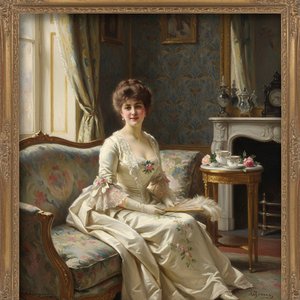
1846 - 1933

Kluczowe informacje

  • Top 3 works:
    • Portrait of Madame Judic during Act II of "Niniche"
    • Scholar at the Table
    • The Levite of Ephraim and the old man of Gibeah
  • Art period: 19th Century
  • Died: 1933
  • Lifespan: 87 years
  • Works on this site: 7
  • Mediums: oil on canvas
  • Born: 1846, Brussels metropolitan area, Belgium
  • Typical colors: earthy

A Life in Color and History

Emile Wauters was a Belgian painter born in the Brussels metropolitan area. A student of Jean-François Portaels and Jean-Léon Gérôme, he gained early recognition with his 1868 work, The Battle of Hastings: The Finding of the Body of Harold by Edith. His career was marked by significant historical compositions, such as Mary of Burgundy entreating the Sheriffs of Ghent to pardon the Councillors Hugonet and Humbercourt, which caused a sensation in 1870. Other notable large-scale works include The Madness of Hugo van der Goes, Sobieski and his Staff before Besieged Vienna, and the vast panorama Cairo and the Banks of the Nile.

His artistic journey included travels to Italy and Egypt, the latter of which inspired works like The Great Mosque and Serpent Charmers of Sokko. Wauters was also a highly accomplished portraitist, creating over two hundred likenesses of prominent figures from Belgium, France, and America. His portraiture evolved from a sober style to a brilliant, forceful palette, eventually embracing pastel for life-size portraits of ladies.

Accolades and Recognition

Throughout his career, Wauters received numerous prestigious distinctions. His achievements include:

He held honorary memberships in the academies of Vienna, Berlin, and Munich, and served as a corresponding member of the Institut de France and the Madrid academy. His technical execution and ability to capture character and vitality placed him at the front rank of his profession.

Quiz

Do każdego pytania dotyczy tylko jedna poprawna odpowiedź.

Pytanie 1:
In which city was Emile Wauters born?
Pytanie 2:
Which artist was one of Emile Wauters' teachers?
Pytanie 3:
What was the subject of Wauters' 1872 painting exhibited in the Brussels Museum?
Pytanie 4:
Which large panorama did Wauters execute in six months and exhibit in Brussels, Munich, and The Hague?
Pytanie 5:
In which year did Wauters exhibit his historical picture of Mary of Burgundy entreating the Sheriffs of Ghent?

Pytania i odpowiedzi

W jakim mieście i kraju urodził(a) się Emile Wauters?

Emile Wauters urodził się w Brussels metropolitan area w Belgium.

Gdzie mogę zobaczyć dzieła Emile Wauters w wirtualnej galerii 3D?

Wirtualna Galeria 3D artysty Emile Wauters to strona prezentująca jego dzieła w wirtualnej galerii trójwymiarowej.

Czy istnieje chronologiczny opis twórczości Emile Wauters?

Chronologiczne zestawienie twórczości Emile Wauters można znaleźć na stronie Osiągnięcia artystyczne, gdzie dzieła prezentowane są w kolejności ich powstania, podzielone na poszczególne etapy kariery.

Pod jakimi innymi nazwiskami znany jest Emile Wauters?

Emile Wauters jest znany/a również pod pseudonimami: Emile-Charles Wauters, E. Wauters, Wauter, Wauters, エミール・ワウタース.

Jak mogę znaleźć dzieła artysty Emile Wauters w konkretnej palecie barw?

Strona Według palet kolorystycznych grupuje dzieła Emile Wauters według ich palet kolorystycznych.

Jak popularne są dzieła artysty Emile Wauters?

Statystyki dotyczące dzieł artysty Emile Wauters można znaleźć na jego stronie Statystyki odwiedzin.

Czy mogę przeglądać dzieła Emile Wauters według nurtów artystycznych?

Nurty, w których tworzył/a Emile Wauters, można zobaczyć na stronie Wszystkie nurty artystyczne artysty, gdzie dzieła są pogrupowane według nurtów.

Czy istnieje oś czasu prac Emile Wauters?

Strona Chronologia dzieł prezentuje dzieła Emile Wauters uporządkowane chronologicznie, rok po roku.

Czy istnieje zestawienie wszystkich tematów, które malował Emile Wauters?

Dzieła artysty Emile Wauters można przeglądać według tematów na stronie Atlas tematów.